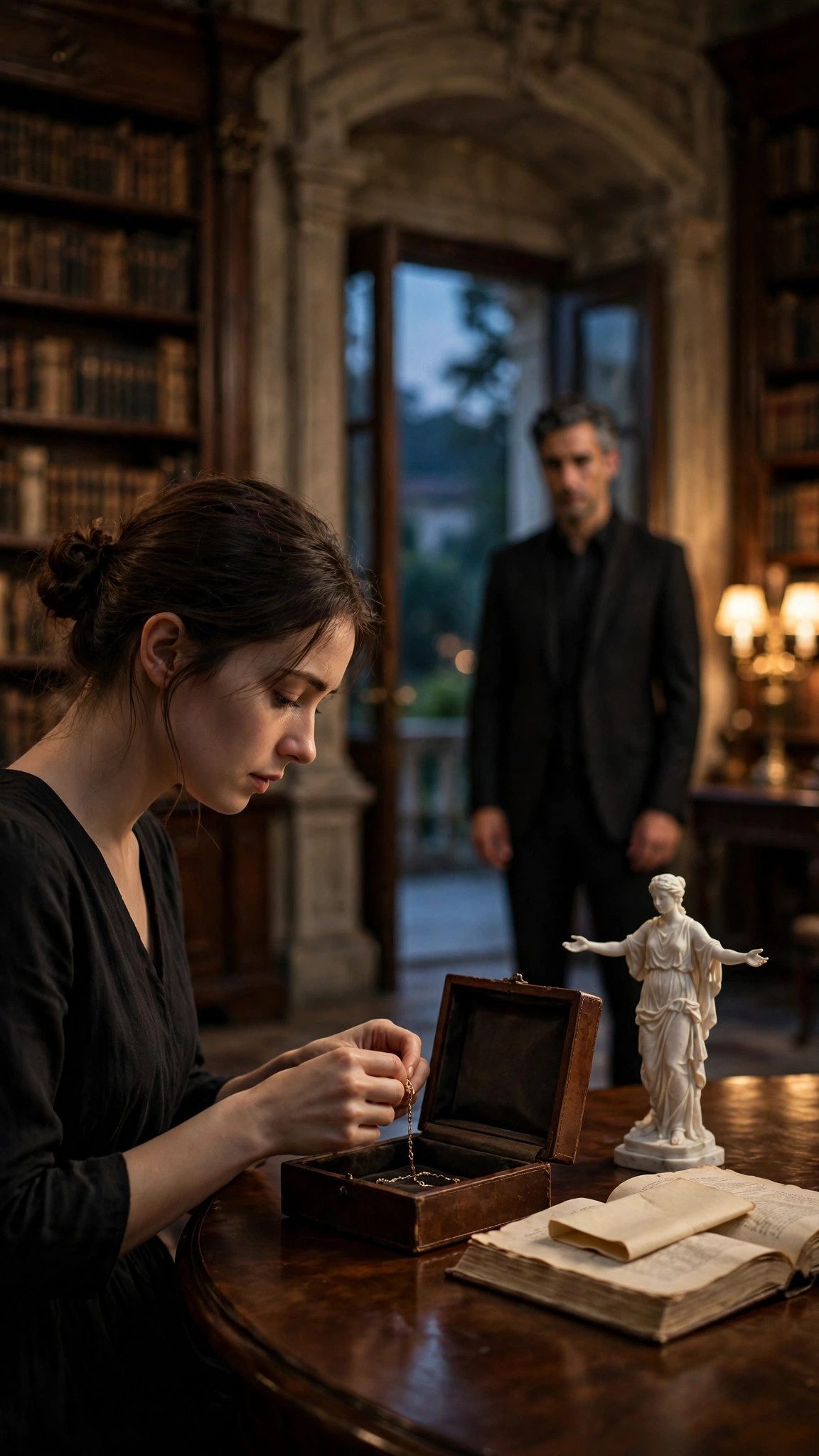
The villa was quiet, but the silence was not peaceful. It was the kind of silence that remained after something important had been taken away, the way a room feels after the furniture has been carried out and only the dust stays behind to show where everything used to stand.
Giulia Ferraro moved through the rooms with care, the way she had always moved through them, placing each gift in a leather box. A gold bracelet sat beside an old statue in the middle of the table. She picked up the bracelet last, because it had been the first thing he had ever given her, and her fingers closed around it for a moment longer than they needed to.
He watched her from the doorway, both hands still at his sides.
She put the bracelet gently into the box and closed the lid. She pressed a folded letter between the pages of a book, then left it on the polished table. And then she walked toward the door.
She did not run. She did not look back. She walked the way a woman walks when she has already said everything she came to say and there is nothing left in the room that belongs to her.
Raphael Carbone stood in the doorway and did not move. He had spent twenty years learning how to make men move when he wanted them to move, and how to make them stay still when he wanted them still, and now, for the first time in his life, he could not make the one person who mattered do either. He watched her go, and something in his expression changed, the way a building changes when a crack runs through it and the whole structure has to decide, in a single second, whether it will hold or fall.
For the first time, the mafia boss was stepping out of his own world. He did not know it yet. He only knew that the villa had never been this quiet, and that the quiet had her name in it.
Five years earlier, Giulia Ferraro had come to the villa for the first time, and the villa had been quiet then too, but it had been a different kind of quiet. It had been the quiet of a house holding its breath.
She was twenty-four years old, and she had answered an advertisement in the newspaper for a companion for an elderly woman. The address had been written in careful handwriting on the back of a card: a villa on the hill above the harbor, behind iron gates, with a garden that no one in the neighborhood had ever seen from the inside. The woman who opened the gate was a housekeeper named Rosa, sixty years old, with flour on her hands and eyes that looked Giulia up and down the way a woman looks at a girl she is deciding whether to trust.
"You are younger than I expected," Rosa said.
"I am older than I look," Giulia said, which was not true, but she had learned that sometimes you had to say a thing before you could grow into it.
Rosa led her through the garden, past lemon trees and a fountain that had not run in years, and into a house that smelled of beeswax and old books and something medicinal underneath it all. The hallway was lined with photographs in silver frames, and Giulia slowed without meaning to, looking at a wedding photograph of a handsome young couple, a photograph of a boy of about ten holding a dog, a photograph of a woman with dark hair laughing at something outside the frame.
"That is the family," Rosa said. "The boy is the boss now. The woman laughing is his mother, Signora Elena. She is the one you will be looking after."
The signora's room was on the second floor, at the end of a corridor with windows that looked out over the harbor. Elena Carbone was seventy-one years old, thin as a winter branch, her dark hair gone almost entirely white, her hands folded on the coverlet the way nuns fold their hands in prayer. But her eyes were alive. They were the kind of eyes that had seen everything and forgiven most of it, and when they settled on Giulia, they did not look away.
"So," Elena said, in a voice that was softer than Giulia had expected, "you are the girl who is going to sit with an old woman while she dies."
Giulia did not flinch. She had sat with dying people before. Her own grandmother had died in her arms when Giulia was nineteen, and she had learned then that the worst thing you could do for a dying person was pretend that death was not in the room.
"I am the girl who is going to sit with you while you live," Giulia said. "As long as that is."
Elena laughed then, a real laugh, rusty from disuse, and Rosa, standing in the doorway, made a small sound that might have been surprise.
"Rosa," Elena said, "bring us tea. And bring the good cups. This one has a spine."
That was how it began. Giulia came every morning at eight o'clock, and she stayed until six, and her work was simple: she read to Elena, she helped her to the window when the light was good, she measured her medicine and wrote down her temperature and her appetite in a small notebook, and she talked. Elena liked to talk about the old days, about the village she had come from, about the husband she had married when she was seventeen and buried when she was sixty, about the son who had been a sweet boy and had grown into a man she sometimes did not recognize.
"He was a sweet boy," Elena said one afternoon, looking out at the harbor. "He used to bring me flowers he had stolen from the neighbors' gardens. Dandelions, mostly. He thought they were the most beautiful flowers in the world because they were the only ones nobody guarded."
"What happened to him?" Giulia asked.
"The world happened to him," Elena said. "And his father. His father gave him the family when he was twenty-four years old, and the family is a heavy thing to carry. It makes a man hard, Giulia. It makes him forget that he was ever a boy who picked dandelions."
Giulia met Raphael Carbone for the first time on her third day at the villa. She was coming down the stairs with Elena's empty teacup in her hand when she heard the front door open, and the whole house seemed to change its posture. Rosa straightened. The maid in the hallway stopped what she was doing. Even the air felt different, the way the air feels before a storm.
He came up the stairs two at a time, and he was not what she had expected. She had expected someone older, someone harder to look at. He was thirty-three years old, tall, dark hair going gray at the temples, a face that would have been handsome if it had ever once relaxed. He wore a black suit that fit him like armor, and his left hand had a thin scar running across the knuckles, white against the skin.
He stopped when he saw her. His eyes moved over her the way a man reads a contract, looking for the parts that matter.
"Who are you?" he asked.
"Giulia Ferraro," she said. "I look after your mother."
"My mother has had three companions this year," he said. "They all left."
"Then they were not very good companions," Giulia said.
Something flickered in his face then, so fast she almost missed it. It might have been amusement. It might have been warning.
"My mother is not an easy woman," he said.
"Your mother is a wonderful woman," Giulia said. "She is dying, and she is braver than anyone I have ever met. If your other companions left, it was because they were afraid of the dying, not of her."
He looked at her for a long moment. Then he nodded once, the way a man nods when a matter is settled, and went on up the stairs toward his mother's room.
That night, when Giulia went home to the small apartment she shared with her friend Marta, she told Marta about the villa, and about the old woman, and about the son.
"He sounds frightening," Marta said.
"He is frightening," Giulia said. "But his mother is not. And she needs someone."
She went back the next morning, and the morning after that, and the morning after that. Elena grew weaker, but her mind stayed sharp, and she told Giulia everything: about the village, about the husband, about the son who had been a sweet boy. And Giulia told Elena about her own life: about growing up in a small flat above a bakery, about her father who had died when she was twelve, about her mother who still lived in that flat and called every Sunday to ask if Giulia was eating enough.
"You are a good girl," Elena said one day, taking Giulia's hand in hers. Her hand was so light it felt like a bird. "I am glad you came. My son does not have enough good people around him. He has men who obey him. That is not the same thing."
"Does he know that?" Giulia asked.
"He knew it once," Elena said. "When he was a boy, he knew it. Then his father died, and the family came to him, and he forgot. Perhaps one day someone will remind him."
Elena died on a Tuesday in October, two years after Giulia came to the villa. She died in the morning, with the light coming through the window and Giulia holding her hand, and her last words were not dramatic. She looked at Giulia and said, "Tell my son that I loved him. Tell him that Victor was the best part of him, and that I hope he finds him again someday."
"Victor?" Giulia asked, but Elena was already gone, and the room was suddenly very still.
Giulia stayed for the funeral, because Rosa asked her to, and because it felt wrong to leave. The villa filled with men in black suits, men with hard faces and quiet voices, men who looked at Giulia the way you look at a piece of furniture you are not sure belongs in the room. She stood at the back of the chapel in her plain black dress and watched Raphael Carbone stand beside his mother's coffin, his face like stone, his hands still at his sides, and she thought about the boy who had picked dandelions.
After the funeral, she packed her small bag and went to Rosa to say goodbye.
"Where will you go?" Rosa asked.
"Home," Giulia said. "To my flat. I will find other work."
Rosa looked at her for a long moment, and then she went into the kitchen and came back with a small leather box.
"Signora Elena left this for you," Rosa said. "She told me to give it to you when the time came."
Inside the box, wrapped in tissue paper, was a small gold bracelet. It was simple, a thin band of gold with a single tiny charm shaped like a flower. Giulia stared at it, and her throat closed.
"She said you were the daughter she never had," Rosa said quietly. "She said you were to stay, if you wanted to. There is a room for you here. The family always needs someone who is not afraid."
Giulia stayed. She did not know then that the bracelet was the first gift, and that there would be many more, and that each one would be a little heavier than the last. She only knew that the villa was quiet, and that someone had to stay in it, and that the man who stood in doorways with his hands still at his sides did not have enough good people around him.
She stayed for the mother. She stayed for the boy who had picked dandelions. She stayed because someone had to remind him, one day, that he had once been Victor.
In those first weeks after the funeral, the villa settled into a new shape around her. Rosa gave her a room on the second floor, small and bright, with a window that looked out over the lemon trees, and a set of keys that opened every door in the house except one: the study at the end of the hall, where Raphael kept his papers and his secrets and where no one went without being called.
Her days found a rhythm. She rose before dawn and opened the shutters. She made coffee the way Elena had liked it, strong and black, and left a cup on the tray outside the study door, because Raphael was often already working by then, and no one else in the house dared to knock. She walked the garden in the afternoons, pulling weeds from the beds Elena had loved, and she talked to Rosa in the kitchen while the bread rose, and in the evenings she read in the library, the room with the tall windows and the smell of old paper, where the family's history sat in leather-bound volumes no one ever opened.
It was in the library, on a Thursday evening three weeks after the funeral, that Raphael found her. She was sitting in Elena's old chair by the window, a book open on her lap, and she did not stand up when he came in. Everyone else in that house stood up when he came in. She had noticed it on her first day, and it had bothered her ever since, the way people rose like grass bending before wind.
"You are in my mother's chair," he said.
"Your mother liked this chair," Giulia said. "She said the light was best here in the evening. I am keeping it warm for her."
He looked at her for a moment, and then, to her surprise, he did not order her out. He walked to the window and stood there with his back to her, looking out at the dark garden.
"Rosa tells me you have taken over the household," he said.
"Someone had to," Giulia said. "The house was falling apart. The garden was dying. Your mother's roses were choking on weeds."
"My mother's roses," he repeated, and something in his voice changed, almost too quiet to hear. "She used to cut them every Sunday. She put them on the table. She said a house without flowers is just a building."
"I know," Giulia said. "She told me."
He turned then, and for the first time since she had met him, he looked at her not the way a man reads a contract, but the way a man looks at a door he did not know was there.
"Why did you stay?" he asked.
It was a simple question, and she gave him a simple answer, because simple answers were the only kind she knew how to give.
"Because your mother asked me to," she said. "And because this house needs someone who is not afraid of it."
He nodded once, the way he always did when a matter was settled, and he left the library without another word. But the next morning, there was a second cup on the tray outside the study door, and a small plate of the almond biscuits Rosa made on Sundays, and Giulia understood, without anyone having to say it, that something had shifted. The villa was still quiet. But it was no longer the quiet of a house holding its breath. It was the quiet of a house learning, very slowly, how to breathe again.