It happened on a Friday night, three weeks after Emily sang.
Three weeks in which Lorenzo Bianchi had quietly, methodically, taken his family back. The lawyer in Geneva confirmed the trust. The accountant confirmed the transfers. The private investigator confirmed the small house upstate, and the woman with dark hair and a new name who lived there, and the silver-haired man who visited her once a month, always at night, always alone.
It had not been easy, those three weeks. Lorenzo had spent them the way a general spends the weeks before a battle — quietly, and carefully, and without telling anyone the full plan, not even Marco, not even his lawyer, not even Emily, who had given him the truth and then had gone back to work, carrying trays, pouring wine, singing softly on the quiet nights when the dining room was nearly empty and the only people listening were the piano and the candles.
There had been a Tuesday night, in the second week, when the restaurant was slow — a rainy night, only a dozen tables taken — and Lorenzo had come to his table by the window, and he had looked up at Emily as she passed with a tray, and he had said, very quietly, "Sing."
And she had. She had stood beside the piano, with old Enzo playing softly behind her, and she had sung the song again — the whole song, from the beginning, about the woman who leaves everything behind — and Lorenzo had listened, and the dozen diners had listened, and nobody had spoken, and when she finished, an old woman at table four had wiped her eyes with her napkin, and a man at table nine had ordered another bottle of wine, and Lorenzo had said, "Thank you," in a voice so low that only Emily could hear it, and she had understood that he was not thanking her for the song. He was thanking her for the truth.
Meanwhile, across town, Giovanni Ferrante had been making his own preparations. He had moved money — five million dollars in a single night, the night after Emily told Lorenzo the truth, a move so large and so clumsy that even his own accountant had questioned it, and Giovanni had told the accountant to mind his own business, in a tone that made the accountant decide, very quickly, to mind his own business. He had called Geneva, from a phone he thought no one was listening to, and he had said, "It's time. Move the rest." He had gone to the small house upstate, and he had told Isabella to pack a bag, and he had told her, "Friday night. The restaurant. We're going to finish this."
And he had posted a man across the street from Il Cielo — a young man with a newspaper he never read, sitting on a bench, watching the door — and the man had reported back, every night, the same thing: the girl is still there. She comes at nine. She leaves at eleven. She walks home alone. She is not afraid. She should be afraid.
Giovanni had smiled, when he heard that. She should be afraid, he had thought. On Friday night, she will be.
Lorenzo had not confronted Giovanni. Not yet. He had waited, because he had learned — in three years of silence, in three years of being made of stone — that the man who moves first is not always the man who wins. He had waited, and he had watched, and he had let Giovanni believe that nothing had changed, that the boss was still broken, that the girl from the office was just a waitress who sang a pretty song.
And Giovanni, believing all of that, had decided to move first.
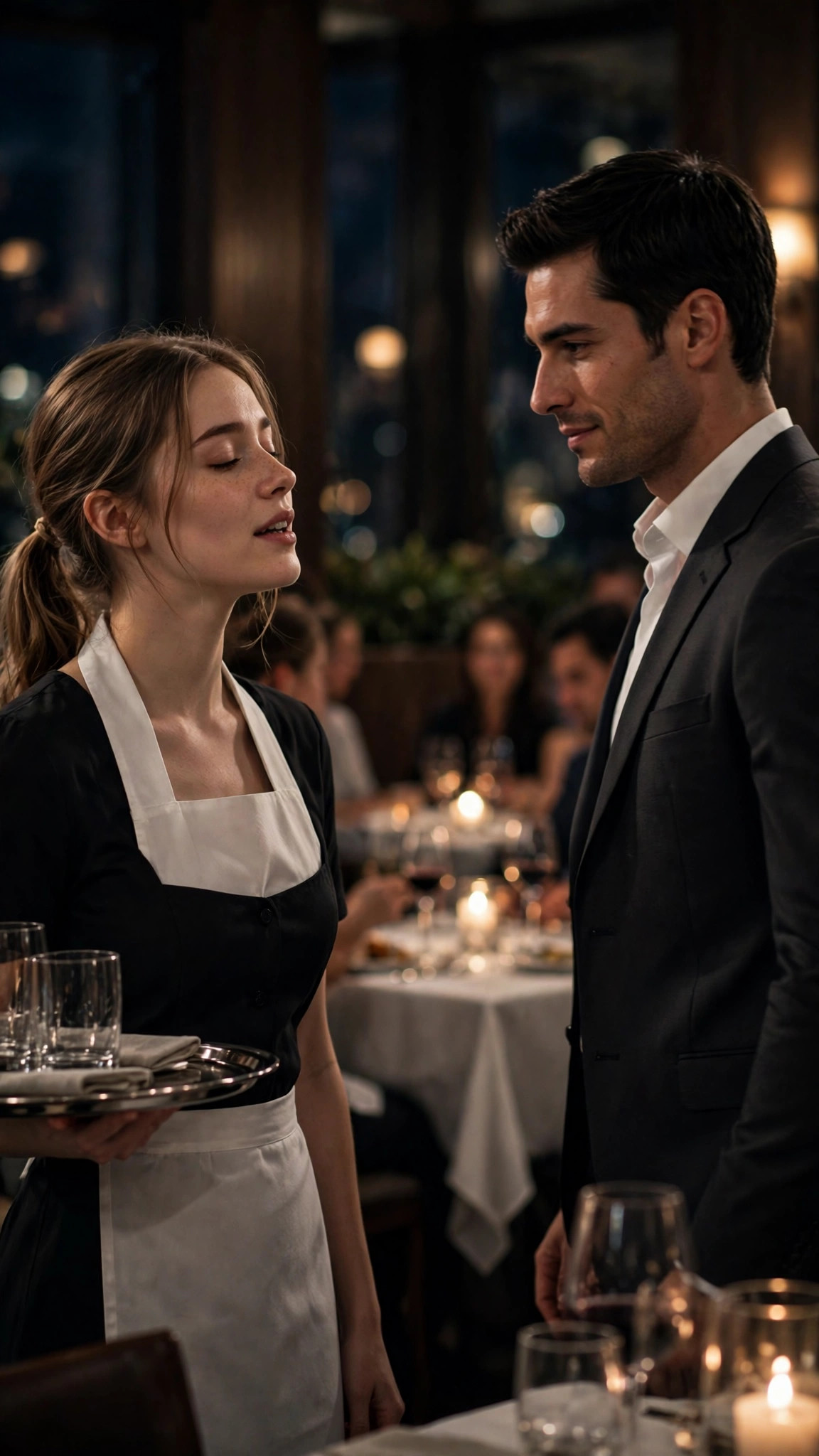
It was a Friday night, and Il Cielo was full, and Emily was working the floor — she had been working the floor for three weeks now, and she had gotten good at it, and she had even started to feel, in a way she had not felt in three years, like she belonged somewhere — and Lorenzo was at his table by the window, and Marco was standing by the door, and everything was ordinary, and everything was fine, until the moment it was not.
Emily was carrying a tray past table six when she began to sing.
She did not mean to. It was the same as the first time — the piano, the melody, the shape of a song rising and falling — and this time, she did not stop herself, because this time, she was not afraid. She had told the truth. She had kept her promise. She had nothing left to hide. And so she sang, softly, while she worked, the song she had written three years ago, about a woman who leaves everything behind, and the man she leaves, and how both of them are still singing the same song.
And Lorenzo Bianchi, sitting at his table by the window, looked up, and he smiled.
Not the faintest smile. Not a crack in the ice. A real smile — small, and slow, and surprised, as if he had forgotten what his own face could do — and the whole dining room saw it, and the whole dining room went quiet, because no one had seen Lorenzo Bianchi smile in three years, and no one had ever expected to see it again.
And then, suddenly, everything stopped.
The police lights flashed through the windows — red and blue, red and blue, painting the white tablecloths in colors that did not belong in a restaurant — and a voice boomed over the intercom, loud and flat and official:
"FBI, everyone out now."
The dining room erupted. Chairs scraped. Glasses fell. People stood, and shouted, and pushed toward the doors, and Emily stood frozen in the middle of it all, her tray still in her hands, her song dying in her throat, and she saw Lorenzo rise from his table, and she saw Marco move to his side, and she saw Marco lean in close and whisper, urgently, "Boss, we need to go. They know."
Tony was shouting, trying to herd the diners toward the exits the way he had been trained to do in a fire drill, except this was not a drill, and the red and blue lights kept flashing through the windows, painting his face in colors that made him look like a stranger. Old Enzo had stopped playing, his hands frozen above the keys, and the piano stood silent for the first time all night. A woman at table four was crying. A man at table nine had dropped his wine glass, and it had shattered on the marble, and nobody had even noticed, because the intercom was booming again — "FBI, everyone out now, FBI, everyone out now" — and the whole room seemed to tilt, the way a room tilts in a dream, and Emily thought, with a clarity that surprised her, that this was the moment she had been running from for three years, and that it had finally caught up with her, here, in the middle of the dining room, under the chandeliers, with her tray still in her hands and her song still dying in her throat.
"Know what?" Lorenzo said, and his voice was calm, and it was cold, and it was the voice of a man who has just been told that the world is ending and has decided not to be impressed by it.
"They know about the money," Marco said. "The Geneva trust. The Amara Foundation. Agent Reyes has been building the case for months. It's not you they're after, boss. It's Giovanni. The laundering. The restaurant accounts. But if we stay here—"
Before Marco could finish, Emily's eyes locked onto Lorenzo's. And Lorenzo's voice was calm but deadly when he spoke, and it was not the voice of a man who was afraid, and it was not the voice of a man who was angry, and it was the voice of a man who has finally, after three years, found the person he has been looking for.
"Who are you really, Emily?" he said.
She froze, her heart pounding. She took a breath, and she whispered, "I'm the one who knows where the money is. I'm the one who knows who gave the order to kill her."
Lorenzo's eyes narrowed, his body tense. "The money that disappeared three years ago? The money that went missing from my family's bank accounts?"
"Yes," Emily's voice trembled. "But it's not just the money. It's the truth behind the night you lost everything. The night your fiancée disappeared. I know the truth, Lorenzo."
He grabbed her arm, his grip firm but not cruel. "Then you're not just a waitress. You're a con artist."
Emily looked at him steadily, her voice calm but filled with pain. "I was just trying to survive. And now I'm caught in the middle of something far bigger than I ever imagined."
Lorenzo's eyes flickered with a mix of anger and curiosity. He didn't know whether to trust her or throw her out. But one thing was certain — Emily wasn't an ordinary waitress.
He leaned in closer, his voice low. "What do you mean by that? You've been lying to me this whole time. What is the money really?"
She swallowed hard. "It's not just about the money. The truth is… the man who gave the order to kill your fiancée was someone you trusted. Someone close to you."
Lorenzo's face darkened. "Who?"
Emily hesitated, then spoke softly. "Your own underboss, Giovanni."
The room went silent. Lorenzo's eyes widened, as if the pieces of a puzzle were falling into place.
"No," he said, his voice low. "Giovanni would never betray me."
Emily's voice was barely a whisper. "But he did. He betrayed you, Lorenzo. He arranged everything — the money, the disappearance, everything."
Lorenzo, stunned, slowly turned, staring at the man who had been standing beside him all these years. Giovanni had betrayed him.
Just as Lorenzo was about to speak, the door to the restaurant swung open, and a man stepped in.
It was Giovanni.
He was here to finish what he started.
"Boss," Giovanni said, his voice calm but dangerous. "You should have never trusted her."
Lorenzo turned to face Giovanni, his fists clenched. The truth was now out. And Lorenzo was going to make sure Giovanni paid for every betrayal. The air was thick with tension, and for the first time, Lorenzo realized that his revenge was not just about the money or the past — it was about the people who had betrayed him.
But just as Giovanni was about to strike, the door to the back room swung open, and another figure appeared.
It was a woman. A woman with dark hair, a familiar face, standing in the doorway.
Lorenzo's heart stopped.
It was his fiancée. She was alive.
Lorenzo turned to Emily, eyes wide with confusion. "Emily… who is she?"
Emily swallowed, her voice quiet. "She's the one who gave the order. She was the one who arranged everything — disappearing, leaving you broken. It wasn't Giovanni. It was her."
Lorenzo's eyes widened in disbelief. His fiancée had betrayed him, faking her disappearance to escape with the money.
"Why?" he asked, his voice shaking. "Why would you do this?"
Isabella Romano stepped forward, and her eyes were filled with regret, and her voice, when she spoke, was the voice Lorenzo had heard in his dreams for three years — the voice that had sung an old Italian song on the night before their wedding, and then had never sung again.
"Because I saw what you were becoming, Lorenzo," she said. "I thought you would never change, never let go of the darkness. But then she came… I didn't know how else to escape."
Lorenzo's face twisted with rage, but before he could react, Giovanni stepped forward, raising a gun.
"You don't get to walk away from this, Lorenzo," Giovanni said, and for the first time in thirty years, his voice was not calm. "You thought you could have it all. But it's over."
The room erupted into chaos. The gun was raised. The tension was rising. Emily screamed — she did not mean to, it just came out of her, a sound she had never made before — and Lorenzo moved, not away from the gun but toward it, toward Giovanni, the way a man moves when he has nothing left to lose and everything left to protect —
And then a loud bang echoed through the restaurant.
Marco Santini took the shot.
He had been standing behind Lorenzo, as he had stood behind Lorenzo for fifteen years, watching the doors, and when the gun came up, he did what he had always done: he stepped in front of it. The bullet caught him in the shoulder, and he went down hard on the marble floor, and the whole room seemed to stop, and for one terrible moment, Lorenzo Bianchi stood frozen, staring at the man who had just taken a bullet for him, staring at the blood spreading across the white tablecloth that had fallen with him, staring at the price of three years of silence.
And then the police stormed in.
They came through the doors in waves — FBI, in vests, with their weapons drawn, with Agent Daniel Reyes at the front, shouting orders, and Giovanni was on the floor before he could fire again, and Isabella was standing in the doorway with her hands up, and Emily was on her knees beside Marco, pressing her apron against his shoulder, telling him to stay awake, telling him to breathe, telling him that he was going to be all right, even though she did not know if it was true.
And as they left — as the agents took Giovanni away in handcuffs, as the paramedics lifted Marco onto a stretcher, as the dining room emptied out into the flashing red and blue light — Lorenzo turned to Emily, his eyes still wild with confusion, and he leaned in, his voice barely above a whisper.
"You saved my life," he said. "But this isn't over. Not yet."
Emily nodded, her voice steady. "I'll be here when you need me."
Then Lorenzo, with a cold, dangerous smile, said, "Take care of her. I'll go deal with Giovanni. And when I'm done, you'll see what happens to people who betray me."
He left, and Emily stood in the middle of the restaurant, her heart pounding, in the wreckage of the dining room — the overturned chairs, the shattered glasses, the blood on the marble — and she knew that night would change everything.
And she was certain that the next time she saw him, he'd be more than just the Mafia Boss.
He was going to ask where the singer is.