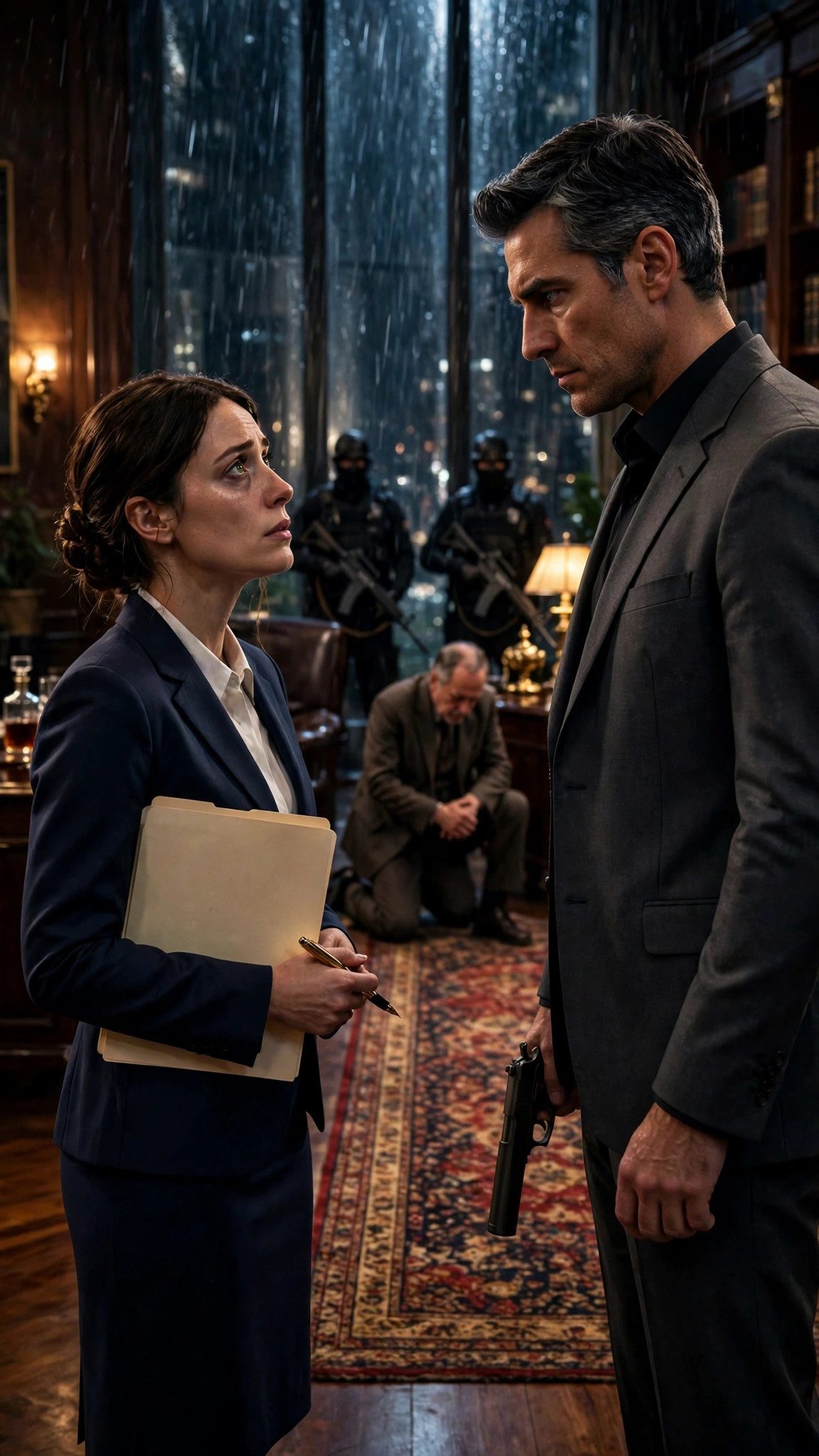
It was a Tuesday in June, exactly eight months after the rainy Thursday, when Dante Marino asked me to marry him.
He did it the way he did everything: quietly, carefully, and without asking anyone's permission first. He waited until the end of the workday, until Gloria had gone home and Tommy had gone home and the office was empty except for the two of us and the rain that had started again outside the windows, because of course it was raining. It always seemed to rain when something important happened in that office.
He came to my desk with a small velvet box in his hand, and he did not kneel, because Dante Marino did not kneel for anyone, but he stood very still in front of me, and he said, "Emily Davis. I have spent nine years being silent, and eight months learning how to laugh again, and I have learned one thing in all of that time. I do not want to be silent anymore. And I do not want to laugh alone."
He opened the box. Inside was a ring, simple and gold, with a single small diamond, the kind of ring a schoolteacher would have worn, the kind of ring Clara would have worn, and I understood, in that moment, that he had chosen it carefully, because he was not asking me to replace anyone. He was asking me to stand beside him, as myself, as Emily Davis, the secretary who had made a joke about a rug.
"I am not asking you to be Clara," he said. "I am asking you to be Emily. I am asking you to keep making me laugh. I am asking you to keep telling me the truth, even when the truth is about a rug. I am asking you to marry me, and to let me spend the rest of my life trying to be worthy of the woman who walked into an execution with paperwork in her hand."
I stared at the ring. I stared at him. And then I did the most honest thing I had ever done in my life.
"Yes," I said. "But on one condition."
"Anything," he said.
"You have to promise me something," I said. "Promise me that you will never stop laughing. Not when things get hard. Not when the family complains. Not when the world tries to make you silent again. Promise me."
"I promise," he said.
"And promise me that Daniel will always have a home, and a garden, and a red truck on his shelf."
"I promise," he said again.
"And promise me," I said, "that we will never, ever buy another Persian rug."
He laughed then. Really laughed, loud and free and unbroken, the way a man laughs when he has finally, finally come home, and the sound of it filled the office like sunlight, and Gloria, who had forgotten her umbrella and come back for it, stood in the doorway with her hand over her mouth, and Tommy, who had come back for his phone charger, stood behind her, and Enzo, who had never left the building, stood in the hallway, and they all heard it, and they all smiled, because the sound of Dante Marino laughing was the sound of a house unlocking its doors after nine years.
We were married three months later, in September, in the garden behind Daniel's house.
It was a small wedding. Gloria was there, in a dress she had bought specially for the occasion, crying before the ceremony even started. Tommy was there, in a suit that did not quite fit, holding the rings like they were made of glass. Sal and Maria came up from Milwaukee, and Maria brought biscotti, and Sal cried during the vows and pretended it was allergies. Enzo stood at the back with his arms folded, looking like a man guarding something precious, which, in a way, he was. Agent Reyes came, in his tired suit, and told me afterward that it was the first wedding he had ever attended where no one was arrested, which he considered a personal victory.
Daniel was my something blue. He wore a blue tie, and he sat in the front row in his wheelchair, and when the minister asked if anyone objected, Daniel shouted, "No! Hurry up!" and everyone laughed, including Dante, especially Dante.
Dante wore a charcoal suit, because of course he did. But he had left off his tie, because I had asked him to, and he looked younger without it, and happier, and when he took my hands and said his vows, his voice was steady and clear, and he did not look away once.
"I, Dante, take you, Emily," he said, "to be my wife. To laugh with you. To be silent with you, when silence is what we need. To protect your brother as my own. To build a family that does not need fear to survive. And to never, ever shoot anyone on a freshly cleaned rug."
Everyone laughed. I laughed. Daniel laughed so hard Grace had to steady his wheelchair. And Dante, standing in a garden in September with the sun on his face and my hands in his, laughed too, and it was the best sound I had ever heard.
At the reception, under a white tent strung with lights, Gloria stood up to make a toast. She had written it on an index card, and her hands were shaking, and she read it twice before she got through it without crying.
"I have worked in the Marino building for eleven years," she said, "and for nine of those years, I watched a good man disappear into silence. I watched him eat the same lunch every day. I watched him sign papers and take phone calls and look out the window like the world had ended. And then one rainy Thursday, a secretary walked into his office with a folder and told him not to bleed on the rug, and everything changed. So here is to Emily Davis Marino, who taught this family that laughter is not a weakness, and that mercy is not a luxury, and that a rug is just a rug, no matter who picked it out."
Everyone raised their glasses. Sal stood up next, with Maria's hand on his arm, and he said, "Mr. Marino spared my life when he had every right to take it. Miss Davis, I mean, Mrs. Marino, found the truth when no one else looked for it. My son is alive because of them. My family is whole because of them. I have been in this family for forty years, and I have never been prouder to be a part of it than I am today."
And then Daniel stood up, or rather, he wheeled himself to the front of the tent, and he took the microphone, and he said, "I'm Daniel. I'm Emily's brother. I want to say something. A year ago, my sister came home and told me her boss laughed at a joke about a rug. Today, that boss is my brother-in-law. And he promised me a red truck, and he brought it, and he listens when I talk about the standing frame, and he is the best brother-in-law in the whole world. Also, he is very tall. Thank you."
The whole tent erupted. Dante wiped his eyes with a napkin and pretended it was the pollen. I took his hand under the table and held it, and I thought about how strange and wonderful it was that a family could be built out of a secretary, a bodyguard, a receptionist, an old captain, and a young man in a wheelchair who loved red trucks.
After the ceremony, we danced in the garden. The music was a small string quartet that Gloria had hired, and the song was one Clara used to love, and I knew that because Dante had told me, and he had asked them to play it, and when it started, he held me a little tighter, and he whispered, "She would have liked this. She would have liked you."
"I know," I whispered back. "She's here. I can feel it."
And she was. Not in a frightening way. In the way that love stays, long after the person is gone, in the garden they planted, in the rug they chose, in the laugh they left behind for someone else to find.
That night, after the guests had gone home and Daniel was asleep in his room with the red truck on his shelf, Dante and I sat on the porch of the small house, and we listened to the crickets, and we drank sparkling water, because old habits die hard, and he told me about the family, about the legitimate businesses, about the foundation he was starting in Clara's name, a foundation that would pay for the care of people like Daniel, people whose families could not afford eight thousand dollars a month.
"We're going to call it the Clara Marino Foundation," he said. "And you're going to run it. Because you're the only person I trust to spend money wisely, and because you know what it costs to care for someone you love."
"All right," I said. "But only if we hire Gloria. She deserves a promotion."
"Done," he said.
We sat there for a long time, in the dark, in the quiet, and I thought about the rainy Thursday, and the rug, and the gun, and the ten seconds that had changed everything. I thought about the secretary I had been, tired and invisible, balancing spreadsheets in a building full of dangerous men. And I thought about the woman I had become, sitting on a porch in September with the man I loved, listening to the crickets, with my brother asleep in the house behind us and a future in front of us that I had never dared to imagine.
"Do you remember," I said, "the first thing I ever said to you in that office?"
"You said, 'Mr. Marino, I need your signature,'" he said.
"And do you remember the second thing?"
"You said, 'Please shoot him at the warehouse.'"
I laughed. "I was very professional."
"You were," he said. "You still are. You're just professional and married to the boss now, which Gloria tells me is a conflict of interest."
"Gloria can file a complaint," I said. "I'll put it in the spreadsheet."
He laughed again, and I laughed with him, and the sound of it rose up into the September night like something bright and alive, and I understood, finally and completely, what home sounds like.
Home sounds like laughter. Home sounds like crickets, and like a brother asleep in the next room, and like a man who spent nine years in silence learning, at last, how to make a joyful noise.
Home sounds like Dante Marino, laughing in a garden, with his wife beside him and his family safe around him, and the rain, for once, nowhere in sight.
In the first weeks of our marriage, the office had to adjust. Gloria started calling me "Mrs. Marino" and then correcting herself, and then giving up entirely and calling me "Emily, Mrs. Marino, whatever you are now," which made Dante laugh every single time. Tommy started saluting me in the hallway, which I told him to stop doing, which only made him do it more. Enzo started walking three steps behind me instead of two, which he said was "respect for the lady of the house," and which I said was "ridiculous," and which he ignored completely.
One morning, Dante came to my desk with two cups of coffee, one black and one with milk, and he set mine down in front of me and said, "I made this myself. In the break room. Gloria supervised, because she said I would burn the building down otherwise."
I took a sip. It was terrible. It was the worst coffee I had ever tasted, worse than the break room sludge, worse than the burnt toast coffee from my first day.
"It's wonderful," I said.
He looked at me. "You're lying."
"I'm your wife," I said. "Lying about your coffee is in the job description."
He laughed, and he kissed my forehead, right there in front of the whole office, and Gloria dropped a stapler, and Tommy pretended to be very interested in the ceiling, and I thought: this is my life now. Terrible coffee, and a man who laughs, and a family that salutes me in hallways. It was not the life I had planned. It was better.
One year later, on a rainy Thursday in October, I walked into Dante's office with paperwork in my hand, exactly the way I had done it the first time. The Persian rug was still there, on the floor between the desk and the window, cleaned every Tuesday, and Sal's replacement, a young captain named Joey Costa who had no idea what the rug meant, was standing in front of the desk looking nervous.
Dante looked up from his papers. "Miss Davis," he said, because he still called me Miss Davis in the office, even though the whole building knew we were married, "what is it?"
"The Clara Marino Foundation helped its first family today," I said, setting the folder on his desk. "A woman in Cicero. Her son has cerebral palsy. She was going to lose their house to pay for his care. We paid the mortgage. She's keeping the house."
Dante was quiet for a moment. Then he stood up, and he walked around the desk, and he took my hands, and he said, "Clara would have liked that. She would have liked all of this."
"She would have liked you," I said. "The you that laughs."
He laughed then, right there in the office, with Marco Bellini staring at us like we had both lost our minds, and I thought about the rainy Thursday a year ago, and the gun, and the ten seconds, and the rug, and I understood that some stories do not end. They just keep going, one laugh at a time, one Tuesday at a time, one family at a time.
And somewhere, in a small house with a garden, my brother was watching a red truck go by on the highway, and the sun was coming through his window, and the world, for once, was exactly as it should be.
The End.
THE END