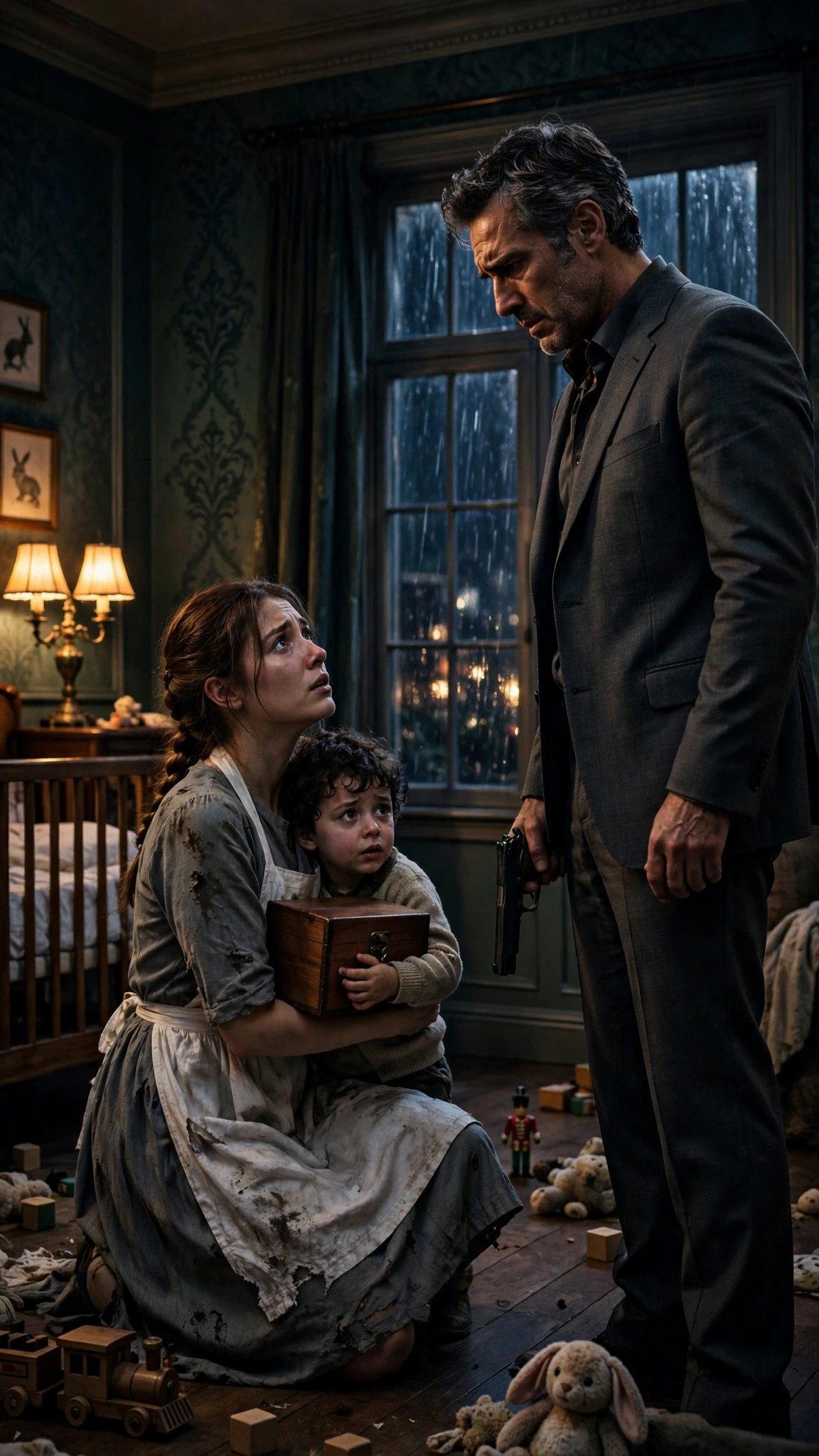
By the time my gun was pointed at the trembling young maid holding my dying son against her bare chest, my boy had already done the one thing twenty years of earning men's loyalty had never done for me. He had told me the truth with his eyes, and he had done it without saying a single word.
Hannah Collins did not run. She did not beg. She sat on the floor of my son's bedroom with her back against the wall, her dress torn and dark with blood, and she held Leo against her chest with both arms wrapped around him like she was the only wall left standing between him and the world. Leo's face was pale as paper. His lips were pale. His eyes were half open, and they were fixed on me, and in them I saw something I had not seen in my son's face in two years, not since the night his mother died. I saw fear. Not fear of the men who had come into our house. Fear of me.
"Don't," Leo whispered. His voice shook. "Don't hurt Hannah."
My finger was on the trigger. My hand did not shake. My hand never shook. That was the problem. My hand had not shaken when I was ten years old and my father put his first gun in it. My hand had not shaken when I was twenty-two and I took over the Rossi family after they carried my father out of a restaurant in a body bag. My hand had not shaken at my wife's funeral, when I stood beside a small white coffin and a smaller boy who did not understand why his mother was not coming home. My hand never shook. And now it was steady while I pointed a gun at the only woman my son had trusted since his mother died, and the only reason it did not fire was that a four-year-old boy whispered two words through pale lips and stopped the most feared man in New York with nothing but his eyes.
I lowered the gun.
That was the moment everything changed. Not the moment the gun went down. The moment I understood that I had almost killed the one person in my house who had been protecting my son, while the man who had actually tried to destroy him was still walking free under my own roof, eating at my own table, calling me boss.
But I am getting ahead of myself. To understand how a man like me came to point a gun at a twenty-four-year-old maid in his own son's bedroom, you have to understand what Leo Rossi was to me, and what Hannah Collins was to him, and what my mother had been whispering in my ear for a year, and what Tony Falco had been doing in the dark while I was busy being feared.
My name is Adrian Rossi. I am thirty-eight years old. I am the head of the Rossi family, and if you live in New York and you move money, or freight, or anything that needs to cross the river after dark, you know my name, and you know it the way you know the name of a storm that is coming. I did not choose this life. It chose me the way it chooses every Rossi son: my father was a boss, his father was a boss, and the oak box in my office holds our family crest, and it has held it for three generations, and one day it will hold it for my son, if my son lives long enough to inherit it.
I was ten years old when the shadows first followed me home. My father took me to a meeting in a warehouse in Red Hook, and I watched men twice my size lower their eyes when he walked into the room, and I understood, the way a child understands things without words, that power was not about shouting. Power was about the silence that fell when you entered a room. I learned to be silent. I learned to be still. I learned that a man who says nothing is a man nobody can predict, and a man nobody can predict is a man everybody fears.
They did not kill me. The shadows never did. I stood tall, and I ran operations alongside the Rossi crest for years, and I told myself that I was a lone wolf, that I did not need anyone, that I could devour the wreckage of my own life and keep walking. I was wrong about all of it. I just did not know it yet.
I met Isabella when I was twenty-six. She was not part of this world. She was a schoolteacher with brown eyes and a laugh that sounded like a window opening in a house that had been locked for years. She knew what I was. I never lied to her about it. She married me anyway, and for eight years, she was the one clean thing in my life. She made our house a home. She made me a better man than I had any right to be. And then, two years ago, on a rainy Tuesday night in November, a truck ran a red light on the West Side Highway, and Isabella died in an ambulance with a paramedic holding her hand, and I was fifteen minutes away in a meeting that did not matter, and I have spent two years trying to forgive myself for being fifteen minutes late to the last moment of my wife's life.
Leo was two years old when his mother died. He was barely older than three when he sang his favorite song with her for the last time — a little lullaby she made up for him, about night wishes and morning songs, about asking God to keep the people you love safe while you sleep. After she died, he stopped singing. He stopped talking, mostly. He would sit in the nursery with his small gray blanket and his wooden train, and he would look at the door every time it opened, the way a child looks when he is waiting for someone who is never going to come.
I hired nannies. I hired the best nannies money could buy. They lasted a week. Two weeks. Leo would not speak to them. He would not eat for them. He would sit in the corner with his blanket and wait for them to leave, and they always left, because there is no amount of money that makes a woman stay in a house where a small boy looks at her like she is a stranger in his dead mother's chair.
And then, a year ago, Rosa brought me a girl from an agency in Ohio. Rosa Benedetti had been our housekeeper for forty years. She had raised me after my own mother decided that running a family was more important than raising a son. Rosa was sixty-one years old, with hands like old leather and eyes that missed nothing, and she stood in my office and said, "This one is different. Give her a week."
Her name was Hannah Collins. She was twenty-four years old. She had brown hair she wore in a braid down her back, and green eyes, and a plain gray dress and a white apron, and she carried nothing but a small suitcase and a paperback book with a broken spine. Her mother had been a nurse in a small town in Ohio. Her father had died when she was sixteen. She had come to New York with nothing and no one, and she needed the work, and I needed someone who could sit in a room with my son without making him flinch.
The first day, she went into the nursery, and she did not try to pick Leo up. She did not try to make him talk. She sat on the floor, a few feet away from him, and she opened her book, and she started reading out loud. Not to him. Just reading, in a quiet, steady voice, like she was reading to herself. Leo watched her for an hour. The next day, he moved a little closer. On the third day, he sat beside her, and she turned the book so he could see the pictures, and he pointed at a drawing of a fox, and he said, "Fox." It was the first word he had said to anyone who was not family in six months.
Within a month, he was laughing. Hannah made him laugh by playing a game with him — a silly game where she would pretend the wooden train was a dragon and the blanket was its cave, and Leo would shriek with laughter, the kind of laughter that sounds like it is coming from a child who has forgotten, for one minute, that his mother is dead. She read to him every night. She carried his small gray blanket when he forgot it. She cleaned my bathroom. She carried trays. She did the work of a maid, and the work of a mother, and she never once asked me for anything more than her wages and a room of her own.
I should have seen what was happening. I should have seen that my son had given his heart to a stranger, and that a stranger with my son's heart was the most dangerous thing in my house — not because she was dangerous, but because anyone who wanted to hurt me would know exactly where to aim.
My mother saw it first. Livy Rossi is sixty-four years old, and she has run the Rossi family from behind the curtain for forty years, since my father's death. She is a small woman with iron-gray hair and a voice like a door closing, and she has never trusted anyone who was not born into this life. From the first week, she watched Hannah the way a hawk watches a field. "A girl like that does not stay for the wages," she told me, more than once. "A girl like that stays for the house. For the name. For the boy. Mark my words, Adrian. She will take something from us. They always do."
I told her she was wrong. I told her Hannah was harmless. I told her to leave the girl alone. But my mother's words are like water on stone — they do not break you all at once, they wear you down, a little at a time, until one day you find yourself looking at an innocent girl and wondering if your mother was right.
And then there was Tony. Tony Falco had been my capo for twenty years. He was forty-five years old, built like a wall, with a voice like gravel and a laugh that filled a room. He had stood beside my father. He had stood beside me. I trusted him with my life, and with my son's life, and with the keys to my house. Tony was the man who told me, a year ago, when I asked him about Hannah, "She's harmless, boss. Just a girl from Ohio. Don't worry about her." I believed him. I had no reason not to.
But there were things I did not see. Small things. The blood on my sleeve one evening, after a meeting in Queens, when Hannah was lying in the nursery reading Leo his favorite book, and she looked up, and she saw the blood, and she said, in that quiet, steady voice of hers, "Maybe Tony has a game to play with you about a pool plan."
I laughed it off. I told her it was nothing. I told her Tony was just Tony. But later, in my office, I thought about it, and I could not make it fit. What pool plan? What game? Why would Hannah Collins, a maid from Ohio, know the words "pool plan"? She had heard something. She had heard Tony talking on the phone in the pool house, and she had remembered it, the way she remembered everything about my son — carefully, quietly, and without telling anyone.
If I had asked her, that night, if she wanted to stay with me — if I had asked her what she had heard, and what she knew — she would have answered me immediately. She would have told me everything. But I did not ask. I was too busy being a boss. I was too busy being feared. I was too busy being the lone wolf who did not need anyone.
That was my first mistake. It was not my last.
On the night everything broke open, I was in Manhattan, in a meeting that ran three hours too long, and my phone was on silent, and when I finally looked at it, there were eleven missed calls from Rosa. Eleven. Rosa never called me. Not once in forty years. I drove home through the rain with my heart hammering against my ribs, and when I turned into the long driveway, I saw that the gatehouse was dark. The gatehouse was never dark. There were always two men there, every hour of every day, for twenty years. That night, there was no one. The gate stood open. The light was out.
I ran. I ran from the car to the front door, and the front door was open, and the hall was silent, and I took the stairs three at a time, and I could hear my own breathing, and I could hear nothing else, and I thought, for one terrible moment, that I was already too late.
I found them in Leo's bedroom. Hannah, on the floor, holding my son against her chest. Leo, pale and barely breathing. And on the floor beside the bed, half in shadow, a woman in a blood-stained dress, lying with her body broken, yet silently she breathed, and when she saw me, she lifted one hand, and she said, in a voice so quiet I had to kneel to hear it, "She did it for you."
It was Rosa. My Rosa. The woman who had raised me. She had tried to stop them, and they had broken her for it, and she was dying on my son's bedroom floor, and the last thing she did with her life was tell me the truth about the girl I had been about to shoot.
My finger tightened on the trigger. And then my son whispered, "Don't hurt Hannah." And I lowered the gun. And I finally, finally started to see.