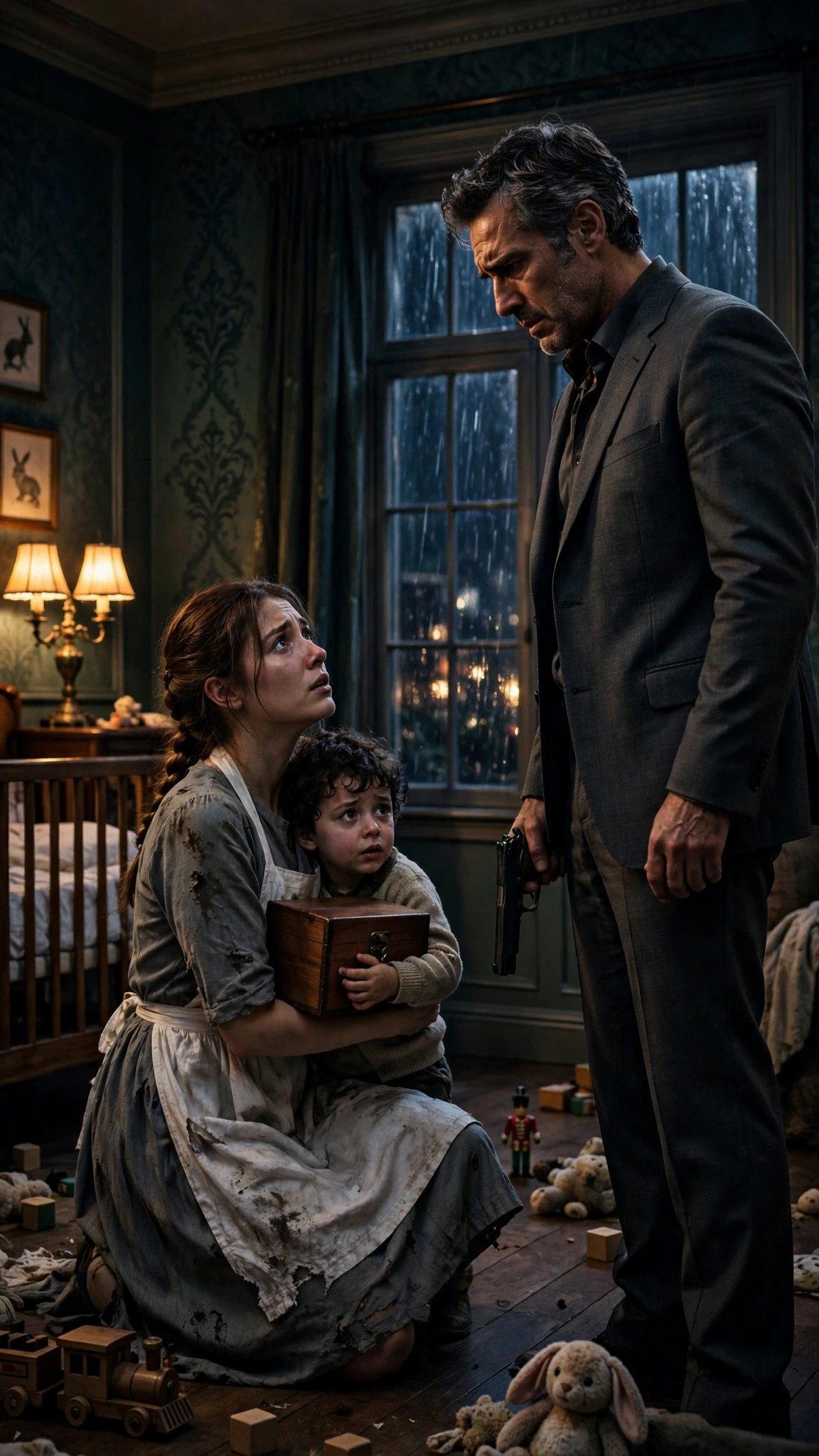
Hannah Collins had never meant to come to New York. She had meant to stay in Ohio, in the small town where her mother had been a nurse for thirty years, in the small house with the blue shutters where she had grown up. She had meant to be a teacher. She had a degree in early childhood education, and a student loan she could not pay, and a mother who had taught her that a woman's hands were for holding children and for healing the sick, and that there was no work in the world more important than that.
Her mother died when Hannah was twenty-two. Not suddenly. Slowly. The way good people die when the world has used them up a little at a time. Her mother had spent thirty years on her feet in a county hospital, lifting patients twice her size, working double shifts, coming home with her shoes soaked through and her back aching, and one day her heart simply stopped, in the middle of a shift, in the middle of helping someone else. The hospital sent flowers. The town sent casseroles. Hannah buried her mother beside her father, and she sat in the small house with the blue shutters, and she understood, for the first time in her life, what it meant to be entirely alone in the world.
She sold the house. She paid the debts. She had three hundred dollars left, and a suitcase, and a paperback book with a broken spine — her mother's copy of a book of poems, the one her mother used to read to her when she was small. She took a bus to New York because New York was the only place she had ever heard of where a girl with nothing could become someone, and she spent two weeks sleeping in a shelter and eating one meal a day, and she applied for every job she could find, and the only one that called her back was an agency that placed maids in big houses.
The agency sent her to the Rossi estate on a Tuesday morning in October. She remembered the date because the leaves were turning, and the driveway was long, and the house was bigger than any house she had ever seen, and when she walked through the front door, an old woman with hands like old leather looked her up and down and said, "You are too thin. We will feed you. Can you read?"
"Yes, ma'am," Hannah said.
"Good," the old woman said. "The boy needs someone who can read. The last four could not read properly. One of them read like a robot. The boy hated it." She held out a hand. "I am Rosa. I run this house. You will do what I say, and you will not touch anything in Mr. Rossi's office, and you will not ask questions about the men who come and go at night. Do you understand?"
"Yes, ma'am," Hannah said.
"And one more thing," Rosa said, and her eyes narrowed. "The boy is the only thing in this house that matters. If you hurt him, I will know. If you are kind to him, I will know that too. Do you understand?"
"Yes, ma'am," Hannah said. And she meant it.
They gave her a small room on the third floor, next to the nursery, with a narrow bed and a window that looked out over the garden. They gave her a gray dress and a white apron. They gave her a list of duties: clean the bathrooms, carry the trays, dust the library, help in the kitchen, and sit with the boy in the nursery in the afternoons. The boy. Leo. Four years old. His mother dead. His father a man whose name made grown men lower their eyes.
The first time Hannah saw Leo, he was sitting in the corner of the nursery with a small gray blanket wrapped around his shoulders and a wooden train in his lap, and he did not look up when she came in. She had seen children like him before, in her student teaching, children who had lost someone and had gone quiet inside themselves, like a house with all the lights turned off. She knew better than to rush at him. She knew that a grieving child is like a wild animal — if you chase him, he runs, and if you sit still long enough, he comes to you.
So she sat on the floor, a few feet away from him, and she opened her mother's book of poems, and she started reading out loud. Not to him. Just reading, in a quiet, steady voice. She read about foxes and rivers and the moon coming up over a field. She read for an hour. Leo did not move. He did not speak. But he did not leave, either. And that, Hannah knew, was a beginning.
On the third day, he sat beside her. On the fifth day, he pointed at a picture of a fox and said, "Fox." Rosa, standing in the doorway, put a hand over her mouth, and her eyes filled with tears, and she turned away quickly, because Rosa Benedetti did not cry in front of anyone, not even in front of a girl from Ohio.
Within a month, Leo was laughing. Hannah invented a game for him, a silly game where the wooden train was a dragon and the gray blanket was its cave, and Leo would shriek with laughter when the dragon roared, and the sound of it filled the nursery, and sometimes it filled the hallway, and once it filled the whole downstairs, and Hannah heard a sound she had never heard before in that house — the sound of a man stopping in the middle of a hallway, in the middle of a conversation about money and freight and men who owed him things, and going quiet, because his son was laughing.
She learned his routines. She learned that he liked his toast cut into triangles, not squares. She learned that he was afraid of thunder, and that when it rained at night, he would climb into her bed — not his father's bed, hers — and curl up small against her side with his blanket, and she would read to him until he fell asleep. She learned that he carried a small oak box everywhere, a box his father had given him, a box that held the Rossi family crest, and that he would not let anyone else touch it, not even her, not even Rosa. She learned the words of his mother's lullaby, the one about night wishes and morning songs, because Leo would hum it sometimes, very quietly, when he thought no one was listening, and Hannah learned the tune so she could hum it back to him, and when she did, he would close his eyes and smile, and for a moment, he looked like a child who had not lost anything at all.
She was happy. She was happier than she had been since her mother died. The work was hard — her hands were raw from cleaning, her back ached from carrying trays up three flights of stairs, and she was on her feet from six in the morning until ten at night — but at the end of every day, there was a small boy with dark curls who would run to her when she came into the nursery, and throw his arms around her waist, and say, "Hannah! Read the fox one!" And that was enough. That was more than enough.
But there were shadows in the house, and Hannah was not blind. She had grown up in a hospital, watching her mother come home with blood on her shoes, and she knew what blood looked like, and she knew what men looked like when they were lying about where the blood came from.
The first shadow was Livy Rossi. Adrian's mother lived in a wing of the house, in rooms full of dark furniture and old photographs, and she watched Hannah the way a woman watches a thief in her kitchen. She never raised her voice. She never said a cruel word. She simply looked at Hannah, every time they passed in the hallway, with eyes that said: I know what you are. You are a girl from nowhere, and you are here for something, and I will find out what it is. Once, when Leo ran to Hannah in the garden and threw his arms around her, Livy said, very quietly, to no one in particular, "He calls her name more than he ever called his mother's." Hannah heard it. She pretended she had not.
The second shadow was Tony Falco. Tony was a big man with a voice like gravel and a laugh that filled a room, and he was kind to Hannah, in the way that big men are kind when they want you to think they are harmless. He brought her coffee from the kitchen. He asked her about Ohio. He told her stories about Adrian when Adrian was a boy. But his eyes never left her. Not in a way that frightened her — not at first. Just in a way that made her feel watched. Like she was a room he was memorizing.
The third shadow was the house itself. Men came and went at night. They came in black cars, and they went into Adrian's office, and they stayed for an hour, and they left without saying goodnight. Sometimes they were angry. Sometimes they were afraid. Hannah learned to keep her head down and her ears open, the way her mother had taught her in the hospital: you do not ask questions about other people's blood. You clean it up, and you keep working.
But one evening, everything changed. It was a Thursday in late September, and Adrian had come home late from a meeting in Queens, and Hannah was lying in the nursery, reading Leo his favorite book, when Adrian came in to say goodnight to his son. He was wearing a dark suit, and his hair was wet from the rain, and when he bent down to kiss Leo's forehead, Hannah saw it: blood on his sleeve. Not much. A smear, dark red, on the white cuff of his shirt. He saw her looking at it, and he straightened up, and he said, "It is nothing. Go back to your book."
But it was not nothing. Hannah knew blood. And later that night, when she was carrying a tray past the pool house, she heard Tony's voice through the open window. He was on the phone, and he was saying words she did not understand — "the pool plan," "Tuesday," "the docks," "make sure the boy is asleep" — and then he saw her, and he stopped talking, and he smiled at her, and he said, "Hannah. You are up late. Go to bed, girl. The night is no place for a maid."
She went to bed. But she did not sleep. She lay awake in her narrow bed, listening to the rain, and she thought about the blood on Adrian's sleeve, and the words "pool plan," and the way Tony had looked at her — not like a man looking at a maid, but like a man looking at a problem. And she thought about Leo, asleep in the next room with his gray blanket and his oak box, and she made a promise to herself, the way her mother had made promises in the hospital, quietly and without telling anyone: whatever was happening in this house, she would not let it touch that boy.
She kept that promise. She kept it for three weeks, while the shadows in the house grew longer, and Livy's eyes grew colder, and Tony's smile grew thinner. She kept it when she found Leo's shoes muddy one morning and he would not tell her where he had been. She kept it when she heard Tony on the phone again, in the library this time, saying, "He talked. The boy talked. We have to know what he said." She kept it when she realized, with a cold feeling in her stomach, that the men who came at night had started looking at her the way Livy looked at her — like she was something that did not belong in the house, and needed to be removed.
She did not know, then, what Tony had done. She did not know about the woods. She did not know about the tree. She did not know that the most dangerous man in her life was not the boss with the gun, but the smiling capo who brought her coffee and asked her about Ohio. She knew only one thing: that a small boy trusted her, and that trust was the only thing she had ever been given in her life that she had not earned with her hands, and she would die before she let anyone take it from him.
On her first Sunday in the house, Rosa took her aside after church and taught her the nursery routine the way a sergeant teaches a new recruit. "The boy wakes at seven," Rosa said, counting on her fingers. "Toast cut into triangles, never squares — squares make him cry, and I do not know why, and I stopped asking years ago. Milk warm, not hot. The gray blanket goes everywhere he goes, and if you lose it, you will hear about it for a week. The oak box stays in his pocket. You do not touch it. You do not ask about it. It was his grandfather's, and his father's, and one day it will be his. And the lullaby — you will learn it. He hums it when he is scared. Do not ask him where he learned it. He learned it from his mother, and that is all you need to know."
Hannah learned it all. She learned that Leo liked to be read to in the big chair by the window, with the light coming over his shoulder. She learned that he hated the dark hallway outside the nursery, and that she had to leave the small lamp on all night, every night, without fail. She learned that he would sometimes wake up crying, calling for his mother, and that the only thing that calmed him was her voice, reading the fox book, over and over, until his breathing slowed and his small hands unclenched from her dress.
One night, after Leo had fallen asleep in her lap, Hannah sat in the nursery with a pen and a piece of paper, and she wrote a letter to her mother. She knew her mother was dead. She knew the letter would never be read. She wrote it anyway, because it was the only way she knew how to talk to the person she missed most. "Dear Mama," she wrote. "I have a job. I have a room of my own. There is a little boy here, and he is four years old, and his mother is gone, and he does not talk much, but today he said a word to me. He said 'fox.' And I thought of you, because you used to read to me about foxes, too. I think you would like him, Mama. I think you would like this house, even though it is too big and too quiet. I am going to take care of him, Mama. I promise. I am going to take care of him the way you took care of me." She folded the letter, and she put it in the drawer of her nightstand, beside her mother's book of poems, and she never sent it, and she never threw it away.
She did not know how soon she would have to prove it.