It happened on a Tuesday. Hannah remembered the day because Tuesdays were the day the gardener came, and the day Rosa went to the market, and the day the house was quietest, with Adrian in Manhattan and Livy in her wing and the guards changing shifts at noon. It was a Tuesday in the middle of October, and the leaves were red and gold, and the air smelled like rain that had not fallen yet, and Leo had been restless all morning, running from room to room with his wooden train, asking Hannah when his father was coming home.
"Soon," Hannah told him. "Your father will be home for dinner. Now, do you want to read the fox book, or do you want to help me in the garden?"
"The garden," Leo said. "The fox can wait."
They went into the garden, and Hannah let Leo run ahead of her on the path, the way she always did, because the garden was walled and safe, and there were guards at the gate, and nothing bad had ever happened in the garden. Leo ran to the oak tree at the far end, the big old tree where his mother used to read to him, and he climbed onto the low branch, and he called out to her, "Hannah! Look! I am a bird!"
She laughed. She was carrying his small gray blanket, folded over her arm, and his oak box was in her pocket, because Leo had asked her to hold it while he climbed. She was ten steps behind him. Ten steps. She counted them later, over and over, in the dark, in the days that followed. Ten steps. That was the distance between safety and everything that came after.
A black car pulled up to the side gate. Hannah saw it, and she thought it was one of Adrian's men, because black cars came and went all day, and she did not worry. The back door opened, and Tony Falco got out, and he smiled at her, and he said, "Hannah. Good. I was looking for the boy. His father wants him. Come here, Leo. Uncle Tony has a game for you."
Leo slid down from the branch and ran to him. He trusted Tony. Everyone trusted Tony. Tony had been in the house since before Leo was born. Tony had held him when he was a baby. Tony had given him his first wooden train. Leo ran to him with his arms out, and Tony picked him up, and he said, "We are going to play a game in the woods, Leo. A secret game. Just you and me. Like soldiers."
Hannah's stomach went cold. She did not know why. She only knew that something was wrong — the way Tony was smiling, the way his eyes did not smile with his mouth, the way he was already turning toward the car with Leo in his arms, fast, too fast, like a man who did not want to be seen.
"Tony," she said. "Where are you taking him? Mr. Rossi did not say anything about a game."
Tony turned, and his smile did not change, and he said, "His father called me, girl. From Manhattan. He said to take the boy to the woods, to teach him to be a man. You are a maid, Hannah. You do not question the boss's orders. Go back to your dusting." And then he put Leo in the car, and he got in, and the car pulled away, and Hannah stood in the garden with the gray blanket over her arm and Leo's oak box in her pocket, and she watched the car disappear down the driveway, and she knew, with a certainty that made her hands shake, that Adrian had not called Tony. Adrian never called Tony about Leo. Adrian called Rosa. Adrian called her. And Tony had lied to her face, with a smile, in the garden, in the daylight.
She ran into the house. She found Rosa in the kitchen, and she told her, fast, breathless, "Tony took Leo. He said Mr. Rossi called him, but Mr. Rossi never calls Tony about Leo, he calls you, he calls me. Something is wrong, Rosa. Something is very wrong."
Rosa put down her knife. Her face went white. "Where?" she said.
"The woods," Hannah said. "He said the woods. The game in the woods."
Rosa did not hesitate. She did not call Adrian first. She called the head guard, and she told him to take two men and follow Tony's car, and she told Hannah to stay with her, and then she went to the telephone in the hall and called Adrian in Manhattan, and when he answered, she said, in a voice Hannah had never heard from her before, a voice like a knife, "Your son is gone. Tony took him. Come home. Now."
Adrian came home in forty minutes. He drove like a man who had already decided who he was going to kill. He walked into the hall, and his face was white, and he said, "Where is he?"
Rosa told him. Hannah told him. She told him about the garden, and the car, and the lie, and the woods. Adrian listened without moving, and then he said, "Find him. Find them both. Now." And the house exploded into motion — men running, cars starting, phones ringing, guards spreading out into the woods behind the estate with flashlights, calling Leo's name.
They found him an hour later. An hour. Sixty minutes, in the dark, in the woods, in October, when the air turns cold at dusk. A guard found him tied to a tree, with a rope around his waist, not tight enough to hurt him, but tight enough that he could not get away. He was sitting at the base of the tree with his back against the trunk, and his face was wet with tears, and his gray blanket was gone, and his shoes were muddy, and when the guard untied him, Leo did not cry. He did not speak. He just held out his arms, and the guard picked him up, and Leo whispered, "I did not tell. I did not tell."
Tony was gone. He had left Leo there and driven away. He had left a four-year-old boy tied to a tree in the dark for an hour, to see if he would talk.
Adrian carried Leo into the house himself. He did not let anyone else touch him. He carried him up the stairs, and he laid him on his own bed, in his own room, and he sat beside him, and he said, very quietly, "Leo. What did he ask you? What did Uncle Tony ask you?"
Leo looked at his father, and his eyes were huge, and he said, "He asked me what Hannah heard. He asked me what Hannah heard on the phone. I told him I did not know. I told him Hannah only reads books. And then he asked me about Mama. He asked me what Mama used to say to me at night. And I told him." Leo's voice broke. "I told him Mama said she asks God to feed me night wishes and morning songs. And then he laughed. And he tied me to the tree. And he said, 'Stay here, little soldier. Let's see if you talk to the dark.'"
Adrian did not move. He did not speak. He sat beside his son's bed for a long time, and Hannah stood in the doorway, and she watched him, and she saw something she had never seen in Adrian Rossi's face before. She saw fear. Not fear of a rival. Not fear of the police. Fear of himself. Fear of what he was going to do to the man who had done this to his son.
And then Livy came into the room. She had been in her wing when it happened, and Rosa had told her, and she came in with her iron-gray hair and her voice like a door closing, and she looked at Leo, and she looked at Hannah, and she said, "This is your fault."
Hannah froze. "Mrs. Rossi—"
"You let him take the boy," Livy said. "You stood in the garden and you watched a man put my grandson in a car, and you did nothing. You are a maid. Your job was to watch him. You failed."
"I tried—" Hannah said. "I told Rosa—"
"You tried," Livy said, and her voice was ice. "A mother would not have tried. A mother would have thrown herself in front of the car. But you are not his mother. You are a girl from Ohio who reads books. And now my grandson has been tied to a tree in the dark because you were too weak to stop it."
Adrian looked up. He looked at his mother. He looked at Hannah. And Hannah saw it happen — she saw the doubt move into his eyes, the way water moves into a crack in stone. He had trusted her. He had watched his son laugh for her. He had seen her hold his boy. But his mother was his mother, and Tony had been his man for twenty years, and Hannah was a girl from nowhere, and in that moment, with his son shaking in his bed, Adrian Rossi did the thing that would haunt him for the rest of his life. He believed the wrong person.
"Go to your room, Hannah," he said, very quietly. "Do not come out until I call for you."
Hannah went to her room. She sat on her narrow bed. She held Leo's oak box in her hands — she had forgotten to give it back to him, it was still in her pocket — and she opened it, and she looked at the Rossi family crest inside, a small silver eagle with its wings spread, and she thought about her mother, in the hospital in Ohio, who had taught her that a woman's hands were for holding children and healing the sick. And she thought about Leo, tied to a tree in the dark, telling a bad man about his mother's lullaby, because it was the only brave thing a four-year-old boy knew how to do. And she made another promise, silently, in the dark, with no one to hear it: she would not leave this house until she knew who had done this, and why, and she would not let them do it again.
Downstairs, Adrian sat in his office with Tony Falco. Tony had come back. He had driven back to the estate as if nothing had happened, and he had walked into Adrian's office, and he had said, "Boss. I am sorry. I took the boy to the woods to teach him to be a man, like you asked. He got scared. He ran. I could not find him in the dark. I am sorry."
Adrian looked at him for a long time. And Tony, who had known Adrian for twenty years, who had stood beside his father, who had eaten at his table a hundred times, looked back at him, and smiled, and said, "You know me, boss. You know I would never hurt the boy."
And Adrian, who had spent his whole life reading men's faces, looked into Tony Falco's face, and saw nothing. No guilt. No fear. Nothing. Just a man who had done something terrible and was waiting to see if he would get away with it.
"I know you, Tony," Adrian said, very quietly. "That is the problem. I know you. And I am going to find out what you did. And when I do, God help you. Because I will not."
Tony left. Adrian sat in his office until dawn, with a glass of whiskey he did not drink, and a gun on his desk he did not touch, and he thought about his son, tied to a tree in the dark, and about a maid from Ohio who had tried to warn him, and about his mother, who had told him to blame her. And for the first time in his life, Adrian Rossi did not know who to trust.
Hannah did not stay in her room. She could not. While Adrian sat in his office, she went down to the kitchen, and she found Rosa there, standing at the sink with her hands in the dishwater, staring out the window at the dark woods. "Rosa," Hannah said. "I am going to look for him. I know the woods. I walked them with him last week, when he wanted to find acorns. I know where the big tree is. I know where the stream is. Let me go."
Rosa turned around. Her face was white, but her voice was steady. "You will not go alone," she said. "Take a flashlight. Take the gray blanket — the spare one, from the linen closet. And take this." She pressed something into Hannah's hand. It was a small silver whistle, old and tarnished. "It was my husband's, when he worked on the docks. Three blasts means you found him. Three blasts, and we will come running."
Hannah took the flashlight and the blanket and the whistle, and she went into the woods with two guards, and she called Leo's name until her voice was raw. "Leo! Leo! It is Hannah! I am here! Leo!" She walked for an hour in the dark, tripping over roots, tearing her dress on branches, calling and calling, and every time she heard a sound, her heart leapt, and every time it was only the wind, her heart broke a little more. She thought about the small boy tied to a tree, in the dark, in October, and she thought about her mother, who had once told her that the worst thing in the world is not being hurt. The worst thing is being alone and afraid and thinking no one is coming for you. And she called his name again, louder, "LEO! I am coming! Do not be afraid! I am coming!"
She was still in the woods, still calling, when the guard's radio crackled, and a voice said, "We found him. By the big oak. He is alive. Bring the blanket." Hannah ran. She ran through the dark with the flashlight bouncing in her hand, and when she reached the clearing, she saw Leo sitting at the base of the tree, with a guard kneeling beside him, untying the rope, and she fell to her knees in the mud, and she wrapped the spare blanket around him, and she held him against her chest, and she said, over and over, "I am here. I am here. You are safe. I am here." And Leo, who had not cried since the guard found him, buried his face in her shoulder and cried, and Hannah cried with him, and the two guards stood back, and pretended not to see, because even hard men know when to look away.
The next morning, Adrian ate breakfast alone in the dining room, and Hannah served him, the way she always did, and he did not look at her, and he did not speak to her, and the silence between them was worse than shouting. Livy sat at the other end of the table, and she watched Hannah with cold eyes, and she said, "The boy is lucky to be alive. Next time, perhaps his nurse will watch him more carefully." Hannah did not answer. She set the plate down, and she went back to the kitchen, and she stood at the sink, and she thought about the woods, and the whistle, and the way Leo had cried into her shoulder, and she thought: I did everything I could. I ran into the dark. I called his name. I held him. And it is still not enough. It will never be enough, for people who have already decided what I am.
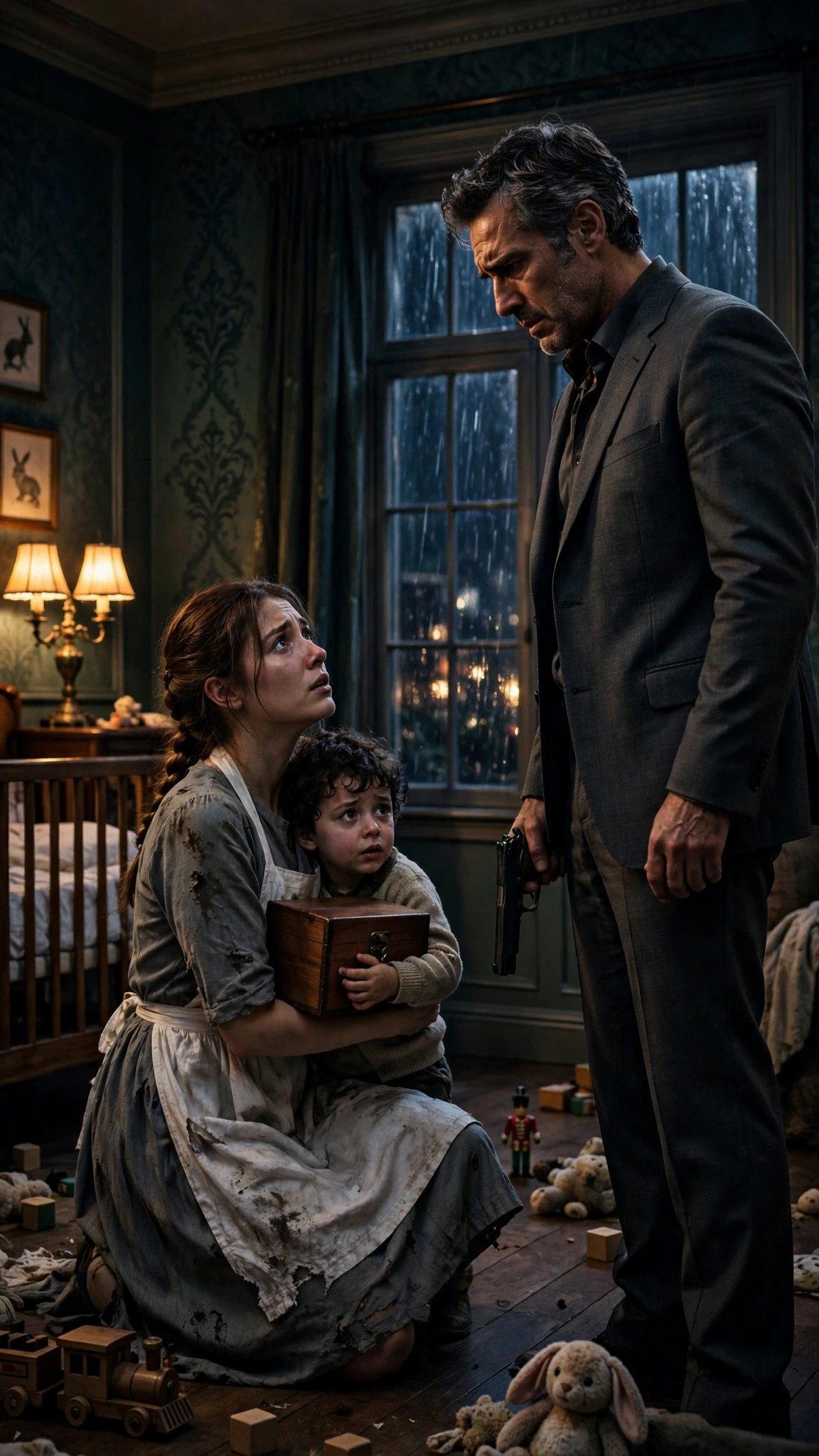
He did not know that the worst night was still ahead of him. He did not know that Tony had already decided what to do next. He did not know that the men who had come to his house in the dark were already planning to come back, and that this time, they would not come for the boy in the woods. They would come for the girl in the nursery. And they would come for the old woman in the kitchen who knew too much. And they would leave Hannah Collins holding his son in her arms, with blood on her dress, and a gun pointed at her face, and no one left alive who could tell him the truth — except the boy himself, and a dying woman on the floor, and the small oak box in Hannah's pocket, still holding the crest of a family that was about to learn what it had almost destroyed.