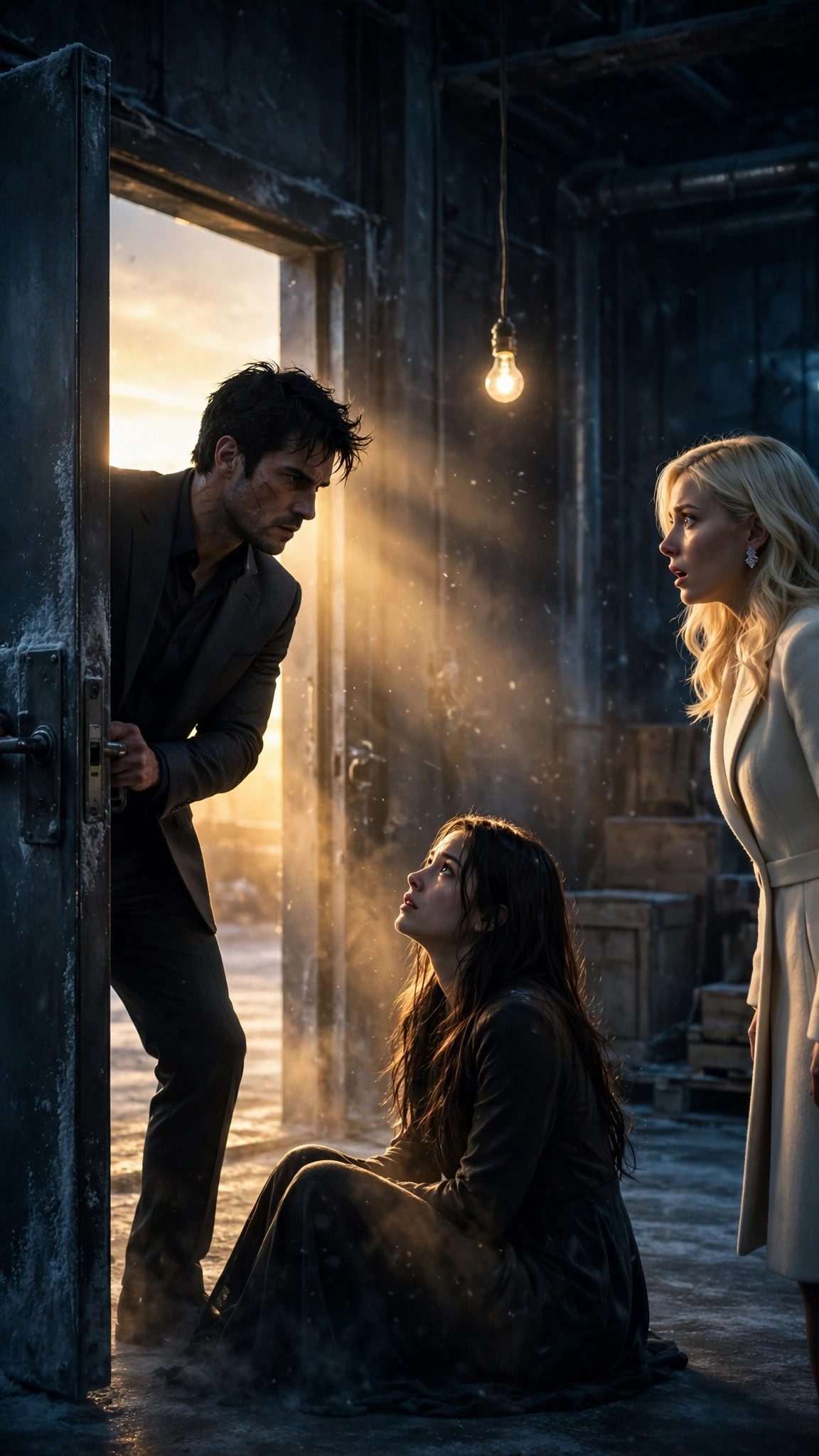
The night they took me, the rain had stopped, and the air over Baltimore smelled like wet pavement and wood smoke, and I was thinking about nothing at all except getting home to Caleb before dark, the way I had promised.
It was a Thursday. Roman had guests again — men in dark suits who arrived in black cars and left the same way, and Evelyn had been at the table in a red dress, laughing too loudly at something one of them said, and I had served the dinner and cleared the plates and gone down to the kitchen to finish the last of the washing up. By the time I left the estate, it was almost seven, and the sky was the color of bruised plums, and my bus was late, and I decided to walk the last six blocks to save time, the way I did when I was in a hurry.
I never saw the van. I remember the sound of a door sliding open, and a hand over my mouth, and a smell like cleaning fluid, and then nothing at all until I woke up on a concrete floor with a rope around my wrists and a headache like someone had split my skull with an axe.
The warehouse was freezing. That was the first thing I understood, before I even opened my eyes properly: the cold, coming up through the concrete into my bones, and the dark, so complete that I couldn't tell whether my eyes were open or closed. There was a single hanging bulb somewhere above me, swaying slightly, and it threw a yellow circle of light on the floor that ended a few feet from where I lay. Beyond the circle, there was nothing. Just dark, and the smell of oil and dust and old rain, and somewhere far away, the sound of water dripping.
I tried to sit up. The rope around my wrists was tight enough to cut, and my ankles were tied too, and my mouth was so dry that my tongue felt like a piece of leather. I tried to call out, and what came out was a croak, and I stopped, because calling out felt like the wrong thing to do, like it would bring someone, and I wasn't sure I wanted someone to come.
I lay there for a long time. I don't know how long. Time in the dark is not time at all. It is just cold and thirst and the sound of your own breathing. I thought about Caleb. I thought about him sitting by the neighbor's window with his tin box in his lap, waiting for me, and I thought about Mrs. Alvarez, our neighbor, who watched him when I was late, and I thought about the note I had left beside his breakfast bowl that morning — Eat everything. Pack your lunch. I love you more than all the stars. — and I thought about the shoebox under his bed, and I thought about how he would read that note again and again, and how he would not understand, and I thought about the promise I had made him that morning.
I will be home tonight. Before dark.
I had broken it. And the worst part was that he would think I had broken it on purpose.
On what I later understood was the second day, the door opened, and light came in, and a man I had never seen before walked in with a bottle of water and a piece of bread. He was big and quiet and he had a scar through one eyebrow, and he set the water and the bread down just outside the circle of light, and he looked at me for a long moment, and there was something in his eyes that I recognized, because I had seen it in the eyes of Roman Calder's men a hundred times. It was the look of a man who is doing a job he does not like and has decided not to think about it.
"Drink," he said. "Slowly."
I drank. The water was warm and tasted like plastic, and it was the best thing I had ever tasted in my life. He watched me drink, and then he picked up the empty bottle and the bread I had not touched, and he left, and the door closed, and the dark came back.
That was the pattern. Twice a day, the door opened. Water. Sometimes bread. Sometimes nothing. The man with the scar never spoke more than a few words. He never untied my hands. He never looked at me for long. He was a man doing a job, and the job was keeping me alive until someone decided what to do with me.
I tried to keep track of the days by the light under the door. There was a thin line of grey light that came and went, and I told myself that when it was there, it was day, and when it was gone, it was night. But the line was faint, and sometimes I slept and missed it, and sometimes I was awake and it was gone, and by the third day I had lost count completely, and I stopped trying, because counting only made it worse.
What kept me alive was not the water. It was Caleb. I thought about him constantly, in a kind of loop, the way you pray without meaning to. I thought about his laugh, and the way he frowned when he was concentrating on his homework, and the way he checked the locks twice every night, and the dented tin box with the baseball stickers, and the stuffed dog with one eye, and the note in the shoebox, and I told myself, over and over, that I would get out of this warehouse, and I would go home, and I would sit beside his bed and I would tell him the truth, which was that I had never left him, not for one second, not in my heart.
On the fourth day, or what I thought was the fourth day, the door opened and Evelyn Sterling walked in.
She was wearing a cream coat and dark trousers and low heels, and her hair was perfect, and her diamond earrings caught the light of the single bulb, and she looked around the warehouse the way a woman looks at a room she has just had cleaned. She did not wrinkle her nose. She did not hurry. She walked across the concrete floor and crouched beside me, elegant even in that, her knees together, her coat arranged around her, and she smiled.
"Hello, Maya," she said. "You look terrible."
I tried to speak. My voice came out as a rasp. "Why?"
"Why?" She tilted her head, considering the question the way a teacher considers a question from a child who should know better. "Because you don't understand your place. Because you thought a cup of tea and a blanket made you special. Because you thought that a man like Roman Calder could be reached by kindness, and you forgot that men like Roman Calder are reached by power, and money, and family. You are a cook, Maya. You are not a rival. You are not even a person, to people like us. You are a function. And functions can be replaced."
"I never wanted him," I whispered. "I never —"
"I know." She smiled again, and this time the smile was almost kind, which was worse. "That's what makes you dangerous. You didn't want him. You didn't scheme. You just… were kind. And he noticed. Do you know how long it took me to get him to look at me the way he looked at you that morning in the library? Two years, Maya. Two years of dinners and galas and charity balls and careful, patient work. And you undid it with chamomile tea."
She stood up, brushing invisible dust from her coat. "Here's what's going to happen. Tomorrow, my people will make sure that everyone believes you left. That you took your little brother's savings and ran off with some man, or to some other city, or wherever girls like you run to when they get tired of being poor. And Caleb — poor little Caleb — will wait by the window for a while, and then he will stop waiting, and he will grow up knowing that his sister abandoned him. And Roman will forget you in a week, because men like Roman forget functions. And I will marry him in June, in the cathedral, in a dress that costs more than your apartment building, and I will be Mrs. Roman Calder, and you will be a story no one tells."
She turned to go, and then she stopped, and she looked back at me over her shoulder.
"Any last wish?" she asked. "Before you leave?"
She thought no one else could hear my answer. She thought the warehouse was empty except for us and the man with the scar, and she thought the steel door was thick enough to keep secrets.
She was wrong about the door. She was wrong about the warehouse. She was wrong about everything.
Because on the other side of that steel door, standing in the dark with one hand pressed flat against the cold metal, was Roman Calder. And he had heard every word.
He had been searching for me for six days. I didn't know that then. I didn't know that on the first night I didn't come home, Caleb had sat by Mrs. Alvarez's window until midnight with his tin box in his lap, and Mrs. Alvarez had called the police, and the police had done nothing, because a twenty-six-year-old woman who doesn't come home is not a missing person, she is a woman who left. I didn't know that on the second day, Caleb had gone to school and told his teacher that his sister was gone, and his teacher had called Mrs. Alvarez, and Mrs. Alvarez had gone to the estate, and the housekeeper had told her that Maya had simply not shown up for work, and no one there had thought to ask why.
I didn't know that on the third day, Roman Calder had come downstairs for his breakfast and found no tray waiting, and no coffee, and no cook, and he had stood in the kitchen for a long time looking at the empty stove, and something in his chest had gone cold in a way it had not gone cold since he was ten years old.
I didn't know any of that. All I knew, lying on that freezing warehouse floor, was that Evelyn Sterling was asking me for my last wish, and the only wish I had in the world was my little brother.
"Tell Caleb…" My voice broke before I could finish.
Evelyn leaned closer, her diamond earrings flashing beneath the single hanging bulb. "Go on, sweetheart."
"Tell him I didn't leave him."
For the first time, her smile became genuine. "By tomorrow, everyone will believe you did."
Neither of us saw the shadow beneath the warehouse door. Neither heard Roman Calder place one hand against the cold steel as something inside him shattered.
And then the door exploded inward, and the light came flooding in, and the six days of darkness ended all at once.
Later, when I could think clearly again, I remembered the parts of those six days that I had not told anyone, not even Agent Reyes, because they were mine, and they were the reason I survived.
I remembered my mother. She died of pneumonia when I was seventeen and Caleb was nine months old, in the same two-room apartment on Fayette Street, in the winter when the heat broke and the landlord took three days to fix it. She was thirty-four years old. She had worked as a seamstress, and her hands were always rough, and she sang while she worked, old songs from the radio, and she told me, on the last night, when her breathing was shallow and her eyes were bright with fever, "Take care of your brother, Maya. He is the best thing I ever made. And never let anyone make you feel small, because you are not small. You are the whole sky to that boy."
I had kept that promise for nine years. I kept it in the warehouse, too, by refusing to die, by drinking the water slowly, by breathing in and out, by thinking about Caleb's laugh instead of the cold.
I remembered, too, the man with the scar through his eyebrow. His name, I learned later, was Eddie Marcone, and he had a daughter in Ohio, and he brought me water twice a day because someone paid him to keep me alive, and on the fifth day, he did something he was not paid to do. He knelt down beside me, and he loosened the rope around my wrists just enough that the blood could move, and he whispered, "I'm sorry, miss. I have a daughter your age. I don't like this job. But they have my girl's college money, and I can't say no." And then he tightened the rope again, not as tight as before, and he left the bread closer to my hand than usual, and I understood that even in a warehouse full of darkness, there were still people trying to be kind in the small ways they could.
I remembered counting. I counted the drips of water from the ceiling. I counted the coins in Caleb's tin box, in my head, over and over, trying to remember the exact number. Forty-seven dollars and thirty-five cents. I counted the notes in the shoebox under his bed. I counted the stars I had promised him I loved him more than. I counted my own heartbeats, when the fear got bad, one-two, one-two, the way my mother used to count my breathing when I was small and sick, and I told myself that as long as I could count, I was alive, and as long as I was alive, I was coming home.
And I remembered the moment I understood why Evelyn had done it. It was not the morning in the library. It was not the blanket or the tea. It was the fact that I had seen Roman Calder as a person, and she had only ever seen him as a prize. And a woman who sees a man as a prize will always be afraid of the woman who sees him as a man.