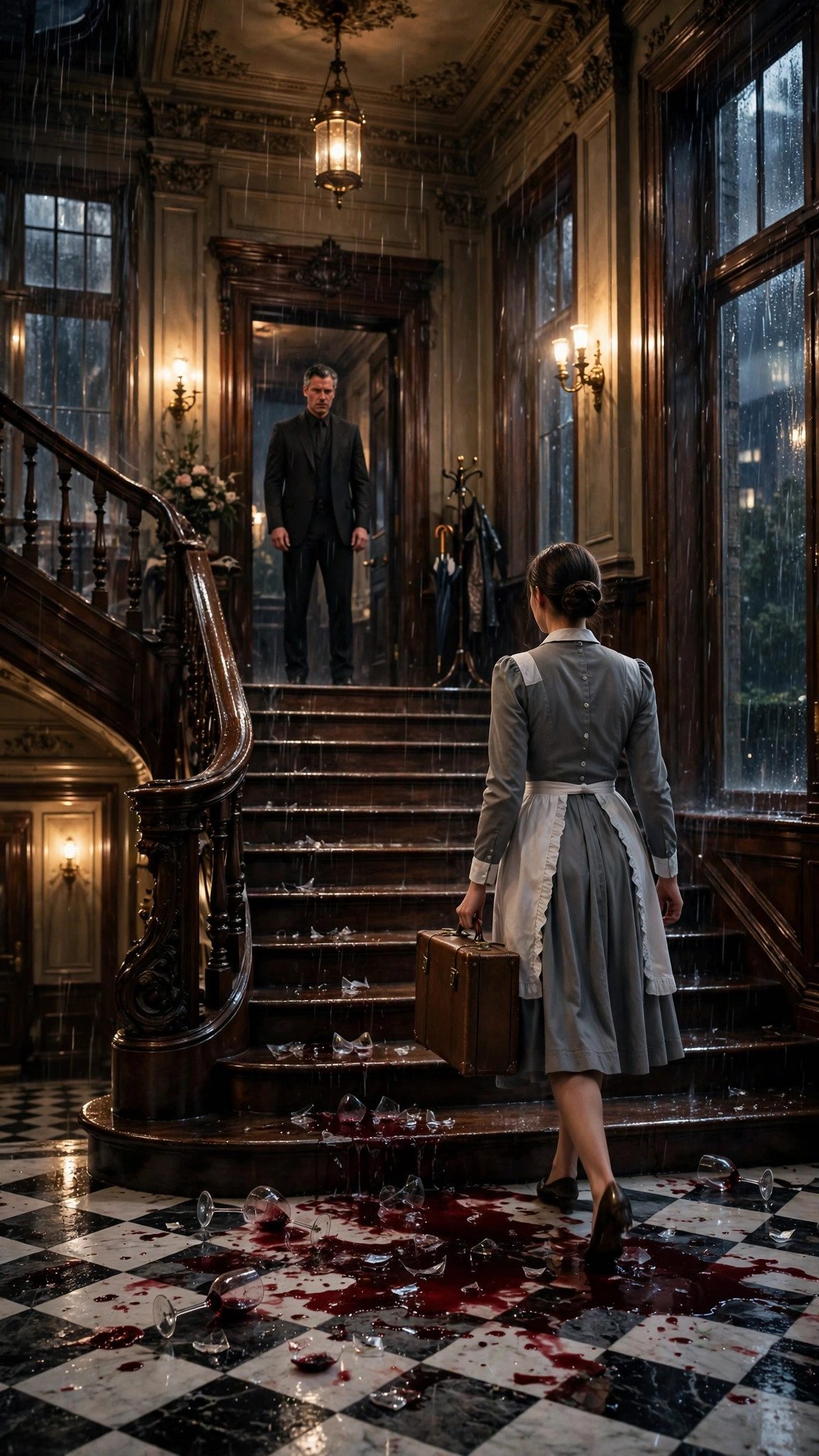
Hazel packed her suitcase in the dark, because she did not want to turn on the light, because the light would have made it real.
She had been packing and unpacking that suitcase in her mind for six weeks, ever since the doctor had told her, and now that the moment was finally here, her hands moved on their own, the way they always did, folding and smoothing and placing, as if she were packing for someone else, as if the woman leaving this house were a stranger.
Two dresses. A sweater. The photograph of her mother. The prayer card. The white cloth with the gold earring inside it, wrapped tight, hidden at the bottom, because she could not leave that behind, and she could not take it with her either, and in the end she took it, because it was the only proof she had, and because some part of her still believed, after five years, that the truth deserved to live, even if she did not.
She wrote the note last. She sat at the little desk and wrote it three times, and tore up the first two, because the first one said too much, and the second one said too little, and the third one said only what was necessary: the pantry, the silver, Sebastian's sweater, the roses on Thursday. She did not write "I love you." She did not write "I am dying." She did not write "Forgive me." She wrote "Thank you for five years," and it was the truest sentence she had ever written, and the saddest.
She put the note on the desk, weighted down by the prayer card, and she picked up her suitcase, and she went to the door, and she stopped.
Before she left the second floor, she went to Sebastian's room. She had not planned to. She had told herself that it would be easier not to see him, that it would be cleaner, that a goodbye would only make it harder. But her feet carried her there anyway, the way they always had, on the nights when he had been afraid of thunderstorms, and she stood in the doorway, and she looked at him sleeping in his narrow bed, his dark hair sticking up on one side, his arms wrapped around the stuffed bear she had sewn for him when he was five, and her heart broke in a way she had not expected it to break.
She had taught this boy to read. She had bandaged his scraped knees. She had sat beside his bed on a hundred nights and told him stories until he fell asleep. She had been the closest thing to a mother he had known since Angela died, and she had loved him the way you love a child who is not yours but feels like yours, and now she was leaving him, and he would wake up in the morning, and she would not be there, and he would not understand why.
She went to his bedside, very quietly, and she folded his blue sweater, the one she had washed that afternoon, and she placed it on the chair beside his bed, and she smoothed his hair back from his forehead, and she whispered, so softly that only the sleeping boy could hear it, "Be good, Sebastian. Be brave. And remember that I loved you, even if you never knew how much."
Then she kissed the top of his head, and she went out into the hall, and she closed his door very gently, and she stood there for a moment with her hand on the doorknob, and she thought about how strange it was that the hardest part of leaving was not leaving Gabriel. The hardest part of leaving was leaving an eight-year-old boy who had never done anything but love her.
The house was quiet. It was past eleven, and the men had gone home, and the kitchen was dark, and the only sound was the ticking of the old clock in the hall and the rain against the windows.
She went down the old wooden stairs, and the wood creaked under her feet with every step, the way it always had, and halfway down she stopped, because the creaking reminded her of the night Angela had died, and for a moment she was twenty-four years old again, standing in the hall with a tray of clean glasses, looking up at the top of the stairs, watching a woman fall.
She shook the memory away. She went down the rest of the stairs. She crossed the front hall. She opened the front door, and the rain came in on the wind, cold and sharp, and she stepped out into it, and she did not look back.
She did not look back because she knew that if she looked back, she would not be able to leave. She would see the warm light in the windows, and the roses in the garden, and the house where she had lived for five years, and she would remember the man in the study who said "Your food is good" every morning, and she would turn around, and she would go back inside, and she would stay, and she would watch him marry Andrea Bellini, and she would die in that house, quietly, while the wedding invitations went out on Monday.
So she walked down the driveway in the rain, carrying her suitcase, and she did not look back, not once, not even when she heard the heavy old bell by the front door ring behind her, and not even when she heard a glass fall and shatter on the marble floor, and not even when she heard Gabriel's voice, far away, calling her name.
She walked for an hour in the rain, all the way to the south side, to the little house her mother had left her, the house with the creaking wooden stairs and the small garden and the peeling paint. On the way, she passed the small church on Halsted Street, the one her mother had taken her to every Sunday when she was a girl, and she stopped under its awning for a moment, out of the rain, and she looked up at the dark windows, and she remembered her mother's voice, teaching her the rules of the house she would one day serve in.
"Be useful, Hazel," her mother had said, kneeling beside her in the pew, smoothing her hair. "Be invisible. The people in that house are not like us. They do not see us. And that is a blessing, because a woman they do not see is a woman they cannot hurt. Do your work. Keep your head down. And never, ever let them see your heart."
Hazel had obeyed her mother for twenty-nine years. She had been useful. She had been invisible. She had never let them see her heart. And now she was standing in the rain outside a dark church, dying, and she understood, at last, that her mother had been wrong about one thing. A woman they do not see is a woman they cannot love, either. And Hazel had wanted, more than anything in the world, to be seen, just once, by the man in the study who said "Your food is good" every morning.
She let herself in with the key she had kept on a string around her neck for five years. She set her suitcase down in the hall. She went to the kitchen and made herself a cup of tea with shaking hands, and she sat at the kitchen table, and she waited for the relief to come.
It did not come. What came instead was the pain, sharp and sudden, in her side, the pain the doctor had warned her about, and she doubled over at the table, and the teacup fell and shattered on the floor, and she thought, with a strange calm, that she was going to die right there, in her mother's kitchen, alone, the way she had always been alone, and that perhaps that was fitting.
But she did not die. She got herself to the phone. She called the clinic. She said her name, and she said the pain, and the nurse on the phone told her to stay where she was, and to unlock the front door, and that an ambulance was coming, and Hazel did what she was told, because that was what she did, and then she lay down on the kitchen floor, and she looked up at the ceiling, and she thought about the rose garden.
She thought about the day she had met Gabriel, kneeling in the dirt with her sleeves rolled up, a thorn in her finger, and the way he had taken her hand, and the way he had said, "Be careful. The roses here have thorns."
She thought about the five years of warm food and quiet mornings, and about Sebastian learning to read at the kitchen table, and about the way Gabriel's voice went soft when he said "Your food is good," and she thought that if she had to choose one memory to take with her, it would be that one: the man in the study, eating his dinner alone, saying the only sentence he knew how to say, and meaning something else entirely.
The ambulance came. The paramedics were kind. They asked her name, and they asked her if she had family, and she said, "No. There is no one," and the younger one, a woman with tired eyes, said, "There is always someone, ma'am. We will find them." They put her on a stretcher, and they carried her out into the rain, and she watched the little house disappear behind her, and she thought that she would never see it again either, and she was right, in a way, and wrong, in a way, because she would see it again, but not as the woman who had left it. She would see it again as a woman who had been found.
At the hospital, they put her in a bed on the fourth floor, and they put a needle in her arm, and they ran the tests, and a nurse with a clipboard asked her the same questions the paramedics had asked, and Hazel gave the same answers, and the nurse wrote them down without comment, and then she went away, and Hazel lay in the bed and listened to the machines beeping, and she thought about the doctor at the clinic, and about what he had said.
He had told her about the treatment. An immunotherapy, and then a surgery, at Northwestern, with a surgeon who had done the operation a hundred times. It would take months. It would cost more money than Hazel had ever seen in her life. The clinic had given her a pamphlet, and she had read it three times, and she had folded it up and put it in her coat pocket, and she had not looked at it since, because reading it meant believing it, and believing it meant hoping, and hoping was the most dangerous thing of all.
"Do not think about the money yet," the doctor had said. "First, tell your family."
She had no family. She had a drawer with a prayer card and a photograph and a gold earring. She had a little house on the south side. She had five years of memories in a house that was not hers. And she had a number on an emergency card, written three years ago in a moment of weakness, the number of a man who had once held her bleeding hand in a rose garden.
The doctor came in, a different doctor, an older woman with kind eyes, and she sat down beside the bed, and she said, "Hazel, your cancer has spread throughout your body. We are going to do everything we can. But I need you to understand that you are very sick, and that you need people around you now. Is there someone I can call?"
Hazel looked at the ceiling. She thought about the number on her emergency card, the number she had written three years ago in a moment of weakness, and she thought about the man who would answer that number, and she thought about what it would mean if he came, and what it would mean if he did not.
"Yes," she whispered. "There is someone. The card is in my coat pocket. Please call him. Please tell him to come now."
The nurse took the card. She went to the phone in the hallway. She dialed the number. And Hazel lay in the hospital bed and listened to the machines beeping, and she thought about the rose garden, and she waited.
She did not have to wait long.
She heard the footsteps in the hallway before she heard the door open, heavy footsteps, running footsteps, and then the door burst open, and Gabriel Rossi stood there, soaking wet from the rain, and his eyes found her across the room, and his face changed, and Hazel understood, all at once, that he had not come because a nurse had called him.
He had come because he had been running toward her since the moment she had left, and the phone call had only told him where to run to.
"Gabriel," she whispered, and her voice broke, and she reached out her hand, and he came to the side of her bed, and he took her hand, and he held it, and for the first time in five years, Hazel Marino did not feel alone.
"I am sorry," she said. "I did not want you to know. I did not want to be a burden. I am sick, Gabriel. The doctors say the cancer has spread. I left because I could not watch you marry another woman, and because I did not want you to watch me die."
"Listen to me," he said, and his voice was shaking. "I am not marrying Andrea Bellini. I am not marrying anyone. Do you understand me, Hazel? I have spent five years not seeing you, and I will not spend one more day that way."
And then, before he could say anything else, the door of the hospital room opened again, and a shadow appeared in the doorway, and Hazel looked up, and she saw the man with the sharp eyes like a blade, holding a gun, reeking of alcohol, and she knew, in a single second, who had sent him, and why, and what he had come to do.
"Gabriel," she whispered, and her hand tightened on his. "Do not move. He is here to kill me. And if you move, he will kill you too."