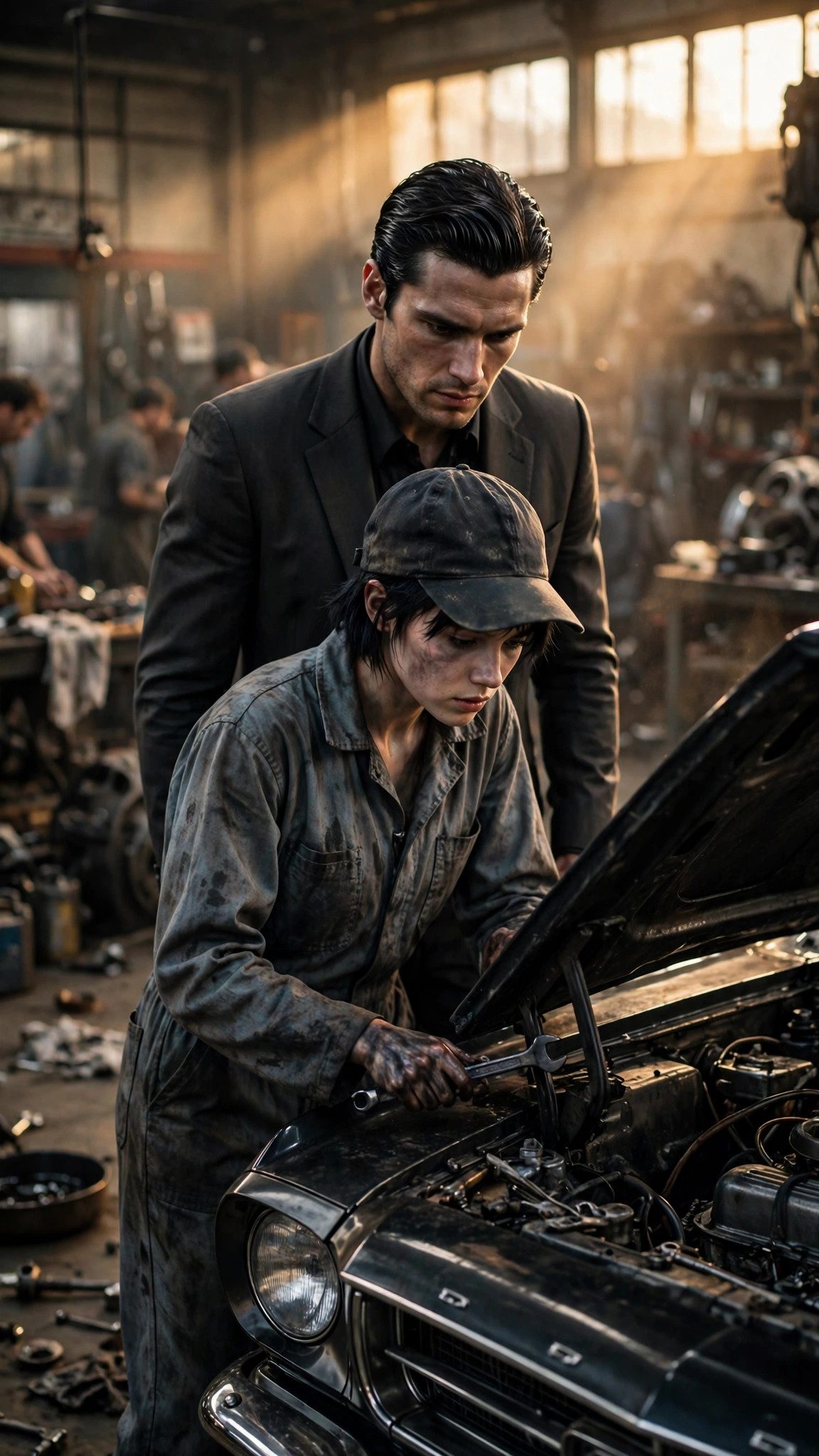
It happened on a Friday, at the end of the day, when the shop was almost empty and the light coming through the high windows had turned the color of old gold.
I was under the hood of a 1972 Corvette, finishing the last job of the day, when I heard the steel door open and three sets of footsteps cross the concrete. I did not look up. Eli Ross did not look up when men walked into the shop. Eli Ross kept his head down and his hands busy.
Then I heard Tony's voice, tight and low: "Mr. Moretti is not here. You'll have to come back."
"I'm not here for Moretti," a voice said. A voice I knew. A voice I had heard in my nightmares for seven months, whispering under a dinner table.
"You'll learn that saying no to me is just another way of asking me to be patient."
Marcus Bellamy was standing in the middle of Moretti Motorworks, in a suit that cost more than my room above the laundromat, with two men behind him who had the flat, bored eyes of men who were paid to find people who did not want to be found.
I froze. My hands were still on the engine, and my heart was beating so hard I was sure the whole garage could hear it, and I did not move, because moving would have meant being seen, and being seen would have meant the end of everything.
"Elena," Marcus said, and his voice was soft, and patient, and terrible. "Elena Russo. I know you're here. My investigator has been very thorough. Seven months, Elena. Seven months of looking. Do you have any idea how much money I have spent looking for you?"
I did not move. I did not breathe. I stood under the hood of the Corvette with grease on my hands and my cap pulled low, and I prayed to a God I had not spoken to in years that he would not recognize me.
"Come out, Elena," Marcus said. "Your father is waiting in the car. He wants to take you home. The wedding is still on. We have simply moved it to next month. Everything is forgiven. Everything is forgotten. All you have to do is come home."
My father was in the car. My father, who had heard Marcus squeeze my wrist under the dinner table and said nothing. My father, who had sold me for trucking routes and warehouse contracts. My father was sitting outside in a black car, waiting to take me home, and I knew that if I walked out of that garage with Marcus Bellamy, I would never be free again.
Tony stepped forward. "I told you, Mr. Moretti is not here. And there is no woman working in this shop. You need to leave."
Marcus smiled, and it was not a kind smile. "Tony Mercer," he said. "Shop manager. Fifty-two. A daughter in college. You should be careful, Tony. Accidents happen to men who get in the way of other people's business."
Tony did not move. He was fifty-two years old, and he was built like a refrigerator, and he was standing between Marcus Bellamy and me, and he did not move an inch.
"Get out of my shop," Tony said.
Marcus laughed. "Your shop? This is Dante Moretti's shop. And Dante Moretti is not here. So I think —"
"I'm here."
The voice came from the top of the metal stairs, low and calm, and the whole garage went silent.
Dante Moretti was standing at the top of the stairs, looking down at Marcus Bellamy, and his face was completely still, and his hands were behind his back, and he looked like a man who had been waiting for this moment for a very long time.
He walked down the stairs slowly, one step at a time, and the sound of his shoes on the metal was the only sound in the garage. When he reached the floor, he stopped ten feet away from Marcus, and he looked at him, and he looked at the two men behind him, and then he looked at me, still frozen under the hood of the Corvette, and his eyes found my face, and he held my gaze for one long second.
"Marcus Bellamy," Dante said, turning back to Marcus. "You are in my shop. You are threatening my people. And you are looking for someone who does not want to be found by you. So I am going to give you one chance to walk out of here, and I am going to give it to you only once."
Marcus smiled. "Dante. We are both businessmen. We both understand how the world works. The girl belongs to her father. Her father has promised her to me. That is a contract. You are a man who respects contracts."
"I respect contracts that are made freely," Dante said. "A twenty-five-year-old woman who has refused you three times has not made a contract. She has made a decision. And you are not going to overturn it in my shop."
"Her father —"
"Her father is sitting in a car outside," Dante said, and his voice dropped lower, and the temperature in the garage seemed to drop with it. "Her father sold his daughter to a man old enough to be her father, a man who grabbed her wrist at his own dinner table and told her she would learn to stop saying no. Her father can sit in that car for as long as he likes. He is not coming in here. And neither are you, ever again."
Marcus's face changed. The smile went away, and underneath it was something cold and ugly, something I had seen at that dinner table seven months ago, when he had squeezed my wrist and whispered in my ear.
"You don't understand what you're doing, Moretti," he said. "I own half the trucking in this city. I own warehouses from here to Milwaukee. I have friends in the mayor's office. I have friends in the police department. You do not want me as an enemy."
"I already have you as an enemy," Dante said. "You made me your enemy the moment you walked into my shop and threatened my people. Now walk out, before I decide to make it worse."
For a moment, nobody moved. Marcus looked at Dante, and Dante looked at Marcus, and the two men behind Marcus shifted their weight, and I could see their hands moving toward their jackets, and I knew, I knew, that this was about to become something terrible.
Then Marcus laughed — a short, sharp sound, like a door slamming — and he held up his hands.
"Fine," he said. "Fine. We will do this another way. Elena will come home eventually. They always come home. And when she does, Dante, I will remember this day. I will remember that you stood between me and what was mine."
"She was never yours," Dante said.
Marcus turned and walked out, and his two men followed him, and the steel door closed behind them, and the garage was silent.
But before I could move, Tony stepped forward, and Ray stepped forward, and Eddie stepped forward, and suddenly all three of them were standing between me and the door Marcus had just walked out of, like a wall made of coveralls and grease-stained hands.
"Nobody is taking her," Tony said, and his voice was rough, and I realized he was shaking, just a little, the way I was shaking. "Not from this shop. Not while I'm standing here."
Ray put a hand on my shoulder — gently, the way a father would — and said, "You're one of us now, kid. Whatever that man wanted, he doesn't get it. Not here."
Eddie, who was twenty-four and talked too much and had once asked me to a Cubs game, looked at the door and then at me, and he said, "If he comes back, I'll be here. We all will."
I looked at them — these men who had barely known me, who had known me only as the quiet kid who never talked and never laughed — and I felt something crack open in my chest, something I had been holding shut for seven months. These men did not know my real name. They did not know my story. But they had stood between me and Marcus Bellamy without being asked, and that was more than my own father had ever done.
"Thank you," I whispered, and my voice broke, and I did not care that it broke, because Eli Ross was gone now, and Elena Russo was standing in the middle of Moretti Motorworks with tears on her face, and nobody looked away.
Dante watched all of this from the bottom of the stairs, and he did not say a word, and his face was still, but there was something in his eyes I had never seen before — something that looked almost like pride. Not in himself. In them. In us. In the shop he had built, and the men who worked in it, and the way they had closed ranks around a girl they barely knew.
"Lock the gates," he said to Tony, quietly. "Double the men on the door tonight. Nobody comes in without my say-so. Not a delivery driver. Not a customer. Nobody."
"Yes, sir," Tony said.
"And Tony —" Dante paused. "Thank you. For standing where you stood."
Tony nodded, and he did not say anything, because there was nothing to say, and Dante turned to me, and he said, "Come to my office, Elena. Now."
I stood under the hood of the Corvette, and my hands were shaking so badly I had to put them in my pockets, and I looked at Dante, and he looked at me, and he walked over to me, slowly, and he stopped in front of me, and he said, "Come to my office, Elena. Now."
I followed him up the metal stairs, and my legs felt like they were made of water, and when we got to his office, he closed the door, and he turned around, and he looked at me, and for the first time since I had known him, his face was not still. It was alive with something I could not name — anger, and fear, and something else, something that looked almost like relief.
"Are you all right?" he asked.
I nodded. I could not speak.
"He will come back," Dante said. "Men like Marcus Bellamy do not walk away. He will come back with more men, or with lawyers, or with your father, or with the police. He will come back, and next time he will not walk into my shop and ask politely. So we need to decide, right now, what we are going to do about it."
"What do you mean?" I asked, and my voice came out small and raw.
"I mean that I can protect you, Elena. I can keep you safe in this shop, behind these gates, for as long as you need. But that is not a life. That is a prison with better lighting. And you did not cut off your hair and crawl through a laundry-room window to trade one prison for another."
He walked to the window and looked out at the garage below, at the cars, at the men working, at the life he had built.
"Or," he said, "we can end this. Not with guns. Not with threats. With the law. Marcus Bellamy owns trucking companies and warehouses and restaurants. Men like that always have something to hide. If I find it, and I give it to the right people, Marcus Bellamy will spend the rest of his life worrying about his own freedom instead of yours. And your father —" He paused. "Your father will have to answer for what he did, too. Are you prepared for that?"
I thought about my father, sitting in the black car outside, waiting to take me home. I thought about the way he had looked at me the last time I refused Marcus, the way you look at a child who does not understand the price of things. I thought about my mother, who had died when I was sixteen, and who had once told me, on the last good day before she got sick, that a woman's life belonged to her, and nobody else had the right to spend it.
"Yes," I said. "I am prepared."
"Good," Dante said. "Then we start tomorrow. And Elena —" He turned around, and his eyes found my face, and he held my gaze. "From tonight on, you do not sleep above the laundromat. You do not walk twelve blocks in the dark. You stay here, in the apartment above the shop. It is mine, and it is safe, and no one will find you there. Is that clear?"
"Yes, sir," I said.
"And one more thing." He walked over to me, and he stopped in front of me, close enough that I could see the flecks of gold in his dark eyes, and he said, very quietly, "You are not Eli Ross anymore. Not to me. You are Elena Russo. And Elena Russo does not hide. Not in my shop. Not ever again."
I nodded, and I could not speak, because my throat had closed up, and because for the first time in seven months, someone had said my name like it was something to be proud of, and not something to be hidden.
That night, I moved my duffel bag and Michael's tool roll into the apartment above the shop. It was small and clean, with a real bed and a window that looked out over the West Side, and I stood in the middle of it, and I took off my baseball cap, and I looked at myself in the bathroom mirror — short black hair, dark eyebrows, a face that had not been Elena Russo's face for seven months — and I thought about the girl in the mirror at 12:43 a.m., the night I cut my hair, and how frightened she had been, and how brave.
I slept that night without my shoes on, for the first time in seven months. I slept with the door unlocked. I slept, and I dreamed about engines that ran clean, and a black Mustang that purred like a sleeping animal, and a man standing at the top of a metal staircase, looking down at the world, and saying, "I'm here."
When I woke up, the sun was coming through the window, and for the first time since the night I left Lake Forest, I was not afraid.