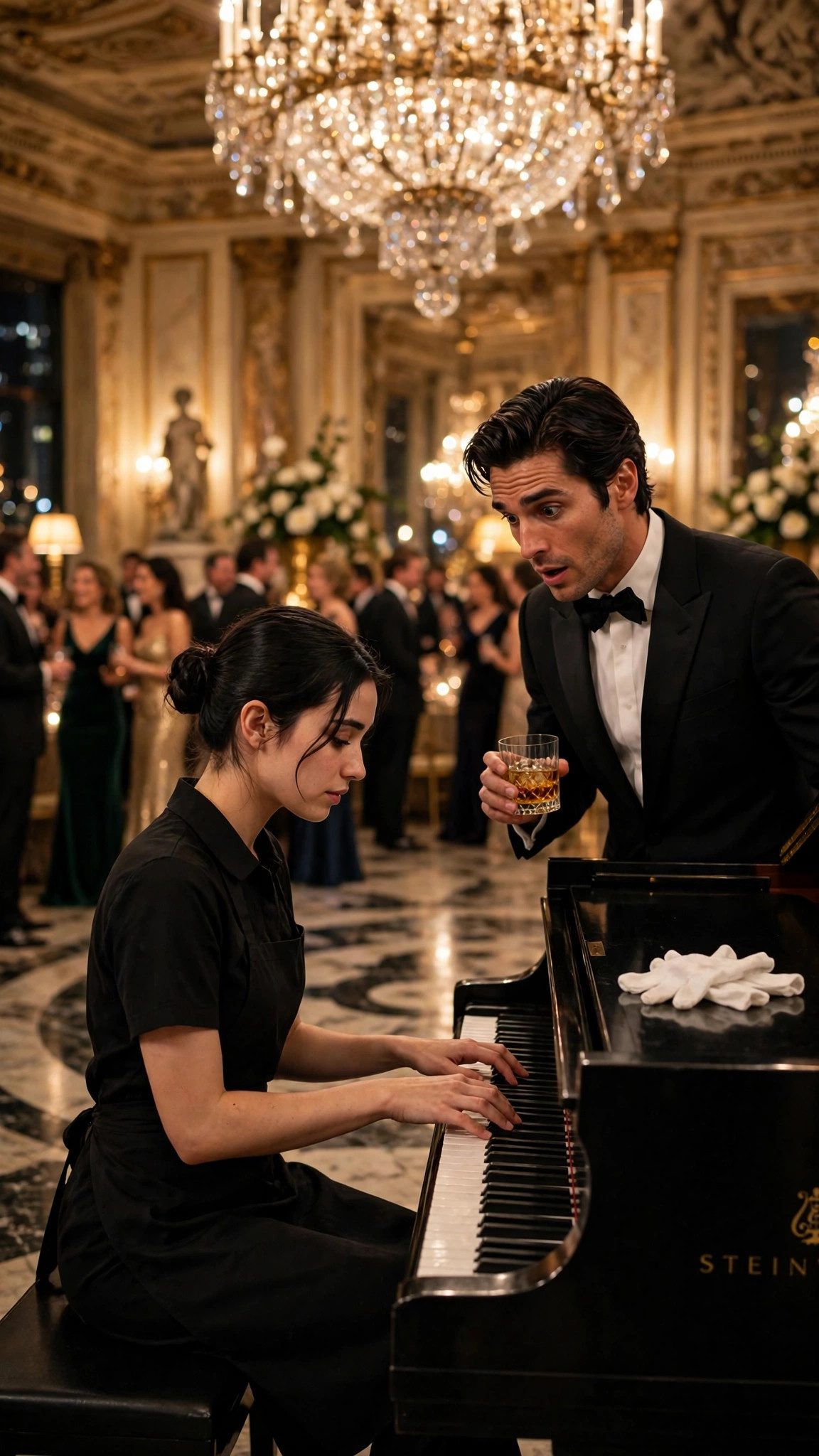
The morning after the night they came for me, I woke up in a hospital room.
Not because I was hurt — I wasn't, except for a bruised shoulder where I had pressed myself against the wall, and a cut on my palm from where my nails had dug in. I woke up in a hospital room because Dominic had insisted on it, and because Agent Daniel Reyes of the FBI had insisted on it too, and because, as Nora said when she arrived with coffee and a bag of clean clothes, "You have had the worst forty-eight hours of your life, and if anyone tries to make you do anything today, I will personally throw a tray at them."
Nora was safe. Dominic's men had gotten to her before Castellano's men did, and she had spent the night at a police station giving a statement, furious and unharmed and already telling the officers exactly what she thought of their coffee. When she walked into my hospital room, she hugged me so hard I thought my ribs would crack, and then she held me at arm's length and looked at me the way she had looked at me in the linen closet three years ago — like a person who is not going anywhere.
"Don't you ever scare me like that again," she said.
"I'll try," I said, and we both laughed, and then we both cried a little, and then Nora wiped her eyes and said, "Also, you are on the front page of every newspaper in Chicago. Again. The headline says 'Maid Pianist Targeted in Mafia Kidnap Plot.' There is a photograph of you playing the piano and a photograph of Dominic carrying you out of the bakery building. You look very dramatic in it. I look terrible in mine, which is unfair, because I was also there."
Agent Reyes arrived at ten. He was a tall man in his forties, with tired eyes and a suit that looked like it had been slept in, and he carried a folder thick with paper. He sat down beside my bed, opened the folder, and laid out photographs — Marcus Hale, Vincent Castellano, a warehouse on the south side, a ledger with columns of numbers.
"Miss Carter," he said, "I have been building a case against Vincent Castellano for two years. I have wiretaps. I have bank records. I have three witnesses who were too afraid to testify. What I did not have, until last night, was a crime committed on tape in the middle of Chicago with a dozen federal agents listening."
He slid a photograph across the blanket toward me. It showed Marcus Hale being led out of the bakery building in handcuffs, his soft voice and patient smile gone, his face twisted with rage.
"Marcus Hale was wearing a wire last night," Reyes said. "Not ours — his. He recorded himself threatening you, Miss Carter, because he wanted proof for Castellano that he had done the job. He recorded everything he said to you through that door. Including the name of the man who sent him." Reyes tapped the photograph of Castellano. "Vincent Castellano ordered your kidnapping. We have it on tape, in his own lieutenant's voice. That is enough for a federal indictment. That is enough for a RICO case."
"And Caroline?" I asked. "She warned me. At three in the morning. She told me not to open the door."
Reyes nodded slowly. "Caroline Whitmore came to us at five this morning, with her lawyer. Her father, Charles Whitmore, owes Castellano four million dollars. Castellano was using that debt to force the Whitmore family into an alliance — a marriage between Caroline and Dominic Vale, which would have given Castellano access to the Vale family's shipping routes and political connections. When you played that concerto, Miss Carter, you didn't just embarrass Caroline. You broke Castellano's plan. That's why he sent Marcus to you."
He paused, and his tired eyes softened slightly. "Caroline has agreed to testify against Castellano. In exchange, her father's debt will be restructured through the courts, and she will not face charges for the recording story — which, for the record, we have confirmed was entirely invented. The pianist in the video has signed a statement. There was no hidden speaker under the piano. You played every note yourself, and we have the audio analysis to prove it."
I sat back against the pillows, stunned. "She testified? Caroline?"
"She did," Reyes said. "She said — and I am quoting her, because I wrote it down — 'I have spent a year being a pawn in a game I didn't choose. I'm done being a pawn.'"
After Reyes left, I lay in the hospital bed for a long time, staring at the ceiling, listening to the soft beeping of the monitor beside me and the distant sound of nurses' shoes in the hallway. My shoulder ached. My palm stung where my nails had cut into it. But underneath the aches, underneath the exhaustion, there was something else — a feeling I had not felt in a very long time. It took me a while to name it.
It was relief. Not the small, tired relief of a crisis survived, but the deep, clean relief of a person who has finally stopped running. For two years, I had run from music. For three days, I had run from fame, from threats, from promises I had not asked for. And now, lying in a hospital bed with a bruised shoulder and a folder full of photographs on the blanket beside me, I was done running. Whatever happened next, I would face it standing still, with my eyes open.
Nora came back in the late afternoon, carrying a bag from the bakery below the safe house — still warm, she said, because she had made Dominic's driver stop on the way — and a stack of newspapers, which she set down on the bedside table with the air of a woman delivering evidence in a trial.
"You should see what they're saying about you," she said, pulling up a chair. "The Tribune calls you 'the bravest woman in Chicago.' The Sun-Times calls you 'the maid who brought down a mafia empire.' And this one —" she held up a tabloid with a photograph of me at the piano — "this one calls you 'the Piano Princess,' which I personally think is terrible, but the photograph is very flattering, so I am willing to forgive them."
"They're saying I brought down an empire?" I asked. "I just played the piano, Nora."
"And then you got kidnapped, and then you helped the FBI arrest the man who ordered it," Nora said, counting on her fingers. "Elena, you did not 'just' do anything. You have had the most eventful week of any person I have ever met, and I once knew a woman who was struck by lightning twice."
She leaned forward then, and her voice dropped, and the teasing went out of her face. "Are you all right?" she asked quietly. "Really. Not for the newspapers. Not for Dominic. For me."
I thought about it honestly before I answered. "I was terrified last night," I said. "When I heard those footsteps on the stairs, I thought — I thought that was it. That was the end of everything. And then I heard Dominic's voice on the phone, and I heard the sirens, and I knew I was going to live, and the first thing I thought was not about Castellano, or about the promise, or about any of it." I paused. "The first thing I thought was: I want to play the piano again. Tomorrow. In public. Where everyone can see me. I don't want to hide anymore, Nora. Not from the music, not from anything."
Nora reached across the bed and took my hand, and she squeezed it hard. "Good," she said. "Then that's what you'll do. And I will be in the front row, with cookies, and I will cry during the slow part, and I will not apologize for it."
A nurse came in then to check my blood pressure, and while she worked, Nora told her, in great and completely inaccurate detail, about the night of the gala, and the nurse — a young woman with kind eyes — listened with her mouth open and said, "You're her? The maid from the video? My mother watched that video four times. She cried every time."
After the nurse left, I closed my eyes for a few minutes, and I thought about my father, and about the Rachmaninoff, and about the fact that a gift is a responsibility, and that I had finally, after two years, picked the gift back up.
Dominic came to see me. He looked exhausted — he had not slept either — but his eyes were clear, and he was carrying a paper bag from the bakery below the safe house, still warm.
"I brought you bread," he said, setting the bag on the bedside table. "It seemed like the right thing. My mother used to say that bread is the only apology that doesn't need words."
"Dominic," I said, "about the promise—"
"Don't," he said, holding up a hand. "Not yet. First, I need to tell you something, and I need you to hear all of it before you say anything."
He pulled a chair up beside the bed and sat down, and he looked at me the way he had looked at me across the piano — as if I were a puzzle he had just discovered in his own house, and he was in no hurry to solve it.
"Ten years ago," he said, "my father was killed. Vincent Castellano ordered it. I was twenty-six, and I inherited a family and a war I did not start, and I became the man I am today because I thought that was the only way to survive. I have spent ten years being feared, Elena. I have spent ten years making sure that no one could ever hurt me again. And in those ten years, no one has ever surprised me. Not once. Until you."
He took a breath. "Last night, when I heard your voice on the phone — when you said, 'They're here, on the stairs' — I felt something I have not felt in ten years. I felt afraid. Not for myself. For you. And I realized something, sitting in that car, driving faster than I have ever driven in my life: I was not afraid because you are a promise I made in front of four hundred people. I was afraid because you are a person I care about, and I did not want to lose you."
He reached into his jacket pocket and took out a small velvet box. My heart stopped.
"This is not the promise," he said quickly, opening the box. Inside was a ring — not a diamond, not a showpiece, but a simple gold band with a single small stone that caught the morning light. "This is a question. A real one, asked in a hospital room, with no audience and no witnesses and no one watching except your friend Nora, who is pretending not to listen from the hallway."
From the hallway, Nora said, loudly, "I am absolutely listening, and I approve."
Dominic smiled, and then he looked back at me, and his dark eyes were steady and honest.
"Elena Carter," he said, "will you marry me? Not because I promised four hundred people that I would. Not because a Vale keeps his word. Because I sat in a ballroom and listened to you play the piano, and I have not been able to think about anything else since. Because you are brave, and honest, and you refused to play on command for a woman who tried to destroy you, and you refused to run when a dangerous man threatened you. Because my mother used to say that the right person doesn't make your life easier — they make it worth living. Will you marry me?"
I looked at the ring. I looked at Dominic. I thought about my father, and about the Rachmaninoff, and about the lid of a piano coming open after two years in the dark.
"Yes," I said. "But I have conditions."
Dominic blinked. "Conditions?"
"First," I said, holding up one finger, "I will not be a trophy wife. I will play the piano — in public, for real audiences, as often as I want. If you marry me, you marry a pianist."
"Agreed," Dominic said immediately.
"Second," I said, holding up another finger, "I keep my job at Hawthorne until the wedding. I will not be the woman who was a maid on Monday and a mafia wife on Tuesday. I will leave on my own terms, with my head high, and I will say goodbye to every person on that staff properly."
"Agreed," Dominic said.
"Third," I said, "we do this the right way. No war. No revenge. Castellano goes to prison because the law puts him there, not because you do. Your family goes legitimate — all of it, the shipping, the docks, the whole business, clean and legal, the way your mother would have wanted. I will not marry into a war, Dominic. I will marry into a future."
Dominic was quiet for a long moment. Then he took my hand, and he slid the ring onto my finger, and he said, "My mother used to say that too. 'A future, Dominic. Build a future, not a fortress.' I think she would have liked you very much."
From the hallway, Nora burst into tears.
That afternoon, Dominic called a meeting of the Vale family council. His uncle Anthony — the consigliere, the man who had called him three times on the night of the gala — listened to the whole plan in silence: the FBI cooperation, the legitimate businesses, the wedding, the concert.
When Dominic finished, Anthony was quiet for a long time. Then he stood up, walked around the table, and put his hand on Dominic's shoulder.
"Your father," Anthony said, "spent his whole life building a fortress. He died inside it. Your mother spent her whole life trying to open the door. I think it is time someone finally walked through it." He looked at me, and his old, lined face softened. "Welcome to the family, Elena Carter. Play something beautiful at the wedding. Your father would have wanted that."
And so it was decided — not by a promise made as a joke in front of four hundred people, but by a choice made in a hospital room, with a ring and a loaf of bread and a friend crying in the hallway.
The law would do what the law could do. Castellano would go to prison. Marcus Hale would go to prison. Caroline Whitmore would testify, and her father's debt would be settled in court, and she would go back to her life — not as Dominic's fiancée, but as a woman who had finally stopped being a pawn.
And I would play the piano again. Not as a maid. Not as a promise. As myself.