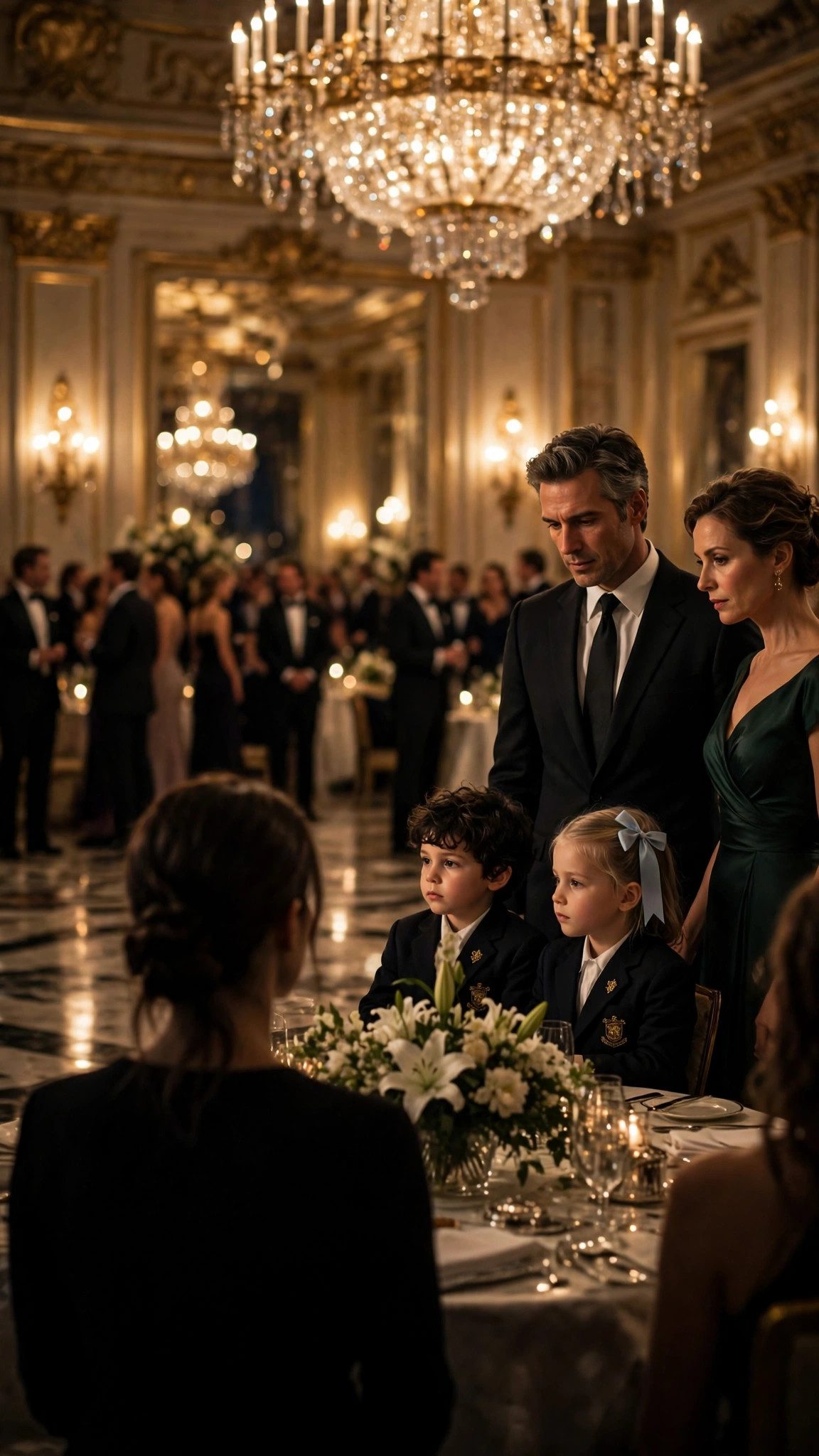
The Drake Hotel ballroom was exactly as I remembered it from the wedding that had not been a wedding: white lilies, crystal chandeliers, two hundred people in black tie, and a silence underneath the music that had nothing to do with celebration and everything to do with power.
I slipped in through the service entrance, the way I had planned — past the kitchen, past the waiters in their white jackets, past a security guard who was looking at his phone and not at the woman in the cheap black dress with her hair pulled back and her hands folded. I found a place at the back of the room, near the bar, where the shadows were thickest, and I stood there, and I waited, and I watched.
The string quartet was playing. A man in a tuxedo was giving a speech about the Mercer Foundation and its work with children's hospitals. People nodded. People sipped champagne. People smiled the particular smiles of people who have given a great deal of money and expect to be thanked for it in public.
And then I saw them.
Leo and Lily were sitting in the front row, side by side, in their school blazers with the gold Mercer crest pinned above their hearts. Leo's hair was dark and curly, and he kept running his hand through it the way Adrian did when he was thinking. Lily sat very straight, her hands folded in her lap, her ribbon — pale blue — tied in a neat bow at the back of her head. She looked like me. Not the me standing in the back row in a cheap dress. The me from before — the girl who had once believed the world was a kind place.
My heart stopped. And then it started again, too fast, hammering against my ribs like it was trying to break out of my chest and run to them.
Six years. Six years of night shifts. Six years of birthdays with candles I blew out alone. Six years of a notebook full of memories I was terrified of losing. And here they were. Alive. Breathing. Real. Close enough that I could have crossed the room in twenty steps and touched them.
I took one step forward. And then another. And then I heard a voice behind me, sharp and cold and familiar, and I froze.
"There she is," Margaret Mercer said. "The ghost finally came home."
I turned. Margaret was standing two feet behind me, in a silver gown, holding a champagne glass that shook in her hand. Her face was white. Her eyes were fixed on mine with an expression I could not read — shock, and grief, and something that might have been anger, or might have been hope.
"Mother," Adrian said.
He was standing three feet from her, and I had not even seen him come up beside us. He was taller than I remembered. His suit was black. His hair was black, going gray at the temples. His face was the same face I had married — beautiful, cold, and closed to me like a door I had never been given the key to.
He did not look at me. He looked at his mother, and his voice was very quiet, and very tired.
"Mother," he said. "I told you they had no mother."
Something in my chest cracked open. Six years of night shifts. Six years of covering for everyone else. Six years of telling myself that it was better to let my babies live a life without me so they would not be hurt. And here was the man who had thrown me away, telling his mother — telling the whole glittering room — that my children had no mother.
"You can tell stories to strangers, Mr. Mercer," I said. My voice sounded calm. I was proud of how calm it sounded. "But I'm not a stranger."
Adrian turned his head then. Slowly. The way a man turns when he hears a voice from a room he thought was empty.
His eyes found mine. And for one terrible, endless second, I saw it — the flicker. The recognition. The shock. The thing he had buried under six years of ice, surfacing all at once, raw and unguarded, before he killed it.
"Clara," he said.
It was not a question. It was not a greeting. It was my name, said the way a man says the name of someone he has already mourned.
Margaret Mercer's champagne glass slipped from her hand and shattered on the marble floor. The string quartet faltered. Two hundred heads turned. And in the front row, a little boy with dark curls turned around in his seat, and a little girl with a ribbon in her hair turned with him, and two pairs of dark eyes — his eyes, my eyes, the same eyes — found me standing in the back row.
I walked over to Adrian. I did not plan it. My feet simply moved, carrying me across the ballroom floor while two hundred people whispered behind me. I walked past the tables. I walked past the lilies. I walked past the waiters frozen in place with their trays. And all the while, my children — my son and my daughter — had already moved away from me, walking toward the door where their father was standing next to a woman I had expected to see.
Evelyn Carter. Standing next to Adrian in a dark green gown, beautiful and composed, her hand resting lightly on his arm the way a wife's hand rests. The woman he had chosen over me. The woman he still loved. The woman whose name had been the last thing he said to me before I signed the papers and walked out of the hospital with empty arms.
She was looking at me, too. And her face — I will never forget her face in that moment. It was not triumphant. It was not guilty. It was afraid. She looked afraid, the way a woman looks when the thing she has been dreading for six years has finally arrived, and she does not know whether it will save her or destroy her.
A man stopped me before I could reach my children.
He moved out of the crowd like a wall sliding into place — tall, broad, gray at the temples, a hand raised, palm out. Marcus Hale. Adrian's head of security. I had seen him a hundred times in the old days, standing behind Adrian's shoulder, saying nothing.
"Not here," Marcus said quietly. "Not tonight. Please."
I tried to turn around, but he moved faster than I did. His hand closed around my upper arm — not hard, not cruel, just firm, the way you hold someone who is about to walk into traffic.
"Let go of me," I said.
"Clara," Adrian said again. And this time his voice broke, just slightly, on the second syllable. "Don't."
"Don't what?" I asked. "Don't look at my children? Don't speak to my children? Don't exist? I've been doing all three for six years, Adrian. I'm done."
The little boy — Leo, my Leo, six years old and brave in a way that broke my heart — took a step toward me. His sister's hand was in his. They moved together, the way twins do, like two halves of a single thought.
And then the lights went out.
Not all of them. Just the chandeliers. The ballroom plunged into a darkness so sudden and complete that for a moment, nobody moved, nobody breathed. Someone screamed. Glass shattered somewhere to my left. Marcus Hale's hand tightened on my arm, and then it was gone, and a voice I did not recognize shouted, "Now! Take them now!"
In the dark, I heard my daughter cry out. "Leo!"
And I heard Adrian Mercer roar my son's name like a man watching his whole world burn.
"LEO!"
I ran toward the sound. I did not think. I did not plan. I ran, in the dark, in my cheap black dress, toward the small voice calling for her brother, toward the man who had thrown me away six years ago and was now shouting for his son like his heart was being torn out of his chest.
The emergency lights came on — dim, red, casting everything in the color of blood. And in that red light, I saw them.
Two men in waiters' uniforms, moving fast toward the front row. One of them — young, dark-haired, a scar through his left eyebrow — had his hand around Leo's arm. Danny Cole. The same man who had pointed a gun at our car on the night my babies were born. The other man — older, heavier, with a face like a slab of concrete — had Lily by the wrist. Enzo Falcone. Castellano's lieutenant. I knew his name because Eddie Marcone had whispered it to me on his deathbed, and because every nurse in Chicago knew the name of the man who collected debts for Vincent Castellano.
"No!" I screamed. I do not know if I screamed it out loud or only in my head. "No, not my babies, not my babies!"
Adrian was already moving. He crossed the ballroom floor in four strides, and he hit Danny Cole like a train hitting a wall — shoulder first, driving the younger man backward, away from Leo, into a table that went over with a crash of glass and silver. Danny went down. Adrian went down with him. They rolled. A fist connected with a jaw. A knee connected with ribs. It was not a fight. It was a father killing the man who had touched his son.
But Enzo Falcone still had Lily. He was dragging her toward the service door, and she was fighting him — kicking, biting, screaming — and she was six years old, and he was twice her size, and he was winning.
I ran at him. I did not think about the fact that he was bigger than me, or stronger than me, or that he almost certainly had a gun. I thought about Lily's tiny fist curled around my finger in the nursery, eleven minutes after she was born, holding on tight. I thought about six years of birthdays with candles I blew out alone. I thought about the notebook by my bed, full of memories I had been terrified of losing.
I hit him with everything I had. My hands, my elbows, my knees. I clawed at his face. I bit his wrist. He shouted and tried to throw me off, but I held on, because I was a mother, and mothers do not let go.
"Clara!" Adrian shouted. He was on his feet again, blood on his shirt, his face a mask of fury. "Clara, get back!"
"No!" I shouted. "She's my daughter!"
Enzo Falcone raised his free hand, and I saw the gun — black, small, ugly — and I saw his finger tighten on the trigger, and I closed my eyes, and I waited for the sound.
It did not come.
Instead, I felt a weight crash into me from the side, knocking me to the floor, and a body covering mine — heavy, warm, smelling of sweat and cologne and blood — and a voice in my ear, low and furious and terrified, saying, "Stay down. Stay down, Clara. Don't move."
Adrian. Adrian Mercer had thrown himself over me. Adrian Mercer, the most feared mafia boss in Chicago, was lying on a ballroom floor with his body shielding mine, while a gunman stood over us with a weapon pointed at his back.
"Move, Mercer," Enzo said. His voice was shaking. "Move, or I shoot you both."
"No," Adrian said. His voice was very calm. Too calm. The calm of a man who has already decided what he is willing to die for. "You shoot me, Castellano gets nothing. You shoot her, Castellano gets nothing. The children are already gone, Enzo. Look around. My men have them. Your men are on the floor. It's over."
Enzo looked around. And I looked around, too, from beneath Adrian's weight, and I saw that he was right. Marcus Hale had Leo in his arms, holding him tight against his chest. Margaret Mercer had Lily, wrapped in her silver shawl, rocking her gently, whispering to her. Evelyn Carter was standing between them and the door, her arms spread wide, her face white but her spine straight, like a wall. And all around the room, Adrian's men — men I had not even noticed, in suits and waiters' uniforms — were standing over Castellano's men, who were face-down on the marble floor with their hands behind their heads.
The police arrived four minutes later. FBI Agent Daniel Reyes walked in through the front doors with twenty agents behind him, and he looked at the scene — the overturned tables, the shattered glass, the men on the floor, the twins safe in their grandmother's arms — and he said, very quietly, "Somebody want to tell me what happened here?"
Adrian got off me then. He stood up. He held out a hand to help me up. His hand was shaking. I had never seen Adrian Mercer's hand shake before.
"They came for my children," he said. His voice was steady, but his hand was shaking, and I understood, in that moment, something I should have understood six years ago: this man was not a monster. He was a father. A father who had spent six years terrified that the men who wanted his empire would take the only two people in the world he could not replace.
And I understood something else, too — something that broke my heart all over again, in a completely different way than it had broken six years ago.
The most feared mafia boss in Chicago was never fighting to get his children back.
He was racing to reach them before his enemies did.
And tonight, for the first time in six years, he had not been racing alone.