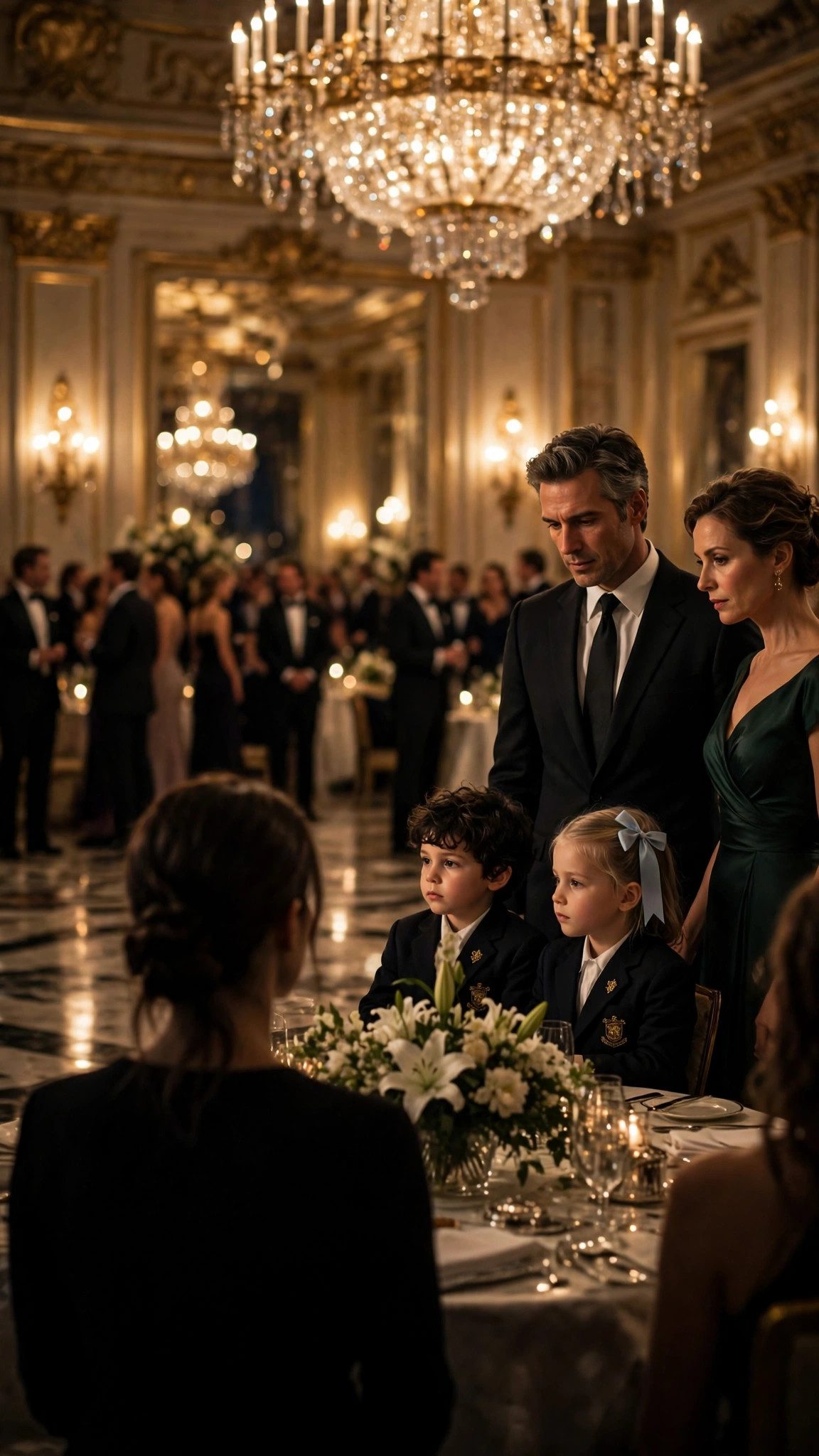
The Mercer house was quiet when we arrived, just before dawn. The guards at the gate nodded at Adrian and did not ask who I was. The long driveway was lined with old oak trees, their branches bare against a gray sky. The house itself — a great stone mansion on the lakefront, with windows that glowed warm even at four in the morning — looked like a place where children should have been laughing. It had been silent for six years.
Margaret Mercer was waiting in the front hall. She was still in her silver gown, though someone had draped a shawl over her shoulders. Her face was pale. Her hands were shaking. When she saw me, she put one hand over her mouth, and tears filled her eyes.
"Clara," she whispered. "Oh, my dear. Oh, my dear girl. You're alive. You're really alive."
"I'm alive, Margaret," I said.
She came to me then — this proud, cold woman who had sat beside her husband at my wedding like a statue carved from marble — and she put her arms around me, and she held me the way a mother holds a daughter who has come home from war.
"I'm sorry," she said into my hair. "I'm sorry I believed him. I'm sorry I never looked for you. I'm sorry I told those babies their mother was gone. I thought — I thought you were dead. Adrian told me you were dead, and I believed him, because why would a son lie to his mother about something like that?"
"Because he was trying to protect us all," I said. "I know that now."
"They're upstairs," Margaret said, stepping back, wiping her eyes with the corner of her shawl. "Leo and Lily. They're asleep. They were so frightened, Clara. But they're safe. They're safe now." She took my hand. "Come. Come and see them. They've been waiting for you for six years, even though they didn't know it."
I followed her up the grand staircase, my heart hammering, Adrian silent behind me. The hallway was lined with photographs — Adrian as a boy, Margaret as a young woman, Salvatore Mercer in his prime — and at the end of the hall, there was a door painted pale blue, with two small wooden nameplates nailed to it at a child's height.
LEO. LILY.
Margaret pushed the door open, very gently.
The room was large and warm, with two small beds against opposite walls, and a nightlight glowing in the corner shaped like a star. Leo was asleep in the left bed, curled on his side, one arm thrown over his eyes, his dark curls wild on the pillow. Lily was asleep in the right bed, on her back, her hands folded on her chest like a little queen, her pale blue ribbon still tied in her hair.
I stood in the doorway and I looked at them, and I felt something inside me — something that had been broken for six years, something I had thought could never be fixed — begin, slowly, to mend.
"Can I — " My voice caught. "Can I sit with them? Just for a little while?"
"Of course," Margaret said. She kissed my cheek, and she left, closing the door softly behind her. Adrian stayed. He stood in the corner of the room, in the shadows, watching me the way he had watched me in the trauma room all those years ago — like I was the only living thing in the world.
I sat down on the floor between the two beds. I did not touch them. I did not want to wake them. I just sat there, in the dark, listening to them breathe, and I let six years of grief wash over me and out of me, like a tide going out.
"Leo," I whispered. "Lily. Mommy's here. Mommy came home."
Leo stirred in his sleep. He turned toward my voice, still half-dreaming, and he murmured something I could not make out. Lily sighed in her sleep, a small, contented sound, and her hand — her tiny hand, no longer tiny, a six-year-old's hand now — slipped off her chest and fell toward the edge of the bed, toward me.
I took it. Very gently. I held my daughter's hand in mine, and I sat there on the floor of her bedroom, and I cried — quietly, so I would not wake her — for everything I had lost, and everything I had found again.
Adrian came and sat beside me on the floor. He did not speak. He just sat there, in the dark, next to me, and after a while, his hand found mine, and we sat like that — the three of us, plus one sleeping boy and one sleeping girl — until the sun came up over the lake and painted the room gold.
The days that followed were not easy. I will not pretend they were. A mother does not walk back into her children's lives after six years and simply pick up where she left off. Leo was angry. He did not understand why I had left, and he did not trust that I would stay, and he tested me — hiding my shoes, refusing to eat the food I made, asking me questions designed to hurt.
"Where were you when I lost my first tooth?" he demanded, on the third day. "Where were you when Lily fell off the swing and broke her arm? Where were you when we needed you?"
"I was in Milwaukee," I said. I did not lie to him. I had lied enough, to myself and to everyone else, for six years. "I was working nights at a hospital. I was thinking about you every single day. And I was wrong to leave. I was wrong, Leo. I thought I was keeping you safe, and instead I left you alone, and I am so sorry."
He stared at me for a long moment, his dark eyes — Adrian's eyes, my eyes — searching my face for a lie. Then he threw his arms around my neck and held on so tight I could barely breathe, and he whispered, "Don't go away again. Promise. Promise you won't go away again."
"I promise," I said. "I'm never going away again. I'm your mommy, Leo. I'm home now."
Lily was quieter. She watched me for days, the way she had watched me in the ballroom — serious, watchful, old beyond her years. She followed me from room to room, silent as a shadow, studying me. On the fifth day, she climbed into my lap while I was reading in the library, and she put her head on my shoulder, and she said, very softly, "You smell like the hospital."
"What does the hospital smell like?" I asked.
"Like soap," she said. "And clean sheets. Aunt Evelyn smells like perfume. You smell like soap."
"Is that all right?" I asked.
She thought about it. Then she nodded, and she put her thumb in her mouth — a habit Margaret told me she had never quite broken — and she fell asleep in my lap, and I sat there for two hours, afraid to move, afraid to breathe, holding my daughter while she slept.
Evelyn came to see me a week after the gala. She brought a box — a small wooden box, old, with a brass clasp — and she set it on the table between us, and she opened it. Inside were photographs. Dozens of them. Leo's first day of school. Lily's ballet recital. Christmas mornings. Birthday parties. Six years of my children's lives, documented in photographs, kept in a box by a woman who was not their mother but had loved them like one.
"I kept these for you," Evelyn said. "I always knew you'd come back. A mother always comes back. I kept them so you wouldn't have to miss everything. You missed enough."
I looked through the photographs, one by one, and I cried, and Evelyn sat with me, and she did not try to fix it, and she did not try to make it better. She just sat there, because she understood that some things cannot be fixed. They can only be carried, together.
"I signed the annulment papers," she said, when I had finished looking. "The marriage is over. Adrian is free. And so am I." She smiled — a real smile, this time, one that reached her eyes. "I'm going to travel, I think. I've always wanted to see the world. But I'll come back for birthdays. And holidays. If that's all right."
"It's more than all right," I said. "You're family, Evelyn. You'll always be family. Leo and Lily love you. I love you — for loving them when I couldn't be here."
She hugged me then, and we held each other for a long moment, two women who had loved the same man in very different ways, and who had both, in the end, chosen the same thing: the children.
Agent Reyes kept his word. Vincent Castellano was arrested three weeks after the gala, on charges that filled a file as thick as a phone book — racketeering, conspiracy, attempted murder, extortion, and the murder of Adrian's older brother, Michael, six years before the wedding that had not been a wedding. Danny Cole testified. Enzo Falcone testified. Carlo Benedetti testified — eight years, in exchange for everything he knew. Castellano was sentenced to life in prison, without the possibility of parole. He died there, two years later, of a heart attack, alone in a cell, with no one to mourn him.
Adrian did what he had been promising himself he would do for years: he chose the law. He handed Agent Reyes every ledger, every record, every name. He closed the gambling rooms. He sold the clubs. He turned the freight company legitimate — real trucks, real cargo, real drivers, real paychecks. He kept the name Mercer, because a name is not a crime, but he made it mean something different: a foundation that built children's hospitals, a scholarship fund for the children of dockworkers, a promise that no child in Chicago would ever be used as leverage again.
And one year after the night the lights went out in the Drake Hotel ballroom, on a warm afternoon in June, Adrian Mercer married me again.
It was nothing like the first wedding. There were no white lilies. There were no armed men. There were no two hundred guests in black tie sitting in silence like mourners. There were twelve people, in a garden behind the Mercer house, under an old oak tree: Margaret, and Evelyn, and Marcus Hale, and Agent Reyes, and Mrs. Kowalski from Milwaukee — who had taken a bus all the way to Chicago because, as she put it, "I always knew that girl was running toward something, not away from it" — and Leo and Lily, in their best clothes, holding the rings.
Leo gave the rings. Lily scattered rose petals. Adrian wore a gray suit, and I wore a simple white dress I had bought with my own money, and when the minister asked if I took this man to be my husband, I did not hesitate. I did not think about duty, or family, or forever. I thought about a trauma room at two in the morning, and a man who had looked at me like I was the only living thing in the world, and a night in a hospital nursery when I had whispered two names into the dark like a prayer.
"I do," I said. And this time, I meant it. This time, it was true.
Adrian kissed me under the oak tree, and Leo cheered, and Lily threw rose petals into the air, and Margaret cried, and Evelyn cried, and even Marcus Hale — Marcus Hale, who had never been frightened of anything — wiped his eyes with the back of his hand and pretended he had something in them.
That night, after the children were asleep, Adrian and I sat on the terrace of the house that was finally, truly, our home, and we looked out at the city lights, and he took my hand, and he said, "I spent six years racing to reach them before my enemies did. I never thought I'd have to race to reach you, too."
"You didn't have to race," I said. "I was already coming home. I just didn't know it yet."
One year later, on a Tuesday in October — the twins' seventh birthday — I woke up in a house full of sunlight and noise. Leo was arguing with Lily about the rules of a board game. Margaret was in the kitchen, burning the toast. Evelyn was on the phone from Rome, singing "Happy Birthday" so loudly that the whole house could hear her. And Adrian was standing in the doorway of our bedroom, holding two cups of coffee, looking at me the way he had looked at me in that cathedral for one second, six years ago — like I was the only living thing in the world.
Only this time, the second did not pass. This time, it lasted.
I work days now, at a children's clinic on the West Side — no more night shifts, no more covering for everyone else. I come home at five. I help with homework. I read bedtime stories. I kiss two small foreheads every night and whisper, "Mommy loves you. Mommy is here. Mommy is never going away again."
And every night, before I turn out the light, Leo says the same thing, in the same serious voice, like a vow he is renewing: "You're our mommy. You're not gone anymore."
And every night, I say the same thing back: "I'm your mommy. I'm not gone anymore. I'm home."
The mother they said was gone came home. And she stayed. And that, in the end, is the whole story. It was not the story they told at the gala. It was ours, and it was true, and it belonged to us forever.
The End.
THE END