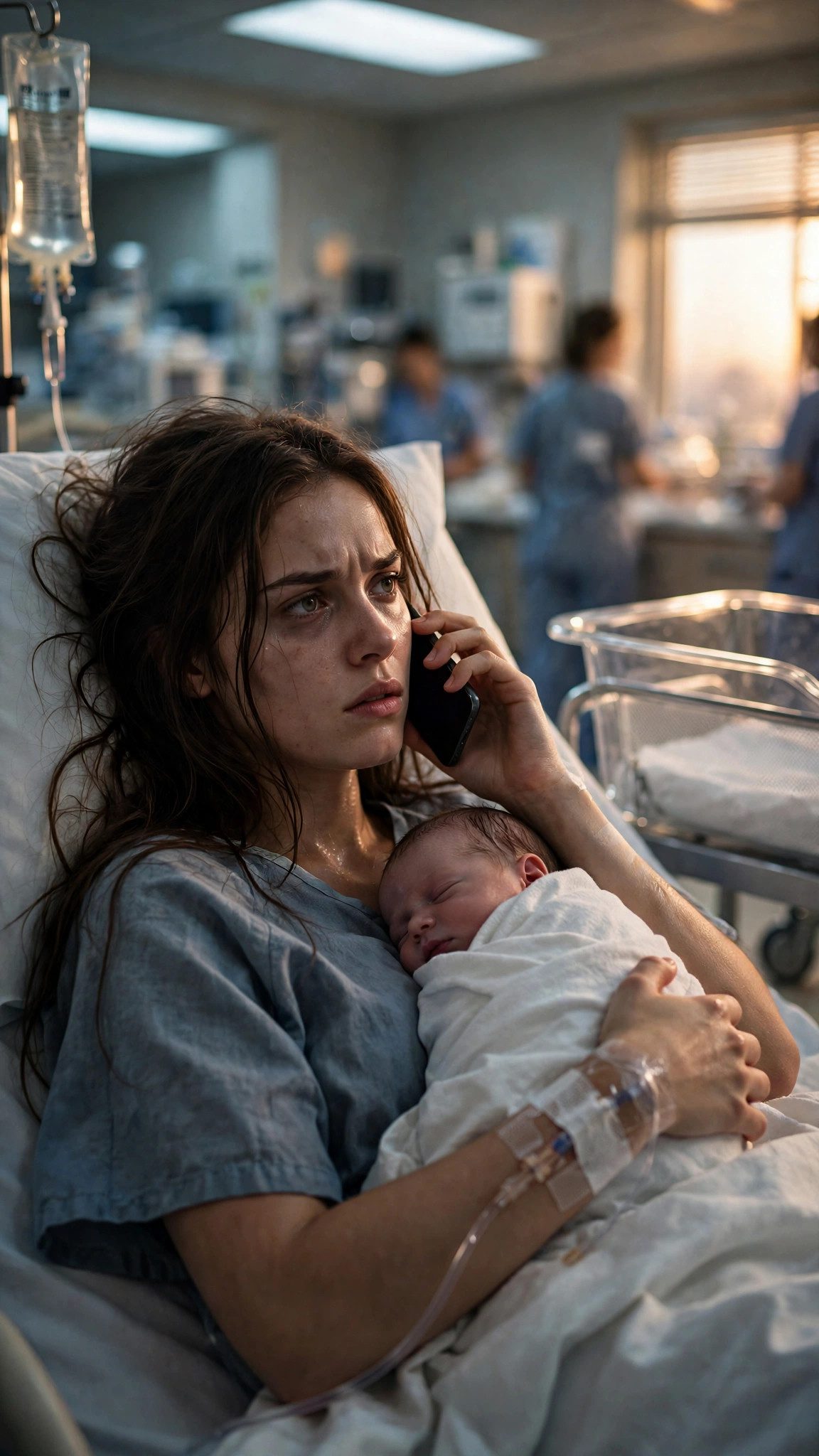
The nurses were calling for more blood when my husband told me to take our newborn son, leave Chicago, and disappear from his life.
I remember the fluorescent lights first. Not the pain, not the fear, not even the sound of my own heartbeat hammering in my ears. The lights. Long white tubes humming above the delivery bed, too bright, too clean, turning everything the color of bone. A nurse pressed me back against the mattress with one hand while another rushed past with blood bags swinging from her fingers like lanterns. Someone said my name. Someone said "pressure dropping." Someone said "we need two more units, now."
And through all of it, the phone was still pressed to my ear, because I had called the only person I thought would come.
"Graham," I whispered, fighting to stay conscious. "I'm hemorrhaging."
A nurse pressed me back against the bed while another rushed past with blood bags.
On the other end of the line, Graham said nothing.
Then I heard a woman laugh beside him. A low, familiar laugh, soft and unbothered, the kind of laugh a woman makes when she is exactly where she wants to be. Vanessa Cole. The woman he had loved before our marriage. The woman he had never stopped loving, not for one day of the three years I had been his wife.
"Are you still talking to her?" Vanessa asked, her voice drifting through the phone like smoke.
When Graham finally spoke, he didn't ask whether I was going to survive.
"Was the baby born safely?"
My heart went cold. Not broken. Cold. The way a lake goes cold in November, all at once, from the surface down.
"Yes," I said. "He's healthy."
Graham exhaled. I could hear the relief in it, and for one terrible second I thought it was relief for me. Then he kept talking, and I understood that it was relief for himself. The baby was alive. The problem was contained. The rest was paperwork.
"Good," he said. "Then this is probably the right time to end things."
He explained the divorce as if he were reviewing a business contract. His voice was calm. Businesslike. The same voice he used in boardrooms, the same voice he used when he told his men which warehouse to burn and which debt to collect. Five hundred thousand dollars. Two thousand a month in child support. Full custody for me. No visitation for him.
I lay beneath the fluorescent hospital lights wondering whether I would live long enough to hold the son his father was already abandoning.
"Can you please come here?" I asked. It was the last question I had left in me. The last small hope, laid out on the bed between the blood bags and the monitors. "Can you please come here?"
He was silent.
Then he said, "I can't leave Vanessa alone."
Something inside me finally broke cleanly. Not shattered. Ended. Like a thread cut with one sharp snip, the two ends falling away from each other without a sound.
"Send the papers," I said.
He sounded surprised. "You're agreeing?"
"I've been agreeable for three years, Graham."
Then came the sentence I would remember longer than the pain. Longer than the blood loss, longer than the wedding vows, longer than the three frozen years of our marriage.
"Take the baby and disappear," he said. "Anywhere outside Chicago. Preferably outside the country. I'll pay for it. Just stay out of my life."
I swallowed. My throat was dry. My lips were cracked. Somewhere beyond the phone, a monitor beeped steadily, counting out the seconds I had left if the blood didn't stop.
"You really want nothing to do with your son?"
"He'll be better off with you."
"Okay."
That was the last thing I said to my husband.
Hours later, I woke to daylight and saw a clear bassinet beside my bed. Inside was a six-pound, fifteen-ounce baby with dark hair, one fist tucked beside his cheek, and eyes that looked painfully like Graham's. Dark eyes. Ashford eyes. The same eyes that had looked at me across a ballroom three years ago and seen nothing but a business arrangement.
When the nurse placed him in my arms, his tiny fingers curled around mine.
Every thought I had ever had about saving my marriage disappeared.
I named him Owen Mercer. Not Ashford. Mercer. My name. My father's name. The name of the family that had actually shown up for me, in the end.
"You're mine," I whispered to him. "And I'm going to be enough."
The next morning, Graham's attorney arrived with a black leather folder. He was a neat man in a neat suit, with neat hands that opened the folder on the rolling table beside my bed as if he were laying out a lunch menu. Graham was surrendering physical custody, legal custody, medical decisions, school decisions, holidays, birthdays, and every form of scheduled visitation. He hadn't even asked for photographs.
"Has he asked how Owen is?" I whispered.
The attorney's face answered before his mouth did.
No.
Then the hospital door opened, and my father walked in. Daniel Mercer. Sixty-one years old, silver at his temples, his suit rumpled from driving through the night from his office. He saw the IV. He saw the bassinet. He saw the divorce papers spread across the rolling table like a bad hand of cards.
When I told him Graham wanted me gone, Dad said quietly, "You don't have to go anywhere."
He was right. Graham couldn't force me to disappear. The law was on my side. The money was on my side. The baby was mine, the house in Lake Forest was in my name, and the divorce papers Graham had so carefully prepared gave me everything except the one thing I had actually wanted for three years, which was a husband who loved me.
But I no longer wanted to stay.
So I looked at the black folder and said, "Show me where to sign."
Because Graham had asked me to vanish.
And he still had no idea how completely I intended to give him exactly what he wanted.
My father stared at me. "Audrey. Think about this."
"I have thought about it," I said. "For three years, Dad. I've thought about nothing else."
The attorney uncapped his pen with a small, precise click. He turned the pages one by one, pointing at the signature lines with the tip of his pen, the way a teacher points at a blackboard. I signed my name eleven times. Audrey Mercer Ashford. Audrey Mercer Ashford. Each signature a little smaller than the last, as if my hand were already learning how to be someone else.
Owen slept through all of it, his fist still tucked beside his cheek, his breathing soft and even. The nurse had told me he was a calm baby. A good sleeper. I hoped she was right, because I was about to take him farther from everything he had ever known than any baby had a right to go, and I needed him to be calm. I needed him to be good. I needed the two of us to be enough for each other, because we were all we had now.
"Where will you go?" my father asked when the attorney had gone, the folder tucked under his arm like a stolen thing.
"I don't know yet," I said. "Somewhere he can't find us. Somewhere I can be Audrey Mercer again, not Mrs. Ashford, not the girl who stole Graham's future. Just me. And Owen."
Dad sat down in the chair beside my bed. He looked older than he had looked that morning, and younger too, the way people look when they are finally seeing something clearly after years of looking away.
"I should have stopped it," he said. "Three years ago. When Arthur Ashford came to my office with his offer. I should have let the company die."
"No," I said. "You saved two hundred jobs, Dad. You saved the men on the factory floor and their families. Don't apologize for that. Arthur Ashford is the one who should apologize, and he never will, so let's not waste the breath."
He took my hand. His palm was rough from years of walking factory floors, shaking hands with men who built things with their own hands. "Then let me help you now. Whatever you need. Money. A house. A plane ticket. A new name, if you want one. I'll sell the company tomorrow if it buys you a clean start."
"I don't want your money," I said. "I want your blessing. That's all."
"You have it," he said. "You've always had it."
That night, after the nurses had checked my blood pressure and Owen had nursed and fallen asleep against my chest, I lay awake in the dark and made a list in my head. Not of what I was losing. Of what I was taking with me.
I was taking my son. I was taking my name. I was taking the five hundred thousand dollars Graham had offered, but not to spend on myself — I would put it in a trust for Owen, untouched, so that one day, when he was old enough to ask about his father, I could tell him the truth: your father paid for you to disappear, and I made sure the money waited for you instead.
I was taking the two thousand a month in child support, and I would bank every cent of it for Owen too. I would live on my own earnings. I had a degree. I had a brain. I had spent three years as Mrs. Ashford learning how the wives of powerful men survived, and I had learned the most important lesson of all: the only person you can count on to save you is yourself.
And I was taking one more thing. A promise. Not to Graham. To Owen. And to myself.
I would disappear so completely that Graham Ashford would never find us. Not because he would try — I knew he wouldn't try. He had made that clear on the phone, in the coldest voice I had ever heard from him. I would disappear because I needed to become someone who had never been married to Graham Ashford at all. Someone whose son had never been abandoned in a hospital bed. Someone who could walk down a street in a new city and not flinch when a man in a dark suit walked past her.
Two weeks later, I stood in the kitchen of the Lake Forest house for the last time. The house was mine in the divorce. I sold it in nine days, to a couple from Milwaukee who had no idea that a marriage had died inside its walls. I packed three suitcases. One for me. One for Owen. One for the things I couldn't leave behind: my mother's photograph, my degree, Owen's first blanket, and a small wooden box that held every letter my father had ever written me from the factory floor when I was a girl at boarding school.
My father drove us to O'Hare in the gray early morning, before the city woke up. Owen slept in his car seat. The sky was the color of wet concrete.
"Where to?" Dad asked at the departures curb.
"Boston," I said. I had chosen it the night before, looking at a map on my phone while Owen slept. Far from Chicago. A city with good hospitals, good schools, and no Ashfords. A city where a woman with a baby and a design degree could start over and nobody would ask her who her husband was.
"Boston," Dad repeated, and nodded, as if the word were a prayer. "Good. Boston's a good city for starting over."
He hugged me at the curb, hard, the way he had hugged me when I left for college. "Call me every day," he said. "Every single day. If you miss one, I'm getting on a plane."
"I will," I promised.
He kissed Owen's forehead through the car seat canopy. "Take care of your mother, little man. She's the bravest person I know."
On the plane, Owen woke as we climbed through the clouds, and for a moment I was terrified that he would cry, that the whole cabin would turn and stare at the single mother with the newborn who couldn't keep him quiet. But he didn't cry. He opened his dark eyes — Graham's eyes, I thought, and then I corrected myself: his own eyes, eyes that happened to be dark — and he looked up at me with the solemn, unfocused stare of a two-week-old baby, and then he yawned, and then he fell asleep again against my chest, his cheek warm through my sweater.
The woman in the seat beside me smiled. She was older, maybe seventy, with silver hair and a paperback folded open on her lap.
"First flight with him?" she asked softly.
"First flight anywhere," I said. "For both of us, in a way."
"Where are you headed?"
"Boston," I said. "We're starting over."
She nodded, as if starting over were the most ordinary thing in the world, as if women did it every day with babies in their arms and three suitcases in the hold. Maybe they did. Maybe the sky was full of women like me, flying away from men who had told them to disappear, carrying everything they owned in their laps.
"My daughter did the same thing once," the woman said. "Left a bad marriage with a baby and a suitcase. She's a judge now, in Portland. The baby's in medical school."
I felt something loosen in my chest, something I hadn't known was clenched tight since the night in the hospital. "Thank you," I said, and I meant it more than she could know.
"You're going to be fine," she said. "You already did the hardest part. You left."
When the plane touched down in Boston, the rain was falling in thin gray sheets against the windows, and the city rose up out of the harbor fog like something being built in front of my eyes. I carried Owen through the terminal in his carrier, my suitcases bumping along behind me, and I thought about the list I had made in the hospital bed that night. My son. My name. My promise.
I had all three. I had everything I needed.
Then I walked into the terminal with my son in my arms and my three suitcases trailing behind me, and I did not look back. Not at my father. Not at Chicago. Not at the life Graham Ashford had told me to leave.
Because I was leaving it.
And I was never coming back.