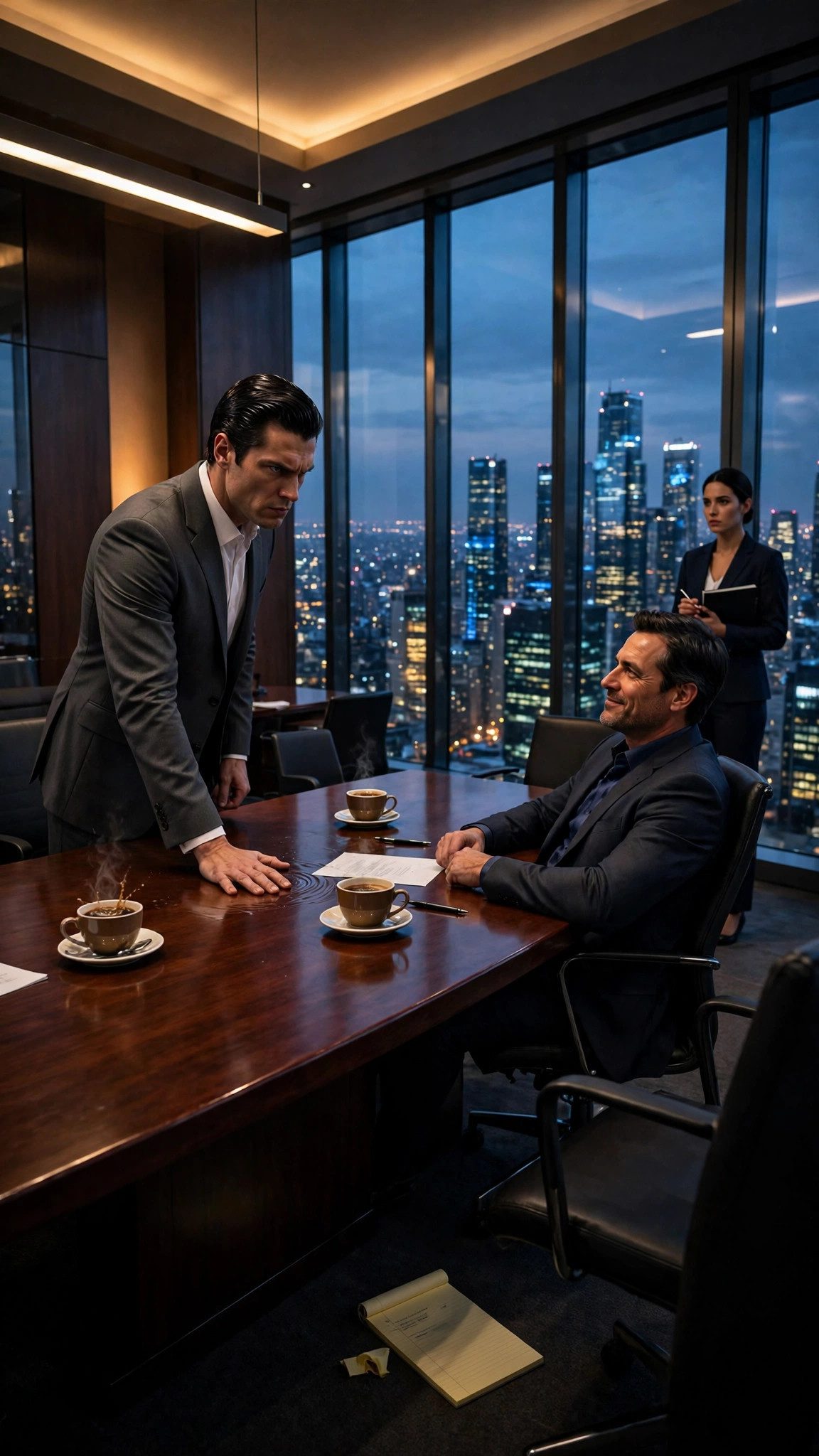
The question came on a Tuesday morning, in the conference room on the thirty-fourth floor, at exactly eight o'clock.
It was the same room where Vincent Calder had asked his question, two years of silence ago. The same mahogany table. The same polished glass walls. The same view of the city and the river below. But everything else was different. The table was not covered in contracts. There were no investors, no attorneys, no men in expensive suits. There was only a single white lily in a glass vase, standing in the center of the table, and Adrian Vescari, standing at the head of it, in a perfectly tailored suit, holding a small black box in his hand.
"Tessa," he said, "come here."
I walked to the head of the table. My notebook was in my hands. My pen was in my pocket. I had been his secretary for two years, and I had carried that notebook into a thousand meetings, and I had never once imagined that I would carry it into this one.
Adrian opened the black box. Inside it was a ring — simple, elegant, a single diamond on a band of white gold. It was not the kind of ring a man like Adrian Vescari would buy to impress anyone. It was the kind of ring a man buys when he has thought about it for a very long time, and when he wants the woman he loves to wear it every day for the rest of her life.
"Two years ago," he said, "a man asked me a question in this room, and I ended a forty-million-dollar deal because I could not bear to hear the answer. That man was Vincent Calder, and his question was, 'Does your secretary have a boyfriend?' And I have spent two years being grateful that he asked it, because it was the question that ended the deal, and started everything else."
He took my hand. His fingers were warm. His palm was rough. And his gray eyes were looking at me the way they had looked at me in the reflection of the glass, two years ago, when I thought I had imagined it.
"Tessa Morgan," he said, "I have asked you one question in this room. 'Are you seeing someone?' And you said no. Now I am going to ask you another one. And I need you to know, before you answer, that there is no wrong answer. If you say no, I will understand. I will go back to my office, and you will go back to your desk, and we will be what we have always been — a boss and his secretary, and two people who loved each other in silence for two years and were too afraid to say it out loud."
He took a breath. His voice was low and steady, the way it always was when he was saying something that mattered.
"But if you say yes —" He stopped. He looked down at the ring. He looked back up at me. "If you say yes, then I promise you this. I will never call you Miss Morgan again. I will never keep three feet of distance between us. I will never let you walk to your car alone in the dark. I will never let a man like Vincent Calder frighten you again. I will spend the rest of my life making sure that you are safe, and that you are happy, and that you never, ever have to wonder whether you are loved. Because you are. You are loved more than I have ever loved anyone in my life. And I have waited two years to tell you that properly."
He knelt down. Adrian Vescari — the most feared man in the city, the man who had never knelt before anyone in his life — knelt down on the carpet of the conference room, in front of the mahogany table, holding a small black box in his shaking hands.
"Tessa Morgan," he said, "will you marry me?"
I looked at him. I looked at the ring. I looked at the white lily in the glass vase, and at the glass walls, and at the city below, and at the two years of my life that had led me to this room, to this morning, to this man kneeling in front of me with his heart in his hands.
And I thought about my mother, and about Sunday dinner, and about the blue scarf, and about the coffee in the blue cup, and about the photograph on the shelf behind his desk, and about the woman in the silver frame who had loved him first and taught him how.
And I thought about the question my mother had asked me on the phone: don't be busy, my love. Be happy.
"Yes," I said. "Yes, Adrian. Yes."
He stood up. He slipped the ring onto my finger. It fit perfectly — as if it had been made for me, as if he had known, all along, exactly who it was for. And then he took me in his arms, and he kissed me, and the conference room on the thirty-fourth floor, where a forty-million-dollar deal had died, became the place where the rest of our lives began.
We were married three months later, in a garden behind a small church on the edge of the city, with white lilies on every table and the late afternoon sun coming through the trees. My mother was there, in a new dress, crying happy tears and holding my hand so tightly I thought she would never let go. Ruth was there, in a hat she had bought specially for the occasion, telling everyone who would listen that she had known all along. Salvatore was there, old and shaking and smiling, leaning on his cane, and he danced with me once, slowly, and whispered in my ear, "He is a good man, my dear. He was always a good man. He only needed someone to remind him."
Adrian's whole company was there — all two hundred of them, from the dockworkers to the executives, standing in the garden in their best clothes, applauding when I walked down the aisle in a white dress, applauding when Adrian took my hand, applauding when the priest said, "You may kiss the bride," and Adrian did, right there in front of everyone, without a moment of hesitation.
After the ceremony, we danced under the trees while the sun went down and the lights came on in the garden. Adrian held me close, and he said, very quietly, so only I could hear, "Do you remember the first rule of working for me? Be early, be exact, and be invisible."
"I remember," I said.
"I am changing the rules," he said. "From now on, the first rule is this: be happy. Be loved. And never, ever be invisible again."
I laughed. I cried. I danced with my husband in the garden while two hundred people cheered, and I thought about how strange life was — how a single question, asked by the wrong man at the wrong time, could end a forty-million-dollar deal and start a whole new life.
The morning of the wedding, I woke up in my mother's house, in the bedroom where I had grown up, with the sun coming through the curtains I had chosen when I was sixteen years old. My mother was already awake. She was in the kitchen, making coffee, humming an old song my father used to sing, and when I walked in, still in my pajamas, she took one look at me and started to cry.
"Don't cry, Mama," I said. "You'll make me cry, and then my makeup will run, and Ruth will kill both of us."
"I'm not crying," my mother said, wiping her eyes. "I'm just happy. Your father would have been so proud of you, Tessa. He used to say that one day, a good man would see what I saw in you. And he was right. He was always right about you."
Ruth arrived at nine o'clock with the dress — white, simple, elegant, the kind of dress that does not need diamonds or lace to be beautiful — and she helped me into it with the same efficient hands that had run the thirty-fourth floor for nineteen years. "Stand still," she said. "Chin up. Shoulders back. Breathe. Good. Now look in the mirror."
I looked. And for a moment, I did not recognize myself. The woman in the mirror was not a secretary. She was not invisible. She was a bride, in a white dress, with a ring on her finger and tears in her eyes, and she looked — I hardly dared to think it — happy. Truly, deeply, completely happy.
"You look beautiful," Ruth said, and her voice was rough, the way it got when she was trying not to cry. "Now let's go. Your husband is waiting. And Adrian Vescari does not like to be kept waiting — except today. Today, he told me, he would wait forever."
At the reception, after the ceremony, after the toasts, after the cake had been cut and the music had started, Adrian did something no one expected. He walked across the dance floor, took my mother's hand, and asked her to dance. My mother — sixty-two years old, in a new dress, with her hair done specially for the occasion — put her hand in his, and they danced together, slowly, while the whole garden watched, and the musicians played an old song, and my mother laughed, and Adrian smiled, and I stood at the edge of the dance floor with tears running down my face, thinking about my father, and about how he would have loved this moment, and about how life had a way of giving you back, in the end, everything it had taken away.
Later that night, when the guests had gone home and the garden was quiet and the lights were still on in the trees, Adrian and I sat together on a bench under the stars, in our wedding clothes, holding hands, not speaking, just listening to the crickets and the wind in the leaves. And Adrian said, very quietly, "Tessa. Thank you for saying yes."
"Thank you for asking," I said.
"No," he said. "Thank you for waiting. For two years, you waited. You were patient. You were kind. You never pushed. You never demanded. You simply stayed, and you did your job, and you loved me in silence, and you waited for me to be brave enough to speak. I will spend the rest of my life making it up to you."
"You don't owe me anything," I said. "You gave me everything. You gave me a life I never thought I would have. You gave me a home. You gave me a family. You gave me yourself. That is enough. That is more than enough."
He kissed me then, under the stars, in the garden, in our wedding clothes, and the crickets sang, and the wind moved through the trees, and I thought about the morning in the conference room, and the question, and the hand slamming against the table, and how a single question could end a forty-million-dollar deal and start a whole new life.
One year later, I sat in the office on the thirty-fourth floor — not at my old desk, but in the office next to Adrian's, the one with the glass wall and the view of the river — and I looked at the ring on my finger, and at the photograph on my own desk, a photograph of my husband and me on our wedding day, dancing in the garden, and I thought about everything that had happened.
Vescari Holdings was a legitimate company now. The warehouses were clean. The shipping routes were legal. The men who worked for us went home to their families every night without fear. Adrian had kept his promise. He had rebuilt the empire in the light, and he had done it with his own hands, and with the help of two hundred people who believed in him.
My mother was well. Her medicine was paid for. She came to dinner every Sunday, and she told Adrian stories about my father, and Adrian listened, and he laughed, and he held my hand under the table, and my mother looked at us the way mothers look at their children when they are finally, truly happy.
Ruth still worked in the building. She was the office manager, and she ran the thirty-fourth floor the way she had always run it — with sharp eyes and a kind heart — and she told every new secretary who walked through the door the same thing she had told me on my first day: "Mr. Vescari hates shaking hands. But Mrs. Vescari — she shakes everyone's hand. She says it's the polite thing to do."
And Vincent Calder — Vincent Calder was in prison, where he would stay for the rest of his life, and the city had already forgotten his name. The newspapers had moved on. The men who had once feared him had found other men to fear. And the lilies he had sent, white and terrible, were nothing now but a memory, fading a little more with every year.
On the fourteenth of March, Adrian and I drove together to the cemetery, and we stood in front of Sofia's grave, and we put down fresh white lilies, and Adrian said, very quietly, "Thank you, Sofia. For everything. For loving me first. For teaching me how. I am happy now. I hope you know that. I hope you are at peace."
And I stood beside him, holding his hand, and I said, "Thank you too, Sofia. For making him the man he is. For leaving behind a space in his heart that was big enough for me to fill."
We walked back to the car together, through the falling leaves, and Adrian opened the door for me, the way he always did, and I got in, and he got in beside me, and we drove home through the city, past the river, past the docks, past the building with the glass walls where it had all begun.
That night, as we sat together in our kitchen, drinking coffee — black, no sugar, in the blue cup, never the white one — Adrian looked at me across the table and said, "Tessa. Do you remember the question that ended the deal?"
"How could I forget?" I said. "'Does your secretary have a boyfriend?'"
"And do you remember my question?" he asked. "'Are you seeing someone?'"
"I remember," I said.
"Well," he said, and he smiled — the small, tired, true smile I had loved for two years, and would love for the rest of my life — "I have one more question for you."
"What is it?" I asked.
He reached across the table and took my hand. His fingers were warm. His palm was rough. And his gray eyes were looking at me the way they had looked at me in the reflection of the glass, two years ago, when I thought I had imagined it.
"Are you happy?" he asked.
I looked at him. I looked at the ring on my finger. I looked at the kitchen, and the coffee, and the life we had built together out of a question, and a deal, and two years of silence.
"Yes," I said. "Yes, Adrian. I am happy."
And I was. I was happy. And I would be happy for the rest of my life.
The End.
THE END