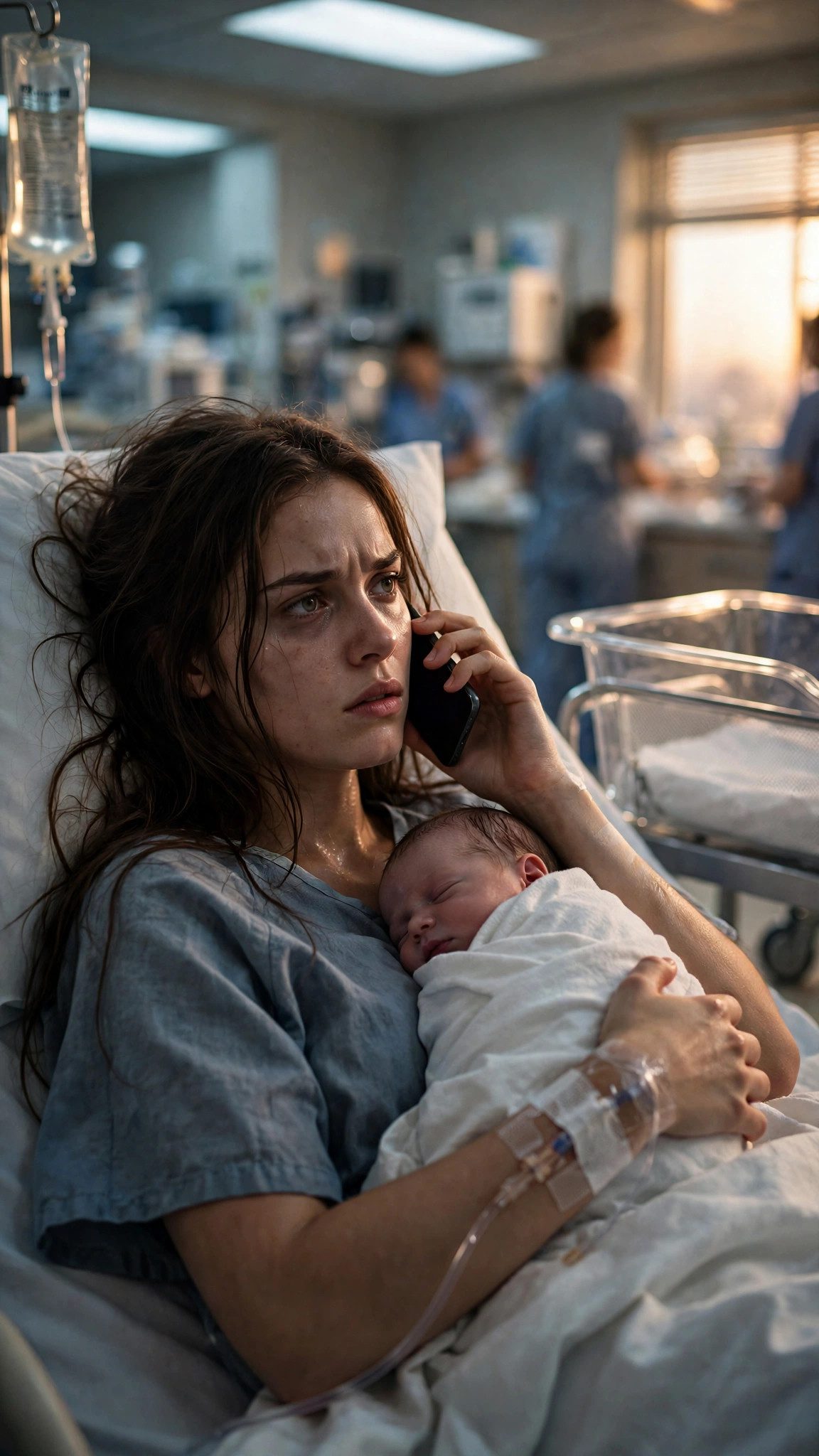
"Come inside, Graham. It's cold out there. And we need to talk."
He came inside. He sat at the kitchen table, in the same chair where I had once sat with a phone in my hand and a teacup going cold, and he folded his hands on the table, and he waited. He didn't try to fill the silence. He had learned, finally, how to wait for me.
I sat across from him. I looked at him — really looked at him, the way I hadn't looked at him in years. He was thinner than he had been in Chicago. There were lines around his eyes. His hair was a little grayer at the temples. He looked like a man who had been through something hard and come out the other side changed. Not broken. Changed.
"I've been thinking about what you asked me," I said. "A year ago, you asked if you could meet him. Just once. Just for a minute. And I said yes. And then you stayed. And you showed up every day at nine o'clock. And you learned to change a diaper, and you learned to make spaghetti, and you learned to read bedtime stories in three different voices. And you wrote me letters. And you testified. And you dismantled an empire because you wanted our son to be proud of you."
"I did all of that because it was the right thing to do," he said. "Not because I expected anything in return."
"I know," I said. "That's why I'm saying this now. I don't want to be married to the man you were, Graham. That man told me to take the baby and disappear. That man chose Vanessa over his wife and his son. That man is gone, and I don't miss him. But the man sitting across from me — the man who drove all night to stand between my son and two men with bad intentions, the man who learned to be a father one day at a time, the man who wrote me letters on real paper — that man I could love. That man I think I already do love. But I need to be sure. And I need you to be sure."
"What do you need?" he asked.
"Time," I said. "Not a week. Not a month. A year. A year of you showing up. A year of us being a family — not a married couple, not yet, but a family. You, and me, and Owen. Dinners together. Birthdays together. Bad days together. If, after a year, we're still standing, and we're still choosing each other, then we'll talk about what comes next."
"A year," he repeated. "I can do a year. I can do ten years, Audrey. I'll do whatever it takes."
"And there are conditions," I said. "Three of them. First: Owen's name stays Mercer. Not Ashford. Not hyphenated. Mercer. He was born a Mercer, and he was raised a Mercer, and if one day he wants to add Ashford, that will be his choice, not ours. Second: my studio stays mine. I built it. I run it. You don't buy it, you don't fund it, you don't put your name on it. Third: we live here. In Boston. Not Chicago. Owen's home is here. My home is here. If you want to be part of this family, you build your life here, with us, not the other way around."
Graham didn't hesitate. Not for a second.
"Done," he said. "All three. Owen stays Mercer. The studio stays yours. We stay in Boston. Audrey — I don't want to go back to Chicago. Chicago is where I lost you. Boston is where I found you. I want to stay here. I want to build a life here. With you. With Owen. Whatever that looks like."
"Then we have a deal," I said. And I held out my hand, the way my father had taught me to close a deal — firmly, looking the other person in the eye.
He shook my hand. And then he laughed, a real laugh, the first real laugh I had heard from him in years, and I laughed too, and for a moment we were just two people sitting at a kitchen table in Somerville, laughing, with a sleeping boy down the hall and a whole year stretching out in front of us.
That year was the best year of my life.
Not because it was perfect. It wasn't perfect. There were hard days. There were days when Graham and I argued — about money, about Owen's schooling, about the past, which neither of us could change and both of us had to live with. There were days when I woke up and looked at him across the breakfast table and felt the old anger rise up, sharp and sudden, like a wave hitting a rock. There were days when he looked at me and I could see the guilt in his eyes, the weight of what he had done, and I had to remind myself that guilt wasn't the same as punishment, and that I had already decided to let him try.
But there were also good days. So many good days. Owen's third birthday, with a cake shaped like a dinosaur and a party in the studio, and Graham wearing a paper crown because Owen insisted that daddies had to wear crowns too. Christmas morning, with snow falling outside the window and Owen tearing open presents under a tree Graham had spent three hours decorating, badly, with lights that blinked out of order. Spring afternoons in the Public Garden, with Owen feeding the ducks and naming every single one of them after superheroes, and Graham and I sitting on a bench, holding hands, not talking about anything at all.
And slowly, without either of us noticing it happening, the year turned into something else. Not a trial. Not a test. A life. Our life. The three of us, together, in a small apartment above a bakery in Somerville, with a design studio down the street and a little boy who called Graham "Daddy" like it was the most natural thing in the world.
On the last day of the year — a Saturday in October, exactly three years after the night Castellano's men came to my kitchen — Graham took me to the Public Garden. Owen was with Margaret. The leaves were turning gold and red. The air smelled like autumn.
He didn't get down on one knee. He had learned, by then, that grand gestures weren't what I wanted. He just took my hands in his, and he looked at me, and he said, "Audrey Mercer. I asked you once to disappear from my life. I'm asking you now to do the opposite. Marry me. Not because my grandfather arranged it. Not because anyone is forcing us. Because I love you. Because I love our son. Because I want to spend the rest of my life proving that to you, one day at a time. Will you marry me?"
I thought about the hospital bed. I thought about the phone call. I thought about the three years of winter, and the two years in Boston, and the year of showing up, and the letters in the wooden box, and the man who had learned to change a diaper and make spaghetti and read bedtime stories in three different voices.
"Yes," I said. "Yes, Graham. I'll marry you."
We were married in a garden in Cambridge, on a Saturday in June, with fifty guests and a flower bill that cost less than a factory worker's weekly wage. I wore a simple white dress that I had chosen myself, not my mother's dress, not a dress anyone else had picked for me. My father walked me down the aisle — a path of white petals between two rows of chairs — and Owen walked beside us, carrying the rings on a small velvet pillow, wearing a tiny suit and a paper crown, because he had insisted that ring bearers had to wear crowns too.
Graham waited at the end of the aisle in a gray suit, handsome and nervous, holding a small bouquet of white roses. When I reached him, he took my hands, and he looked at me, and he said, in a voice loud enough for everyone to hear, "Audrey Mercer. I love you. I've loved you for a long time, even when I didn't know how to say it. Thank you for giving me a second chance. I won't waste it."
"I love you too," I said. And I meant it. Not the desperate, hopeful love of a girl who had married a stranger. The steady, grown-up love of a woman who had built a life out of nothing and chosen, with her eyes open, to share it with a man who had earned his way back.
Owen tugged on Graham's sleeve. "Daddy," he whispered, loudly enough for the whole garden to hear, "can I have cake now?"
The whole garden laughed. Graham picked him up and held him high in the air, and Owen laughed, and I laughed, and my father laughed, and Margaret cried, and Priya took a photograph that I still have on my desk today.
At the reception, under strings of lights in the garden, my father stood up to give a toast. He held his glass in both hands, the way he always did when he was nervous, and he looked out at the fifty guests, and then he looked at me.
"I gave my daughter away once before," he said, "at a wedding in a cathedral, with four hundred guests and a flower bill I don't want to think about. That time, I watched her walk down the aisle toward a man who didn't love her, and I didn't stop it, because I thought I was saving my company. I was wrong. I wasn't saving anything. I was selling the most precious thing I had."
The garden went quiet. Even Owen stopped chasing a butterfly and came to stand beside me.
"This time," my father said, "I'm not giving her away. I'm watching her choose. She chose this man — not because anyone arranged it, not because anyone forced her, but because he earned her. He showed up. Every day. For a year. And then for another year. And he will show up for the rest of his life, or he will answer to me."
He raised his glass. "To Audrey. To Graham. To Owen. To second chances — and to the woman brave enough to take one."
Margaret stood up next, dabbing at her eyes with a napkin. "I hired Audrey when she was a new mother with a baby and a portfolio and no references I could check," she said. "She told me she was starting over. I didn't ask from what. I just gave her a desk and a chance. And she built a studio, and a life, and a family, all out of nothing but stubbornness and a good eye. Audrey, my dear — you were always going to be fine. You just needed someone to get out of your way long enough to let you prove it."
Graham stood last. He held his glass, and he looked at me, and for a moment he couldn't speak. Then he said, "I asked Audrey once to disappear from my life. It was the worst thing I have ever said to anyone. I spent two years trying to undo it, and I will spend the rest of my life making sure I never say anything like it again. Audrey — you didn't disappear. You became someone I barely recognized, someone stronger than the girl I married. And I fell in love with that woman. I fall in love with her every single day. Thank you for letting me stay. Thank you for letting me be Owen's father. Thank you for this life."
Owen tugged on my dress. "Mama, can we dance now?"
So we danced. Graham held Owen on one arm and me in the other, and we swayed under the garden lights while the band played something slow and sweet, and Owen sang along in a voice that was completely off-key and completely perfect, and I thought about the hospital bed in Chicago, and the phone call, and the three years of winter — and I thought about how far away all of that felt now, like a story about someone else, someone I used to be.
One year later, I sat at my drafting table in the studio, looking out the window at the street where my life had started over, and I thought about the list I had made in the hospital bed that night. My son. My name. My promise.
I had all three. I had more than three. I had a husband who showed up every day. I had a son who was healthy and happy and loved. I had a studio with four employees and a waiting list. I had a father who visited every month. I had Margaret, and Priya, and a whole city full of people who knew me as Audrey Mercer, the designer, the mother, the woman who had built something out of nothing.
And I had one more thing. Something I hadn't put on the list, because I hadn't known to ask for it.
I had a choice. Every day, I had a choice. To stay. To love. To build. To forgive — not because Graham deserved it, but because I deserved to be free of the anger. To live the life I had chosen, not the life someone else had told me to leave.
Graham came into the studio that afternoon with Owen, who was four years old by then and taller than I could believe, and Owen ran to me and climbed into my lap, and Graham kissed my forehead, and he said, "How was your day?"
"Good," I said. "How was yours?"
"Good," he said. "Owen fed the ducks. He named a new one. Batman."
"Batman the duck," Owen announced proudly. "He's the best one."
I looked at my husband. I looked at my son. I looked out the window at the street, at the bicycles and the strollers and the people who had no idea who we were, and I thought about a hospital bed in Chicago, and a phone call, and a man who had told me to take the baby and disappear.
He had told me to leave my life behind.
And I had. I had left it behind, and I had built a better one, and then — when he had finally become a man worth coming home to — I had let him find me.
That was the life he told me to leave.
This was the life I chose.
The End.
THE END