I didn't sleep.
The suite on the second floor was bigger than the apartment I'd shared with Marie — bigger, and quieter, and filled with the particular silence of a house with thick walls and armed men. Someone had left a nightgown on the bed that still had its tags. Someone else had left, on the dresser, a glass of water and the two pain pills I hadn't taken. I lay in the dark with my stitched hand throbbing on top of the covers and went over four years of my life the way you go over a letter you suspect was forged — holding every line up to the light.
By dawn I had a list. It had one item on it.
I found Alessandro in a study off the main hall at six in the morning, still in yesterday's shirt, sleeves rolled to the elbow, the tattoos on his forearms bare, a wall's worth of paper spread across the desk and Dante standing over it like a general over a map. Neither of them looked surprised to see me.
"You're taking me to Marie," I said.
Dante glanced at Alessandro. Alessandro looked at the papers, then at me, and I watched him decide not to argue with the tone in my voice.
"There's a car in twenty minutes," he said. "I sit in the front. You talk to her alone. If you want me in the room, you say so. If you want me gone — "
"I want the truth," I said. "Wherever it is."
Marie lived on the third floor of a walk-up across the river, in the apartment whose rent I paid. The stairs smelled of cabbage and damp plaster. Alessandro waited in the car below with two men at either end of the street, and I climbed the steps I'd climbed a thousand times with grocery bags cutting into my fingers, and knocked on the door I'd paid to keep closed against the world.
She opened it in her housecoat. Sixty-one years old and shrunken inside her own skin, her hair pinned up in the same gray knot she'd worn since my childhood. She took in my face, my bandaged hand, the good coat someone at the estate had pressed on me — and I watched the blood leave her face in a slow, terrible tide.
"Oh," she said. "Oh, no. Sophia. Baby. No."
"You knew," I said. It wasn't a question. Four years of questions had burned down to this one coal. "All this time. You knew."
She backed into the apartment and I followed her, and I closed the door behind me myself, gently, because I was afraid of what my hands would do if I let them be anything but gentle.
"Tell me about the night they moved me."
"Sophia — "
"Tell me about who told you Alessandro didn't want me. Tell me about the money, Marie. Start anywhere. Start with my father."
She sat down at the kitchen table — the same table where she'd told me about the accident, her hands around a mug she never drank from. I hadn't known, at twelve, that people did that with their hands when they were lying. Held onto things to keep from shaking apart.
"It began before he died," she whispered. "Your father found things, Sophia. Papers. Books that didn't balance — he did accounts for half the families in Bellhaven, you know that, and one winter he found a second set of books, Bellandi books, and he understood what he was looking at. He went to the Carusos. He made the marriage — him, Daniel, it was his doing, his insurance policy for you. And then in March they ran his car off the Mill Road — "
I sat down very carefully across from her, because the floor had become uncertain.
"They told me it was the wet road. You told me it was the wet road."
"I told you what I was told to tell you!" Her voice cracked like thin ice. "They came to me after the funeral, Sophia. Men from the Bellandi family. Courteous men. They showed me my markers — you have to understand, I already owed, I'd been at the tables for years before your father died, small debts, shameful little debts — and then they bought them. All of them. Consolidated, they called it. One friendly arrangement. And after that they owned the rope around my neck, and every few months they made it a little tighter, and all they ever asked — at first — all they ever asked was that I keep you close, keep you home, keep you away from that husband of yours. And later, when the questions started — when you cried at that table, at sixteen, at eighteen, asking why he never wrote — the words were already written for me. He discarded you. He signed the papers. A man like that doesn't keep a girl like you."
"There were no papers," I said.
"There were no papers." She was crying openly now, soundlessly, the way she'd taught me to cry in a house where crying had consequences. "That was the phrase they gave me. Discarded. Like you'd been — and I said it, Sophia. For years I said it. And every month they let a little of my debt breathe, and every month you handed your wages to their collectors at that very door, and I told myself it was survival. I told myself I was keeping you safe, because a hidden girl is a safe girl, and as long as you stayed small and quiet they'd never need to — "
"Need to what?"
She looked at my bandaged hand.
"The ledger," she whispered. "Your father kept a copy of everything he found. Insurance, he called it — his word, the same word he used about the marriage. The Bellandi have never known where it is. And a hidden girl can be watched, Sophia. A found girl asks questions. A found girl opens boxes."
Dante's men had found the first of it by midnight: Marie's debts had not grown the way debts grow. They'd been bought, consolidated, engineered — purchased in a block by a Bellandi front within weeks of my father's funeral, then fed, deliberately, like an animal being raised for a purpose. The knock-on-the-door men who had taken my wages for four years were Bellandi collectors. Every dollar I'd handed over had gone to the family that murdered my father — paid, in installments, for my own hiding place.
Alessandro told me all of this standing in Marie's doorway, where he had come up the stairs without a sound sometime during my aunt's confession, and I will say this for him: he did not say one word to her. He looked at her for a long moment — this woman who had raised me and ruined me in the same pair of hands — and whatever he saw there made him step aside and hold the door for her as she came out with her little suitcase, because I had already decided.
"She's coming with us," I said. "She's not staying here for them to use again. I don't care what you think. I'm not asking."
"I wasn't going to refuse," he said. "Get in the car, Mrs. Chen."
She flinched at the courtesy of it more than she would have flinched at a blow.
The drive back across the river took us through the old neighborhoods, and Marie sat beside me in the back with her suitcase on her knees like a shield, staring out at streets she'd walked for sixty years. Alessandro rode in front, beside the driver, saying nothing. The silence in that car had layers — hers, mine, his — and somewhere around the midpoint of the bridge, with the water going gray-green below us, she spoke without turning her head.
"Your mother used to say I had a gambler's heart before I ever saw a card table," she said. "She meant I always believed the next thing would save me. The next hand. The next loan. The next lie I told you — I believed every one of them was the last one I'd need. That's the sickness of it, Sophia. It isn't the losing. It's that the hoping never stops feeling like a plan." Her hands worried the clasp of the suitcase. "When they first came — the courteous men — they didn't threaten me. That's what I need you to know, so you know the exact size of my shame. They offered. A consolidation. A little breathing room. All they wanted was to know you'd be home for dinner, and not — not going back to that church, that name. It sounded like protecting you. I let it sound like protecting you, because the alternative was admitting I'd sold the last of your mother's family to a card game." She turned then, finally, and her face was stripped down to something I hadn't seen on it since I was twelve years old and she was the tallest person in my world. "By the time they asked me to say the word discarded to your face, I understood what I'd done. And I said it anyway, because by then the rope was around both our necks and I was too much a coward to be the only one who hanged. Forgive me or don't. I have it to carry either way, and that's — that's the first honest arithmetic I've done in six years."
Alessandro's eyes met mine in the rearview mirror. He said nothing. He had promised me the talk would be mine, and it was, and his silence in that moment — his refusal to make himself the hero or the judge of the thing — was the moment I first believed, in my body and not just my ears, that the man I'd married might be worth the knowing.
"I'm not going to forgive you today," I told her. "I might not know how for a long time, and I'm done lying to people in this family, including you." I put my good hand over hers on the suitcase clasp, and felt hers turn over beneath it and grip on like a drowning woman. "But you're coming home with me, and nobody is ever going to put words in your mouth again. That's where we start."
We were three blocks from the river bridge when it happened.
A gray sedan pulled out of the mouth of an alley and swung across our lane — not a crash, a block, smooth and practiced — and a second car boxed us from behind, and I understood with a clarity that arrived before fear did that this was not an accident, that nothing in my life had ever been an accident. Dante was already shouting, already moving. The man in the passenger seat beside him had his weapon out. Alessandro did something I will never forget as long as I live: he turned in his seat, braced one arm across me and Marie both like a bar, and said, very calmly, "Eyes on me. Both of you. Eyes on me."
The sedan's doors opened. Three men. I saw the first one's face clearly — young, bored, professional, a face doing a job — and then Alessandro's men were simply there, the way weather is there, cars at both ends of the street that I hadn't known were ours, and the whole geometry of the ambush inverted in about the time it takes to draw a breath.
It was over without a shot. That's the part the movies get wrong. It was over in voices, and hands shown empty, and the young professional's face going carefully blank as he understood the arithmetic had been done wrong somewhere above his pay grade. They were disarmed and held for the police Alessandro's people would call — later, in their own time, in their own way — and we drove on through the gap like a knife through silk.
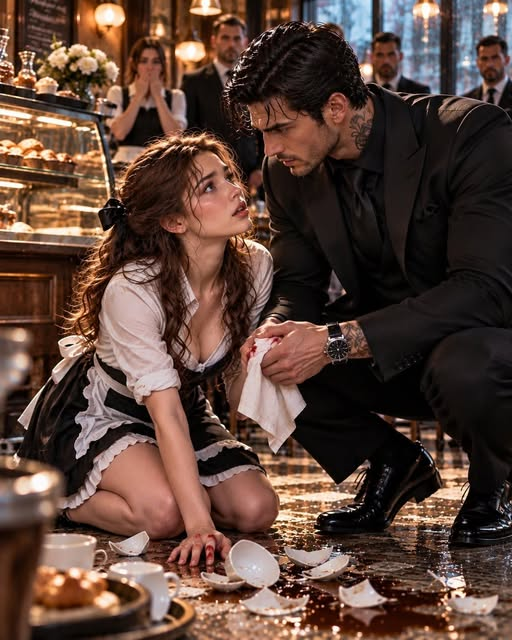
Marie didn't make a sound the entire time. Neither, I realized, had I. My good hand hurt, and when I looked down I saw I was gripping Alessandro's sleeve exactly the way I'd gripped it in the bakery, and he was letting me, and his arm was still braced across us like the bar of a gate.
"That was for me," I said, when the river was behind us.
"That was for you," he agreed. "They've lost their watcher, their collector, and their hiding place in one day. Enzo Bellandi is not a man who tolerates arithmetic like that." The car turned through the estate gates, and the gates closed behind us with their deep iron finality, and Alessandro finally — finally — took his arm away.
"Now he has to come and get you himself," he said. "And that, Sophia, is when we finish it."