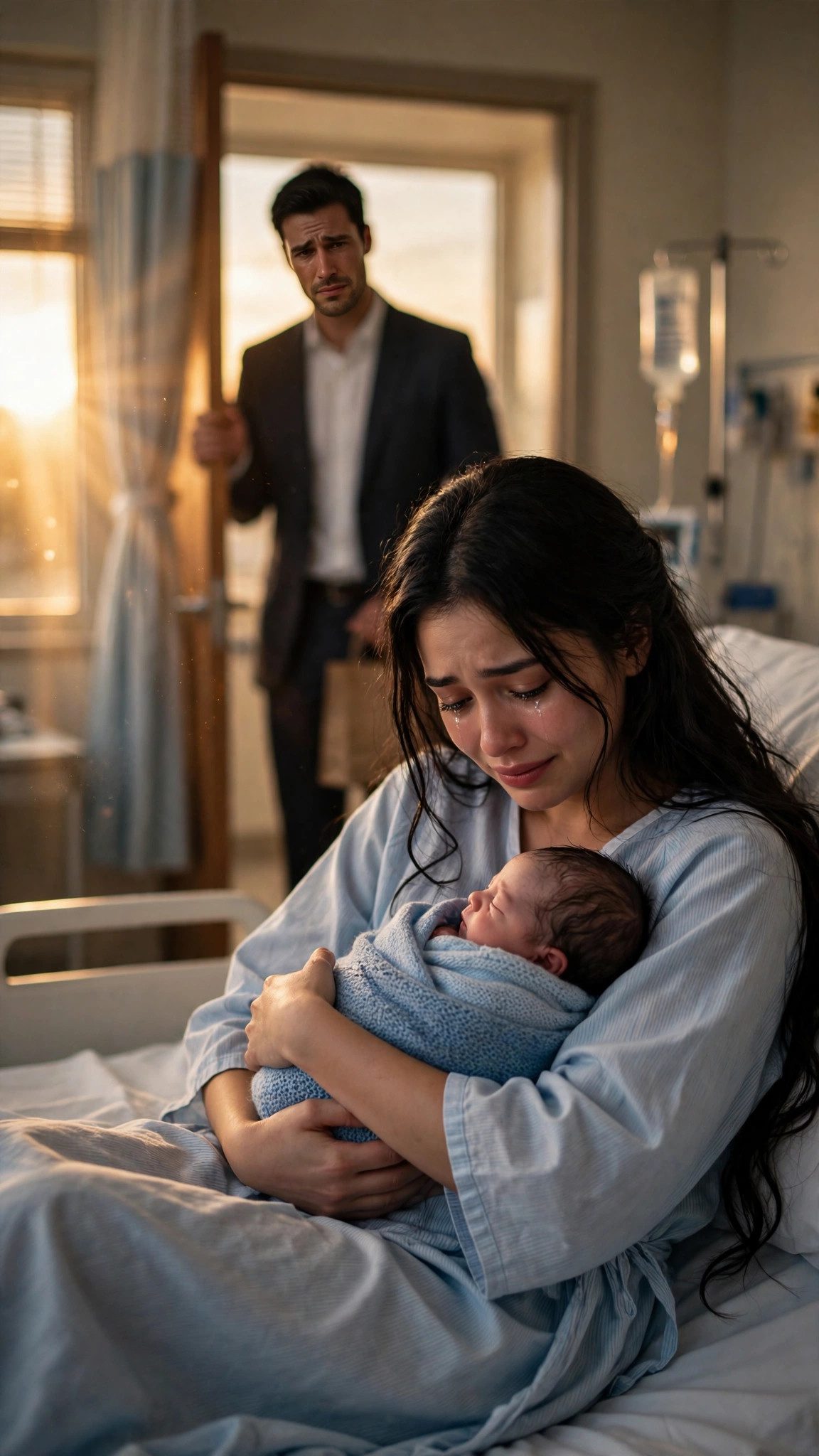
I left the hospital at 5:12 in the afternoon, carrying my handbag and a small box containing my son's ashes.
I did not take a car. Damian's cars were everywhere in Chicago, and his drivers knew my face, and I did not want to be found. I walked out of the hospital through the emergency entrance, the way I had walked out a thousand times after night shifts, and I kept walking until the hospital was behind me. Then I took a bus to Union Station, and I bought a ticket with cash, because cash does not leave a trail, and I sat on a wooden bench and waited for the train to Lake Geneva, Wisconsin.
Lake Geneva was where I grew up. It was where my mother still lived, in a small white cottage on a quiet street with a garden she tended the way other people tend to their children. It was the last place in the world Damian would think to look, because Damian had never really understood Lake Geneva. He had come there twice, both times for my mother's birthday, and both times he had been polite and charming and completely out of place, a man in a black suit standing in a garden full of roses, checking his phone. My mother had liked him anyway. My mother liked everyone. That was her gift and her weakness.
The train ride took two hours. I sat by the window and watched the city turn into suburbs, and the suburbs turn into fields, and the fields turn into the small, green hills of Wisconsin. I held the box in my lap the whole way. It was so light. That was the part I could not get used to. My son had weighed two pounds and nine ounces when he was born, and now he weighed almost nothing at all, and the box sat in my lap like a secret, like something I was smuggling, and I thought about how strange it was that a whole life could fit into something so small.
When the train stopped in Lake Geneva, I walked the twelve blocks to my mother's cottage. It was getting dark. The streetlights were coming on. The air smelled of cut grass and lake water. Before I turned onto my mother's street, I stopped at a small shop near the station and bought a cheap phone with cash, the kind that comes in a plastic package and works for a month. I did not want anyone to be able to reach me on my old number. I did not want Damian's men to find me through a signal or a bill or a name on an account. I wanted to disappear, completely, the way my mother had taught me to disappear when I was a little girl and the world was too loud: quietly, and into a garden.
My father had planted the rosebush in my mother's garden the year I was born. He had been a schoolteacher, a quiet man with big hands and a soft voice, and he had planted it on the day he brought my mother home from the hospital, and he had said, "This rosebush will grow with our daughter." He tended it every year until he died, when I was nineteen, and after that, my mother tended it, and when I came home from nursing school, I tended it with her. It was the oldest living thing in our family, older than me, older than my marriage, older than everything except my mother's love. When I scattered Elias's ashes beneath it, I was putting him in the care of the only thing in my family that had never let anyone down.
My mother opened the door before I knocked. She must have seen me coming up the walk. She took one look at my face, and she did not ask a single question. She opened her arms, and I walked into them, and I stayed there for a long time, crying into her shoulder the way I had cried when I was a little girl and the world had hurt me.
"Come inside, baby," she said. "Come inside."
She made tea. She sat me down at the kitchen table, the same table where I had done my homework, where my father had read the newspaper, where my mother had taught me how to roll out pie dough. She put the box on the table between us, very gently, and she looked at it, and she looked at me, and she said, "Tell me his name."
"Elias," I said. "Elias Moretti."
She nodded. She touched the box with one finger, the way you touch something holy. "Elias," she repeated. "It is a good name. A strong name."
I told her everything. I told her about the contractions at 1:07 in the morning. I told her about the eight phone calls. I told her about the music and the laughter from Capri. I told her about the twelve hours in the NICU, and the video call, and the silence at 1:03, and the goodbye at 2:46, and the monitor changing at 3:23. I told her about the paper bag in Room 807, and the letter, and the standing order that had let me walk away. I talked until my voice gave out, and then I sat in silence, and my mother held my hand across the table, and outside the window, the lake went dark.
That night, I slept in my childhood bedroom. The walls were still pale blue. The bookshelf still held the books I had read as a girl. The window still looked out over the garden. I put the box on the nightstand beside my bed, and I lay down, and I stared at the ceiling, and I thought about Elias. I thought about the way his tiny hand had curled around my finger. I thought about the way his chest had risen and fallen. I thought about the fourteen seconds of video on my old phone, and I was glad I had left the phone in Room 807, because if I had kept it, I would have watched it all night, and I did not think I could survive watching it all night.
In the morning, my mother and I held a small service for Elias in the garden. It was just the two of us. My mother read a poem she had loved since she was a girl, something about a child being a gift that is lent to us for a little while and then returned. I scattered half of his ashes beneath the rosebush in the corner of the garden, the one my father had planted the year I was born. I kept the other half in the box. I did not know why. I only knew that I was not ready to let all of him go.
After the service, my mother told me about the year my father died. She told me how she had sat in this same garden, in this same chair, for weeks, unable to do anything except watch the roses grow. She told me that grief does not ask permission, and it does not follow a schedule, and that the only thing that helped her was doing one small thing each day: watering one plant, cooking one meal, walking to the end of the street and back. "You do not have to be strong today," she said. "You only have to be here. Tomorrow, you only have to be here again. That is enough."
"Where will you go now?" my mother asked me, as we sat on the porch with tea gone cold in our cups.
"I don't know," I said. "I know I can't go back to Chicago. Not yet. Maybe not ever. I know I can't live in that house, in that bedroom, with the nursery painted pale yellow down the hall. I know I can't look at Damian and not see the empty space where our son should have been."
My mother nodded. She did not argue. She did not tell me to forgive him. She did not tell me to be strong. She only said, "Then you stay here, baby. As long as you need. This house is yours. It always was."
For three days, I stayed in the cottage and did almost nothing. I slept. I ate the soup my mother made. I sat in the garden and watched the roses. I cried, sometimes quietly, sometimes so hard my whole body shook. My mother never left me alone for long, but she never crowded me either. She understood grief the way people understand it who have lived through it themselves. She had lost my father. She knew that grief is not something you get over. It is something you learn to carry.
On the fourth day, my phone buzzed. It was my new phone, the one I had bought with cash at the train station, the one almost no one had the number for. The message was from a number I did not recognize. It was a photograph.
The photograph showed Damian in a restaurant in Capri, sitting across from Alessia, leaning toward her, smiling. The caption underneath said: "He came back to me the same night. Some men never change. Don't waste your time waiting for him to."
My hands went cold. I stared at the photograph for a long time. Damian was wearing the same shirt he had been wearing on the video call. Alessia was wearing the red dress. The restaurant was the same one where he had taken me on our anniversary, two years ago, before everything went wrong.
For a moment, I believed it. For a moment, I thought: of course. Of course he went back to her. Of course he flew to Chicago, found the empty room, read the letter, and then flew straight back to Capri, to the woman who had never asked him for anything except his time. Of course.
Then my mother came into the room, and she saw my face, and she took the phone from my hand, and she looked at the photograph, and she said, "Claire. Look at the date."
I looked. The photograph had been taken three weeks ago. It was an old photograph. Alessia had sent it to me to make me believe that Damian had gone back to her, when he had not. She had found my number somehow, perhaps from Damian's phone, perhaps from one of his men, and she had sent me a lie dressed up as the truth.
"She is afraid," my mother said. "A woman who is secure does not send photographs to another woman's phone. She is afraid of losing him, and she wants you to be afraid too. Don't let her win, baby. Whatever you decide about Damian, decide it because of what you know, not because of what she tells you."
I deleted the photograph. I blocked the number. But the damage was done. For the rest of that day, I could not stop thinking about Damian, and about whether he was searching for me, and about whether he even cared enough to search.
He was searching. I did not know it then, but he was searching the only way he could: alone.
Without his men, without his drivers, without his network, Damian Moretti was just a man in a black suit with a paper bag in his hand, driving his own car through the streets of Chicago, going to every place he thought I might be. He went to the hospital first. He went to Room 807, and he stood in the empty room, and he asked the nurses where I had gone. Most of them would not tell him. They had seen me leave. They had seen my face. They knew what had happened. But Nurse Elena Ruiz, the nurse who had held my hand through the worst day of my life, looked at him for a long moment, and then she said, "She talked about her mother. She talked about a cottage. She talked about Lake Geneva."
"Lake Geneva," Damian repeated. "Wisconsin."
"She said her mother has a garden," Elena said. "She said her father planted a rosebush there the year she was born. That is all I know. I am telling you this because I think you should know what you lost, Mr. Moretti. I am not telling you because I think you deserve to find her. That part is up to her."
Damian thanked her. He got into his car. He drove north, out of Chicago, past the suburbs, past the fields, toward the small, green hills of Wisconsin. He drove for two hours, and he did not stop, and he did not call anyone, because there was no one to call. His men would not help him. His consigliere would not help him. The only person who could help him find his wife was his wife, and she had not left him a map.
He reached Lake Geneva after dark. He drove slowly through the quiet streets, looking for a small white cottage with a garden. He did not know the address. He had been there twice, both times for my mother's birthday, and both times he had been driven there by someone else, and he had not paid attention to the street names. He drove in circles for an hour, past the lake, past the closed shops, past the darkened houses, and he thought about turning around and going back to Chicago, and he thought about what he would do if he never found me.
Then he saw it. A small white cottage on a quiet street, with a garden full of roses, and a light on in the kitchen window, and a car in the driveway that he recognized as a rental, and his heart stopped, because he knew. He knew the way you know something in your bones, before your mind has time to catch up.
He parked across the street. He turned off the engine. He sat in the dark for a long time, looking at the light in the kitchen window, holding the paper bag in his hands, and trying to find the words he would say to the woman inside.