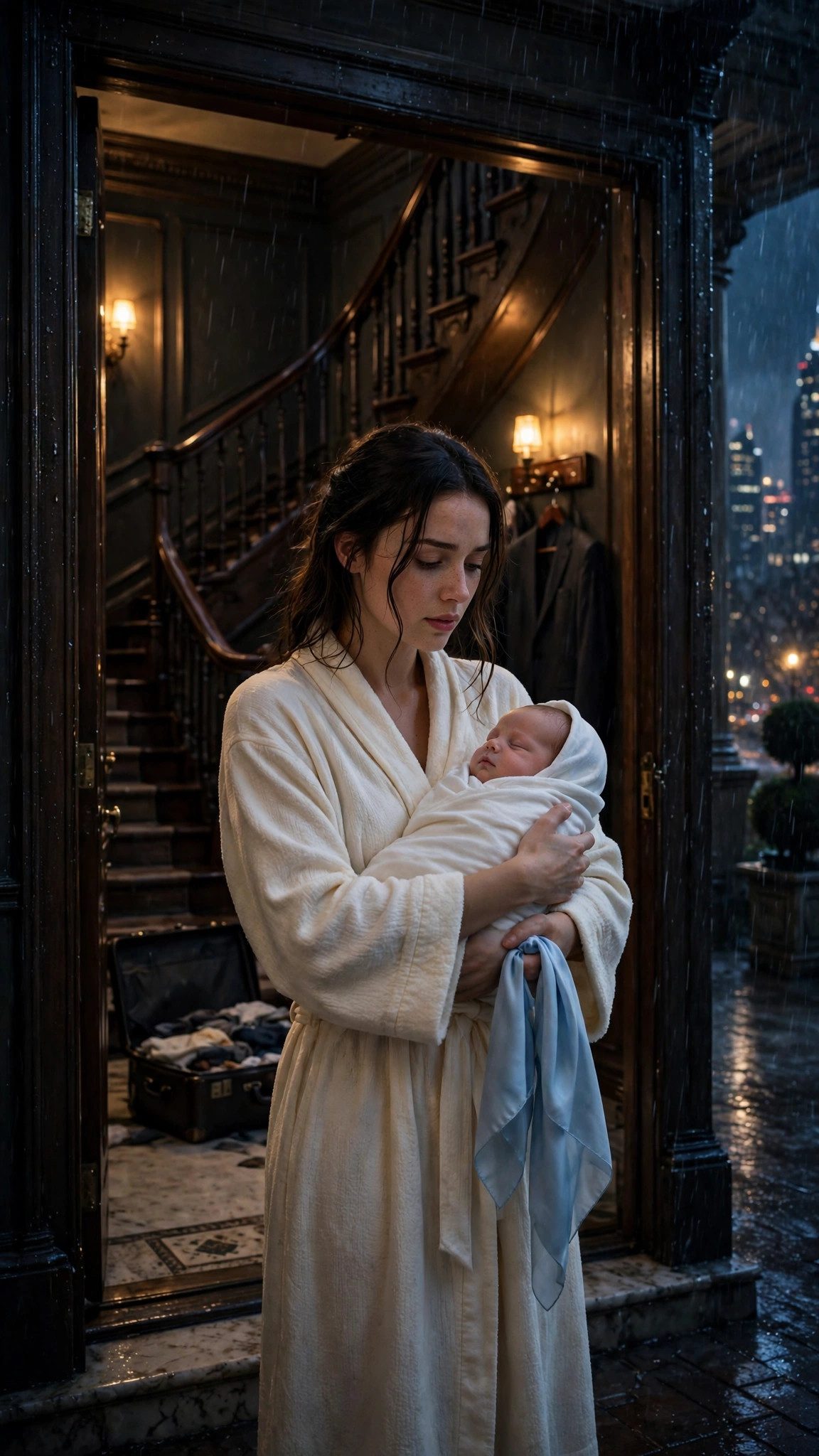
I did not go back to the house. I did not drive to the airport. I drove to Decatur, to the small brick house on a quiet street where my mother's sister lived, because Aunt Rosa was the only person in the world who had never once asked me to be reasonable about a man.
Rosa Delgado was sixty-one years old, a retired schoolteacher with gray hair she wore in a braid down her back and a kitchen that always smelled of cinnamon and coffee. She had raised me for two years after my mother died, when I was sixteen and angry at the whole world, and she had never once told me to calm down. She had said, "Anger is information, Lauren. Listen to it."
I pulled into her driveway at eleven o'clock at night. Ren was awake now, fussing in her car seat, and I unbuckled her and held her against my chest, and I stood on Rosa's porch in the dark with my baby in my arms and my suitcase still in the trunk and the phone still warm in my pocket from Jade Foresight's call, and I knocked.
Rosa opened the door in her nightgown, her reading glasses pushed up on her head, and she looked at me for exactly two seconds. Then she stepped aside and said, "Come in, baby. Bring her in."
I did not cry until I was sitting at her kitchen table with a mug of tea in front of me and Ren asleep in the crook of my arm. Then I cried the way you cry when you have been holding yourself together for seventeen days and someone finally gives you permission to fall apart.
Rosa did not ask questions. She put a hand on my back and waited. When I could speak, I told her everything. The Lisbon ticket. The scarf. The photograph from Greece. The whispered phone calls. The envelope with Jade Foresight's name on it. The call from the unknown number.
"She said he's bleeding to death in a parking garage," I said. "She said I'm the only person who can save him."
Rosa was quiet for a long time. Then she said, "Do you believe her?"
"I don't know," I said. "I don't know what to believe anymore. Three weeks ago I believed my husband loved me. This morning I believed he was leaving me. Tonight I believe a woman I have never met is telling me the truth about a man I thought I knew."
"Then believe this," Rosa said. "You are not going back to that house tonight. You are not driving to that airport. You are going to sleep in my spare room with your baby, and in the morning, when your head is clear, you are going to decide what to do. No decision made at midnight with a newborn in your arms is a decision you can trust."
She was right. She was always right. I slept that night in her spare room, in a narrow bed with clean sheets that smelled of lavender, with Ren in a laundry basket lined with blankets beside me, because Rosa did not have a crib and a laundry basket was the safest thing we had. I woke every two hours to feed her, the way I had woken every two hours for seventeen days, and each time I woke, I checked my phone. There were no more calls from the unknown number. There were three missed calls from Colton's phone, all within ten minutes of each other, all just after midnight. And one text message, sent at 12:04 a.m.
Lauren. I'm sorry. I was wrong. Please. Ren.
I stared at the message until the words blurred. I was wrong. Please. Ren. He had not written "I love you." He had not written "Come home." He had written her name, as if her name were the whole argument, as if the fact of our daughter were enough to undo everything else.
In the morning, Rosa made pancakes, and I ate them standing up in her kitchen while Ren slept, and I told her the story from the beginning, the way you tell a story when you need to hear it yourself to understand what happened.
I told her about the emergency room, about the bullet in his shoulder and the calm in his voice. I told her about the lilies at the nurses' station and the dinner in Buckhead and the truth he had told me on the first date. I told her about the wedding in Savannah and the way he had met me halfway down the aisle.
"I thought that meant something," I said. "A man who meets you halfway. I thought that was a promise."
"It was a promise," Rosa said. "He broke it. That doesn't mean it wasn't real when he made it."
I told her about the pregnancy. How happy he had been at first, how he had come to every appointment, how he had painted the nursery himself, a soft pale green, because he said green was the color of new things. How he had read three books about fatherhood and underlined passages and left them on the nightstand for me to find.
"And then?" Rosa asked.
"And then the baby came, and he disappeared. Not all at once. Slowly. First it was the late nights. Then it was the phone calls he took in the other room. Then it was the office."
The office. Colton's father had died five years ago, of a heart attack in that very office, a small room on the fourteenth floor of a building downtown with a view of the rail yards. Colton had inherited it along with the shipping companies and the warehouses and the rest of the empire. He had always hated that office. He had told me once, in the early days, that his father had died alone in it, on the floor, and no one had found him for three hours, and that he never wanted to sit in his father's chair.
"But for the last month, he went there every night," I said. "He said he needed to work late. He said there were shipping contracts. And every night, Hannah would call me."
Hannah Reyes was Colton's assistant, a woman of forty with sharp eyes and a sharper tongue, who had worked for his father before him and who had never once liked me. She had called me every evening for a month, always with the same message, delivered in the same flat voice.
"Mr. Beckett asked me to tell you he'll be late. It's business. He'll come around."
"He'll come around," I repeated to Rosa. "As if my husband were a train that was running behind schedule."
"Did you believe her?" Rosa asked.
"I wanted to," I said. "I wanted to believe that he was overwhelmed. That new fatherhood had frightened him. That he would come around. Because the alternative was that he had stopped loving me, and I didn't know how to live with that while I was still bleeding and still learning how to keep a tiny human being alive."
Rosa reached across the table and took my hand. Her hands were lined and warm, the hands of a woman who had graded ten thousand essays and held a hundred frightened children.
"Tell me about the photograph," she said.
It had arrived in a plain envelope, no return address, slipped under our front door. I found it the day I came home from the hospital with Ren. A photograph, printed on glossy paper, of a café patio in Greece. White tables. Blue sea in the background. And Colton, sitting at a table in a linen shirt I had never seen, leaning toward a woman with dark hair and a baby-blue scarf around her neck. His hand was on the table, inches from hers. He was smiling. Not the smile he gave in business photographs. A different smile. A private one.
"I told myself it was a client," I said. "I told myself the scarf was a coincidence. But the scarf he brought home this morning was the same blue. The same silver thread in the hem. I held it in my hands, Rosa. I held the proof in my hands, and he stood there and told me she was just a client."
"And the phone calls?" Rosa asked.
"Every night, after he left for the office, his phone would ring. Not his work phone. His personal phone. And he would step into the other room to answer it, and when he came back, he would smell different. Not of perfume. Of the sea. Of somewhere far away."
I had not told anyone about the phone calls. Not Hannah. Not Rosa. Not even myself, really. I had filed them away in the part of my mind where you put things you cannot afford to look at yet.
"Lauren," Rosa said, very gently, "do you know what I think? I think that woman, Jade, did not send you that photograph to hurt you. I think she sent it to you because she wanted you gone. I think she wanted you and Ren out of that house before whatever is happening tonight happened. And I think that phone call, whatever it was, was not an accident."
"You think she's trying to help me?"
"I think she's trying to help herself," Rosa said. "And right now, her interests and yours might be the same. That doesn't make her your friend. But it doesn't make her a liar, either."
Ren woke then, and cried, and I picked her up and held her against my shoulder, and she quieted the way she always did when she heard my heartbeat. Rosa watched us, and her face softened, and she said, "She looks like you, you know. Around the eyes."
"She looks like him," I said.
"She looks like you," Rosa said firmly. "And whatever you decide to do about that man, you decide it for her. Not for him. Not for the past. For her."
My phone buzzed on the table. Unknown number. My hand shook as I picked it up.
"Lauren," Jade whispered. "It's me. Please. He's at Grady Memorial. They brought him in forty minutes ago. Two bullets. One in the shoulder, one in the side. He's alive. He's asking for you. But Lauren, you have to listen to me. The men who shot him are still out there. They know about you. They know about Ren. If you come to the hospital, come quietly. Don't tell anyone. Don't call the police. Not yet. I'll explain everything when you get here. Please. He said you would know what to do."
I looked at Rosa. I looked at Ren, asleep again in my arms, her tiny fist curled against my collarbone.
"I'm going," I said.
Rosa nodded. She did not try to stop me. She stood up and took Ren from my arms, gently, the way you take something precious from someone who is about to walk into a fire.
"She stays with me," Rosa said. "You go. You find out the truth. And then you come back here, and we decide together what happens next. Do you understand me? I will not let anything happen to this baby. Not while I am breathing."
I kissed Ren's forehead. I kissed Rosa's cheek. I picked up my keys, and I walked out into the morning light, and I drove toward Grady Memorial Hospital, toward the emergency room where I had once been a nurse, toward the man I had married, who was bleeding in a hospital bed and asking for me by name.
The next morning, while Ren slept in her basket, I went through the baby's bag, the one I had packed in a hurry in the bedroom the day I left. Diapers. A spare outfit. Her favorite blanket. And at the bottom, underneath the blanket, something I had forgotten I put there: the small plastic bracelet from the hospital, the one they had put on Ren's wrist the day she was born. It said, in tiny printed letters, BABY GIRL BECKETT, and the date, and the time. I held it in my hand for a long time. Seventeen days ago, she had been Baby Girl Beckett, a name on a bracelet, a weight on a scale, a footprint on a card. Now she was Ren, with a face, and a cry, and a way of curling her fist around my finger, and I thought about how much had changed in seventeen days, and how much had been lost.
Rosa came into the room with two cups of coffee. She set one down beside me and sat on the edge of the bed.
"Your mother would have liked him, you know," she said. "Colton. In the beginning. She liked men who were steady. She liked men who showed up."
"She never met him," I said.
"No," Rosa said. "But she knew you. And she used to say, 'That girl of mine, she doesn't fall for pretty words. She falls for people who stay.' And Colton stayed, Lauren. For two years, he stayed. Remember that, when you're deciding what comes next. The man who left is real. But so is the man who stayed."
I thought about the day I told Colton I was pregnant. It was a Tuesday, in the kitchen of our house, in the early morning, before he went to work. I had taken the test at five in the morning, and I had sat on the bathroom floor for twenty minutes, staring at it, before I walked into the kitchen and put it on the table in front of him, without a word. He had looked at it. He had looked at me. And then he had stood up, and he had picked me up, and he had spun me around in the kitchen, laughing, and he had said, "We're going to be parents. Lauren, we're going to be parents." And that night, he had come home with paint samples, six shades of green, and he had held them up against the nursery wall, one by one, until I picked the soft pale green, and he had painted the whole room himself, over a weekend, with a roller and a ladder and paint on his shirt, and he had said, "Green is the color of new things."
I told Rosa all of this. I told her about the paint samples. I told her about the spinning in the kitchen. I told her about the way he had read three books about fatherhood and underlined passages and left them on the nightstand for me to find.
"That man is still in there," Rosa said. "Somewhere. Underneath the fear, and the running, and the mistakes. That man is still in there. The question is whether you want to wait for him to find his way back. And there is no wrong answer to that question, Lauren. None. Whatever you decide, I will be here, and Ren will be here, and we will be all right."
Ren woke then, and cried, and I picked her up, and I held her against my chest, and I thought about the man who had painted a nursery pale green, and the man who had folded a navy-blue suit into a suitcase, and I wondered if they were the same man at all.