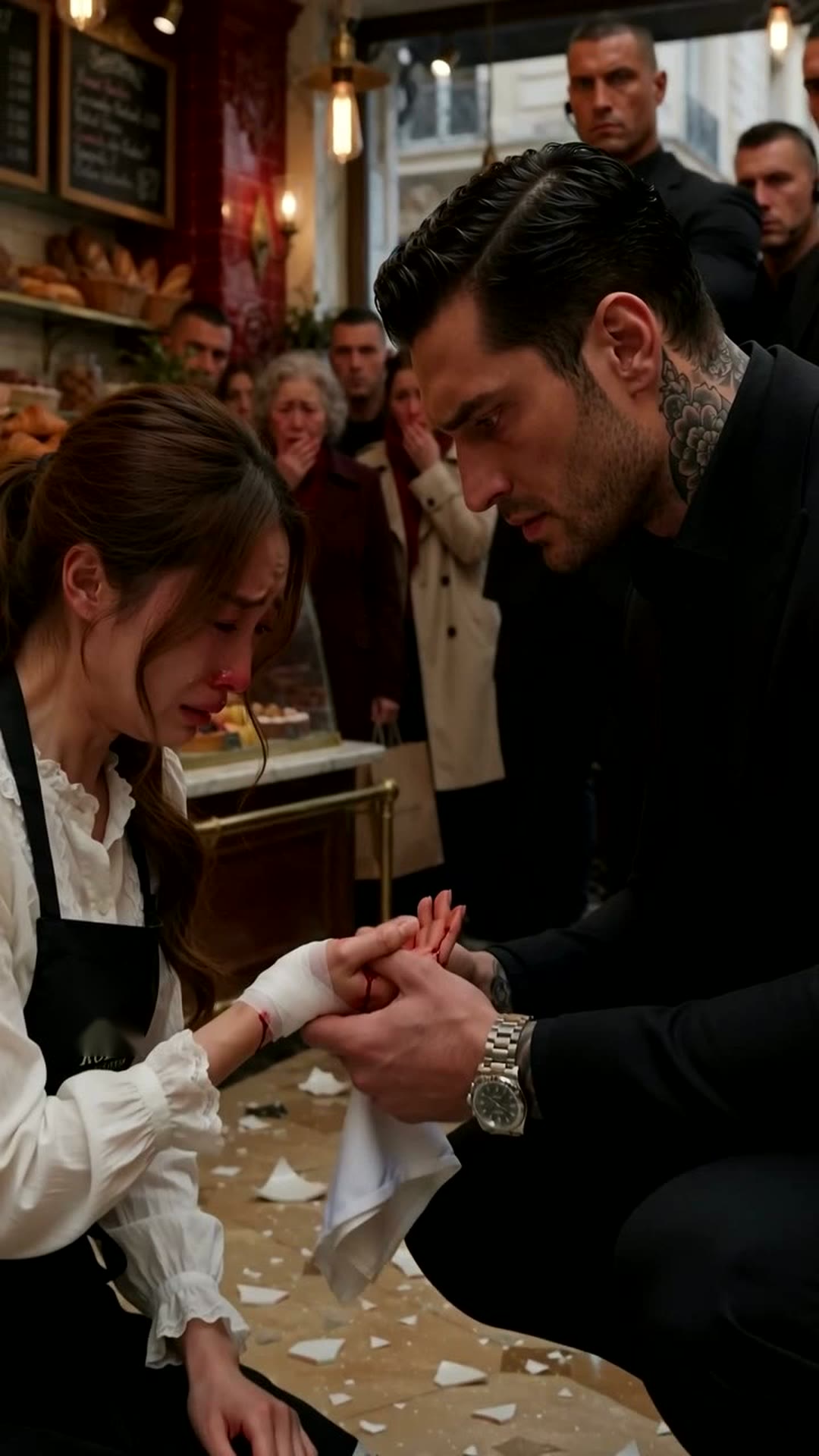
They got me into the SUV the way you load something precious and breakable — fast, low, with Alessandro's body between me and the street the entire time.
Dante drove. Another car fell in behind us, and a third ahead, and Bellhaven slid past the rain-streaked windows in gray smears while I sat with my bleeding hand wrapped in a mafia boss's handkerchief and an envelope with my dead father's handwriting on it pressed against my ribs under my crossed arms.
Alessandro had handed it to me in the car. He hadn't said anything when he did it. He'd simply held it out, waited until I took it, and then turned to watch the road behind us, and somehow that told me more than the envelope did: whatever was in it, he had carried it a long time, and giving it to me was not a small thing for him.
"You're not opening it," he said, without looking at me.
"Excuse me?"
"Not in a moving car. Not like this." Now he did look at me, and his gray eyes were doing that thing again — flattening every feeling down into something controlled and cold, except I was beginning to understand that the coldness wasn't the absence of feeling. It was a lid on it. "When we arrive. When you're sitting down and your hand is treated. Then."
"It's mine. My father wrote my name on it."
"I know whose name is on it, Sophia. I've looked at it every day for six years." He turned back to the window. "You can wait twenty minutes. I've waited six years. It's your turn to be patient."
I should have hated him for that. Instead I sat in silence with my father's handwriting warm against my skin and watched the wipers beat, and tried to remember how to be the woman who had left that bakery an hour ago, because I was fairly sure she was never coming back.
The Caruso estate sat above the city behind walls I remembered and gates that opened before we reached them. Six years — no. Four years, and the gravel still crunched the same way, and the house still rose out of the rain with every window lit, and an old man I recognized — Tomaso, the groundskeeper, grayer now — actually crossed himself when he saw me climb out of the car.
"Madonna," he said. "Mrs. Caruso. You're home."
The entrance hall had not changed at all, and that was its own ambush. The same dark wood staircase. The same smell of beeswax and old stone. The portrait gallery along the corridor to the dining room — Caruso fathers and mothers in gilt frames, a century of people who had never once looked uncertain — and there, among them, in a smaller frame at the height of my shoulder, a photograph I had never seen: my father, young, laughing, with his arm slung around Alessandro's father's shoulders, both of them in rolled shirtsleeves on the deck of a ship. Someone had hung it there after I left. Or before. I had simply never walked this corridor with my eyes open during my marriage.
Under the photograph, in a little brass plaque, someone — I learned later it was Alessandro, and that he had done it himself, badly; the screws were crooked — had engraved two words.
PARTNER. FRIEND.
I touched the crooked plaque with my good hand as I passed, and I did not cry, because Dr. Rosini was waiting and my palm was bleeding through a mafia boss's handkerchief, and because if I started I was not sure the house had enough rooms for all of it.
I am not, I wanted to say. I didn't say it. My knees were shaking too hard to argue with an old man's joy.
Inside, the house smelled of wood polish and rain. Staff appeared the way they always had, silent and efficient, and every single one of them looked at me like a ghost that had finally been located. Dr. Rosini arrived within the half hour — a small, brisk man in his sixties with a leather bag and the unimpressed air of a person who has stitched the Caruso family in every room of this house. He unwrapped the handkerchief from my palm at the long dining table, under the chandelier, while Alessandro stood behind my chair and did not sit and did not leave.
"Seven stitches," Dr. Rosini announced. "Perhaps eight. You're lucky. The porcelain was clean." He glanced up at Alessandro without pausing. "Hold her wrist steady. Gently. She's thinner than the last time I saw her, and she flinches."
"I'm fine," I said.
"You are not fine. You are malnourished and in shock and you have been, I would guess, lying about both for some time." He said it the way other people comment on weather. "Hold still now."
Alessandro's hand closed around my wrist — carefully, below the bruise, which he had clearly memorized the position of — and I watched the needle go in and out of my own skin and thought, absurdly, about bread. About the tray Mrs. Moretti would be setting out for the morning crowd right now, in a bakery with a shattered window and police tape, presumably, and my name being said in it by strangers. My whole small life, blown apart before nine in the morning.
"You keep looking at the door," Alessandro said quietly, while the doctor worked. "Are you planning to run, or deciding whether you believe me?"
"Both."
"Run where, Sophia?" It wasn't a taunt. That was the terrible thing. His voice was almost gentle. "Back to the apartment your aunt's creditors visit on Thursdays?"
I went very still.
"The one who hurt your wrist," he said. "His name is Rocco Fenn. He works collections for a company you've never heard of that answers, eventually, to men who do not answer to me. He reported a woman matching your description to his handler eleven days ago. We didn't know that this morning. We know it now. The shooting at the bakery was not a warning, Sophia. It was a correction. They were fixing a mistake — the mistake of having lost you."
"Then Marie—" I stopped.
"Yes," he said. "Marie. We'll come to Marie."
Dr. Rosini tied off the last stitch, bandaged my hand with brisk competence, and prescribed food, iron, sleep, and — looking pointedly at Alessandro — "less excitement than this family customarily provides." Then he left us alone in that enormous dining room, with the rain still coming down and twenty empty chairs between us and the ends of the table.
I got up from the table while Alessandro was speaking to Dante in low voices by the door, and I walked — calmly, like a woman going to look at the rain — to the tall doors at the end of the dining room that opened onto the terrace.
They weren't locked.
I want that understood, because I understood it standing there with my hand on the handle: the doors weren't locked. Outside, in the wet garden, a man in a dark coat stood under the portico with his back to me, and when he heard the door he turned, took one look at my face, and stepped courteously aside to let me pass.
"Can I get you a coat, Mrs. Caruso?"
I could have walked out. Down the terrace steps, across the wet lawn, to the gates — which would also, I was quite sure, have opened. That was the architecture of this place, and maybe of Alessandro himself: the doors were never locked. The world outside was the lock. Somewhere beyond those gates were men who had put a bullet through a bakery window at breakfast time because a collections thug had remembered my face, and every step I took away from this house was a step toward them doing it again, better.
I closed the terrace door.
I stood there a moment with my forehead nearly touching the cold glass, watching the rain run down it in crooked lines, and I cried — silently, the way I'd learned to cry in other people's houses, in rented rooms, in bakery bathrooms on my break: without sound, without moving my shoulders, so that no one would ever have to be inconvenienced by it.
"You learn to do that quietly," Alessandro said behind me. Not close. He hadn't come close. "In my house. During our marriage. I used to hear you through the door of your room, and stand there like a coward, and do nothing, because doing something would have meant admitting I'd married a grieving child for her father's business reasons and then failed to be any comfort to her at all."
"You don't get to say things like that now," I said to the glass. "You don't get to be honest now. Honest was six years ago."
"I know," he said. "Sit down anyway. Please."
"I want to go home," I said.
"You are home."
"This is not my home. My home has a leaking tap and a landlord named—"
"Your home," Alessandro said, "was being watched by the men who murdered your father. Forgive me if I don't drive you back to it."
"And I'm supposed to just — stay? Behind your gates, under your guards, eating your food, like a—"
"Like my wife."
The word landed between us like something dropped from a height.
"I stopped being your wife the night your signature—"
"There was no signature." He came around the table then, and sat — not at the far end, the way he had through two years of marriage, but in the chair beside mine, turned toward me, close enough that I could see the rain still drying in his hair. "There was no annulment, Sophia. There was no document. There was a forgery good enough to fool a frightened twenty-year-old in a car at two in the morning, and a husband who came home to an empty house and a wedding ring on a dresser and no wife."
My ring. I had left it. I had left it because Marie said rings could be traced, and I had believed her because I believed everything, because believing her was the only raft I had.
"I searched," he said. "I want you to understand that before anything else happens. Whatever she told you — I searched for four years. And I am still — " He stopped. Reset. The lid came down again, but slower this time, and I saw it cost him. "The envelope. Open it now. Sitting down, like I asked. I'll be in the study. What your father wrote is yours. I never opened it."
He stood and walked out, and I sat alone at the long table with my stitched hand throbbing and the envelope in front of me, and my father's handwriting on it, patient as the grave.
Inside the outer envelope there were two things.
The first was a letter, four pages, in the same careful upright script.
The second was a sealed packet, wax-sealed, stamped with the name of a law firm, with a note paper-clipped to it in my father's hand: FOR THE LAWYERS — DO NOT OPEN ALONE.
I read the letter standing up, because sitting felt like surrendering to it.
My dearest Sophia — if you are reading this, then I failed…
He had known. That was the thing I could not make my mind hold still around. He had known men were coming for him — partners, he called them, in the shipping venture; a man he named only as "the friend who smiles at my table" — and he had arranged the marriage to Alessandro the way another father might arrange a will: coldly, quickly, with lawyers. The Caruso name is a wall, he wrote. I am putting you behind it. Alessandro is a hard man and a young one and he does not love you, and I am sorry, my darling, I am so sorry — but he gave me his word, and a Caruso's word is the only currency I trust more than gold. He will keep you alive. Alive is enough. Alive is everything. Everything else, you can build later, when you are safe.
The last paragraph I read three times.
They will tell you to run from him. It will be people you trust who tell you, because that is how these men work — they borrow the voices you love. When that day comes, remember this letter. Remember that the man they paint as your jailer is the only one who never lied to you about what the world is. Forgive your mother-tongued old father his secrets. I kept them to keep you breathing.
I stood in the dining room of the man I had run from for four years, with my father's letter in my bandaged hand, and understood that my whole life since I was eighteen had been built — brick by careful brick — out of other people's lies.
And the envelope's second, sealed half was still lying on the table.
Waiting.