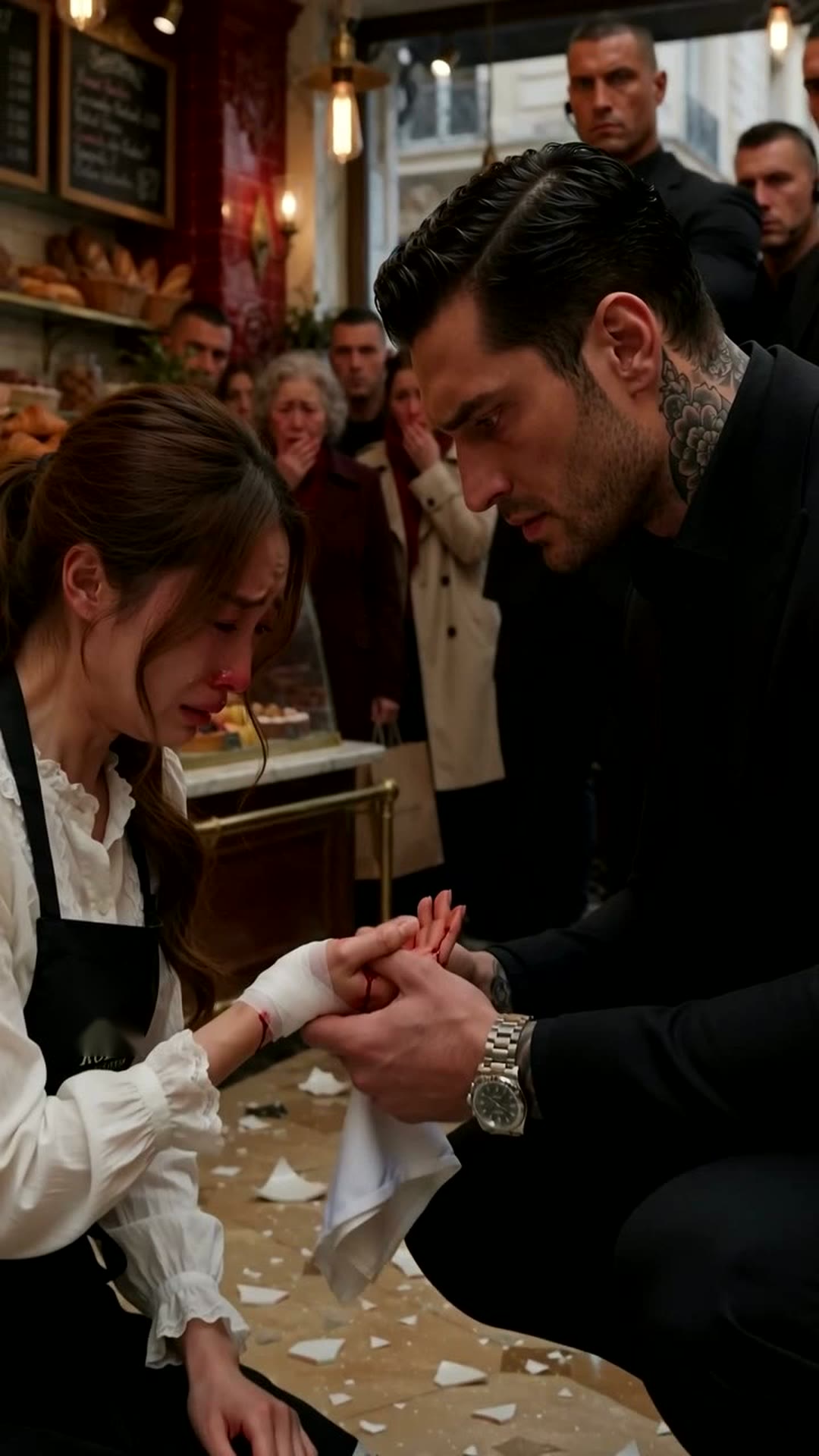
They put me in my old room.
I don't know what I had expected — a guest suite, something neutral — but the door Alessandro's housekeeper opened at the top of the stairs was the door of the room I had slept in as a bride, and it was exactly as I had left it. Not preserved like a shrine. Worse than that. Maintained, like a room whose occupant was expected back: the bed made with the same cream coverlet, my books still on the shelf by the window — I had left them in a stack and someone had stood them upright — and in the wardrobe, hanging in plastic, the dresses of a girl who had worn them to dinners where nobody spoke to her.
"We kept everything," the housekeeper, Signora Bianchi, said at my shoulder, with the defiant tenderness of a woman daring me to call it strange. "He said you would want your things. He said — " she stopped herself. "Dinner is at eight. There's a dress laid out. It's new. He said you wouldn't wear the old ones."
He was right. I wouldn't.
The dress on the bed was dark green, simple, with long sleeves that covered my wrist. I stood looking at it for a long time. Even this. Even a sleeve, chosen by a man who had catalogued my injuries from across a bakery and arranged a piece of silk over the evidence. I put it on because my uniform smelled of coffee and rain and gunpowder, and I went down to dinner at eight o'clock like a woman walking into a courtroom to hear a verdict about her own life.
They'd set two places.
Not at opposite ends of the long table — two places at the near corner, adjacent, close enough to pass the bread. I don't know if that was his doing or the staff's quiet rebellion, but it undid me more than the room had. Alessandro stood when I came in. He'd changed his wet suit for another identical one. He pulled out my chair himself.
"Sit," he said. "Eat first. The rest after."
"I'm not hungry."
"You haven't eaten today."
"How do you — "
"You fainted twice in my memory," he said, "and both times it was because you'd given your dinner to someone else's problem. Eat, Sophia. Then fight me. You'll fight better."
So I ate. God help me, I ate — soup first, because Signora Bianchi set it in front of me with an expression that brooked no argument, and then bread I didn't have to earn, and chicken, and greens, and all the while Alessandro ate almost nothing and watched me the way a man watches weather he has been waiting years to stand in. When I finally put my fork down, my bandaged hand aching dully, he poured me wine I didn't drink.
"You paid off my job today," I said. "You stood in a bakery and ordered audits and severance like you'd bought the building. Do you understand what it is to watch a man purchase your entire life before lunch?"
"Your severance is your wages," he said evenly. "Twelve weeks of them, which Mrs. Moretti owed you in spirit for six years of opening her shop in the dark. I didn't purchase your life, Sophia. I interrupted its sale. It was being sold in pieces — Thursdays, wasn't it? Forty dollars short and a man's hand around your wrist."
"You don't get to know about Thursdays."
"I know about Thursdays because knowing is what I do instead of sleeping." He turned his wine glass a quarter-turn on the tablecloth, precisely, the way another man might have raised his voice. "I know your landlord raises the rent every March. I know Marie's medicine costs more than she tells you. I know the bakery's ovens—"
"Stop."
"— I know there is a church on Whitfield Street where you leave the unsold bread on Thursdays for a woman with two children, bread that was supposed to be your dinner. You have been starving politely for four years, in a city I own pieces of, and I found out three weeks ago."
"I didn't ask to be found by a man who counts my dinners."
"No," he said. "You asked — the day you married me, in a white dress, shaking so badly the priest had to say the responses twice — you asked, with your eyes, whether anyone was ever going to stand between you and the world. And then for two years I sat at the other end of a table and failed to answer. Whatever you accuse me of tonight, accuse me of that first. The rest is administration."
I had no answer to that. My throat had closed. He let the silence stand a moment, out of what might have been mercy, and then he said:
"Tell me about the night you left."
"You know about the night I left."
"I know what I found. I want what you were told."
So I told him. The whole of it, at his own table, in a dress he'd bought me. Marie at the door of my room at two in the morning, pale, urgent, a bag already packed. The car downstairs. The two relatives. The document on the seat between us — heavy paper, a notary's stamp, my name typed, his name signed, annulment in letters an inch high. Marie's voice, gentle as poison: He never wanted the marriage, Sophia. His father and yours arranged it over his head too. He's found a way out of it — sign nothing, say nothing, just go, it's the kindest thing, don't make him look at you and lie. And me, twenty years old, holding the paper with both hands, thinking: of course. Of course. It explains everything. The cold table. The empty corridors. He had been enduring me, and now he was free, and the only dignity available to me was to not be dragged.
"I practiced not hating you," I said. "For years. I told myself you were just a man who'd been forced like I was forced. That's how I got through it. I never once — not once — allowed myself to wonder if the paper was fake, because if the paper was fake then I'd been stolen, and I couldn't afford to have been stolen, Alessandro. I could only afford to have been left."
The silence after that was the loudest thing in the house.
"Come with me," he said at last.
He took me to his study.
One wall of it — one whole wall — was my disappearance. Photographs under glass: dock manifests, train stations, a map of the eastern seaboard with three cities pinned in red thread. Files in labeled boxes. Four years of them. He stood aside and let me look, and I walked the length of that wall with my stitched hand pressed to my chest like I was holding my heart in manually, reading the archaeology of a search I had never believed existed.
Bellhaven, three weeks ago — a photograph of the bakery, taken from across the street. Me, in the window, a smudge with an apron.
"You found me three weeks ago," I whispered. "You've known for three weeks."
"I found a woman who might have been you. I don't move on 'might,' not with your life. I verified. Slowly, through people who don't know my name." His voice went rough at the edges. "And this morning I walked into that bakery to be certain — and you dropped a cup, and looked up, and I was certain, and I have never been so happy or so furious in my entire life. Three weeks I had a plan, Sophia. Approach you carefully. Through lawyers. Slowly, so you wouldn't run. And then you cut your hand open in front of me and the plan became whatever kept the blood off the floor."
"You were going to approach me through lawyers."
"I was going to do everything through lawyers," he said, "because the last clear memory I had of my wife was of her flinching when I entered a room. I was not going to be the thing that jumped out of the dark at her twice."
In a drawer of his desk, under a brass key he turned without hesitation in front of me, there were four letters. My name on each envelope. Four different Aprils — my birthday — in his handwriting, which I had never seen before that day and which was nothing like my father's: slanted, impatient, the writing of a man who thinks faster than pens move.
"You wrote to me."
"Every year. There was nowhere to send them." He didn't touch the letters. He left them in the open drawer like evidence he was submitting. "The first one is angry. You can burn that one if you like. The second one apologizes for the first. The third one is — shorter. By the fourth I had mostly stopped performing and just told the truth."
"What truth?"
"That I would find you." He closed the drawer gently. "That it had stopped being about your father's promise in the second year and become something I was no longer willing to explain to anyone. You're allowed to hate that, Sophia. Men have been killed for less presumptuous sentences."
"Why not just remarry?" I said. "Annul it for real. You're a Caruso. The Church, the lawyers — your family arranges things. You could have been free in a year."
Something in his face stopped being careful at all.
"Because you were mine to lose," he said, "not mine to discard. There's a difference, and I have paid four years of my life making sure the world keeps them separate. And because—" he stopped, and started again, quieter, "—because a girl once left broth outside my door. Second winter. I had the flu and a fever and a household under orders not to disturb me, and a tray appeared anyway. Broth. Bread. Medicine. A note that said Take all of it, in handwriting the note-writer apparently believed I wouldn't recognize from her schoolgirl signature on a thousand household lists."
I had gone completely still.
"The housekeeper didn't recognize the handwriting either," he said. "She thought it might be the new girl. I never corrected her."
I turned from the wall.
"Why didn't you tell me?" It came out smaller than I wanted. "At the wedding. After. You knew my father. You knew why. You could have said one true thing in two years."
"Yes." No defense. He didn't dress it up. "Your father asked me not to. He said if you knew he was marked, you'd spend your childhood's last years watching doors. He wanted you one ordinary year. And I — " For the first time since the bakery, Alessandro Caruso looked like the twenty-six-year-old he had been. "I thought silence was the protection. I thought if I stood far enough away from you, the people watching me wouldn't see you. It's taken me six years and one wall of failures to understand that standing far away from you was the whole catastrophe. I kept you safe from everyone except the people in your own house, Sophia. I never once thought to ask who had access to you that I didn't."
"Marie," I said.
"Marie," he agreed.
We stood in that study with four years of searching pinned up between us, and I felt the thing I had believed since I was twenty begin to crack — not shatter, not yet, but crack, the way ice cracks: audibly, under weight, in the dark.
"Boss." Dante, in the doorway, with a tablet and an expression I'd already learned meant the world had gotten worse. "The audit's done. Every creditor, every account, every payment Marie Chen ever touched." He looked at me, and then — deliberately, like a man handing over a loaded thing — back at Alessandro. "She needs to hear this from the numbers, not from me. But you should both sit down. Because whoever's been paying her — it's the same money that's been trying to kill her since she was eighteen. And, boss — part of it moved this morning. An hour before the shooting."