Galena, Illinois, is the kind of town where everybody knows your name by the end of the first week, and nobody asks you where you came from if you do good work and keep your head down.
I found Marta Kowalski's flower shop on my second day in town. It was a small brick building on Main Street with a green awning and a window full of sunflowers, and Marta was standing in the doorway with her hands on her hips, looking at me the way a woman looks at a stray dog — deciding whether to feed it or chase it off.
"You look like a florist," she said.
"I am a florist," I said.
"Then come inside," she said. "The roses in the back need someone who knows what she is doing, and I am too old to climb the ladder anymore."
Marta was sixty-eight years old, widowed, with white hair she wore in a braid down her back and hands that had arranged flowers for every wedding and funeral in Galena for forty years. She gave me a job. She gave me the apartment above the shop, a small place with a slanted ceiling and a window that looked out over the river. She did not ask me where I had come from. She did not ask me why a twenty-six-year-old woman from Chicago was living in Galena with one suitcase and no family. She only said, "You work hard, you pay your rent when you can, and you tell me if you need anything. That is the arrangement."
Three weeks after I arrived, I threw up my coffee in the bathroom of a diner outside Rockford and counted the days on my fingers, and I understood. I sat in that bathroom for a long time, staring at the cracked tile, and I thought about the man I had left in Chicago, and I thought about the baby growing inside me, and I thought about the fact that I had walked away from a marriage I believed was a transaction, and the transaction had left me with the one thing that was real.
I told Marta that evening. She listened without interrupting, and then she put the kettle on, and she made tea, and she said, "Well. Then we will need a crib. And you will need to eat more. And that baby will need a name."
"Her name is Ava," I said. I had not known I had chosen a name until I said it. "Ava."
"Ava," Marta repeated, and nodded, like the name had already been decided by someone wiser than both of us.
The pregnancy was hard and lonely and, in the end, the best thing that ever happened to me. I worked in the flower shop until my back ached and my feet swelled, and Marta made me sit down and put my feet up every afternoon at three o'clock, and the old ladies of Galena brought me casseroles and knitted blankets and told me stories about their own children. I had never had a family — my mother had died when I was nineteen, my father years before that — and suddenly I had a town full of grandmothers. I learned that a family is not always the one you are born into. Sometimes it is the one that brings you a casserole and does not ask questions.
Ava was born on a Tuesday in June, in the little hospital in Galena, at 3:17 in the morning. Seven pounds, two ounces. She cried once, very loud, and then she opened her eyes — dark and serious, his eyes — and she looked at me like she was checking whether I was going to stay.
"I will stay," I whispered to her. "I will always stay."
Marta was there. She held my hand through the whole night, and when the nurse put Ava in my arms, Marta cried, and I cried, and the sun came up over the river, and for the first time in two years, I felt like my life belonged to me.
I raised Ava in the apartment above the flower shop. I worked downstairs while she slept in a basket behind the counter. I learned to arrange flowers with one hand and hold a baby with the other. I learned that a child changes everything — the way you sleep, the way you spend money, the way you look at the future. I stopped thinking about Chicago. I stopped thinking about Alexander. I told myself that Ava was mine, and that her father was a man who had married me for a will, and that she was better off without him.
Her first word was "mama." She said it on a Tuesday morning in November, when she was nine months old, sitting in her high chair in Marta's kitchen with oatmeal all over her face, and she looked straight at me and said it as clearly as if she had been practicing in secret. "Mama." Marta dropped the spoon she was holding. I burst into tears, right there at the kitchen table, oatmeal and all, because in nine months of loneliness no one had called me anything that mattered, and suddenly my daughter had given me a name that was mine.
Her first steps came in February, in the middle of the worst winter Galena had seen in years, snow piled up against the shop windows and the river frozen solid. She took three wobbling steps from the couch to Marta's outstretched hands, and then she fell on her bottom and laughed, and Marta picked her up and swung her around, and the two of them laughed together, and I stood in the doorway with a basket of roses in my arms and thought: this is my family. A seventy-year-old florist and a baby girl and me. It is not the family I expected. It is the family I have.
That winter, Marta taught me to make preserves. We spent Sundays in her kitchen, sterilizing jars and boiling fruit, and she told me stories about her own life — her husband, who had died twenty years earlier; her four children, scattered across the country; the flower shop, which she had built from nothing after her husband's death, one wedding at a time.
"You know what I learned, Gianna?" she said one Sunday, wiping her hands on her apron. "I learned that a life is not what happens to you. A life is what you build after what happens to you. You came here with one suitcase and a broken heart, and you built a life. You built it out of flowers and a baby and hard work. That is not nothing. That is everything."
"Do you ever miss him?" I asked her. "Your husband?"
"Every day," she said. "And I would not trade one day of missing him for a life without him. That is what love is, girl. It is not the easy days. It is the missing, and the staying anyway."
I thought about Alexander then, for the first time in months. Not with anger, but with a question I had never allowed myself to ask: if I missed him, did that mean I still loved him? And if I still loved him, what did that mean about the night I walked away? I pushed the question down, the way you push down a weed in a garden, knowing it will come back. I had a baby to raise. I had a shop to run. I did not have time for questions that had no answers.
But the questions came back anyway, late at night, when Ava was asleep and the shop was dark and the river ran slow past the old brick buildings. They came back in the dark, and they stayed until morning, and I learned to live with them the way you learn to live with a draft in an old house — you stop noticing it, until the winter comes and you remember it was always there.
I was wrong. I know that now. But in those two years, wrong felt like the only way to survive.
While I was learning to be a mother in Galena, Alexander Moretti was tearing Chicago apart looking for me.
I know this now because he told me, sitting at Marta's kitchen table on the night he found us, with Ava asleep upstairs and the rain coming down outside. He told me everything, in the flat, exhausted voice of a man who has been carrying a story for two years and finally has someone to tell it to.
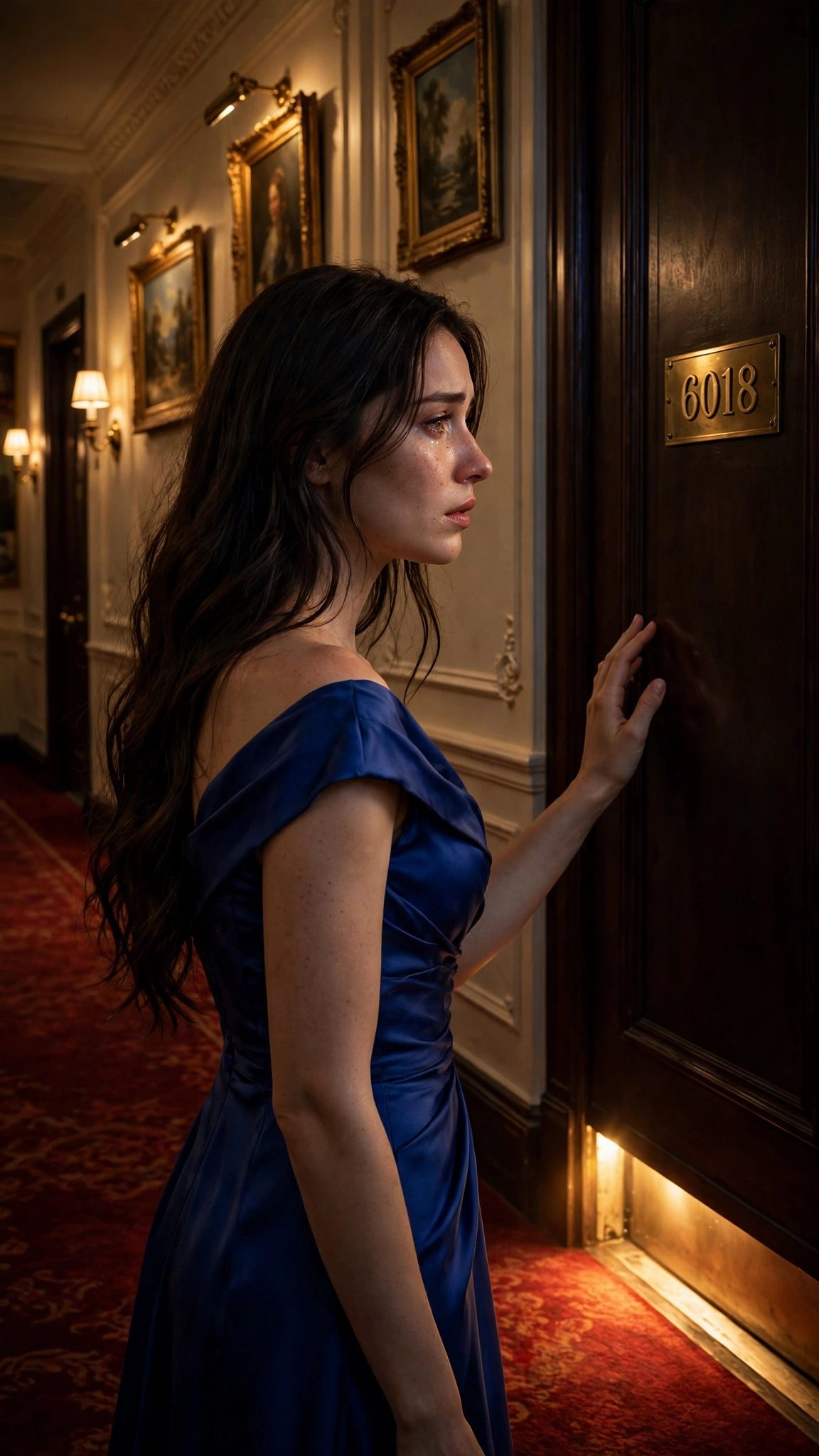
He came home from the Drake Hotel at midnight on the night of Room 6018, and he found my message on his phone — I am done. Do not look for me — and he found my suitcase gone, and the blue dress folded neatly on the bed, and the ring on the dresser. He called me fifty times. He sent his men to the train station, to the airport, to every hotel in the city. He went to the Drake himself, at two in the morning, and demanded the security tapes from the sixth floor.
There was no tape. The camera on the sixth floor had been disconnected that night — unplugged, the hotel said, by someone who knew where the wires were. The front desk had no record of a woman checking into Room 6018. The room had been booked under a false name, paid for in cash, three days earlier.
"I knew then," Alexander said, "that someone had staged it. Someone had put a woman in that room and sent you a text from my phone, and you had walked away believing I had betrayed you, and I had no way to prove otherwise, because the proof had been erased before I even knew I needed it."
He searched anyway. He hired private investigators. He sent Danny Cole to every city within five hundred miles. He checked hospitals, shelters, bus stations, train stations. He offered a reward, quietly, through channels no police officer would ever hear about. And he found nothing, because I had used my maiden name on the lease in Galena, and I had paid cash for everything, and I had told no one in Chicago where I was going.
And while he searched, Vincent Castellano moved.
Castellano had filed his challenge to the will the week after I left, claiming the marriage was a sham, that Alexander had bought a bride to satisfy a dead man's condition, and that the bride's abandonment proved it. His lawyers argued that a marriage that lasted fourteen months and ended with the wife vanishing in the night was no marriage at all. The court case dragged on for eighteen months. Alexander spent a fortune on lawyers. He spent more on investigators looking for me, because my testimony — that the marriage had been real, that I had left because I believed he had betrayed me, not because I had been paid — was the one thing that could kill Castellano's case.
But the worst betrayal was closer to home than Castellano.
It was Danny Cole who found it, six months into the search. Danny had been Alexander's driver for twelve years, a quiet man who noticed everything and said very little. He noticed that Marcus Hale, Alexander's head of security — the man who had guarded Alexander's life for a decade — had bought a new house in the suburbs. Cash. He noticed that Marcus's wife had started wearing jewelry she had never worn before. He followed Marcus one night, to a restaurant on the west side, and he watched him sit down with a man Danny recognized: one of Castellano's lieutenants.
Marcus Hale had been paid fifty thousand dollars a month by Vincent Castellano, through a shell company called Bellini Holdings, to be Castellano's eyes inside the Moretti family. It was Marcus who had given the actress, Camila Duarte, the key to Room 6018. It was Marcus who had sent the text to my phone from a cloned number, making it look like it came from Alexander. It was Marcus who had disconnected the security camera on the sixth floor. And it was Marcus who had told Castellano, the night I left, that the marriage was broken and the will was vulnerable.
Alexander did not kill him. That surprised me when he told me. "I wanted to," he said. "God forgive me, I wanted to. But Danny talked me out of it. Danny said: dead men cannot testify. And we needed Marcus alive, because a living traitor is worth more than a dead one."
So Marcus Hale was kept close, watched, and allowed to believe he was still trusted — while Alexander's real search went on in secret, and the case against Castellano was built, piece by piece, by men who knew how to wait.
And then, three days before the rain in Galena, a private investigator in Chicago found a photograph. It was on the website of a flower shop in a small town in Illinois — a photograph Marta had posted to show off her new window display. In the background, behind the sunflowers, a young woman was arranging white roses. And in a basket behind the counter, half-hidden by a blanket with yellow ducks on it, a baby was sleeping.
The investigator had almost missed it. But he had been looking at photographs of me for two years, and he knew my face, and he knew the baby's eyes — dark and serious, the Moretti eyes — and he called Alexander at midnight, and Alexander drove to Galena himself, through the rain, without telling a single one of his men where he was going.
"I did not want to scare you," he said to me at Marta's kitchen table. "I did not want you to see a convoy of black cars and run again. So I came alone. Just me. A man who had lost his wife and did not know he had a daughter, driving through the rain to a flower shop in a town he had never heard of, to ask the only question that has mattered to me for two years."
"Why did you never knock on the door, Gianna?" he said. "Why did you never ask me?"
And I sat at Marta's kitchen table, with my daughter asleep upstairs, and I told him everything I had heard that night in the hallway outside Room 6018. And for the first time in two years, the story made sense to both of us.