The hearing was held in a courtroom in downtown Chicago on a cold morning in November, in a building of grey stone that had seen a hundred years of men like Alexander Moretti walk through its doors — some to be judged, some to be freed, all of them carrying the weight of their family names on their shoulders.
I was not in the courtroom. That was the condition Alexander had set with Daniel Reyes, and it was the one condition he would not bend on: his wife and his daughter would not be named, would not be called, would not be put on display for Castellano's lawyers to pick apart. I sat in a small room down the hall with Ava on my lap, drinking bad coffee from a paper cup, while Marta — who had insisted on coming to Chicago with us, because, as she put it, "someone has to watch the baby while you two go and be brave" — read Ava a picture book about a duck.
Through the wall, I could hear nothing. Courtrooms are built to keep their secrets. But every twenty minutes, Danny Cole came out and gave me a report in his quiet, careful way, and I pieced the morning together the way you piece together a story from the people who walk out of a room.
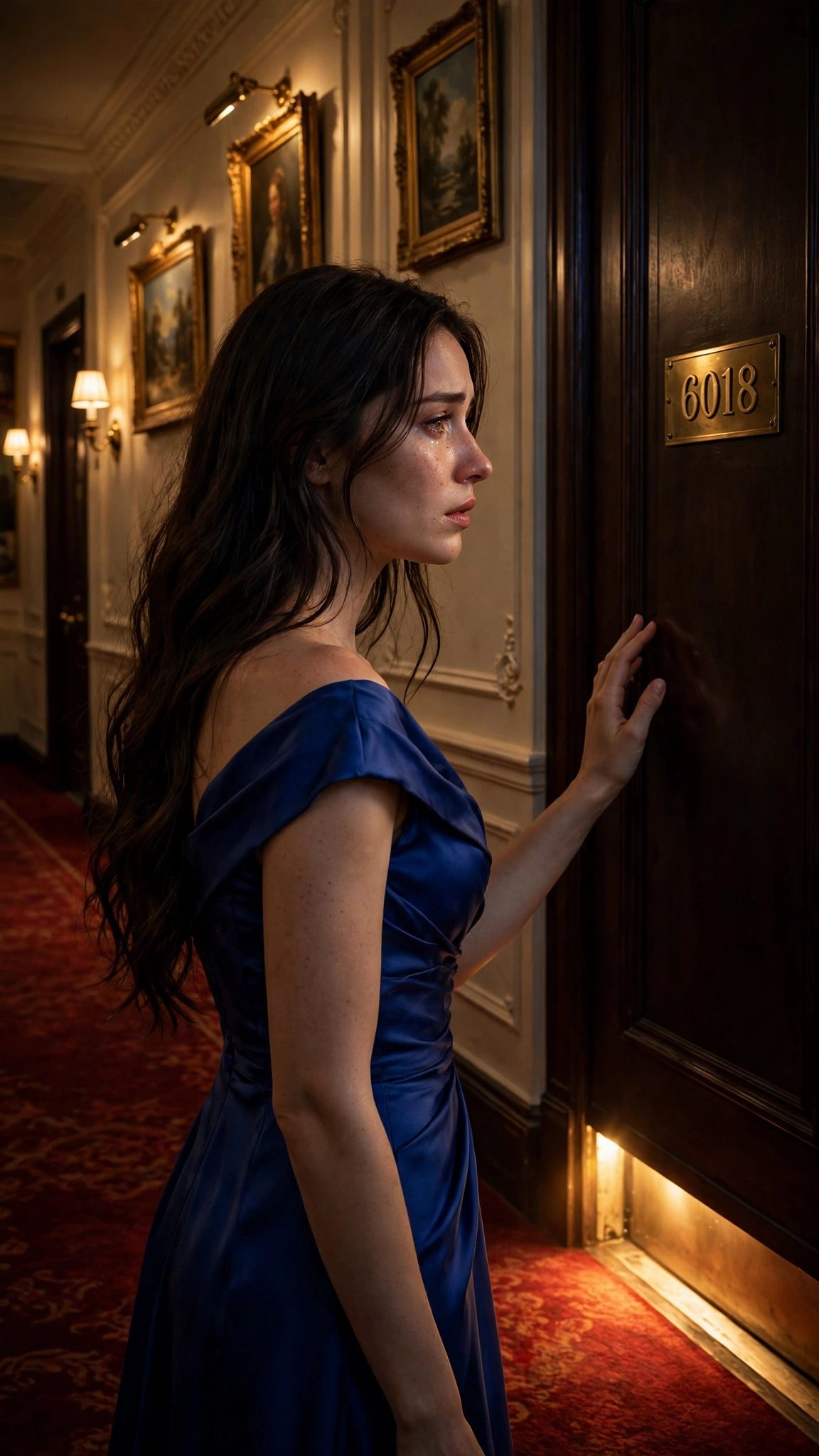
First, Camila Duarte testified. She was twenty-four years old, and she wore a plain grey dress, and she cried twice on the stand, and she told the truth: that Castellano's people had paid her five thousand dollars to spend one night in Room 6018 of the Drake Hotel and laugh loudly enough for a woman in the hallway to hear. That she had not known who the woman would be. That she had needed the money for her mother's medical bills. That she had thought it was a prank. The judge listened. Castellano's lawyers tried to make her sound like a liar, and she looked at them and said, "I am not a liar. I am a woman who made a terrible mistake for five thousand dollars, and I have spent two years being ashamed of it."
Then Marcus Hale testified. He was brought into the courtroom in handcuffs, and he looked ten years older than the man I had known — the man who had guarded Alexander's life and smiled at me at family dinners and all the while been selling us to Castellano for fifty thousand dollars a month. He testified for three hours. He told the court about Bellini Holdings. He told them about the cloned phone number. He told them about the security camera he had disconnected on the sixth floor of the Drake. He told them about the night he had reported to Castellano that the marriage was broken and the will was vulnerable. He cried once, near the end, when the prosecutor asked him why he had done it.
"Because I was afraid," Marcus said. "Castellano had photographs of my daughter at her school. He said that if I did not help him, something would happen to her. I believed him. I have believed him for four years. I am not asking for forgiveness. I am asking for the chance to tell the truth before it is too late."
The judge sentenced Marcus Hale to eight years in federal prison, with the possibility of a reduced sentence for his cooperation. His wife wept in the gallery. His daughter was not there. I thought about the photographs Castellano had used to frighten him, and I thought about Ava asleep in the next room, and I felt something I had not expected to feel for the man who had destroyed my marriage: pity. He had been a weapon, too. Castellano was very good at finding people who loved someone and making them into weapons.
Then Alexander himself took the stand.
Danny came out to tell me, and I pressed my hands flat against the wall of the little room, because I knew what it cost Alexander to stand in front of strangers and tell the truth about himself. He had spent his whole life being unreadable. Now he was going to be read.
According to Danny, Alexander walked to the witness stand in a grey suit, and he raised his right hand, and he swore to tell the truth, and then he told it — all of it, without hiding behind lawyers or careful language.
"My grandfather wrote his will the way he did because he believed a married man is a man with something to lose," Alexander said. "He was right. I married Gianna Ferraro because the will required it. I will not lie to this court about that. The marriage began as a condition. But a marriage is not its beginning. A marriage is what it becomes. And what it became was real. I loved my wife. I loved her every day we were together, and I did not tell her, because I was raised to believe that a man who says what he feels is a man who can be hurt. I was a coward, and my cowardice cost me two years of my wife's life and sixteen months of my daughter's life, and I will carry that for the rest of my life."
The courtroom was silent. Danny said you could hear the radiators hissing.
"Mr. Castellano's lawyers will tell you my marriage was a sham," Alexander said. "They will tell you my wife left me because the marriage was a transaction. My wife left me because she believed I had betrayed her — because Mr. Castellano's men staged a scene in a hotel room to make her believe it. She left because she loved me and believed I did not love her. That is not a sham marriage. That is a real marriage, broken by a crime. And I am here to ask this court to see the difference."
He stepped down from the stand, and Danny said the judge looked at him for a long moment before moving on, the way a judge looks at a man he has just decided he believes.
Then came the evidence that ended it. Daniel Reyes, the FBI agent Alexander had called from Marta's kitchen table, laid out the case against Vincent Castellano the way a man lays out a map — carefully, patiently, piece by piece. The black leather ledger, recovered from a safe-deposit box Castellano's own accountant had been too afraid to destroy, with twenty years of payments recorded in Castellano's own handwriting. The bank records from Bellini Holdings. The phone records. The testimony of Camila Duarte and Marcus Hale and three other men who had worked for Castellano and had finally, after decades of silence, decided to speak.
And then, the piece of evidence that mattered most to the will: the marriage certificate. Alexander's lawyers produced it — signed by a priest, a judge, and fourteen witnesses — and they produced the record showing that no divorce had ever been filed. Not by me. Not by Alexander. In two years of separation, neither of us had ever asked for a divorce. The marriage had never ended. The will's condition had never been broken. Castellano's entire challenge had been built on a marriage that was still, legally and truly, intact.
"Your Honor," Alexander's lawyer said, "my client's wife left him because she believed — wrongly, and through no fault of my client's — that he had been unfaithful. She never filed for divorce. My client never filed for divorce. They have a daughter together, born during the separation. The marriage is real. The marriage has always been real. Mr. Castellano's challenge is not a legal argument. It is a burglary, committed with lawyers instead of guns."
The judge ruled that afternoon. The challenge to the will was dismissed. Control of the Moretti empire remained with Alexander Moretti, married, as his grandfather had required. Vincent Castellano was sentenced to life in federal prison without the possibility of parole, on charges that included racketeering, extortion, witness intimidation, and conspiracy to commit fraud. Eddie Krol received twenty-five years for the attack in Galena and a dozen other crimes. Tommy Falco received fifteen.
When Alexander walked out of the courtroom, the reporters were waiting on the steps, shouting questions, cameras flashing in the cold November light. He did not stop. He walked straight to the little room down the hall where I was sitting with Ava, and he picked Ava up out of my lap, and he held her against his chest, and he said to me, very quietly, "It is over. The law did what the law could do. The rest is up to us."
Daniel Reyes followed him into the room. He was a tall man in his forties, with tired eyes and a suit that had seen better days, and he shook my hand like I was a person he respected, not a piece of evidence.
"Mrs. Moretti," he said, "your husband kept his word. He gave us everything — the ledgers, the names, the routes, twenty years of the Moretti family's business, all of it. In return, the shipping company stays. The docks stay. The legitimate businesses stay. The rest is gone. He is done. I have been doing this job for twenty years, and I have never seen a man walk away from an empire for his family. I have seen men walk away from their families for an empire. Never the other way around."
"Thank you," I said. I did not know what else to say.
"Thank your husband," Reyes said. "He did the hard part."
After Reyes left, Alexander sat down beside me, and Ava climbed from his lap to mine, and then back to his, the way children do when they are deciding where they belong, and I looked at the two of them — my husband, my daughter — and I thought about the law, and what it could do, and what it could not do.
The law could dismiss a challenge to a will. The law could send a guilty man to prison for the rest of his life. The law could protect a marriage certificate and a little girl's name.
But the law could not make a man say "I love you." The law could not make a woman believe it. The law could not repair two years of silence, or teach a father how to hold his daughter, or tell a wife that the man she had married in front of a priest and a judge and fourteen witnesses had loved her all along.
That part was up to us. And it was the only part that mattered.
We drove back to Galena that evening, all three of us, in Alexander's car, with Danny following behind in his own car, the way he always did — close enough to help, far enough to give us room. Ava fell asleep in her car seat before we reached the highway, her head tipped to one side, her blanket with the yellow ducks tucked under her chin, and I watched her in the mirror, and I watched the city fall away behind us, the grey stone buildings and the lake and the skyline I had loved and left, and I felt something I had not expected to feel: relief. Not happiness, not yet. Relief. The way you feel when a storm has passed and the roof is still on the house.
Alexander drove with one hand on the wheel and the other resting on the seat between us, palm up, an open question. I looked at his hand for a long time — the hand that had signed orders and held guns and, gently, held my face on our wedding night — and then I put my hand in it, and he closed his fingers around mine, and he did not let go for the rest of the drive.
"Talk to me," he said, after a while. "Tell me about Galena. Tell me about the two years I missed."
So I told him. I told him about Marta, and the flower shop, and the apartment with the slanted ceiling. I told him about the diner outside Rockford, and the little hospital, and the Tuesday in June when Ava was born at 3:17 in the morning. I told him about her first word, and her first steps, and the winter Marta taught me to make preserves. I told him about the old ladies who brought casseroles, and the river that ran slow past the old brick buildings, and the nights I sat awake with questions that had no answers.
He listened the way he had listened to me on the ladder in the ballroom, all those years ago — like my words were something he intended to keep.
"And you?" I asked him. "Tell me about the two years I missed."
So he told me. He told me about the search — twenty-three cities, and the private investigators, and the nights he sat in his study staring at the list, adding a new city, crossing off an old one. He told me about the court case, and the lawyers, and the eighteen months of waiting. He told me about the night Danny found the bank records, and the morning he learned about Marcus, and the hour he sat alone in his office and understood that the man who had guarded his life for a decade had sold it for fifty thousand dollars a month.
"I wanted to kill him," Alexander said, very quietly, his eyes on the road. "I want you to know that. I wanted to kill him with my own hands. And Danny talked me out of it, and I am glad he did, because a dead man cannot testify, and because Ava will ask me one day what kind of man her father is, and I want the answer to be a man who chose the law over revenge."
"That is a good answer," I said.
"It is the only answer I have," he said.
We reached Galena after dark. Marta was waiting on the porch of the flower shop with the lights on, and she had made soup, and she had put fresh sheets on the bed in the apartment upstairs, and she stood in the doorway with her hands on her hips and said, "Well? Is it over?"
"It is over," Alexander said.
"Good," Marta said. "Then come inside and eat. And tomorrow, we will talk about the wedding."
"The wedding?" I said.
"The second one," Marta said, like it was the most obvious thing in the world. "The real one. The one with the garden and the white roses and no judges. You two owe me a wedding, and I intend to collect."
Alexander looked at me, and I looked at him, and Ava slept on in her car seat, unaware that the most important decision of our lives had just been made for us by a seventy-year-old florist standing on a porch in Galena, Illinois.
"Tomorrow," Alexander said.
"Tomorrow," I agreed.
And for the first time in two years, the word felt like a promise instead of a threat.