We did not renew our vows in a cathedral. We did not invite fourteen witnesses, or a judge, or the alderman, or any of the men who had stood in that church two years earlier and watched a business transaction dressed up as a wedding. Alexander asked me where I wanted to do it, and I said, "Galena. In Marta's garden. With the people who were there when there was nothing."
The morning of the vows, Marta woke me up at dawn and marched me into the flower shop, where she had laid out a dress on the counter — not a wedding dress, but a simple white dress, soft and light, the kind of dress a woman wears in a garden in May. Beside it was a small box, wrapped in brown paper, tied with string.
"Open it," Marta said.
Inside the box was a veil. Not a new veil — an old one, yellowed at the edges, made of fine lace, folded carefully in tissue paper.
"It was my mother's," Marta said. "She wore it in 1952, in a little church outside Krakow, and I wore it in 1978, in the church down the street from this shop. It has been in that box for forty years, waiting for someone who deserved it. You deserve it, Gianna. You built a life out of nothing, and you raised a beautiful girl, and you forgave a man who did not know how to say he loved you. That is what this veil is for. Not for brides. For women who have earned it."
I cried. I put the veil on, and Marta pinned it into my hair, and she stepped back, and she looked at me, and she said, "Your mother would be proud of you. I know she would, because I am proud of you, and I am only the woman who gave you a job."
Ava came running in then, in her white dress, with daisies already stuck in her curls, and she climbed onto the stool beside me, and she looked at herself in the mirror next to me, and she said, very seriously, "Mama pretty."
"You are pretty too, baby," I said.
"We both pretty," Ava agreed, and Marta laughed, and I laughed, and the morning smelled of white roses and coffee, and for the first time since the night I walked out of the Drake Hotel, I felt like a bride — not a signature, not a transaction, but a bride.
So on a Saturday in May, six months after the hearing, we stood in the little garden behind Marta's flower shop, under an arch of white roses I had arranged myself, and Alexander Moretti took my hands in his, and this time there was no priest reading from a script, and no judge waiting with a pen, and no grandfather's will hanging over us like a storm cloud. There was only Marta, crying into a handkerchief. There was Danny Cole, standing at the back in a suit that did not quite fit, holding a small velvet box. There was Ava, two years old now, in a white dress with a crown of daisies on her dark curls, holding a basket of rose petals and scattering them with great seriousness in entirely the wrong direction.
And there was Alexander, looking at me the way he had looked at me on the ladder in the ballroom of the Drake Hotel, all those years ago, like I was the most interesting thing he had ever seen.
"Gianna," he said, and his voice shook, and he did not try to hide it. "The first time I married you, I said the words my grandfather taught me to say. I said them carefully, like a contract, because I was afraid that if I said what I actually felt, you would see the fear in me and leave. I was wrong. The fear was never the problem. The silence was the problem. So I am going to say the words now, the real ones, in front of the only witnesses who matter."
He took a breath. The garden was quiet. Even Ava stopped scattering petals.
"Gianna Ferraro," he said, "I love you. I loved you the day you stood on a ladder in my ballroom and told me to hold it or move. I loved you the day you arranged white roses in my house and made it feel less like a museum. I loved you the day you sat beside my bed for two days with the flu and read me poetry I did not understand. I loved you every single day of our marriage, and I never once said it, because I am a man who was raised to believe that love is a weakness and a wife is a signature, and I believed it until the night you walked out of my life and I understood that I had lost the only thing that ever made me strong."
He stopped, and he swallowed, and I saw tears on his face, and I did not look away, because looking away would have been easier and I was done doing the easy thing.
"I am not asking you to marry me for a will," he said. "There is no will anymore. There is no empire to protect. There is only a man, and a woman, and a little girl who calls me Dada, and a garden full of white roses. Gianna, will you marry me — not because a dead man required it, but because I am asking, and because I love you, and because I will spend the rest of my life proving it?"
I said yes. I said it before he finished the sentence, the way I had said it the first time, in the flower shop, on one knee, in front of Mrs. Deluca and a delivery man and a bucket of sunflowers. Only this time, I knew what I was saying yes to. Not a transaction. Not a signature. A man. A man who had driven through the rain to a town he had never heard of to find his wife and his daughter, and who had sat on the floor of a flower shop apartment with blood on his knuckles and cried while his daughter patted his cheek.
Danny Cole brought the box forward. Inside it were two rings — simple gold bands, not too big, not too small. Alexander had sold the diamond ring from our first wedding. He had given the money to a foundation for children who had lost their parents to violence, in Ava's name. "The first ring belonged to the will," he told me. "These belong to us."
He slid the band onto my finger, and I slid his onto his, and Marta sobbed loudly enough to startle a bird out of the apple tree, and Ava threw her entire basket of rose petals into the air at once, and they came down all around us like snow, and Alexander kissed me in the garden behind the flower shop in Galena, Illinois, in front of the only witnesses who mattered, and for the first time in my life, I believed a marriage was real.
We stayed in Galena for the summer. Alexander sold the house on Lake Shore Drive — all marble and tall windows and portraits of dead men — and we bought a small house on the edge of town, with a garden big enough for roses and a room big enough for a crib and a rocking chair. He kept the shipping company and the docks, the legitimate businesses, and he ran them from an office above the flower shop, in shirtsleeves, with Ava asleep in a basket behind his desk. He went to Chicago twice a month, for meetings, and he always came home. He always came home.
In the autumn, we started something together — the first thing we had ever built as a husband and wife, not as a don and a signature. We called it the Ava Moretti Foundation, and its work was simple: it paid the medical bills of mothers who had nowhere else to turn. The first mother we helped was Camila Duarte's mother, whose treatment had started this whole story. Alexander wrote the check himself, in the office above the flower shop, and he did not tell anyone except me. "That laugh cost us two years," he said. "This is what two years is worth. It is worth making sure no other mother has to sell her daughter's future to pay for her own."
By the spring, the foundation had helped eleven mothers. By the summer, it had helped thirty. Marta kept the list on the wall of the flower shop, in her careful handwriting, and every time a new name went up, she made tea, and we sat at the kitchen table, and we read the names out loud, and Ava — who was learning to read — pointed at each one and sounded it out, very slowly, very seriously, like the names were the most important words in the world.
Marta ran the flower shop until she was seventy, and then she handed it to me, and I ran it after her, and every spring I planted white roses in the garden behind the house, because white roses were the flowers I had arranged on the day I met my husband, and the flowers I had arranged on the day I married him for the second time, and the flowers I would arrange for the rest of my life.
Camila Duarte wrote me a letter, once. She had finished her mother's treatment, and she had gone back to the theater, and she had played the lead in a small play about a woman who makes a terrible mistake and spends the rest of her life trying to make it right. "I do not expect you to forgive me," she wrote. "I only wanted you to know that I think about you every day, and that I am glad you found your way back to each other." I wrote her back. I told her I forgave her. I told her that forgiveness is not something you give to the person who hurt you. It is something you give to yourself, so you can stop carrying the weight of what happened. I meant it.
Marcus Hale wrote to Alexander from prison, once. Alexander did not read the letter. He burned it in the fireplace, unopened. "Some doors," he told me, "do not need to be opened again."
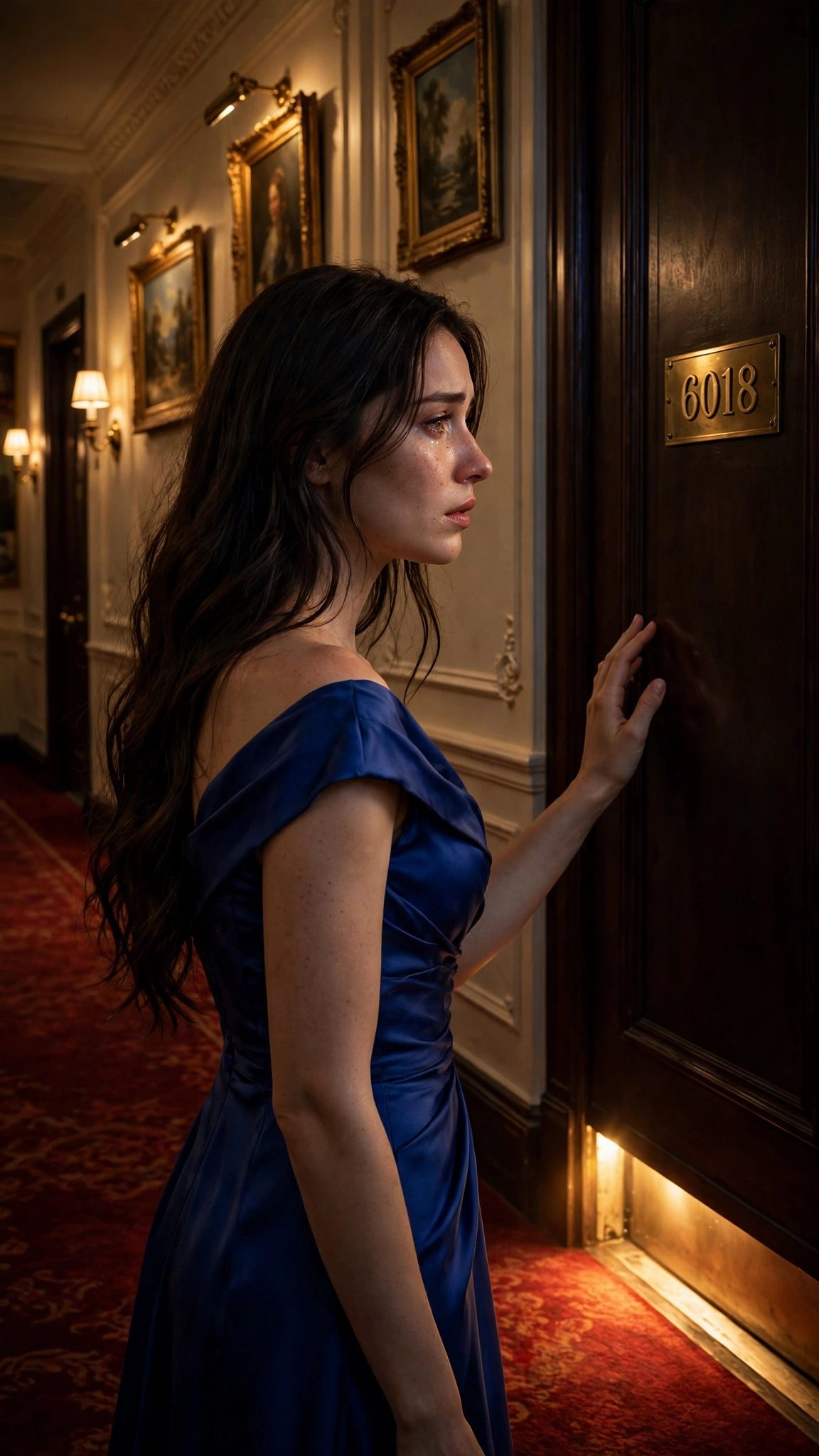
One year after the vows in Marta's garden, on a Saturday in May, we stood in the same garden, under the same arch of white roses, and Ava — three years old now, in a white dress with a crown of daisies — scattered rose petals in entirely the wrong direction, and Alexander held my hand, and I held his, and I looked at my husband and my daughter and my garden and my life, and I thought about the night I stood outside Room 6018 and heard another woman laughing, and I thought about the taxi in the middle of the night, and the train to a town I had never heard of, and the diner bathroom outside Rockford, and the little hospital in Galena, and the curtain of dried lavender, and the man in the wet black suit who had walked into my flower shop out of the rain and asked me why I had never knocked on the door.
That afternoon, we had a party for Ava's third birthday, in the same garden, under the same arch. Marta made a cake with white frosting and three candles, and Danny Cole came all the way from Chicago with a stuffed giraffe nearly as tall as Ava herself, and the old ladies of Galena brought casseroles and presents wrapped in too much tape, and Alexander — the most dangerous man in Chicago, the man who had once made entire rooms go quiet just by walking into them — sat cross-legged on the grass in his good suit, helping his daughter plant a rosebush in the corner of the garden.
"Like this, Dada?" Ava asked, patting the dirt with her small hands, her white dress already filthy, her crown of daisies sliding sideways over one eye.
"Like that," Alexander said. "Pat it down, gentle. Roses need a firm bed and a gentle hand. Your mother taught me that."
"Will it grow?" Ava asked.
"It will grow," he said. "Everything your mother plants grows. That is her magic."
"Is it your magic too?" Ava asked.
Alexander looked at me across the garden, over the top of our daughter's dark curls, and he smiled — the real smile, the one I had seen on the ladder in the ballroom all those years ago, the one that had made me fall in love with him before I knew his name.
"My magic," he said, "is that I found your mother. Twice. And I am never losing her again."
Ava nodded, very seriously, like this was a perfectly reasonable kind of magic, and she went back to patting the dirt, and the sun came down through the apple tree, and the garden smelled of white roses, and I stood there with a plate of cake in my hands, watching my husband teach my daughter to plant a rose, and I thought: this is what I walked away from Chicago to find. Not a town. Not a flower shop. Not an escape. A garden. A man who plants roses with his daughter. A life that belongs to us.
And I thought: I walked away from the Mafia King because I believed he had never loved me. And he spent two years tearing a city apart to find me, because he had loved me all along, and he had simply never learned how to say it.
That night, after Ava was asleep in her crib with the blanket covered in yellow ducks, Alexander and I sat on the porch of our little house, and he put his arm around me, and he said, very quietly, "My wife."
It was the first time he had ever called me that. Not Gianna. My wife. Two words, said simply, in the dark, with no one to perform for. And I leaned my head against his shoulder, and I said, "My husband."
And the garden smelled of white roses, and the river ran slow and brown past the old brick buildings, and the town of Galena, Illinois, went quiet around us, and our marriage — the real one, the one we had chosen — began.
The End.
THE END