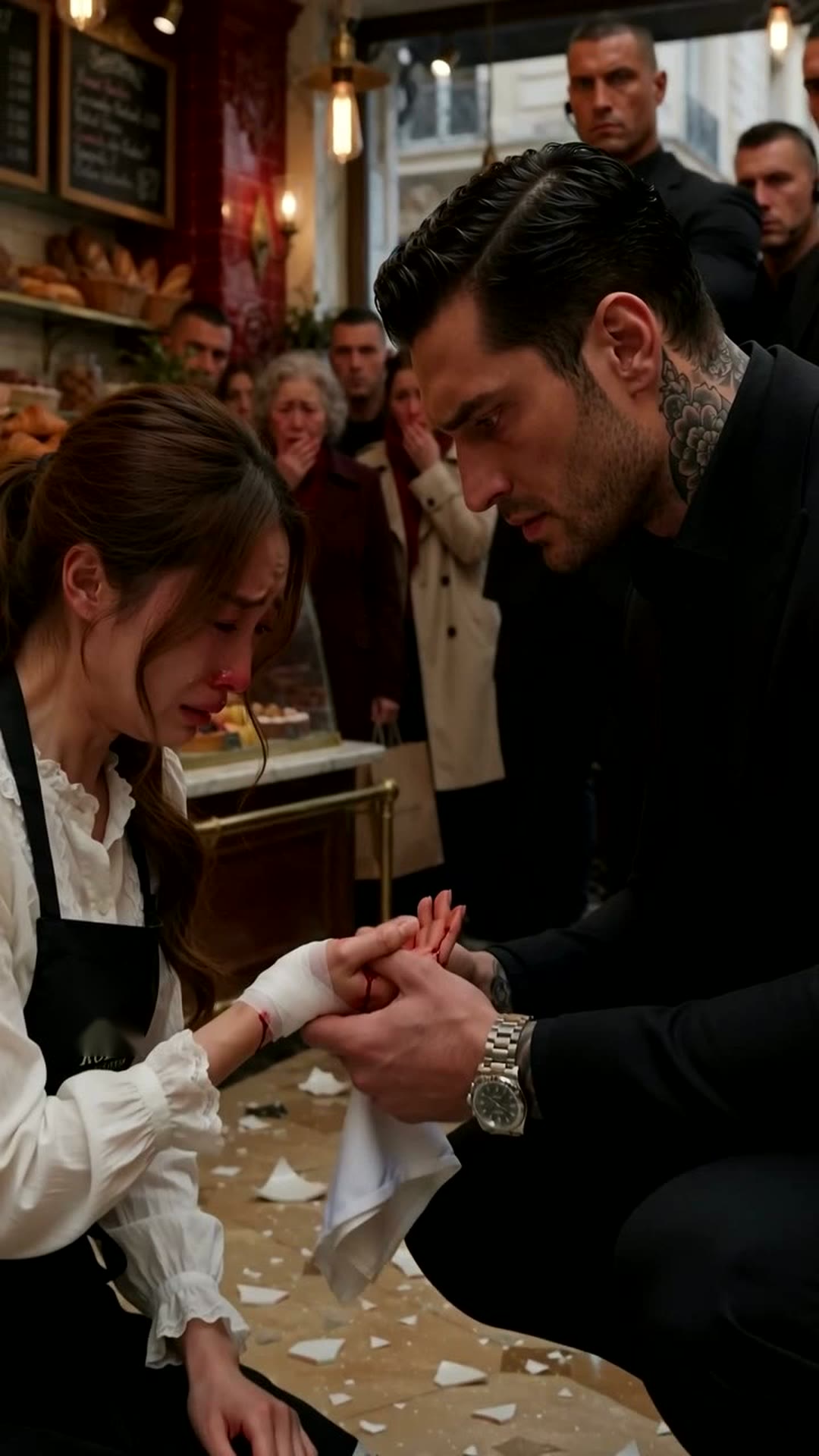
I made him wait three days, in the end. Not out of cruelty. Out of bookkeeping.
There were things to finish first, and I wanted to finish them standing on my own feet, in my own name, so that when I finally answered Alessandro Caruso's question there would be nothing unfinished standing behind me doing the talking.
The first was Marie's debts.
Alessandro had them all by then — every note, every IOU, every Thursday ever itemized — bought out of Harborlight's collapsing shell for cents and delivered to the estate in a cardboard box that the staff set down in the library like it was ordnance. Ninety-one thousand dollars of my aunt's fear, in paper form. We burned them in the library fireplace on a bright cold morning, page by page, together. He fed the fire one-handed, his shoulder still in its sling, and I read some of the amounts aloud, because they deserved to be heard before they were ash: forty dollars short on a Thursday. A winter coat, pawned and redeemed and pawned again. A debt that had started, six years ago, as nine hundred dollars for a card game in a back room — nine hundred dollars, compounded by fear into a chain that had held two women.
"I used to dream about these papers," I said, dropping the last one in. "I'd dream the men were in the apartment and the envelopes were empty. Every Thursday for a year I had that dream."
"You'll have better dreams," Alessandro said. "I'll see to the scheduling."
The second was the bakery.
Mrs. Moretti had telephoned the estate four times — the staff had stopped pretending the calls weren't for me — and on the third day I went down to Bellhaven in a car with exactly one guard, who waited across the street like a normal person, which for us counted as a honeymoon of privacy. The bakery window had been replaced. There was a crack in one tile by the counter that she said she was keeping, for character. She hugged me hard enough to hurt my ribs and then held me at arm's length and looked me over the way she'd looked at bread for thirty years, judging the bake.
"Your job is here when you want it," she said. "That's first. Second—" and she bustled, and produced, from under the counter, the offer she'd clearly been rehearsing: the building's owner was selling. Her lease was old. She had a little money and not enough, and she'd heard — the whole street had heard, because ports talk — that the Chen girl had come into her inheritance. "Partners," she said. "You and me. You buy the building, I run the ovens till I'm ninety, and you—" she pointed a floury finger at me, "—you work mornings because you love it, not because some man is coming on Thursday. There's a difference and you've never had it."
I bought the building. Well — my signature did, in Ms. Hale's office, with tea, in the ordinary miraculous way of free people doing business. Moretti's Bakery, est. whenever, owned now by a partnership of one stubborn Sicilian and one twenty-four-year-old port shareholder, and if that isn't the most Bellhaven sentence ever written I don't know what is.
I kept the morning shifts. I want the record to show that too. Four days a week, I get up before sunrise because the bread does, and I tie my hair back and tie on an apron — a new one, with my name embroidered by Mrs. Moretti in green thread — and I carry coffee to table seven past a window that is whole, and nobody in the warm, flour-smelling room is afraid of anything except running out of the good croissants by nine.
And the third thing, on the third day, was the answer.
He was in the garden. The estate garden in autumn is mostly green going gold, and he was standing at the stone balustrade with two coffees, because he'd known — of course he'd known — that I'd come out when I'd finished my calls. His sling was off for an hour a day by then. The box was not in his hand. I'd checked. He'd meant what he said in the hospital: he wasn't asking.
"I've been thinking about what I want," I said.
"I'd noticed." He handed me a coffee. "You've been thinking at a volume the whole house could hear. Signora Bianchi has started leaving sandwiches outside the library like it's a siege."
"Here's my list. I want the bakery, mornings. I want my name on my own door — I'll move back here if I choose it, Alessandro, and I do choose it, but my apartment stays mine until my lease ends, because a woman should own an exit even if she never uses it. I want Thursdays to be for the woman on Whitfield Street. She has two children. We're taking her bread on a standing order, paid by the consortium's charitable fund, which I now apparently help direct, and which nobody is allowed to find touching except me."
"Done," he said. "All of it. That isn't a negotiation, Sophia, it's a shopping list. Was there anything on it you expected me to refuse?"
"Yes," I said. "The last item."
I took the box out of my own pocket.
I'd asked Dante for it that morning — not stolen it: asked, formally, the way you request the transfer of state property, and Dante had gone very still and then produced it from the study safe with the air of a man handing over a crown. The silver ring sat in it, cold and plain and mine.
"I want to marry you," I said. "Again. Properly. In a registry office, or a garden, or a bakery — Mrs. Moretti has already volunteered the bakery and, I think, the cake — with no fathers arranging it and no enemies requiring it and nobody's protection anywhere in the paperwork. I want to say the words because they're true and not because they're a wall. I want witnesses who are there for love and not for surveillance." I held the box out to him, and my hand was perfectly steady. Six years, and my hand was steady. "Four years ago you searched for me. Six years ago you married me to keep me alive. I'm not asking you to keep me alive anymore, Alessandro. I'm asking you to be my husband because I, Sophia Chen, freely and in broad daylight, choose you. Will you—"
He took my face in both hands — the bad shoulder be damned, and the doctor, and the sling schedule — and he said, "Yes," into my mouth, more or less, and kissed me in his own garden like a man who had been practicing restraint for six years and had just been honorably discharged from the army of it.
On the morning of the wedding I went to my father's grave. I hadn't been since I was eighteen — Marie had always taken flowers on the family's behalf, which I now understood as one more door she had stood in — and I went early, before the house woke, with Dante driving and saying nothing at all. Alessandro had offered to come and then, reading my face, had offered instead to wait at the cemetery gate, which he did, in his good coat, like a sentry who has finally learned the difference between guarding a person and guarding her privacy.
The stone said his name and two dates and BELOVED, in the careful upright lettering of a man who had chosen even that. I put white flowers down — not the funereal banks of my first wedding, a small bunch I had picked from the estate garden without asking, which made them the first thing I had ever taken from that house purely because I wanted it.
"I'm safe, Papa," I said, out loud, to a stone, in the cold. "It took all of us and most of a decade, and your friend is finished, and your daughter signs her own name now. And I'm marrying him today. Again." I laughed, standing there, and it wasn't sad, exactly. "You'd have liked that it's my idea this time. You'd have pretended not to, for the negotiating position, and then you'd have cried at the cake. I'm having the cake anyway. Watch from wherever. It's five tiers. Mrs. Moretti calls it modest."
The gate was a long walk back. Alessandro didn't ask what I'd said. He just opened the car door, and on the way home, at a red light, without looking at me, he said, "He would be out of his mind with pride. I have some experience of the condition," and drove on.
We were married on a Saturday, three weeks later, in the garden, with forty guests and no business conducted whatsoever. Mrs. Moretti made the cake — five tiers, which she called modest. Dante stood as his witness and cried without any shame at all and denied it twice before dessert. Tomaso gave me away, because my father couldn't, and because the old man had crossed himself at the sight of me in the rain the day I came home, and some debts you pay in honor. I wore a white dress I chose out of a shop window because I liked it. I walked down a path of his roses on no one's arm but my own decision, and Alessandro Caruso — who had faced down gunmen, surgeons, and six years of Tuesdays of failure without a tremor anyone could detect — stood at the end of it visibly not breathing, with my ring in his pocket, where his whole life used to live.
"I, Alessandro," he said, when his turn came, "take you, Sophia." He stopped. Restarted, in front of everyone, with his voice wrecked. "I spent four years trying to find you. I'll spend the rest of my life making sure you never have to be found again — only ever, always, exactly where you choose to be."
And I said my name, and his name, and the words, and meant every syllable as a free woman means things.
The ring went on warm this time.
That was a year ago. The port does whatever ports do, at slightly more honest rates. The bakery's croissants still run out by nine. On Thursdays I take bread to Whitfield Street, and sometimes Alessandro comes with me, carrying the crate without being asked, a feared man in a black coat delivering brioche to a doorstep while two children hide behind their mother to stare at the tattoo on his neck.
The long dining table seats twenty. We use one end of it — the same two adjacent places, close enough to pass the bread — and on Sundays Signora Bianchi revolts quietly and sets six, and the house fills: Dante and his terrible jokes, Dr. Rosini inspecting my scar and pronouncing it "a signature," Ms. Hale with her good pen put away and a bottle of something scandalous instead, Mrs. Moretti arriving with bread like a visiting head of state. My husband conducts these dinners from beside me, not across from me, and if a guest ever wonders why the far end of the table stays empty, nobody explains. Some furniture is a memorial. We let it be one.
He still stands, sometimes, in doorways of our house — the kitchen at dawn, the library at dusk — and watches me the way he watched me eat that first dinner, like weather he waited years to stand in. It used to frighten me, that stillness. Now I know what it is. It's a man reminding himself that the search is over.
I was forced into a marriage at eighteen with a man I believed hated me. I was wrong about almost everything — the hatred, the leaving, the accident, even my own name on other people's paper. But I've learned this: a cage and a shelter can look identical from inside a storm. The difference is who holds the door, and whether it's open, and whether the person standing in it would die — has nearly died — to keep it your choice.
Alessandro's hand finds mine across the breakfast table most mornings now, over bread I made because I love it, in a house whose doors have never once been locked.
He spent four years trying to find me.
I intend to spend the rest of my life being gloriously, deliberately, happily found.