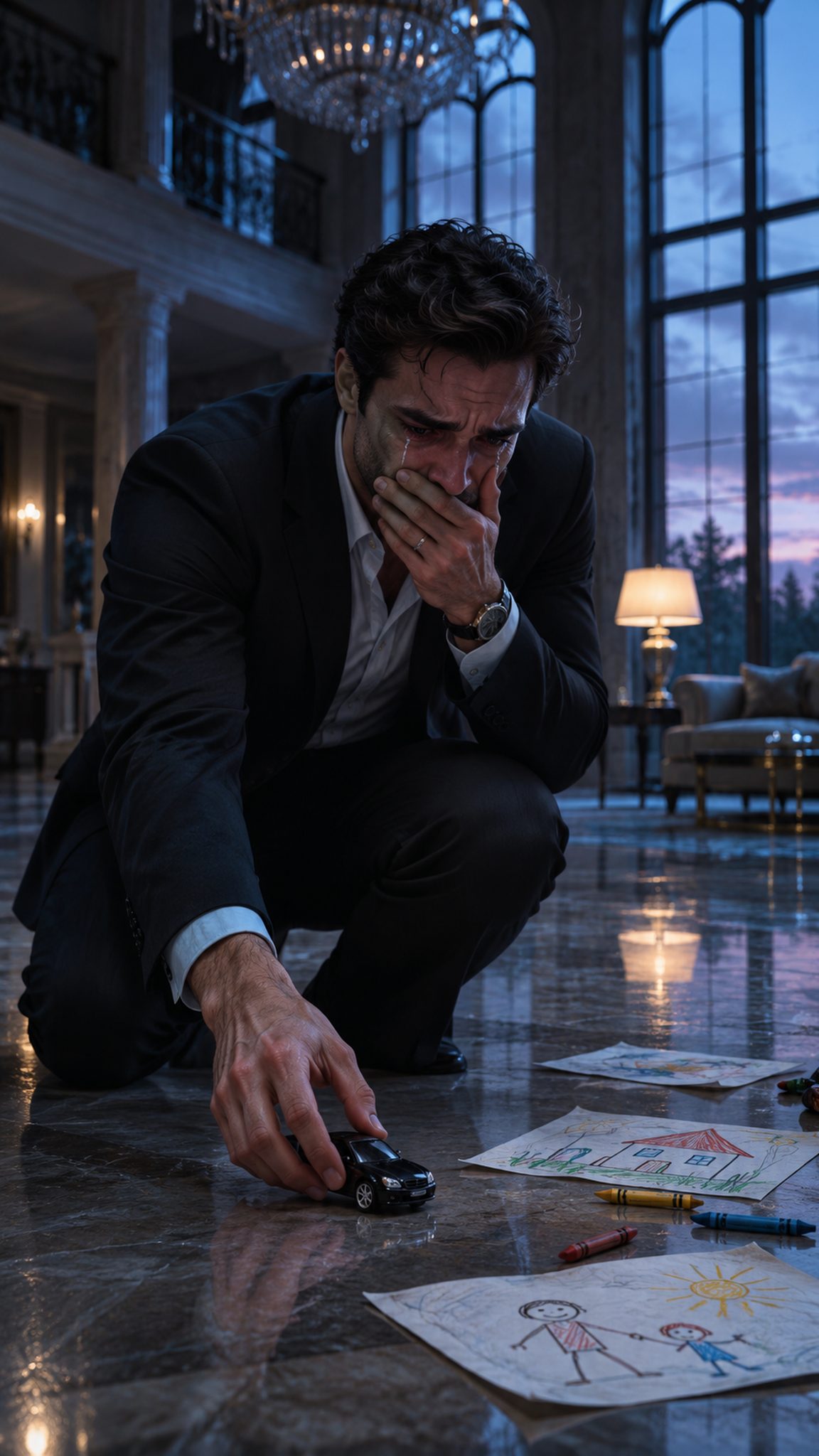
The first thing I learned about keeping a promise was that it had to survive ordinary days.
There were no hospital alarms in our new house, no surgeons waiting behind closed doors, and no monitor telling me whether my son was safe. There was only the refrigerator humming in the kitchen, the small clock above the doorway, and Lucas asking whether I would be home before dinner.
“Yes,” I told him.
He studied my face. “Even if work calls?”
“Even then.”
He considered that answer, then returned to his cereal. I understood that he was not testing me to be difficult. He was checking whether the world had changed enough for him to trust what he heard.
I made sure it had.
Lucas's recovery continued under the care of his specialists. We kept every follow-up appointment. We brought the records, asked questions, and listened carefully to the doctors' instructions. There were examinations that made him nervous and days when he came home tired. Sometimes he asked whether his heart was getting better. We answered honestly: the doctors were encouraged by his progress, but they still needed to monitor him.
I stopped trying to turn uncertainty into a promise.
At one appointment, the specialist reviewed the latest results and explained that Lucas was continuing to recover. He still needed regular follow-up care and careful attention to symptoms, but there was no immediate reason to change the plan. Elena asked about the next checkup. I wrote the date in my calendar and repeated it aloud.
Lucas sat between us, swinging his feet above the floor.
“Does that mean I can play outside?” he asked.
“With the limits we've discussed,” the doctor said. “You can enjoy gentle activities, and your parents will help you follow the plan. If you feel tired, you stop and tell them.”
Lucas nodded solemnly, as if he had been given an important responsibility.
On the way home, he asked whether we could visit the small park near our house.
“We can walk there,” Elena said. “We'll see how you feel.”
“I feel okay.”
“Then we'll take it slowly,” I told him.
He reached for my hand. I held it, matching his pace rather than pulling him along. The park was ordinary: a few benches, a patch of grass, a path beneath trees, and children playing at a distance. Lucas sat beside Elena and watched them for a while. He did not complain that he could not run with them. He asked me to tell him what kind of bird was sitting on the fence.
I did not know.
“I think it's a sparrow,” I said.
“You think?”
“I'll look it up when we get home.”
He smiled. “You don't know everything?”
“Not even close.”
He seemed delighted by that discovery.
At home, I found a book about local birds and sat with him at the kitchen table. We identified the bird together. He drew it beside the house on a fresh sheet of paper, adding a tree that was much taller than the roof.
These small afternoons became the center of my life. I learned which pencils Lucas preferred, which stories he wanted repeated, and how long he could concentrate before he needed a break. I learned that he liked the crusts cut from his sandwiches but wanted the crusts saved if they were shaped like triangles. I learned that he sometimes wanted Elena to help him and sometimes wanted me.
I did not take those choices personally. I had no right to demand that he make up for the time I had missed.
I kept my evenings clear. If a lawyer needed a signature, it could be arranged during the day. If a former associate wanted to discuss the old organisation, the answer was no. Victor handled the remaining transition, and my attorneys dealt with the business matters that could not simply disappear. Some disputes took longer than expected. There were documents to review and obligations to settle. I did what was necessary through lawful channels, then returned to the life I had chosen.
I no longer kept a private office in the house. I used a small desk in the spare room for correspondence, and I closed the door when I finished. The phone stayed on the desk during dinner. If it rang, I let it ring unless it concerned an immediate family need.
At first, I had to remind myself that nothing terrible would happen if I was unavailable for an hour. The old instinct remained. I would hear a vibration and reach for the phone before remembering where I was. Then I would look at Lucas, who was usually telling me something about a drawing or a book, and put the phone down.
One evening, he stopped in the middle of a story.
“Are you listening?”
I looked directly at him. “Yes. You were telling me why the blue car won the race.”
“Because it didn't stop.”
“Right. And what happened after that?”
He continued, pleased that I remembered. I made sure I did.
Elena noticed the changes, but she did not announce them. Trust was not a prize she handed me for completing a list of tasks. It grew in small moments, and sometimes it seemed to retreat. There were evenings when she talked easily with me and others when she became quiet after remembering something from the past.
I learned not to demand an explanation every time her expression changed.
One night, she found me checking Lucas's next appointment against the calendar.
“You've got the date right,” she said.
“I checked it twice.”
“You don't have to prove anything to me with a calendar.”
“I know. I just don't want to miss it.”
She leaned against the doorway. “I used to keep all of those dates in my head because I couldn't rely on you to remember.”
“I know.”
“It was exhausting.”
“I am sorry.”
She looked at the calendar for a moment. “It's easier now that we're sharing it.”
That was all she said, but I carried the sentence with me for the rest of the evening.
The divorce papers remained in a drawer. We had agreed not to rush a decision while Lucas was recovering, and neither of us had pretended that living together meant the marriage was repaired. We had talked about what had happened, but there were still conversations we had not finished.
One Saturday, after Lucas had gone to a friend's family gathering with Elena's permission and under the activity limits his doctors had given us, Elena and I sat at the kitchen table. The papers were between us.
“I think we should decide what we're doing,” she said.
I looked at the envelope. “About the divorce?”
“Yes. I don't want us to drift because it's easier not to decide.”
I nodded. “Then let's talk honestly.”
She rested her hands on the table. “When I filed, I believed I had to end the marriage to protect Lucas and myself. I couldn't keep waiting for you to become someone you had no intention of being.”
“I understand why you filed.”
“I need you to understand that I didn't leave to teach you a lesson. I wasn't trying to make you chase me.”
“I know that now.”
“I had already decided I could not raise Lucas in that house, with Serena coming and going and you treating his feelings as an inconvenience. His health made the decision more urgent, but it wasn't the reason I first wanted to leave.”
I listened without interrupting.
“I know you've changed some things,” she continued. “You've stepped away from the organisation. You've stayed with Lucas. You've been at every appointment since we came here. But I need to know what happens when life becomes difficult again. When work is demanding. When someone threatens you. When you are angry.”
“I can't promise that I will never be angry or that problems won't come. I can promise that I won't make you and Lucas pay for them. I won't return to the life I had before, and I won't use my past as an excuse.”
She watched me closely. “What if the old men come looking for you?”
“I will not meet them privately or send anyone after them. The remaining matters will go through lawyers and the authorities. I won't rebuild the organisation under another name.”
“And Serena?”
“There is no relationship. There will not be one.”
“I don't want to spend the rest of my life wondering whether someone else is waiting for you in a hotel room.”
“You shouldn't have to.”
She looked down at the papers. “I loved you before you became powerful. I loved the man who used to sit with me after a long day and tell me what he was afraid of. Somewhere along the way, you stopped letting me know you. You made yourself into someone nobody could question.”
“I thought being feared meant I was safe.”
“Were you?”
“No. I was alone in a house full of people.”
She took a slow breath. “I don't want the old marriage back.”
“Neither do I.”
“I want honesty. I want a partner. I want Lucas to see two adults who respect each other, whether we agree or not. I want to know that if I tell you something hurts me, you won't call it an attempt to control you.”
“You have my word.”
She raised her eyes.
“I know words aren't enough,” I said. “So I won't ask you to decide because of what I'm saying today. I want to choose you again, but I want you to choose freely. If you need more time, I'll give it. If you decide the divorce is still right, I won't punish you for it.”
She was quiet for a long time.
“I don't want to divorce you now,” she said at last. “I want to set the papers aside. Not destroy them. Not pretend they never existed. I want us to rebuild slowly, and I want us to be able to stop if the old patterns return.”
I felt something loosen in my chest, but I did not reach across the table as though the decision belonged to me.
“That's what I want too,” I said.
“Then we remain married for now, on honest terms. We take it one day at a time.”
“One day at a time.”
She reached across the table. I placed my hand beneath hers, and she let it rest there. It was not the end of our difficulties. It was a choice made with open eyes, and that made it more meaningful than any promise I had ever made in anger or fear.
Lucas came home that afternoon carrying a small paper bag. He had chosen a present for Elena from the little shop near the park: a painted wooden bird. He gave it to her with a seriousness that made her laugh.
“For the kitchen,” he explained. “So the real birds know where we live.”
Elena kissed his forehead. I helped him put the bird on the shelf. He looked at the drawing on the refrigerator, then at the wooden bird, and decided the picture needed another tree.
We added it together.
As the months passed, Lucas grew stronger. His follow-up visits continued, and we remained careful about his activity. The specialists were pleased with his progress, though they reminded us that his congenital heart condition required ongoing attention. We did not treat good news as permission to ignore the plan. We kept the appointments, followed the instructions, and made room for ordinary childhood without pretending he had never been ill.
His laughter returned in fuller bursts. He began spending longer periods drawing and building things. He still had tired days, and sometimes he asked to rest while other children played. We made sure he never felt he had to prove he was strong.
I learned that protecting him did not mean surrounding him with men or removing every possible risk. It meant listening when he said he was tired, making sure he received the care he needed, and letting him have a childhood that was not organized around my reputation.
His birthday approached.
The previous birthday remained a wound I could not erase. I remembered the promise I had made and broken, the tiny suit, the cake, and the empty chair. I remembered the photograph of Serena wearing the diamond necklace and Lucas asking why I always chose her.
This time, I wanted no grand event. Lucas and Elena agreed on a small celebration at home. We would invite a few people he liked, make the cake together, and keep the day gentle. The doctors' guidance would determine what he could comfortably do. There would be no crowded ballroom, no business guests, and no reason for me to leave.
A week before the birthday, Lucas asked what time I would come home.
“I'll already be here,” I said.
“What if somebody calls?”
“They can leave a message.”
“What if it's important?”
I crouched beside him. “You are important. Your birthday is important. I will be here.”
He looked at me for a long moment. “Before the candles?”
“Before the candles.”
I did not say it casually. I put the date in my calendar, told my office I was unavailable that evening, and arranged for the remaining legal work to be handled earlier. I also told Victor that no one was to contact me unless there was an immediate emergency involving safety. There would be no business dinner and no late meeting.
On the morning of his birthday, Lucas woke early. He came into the kitchen wearing his favorite shirt and asked whether we could decorate.
Elena had already prepared the table. I helped Lucas hang paper decorations at a height he could reach. We made a small banner with colored letters. He insisted that one letter be crooked because it looked funnier that way.
The cake took most of the afternoon. Lucas helped mix the batter while Elena measured the ingredients. I was assigned to wash the bowls and keep the kitchen tidy. At one point, flour landed on my sleeve.
Lucas laughed. “You look like a ghost.”
“An extremely dangerous ghost?”
“No. A messy one.”
Elena laughed too, and for a moment the kitchen filled with the kind of noise I had once believed would always be waiting for me.
We kept the celebration small. A few of Lucas's friends came with their parents. They played quietly in the garden and spent time drawing at the table. Lucas tired sooner than they did, so we let him rest before bringing out the cake. Nobody made him feel that he was missing anything.
At six, I checked the time. There was no reason to check it. I was already home, and I had nowhere else to be.
Lucas came into the living room holding the black toy car.
“Can it sit beside the cake?” he asked.
“Of course.”
He placed it on the table, carefully away from the plates. The little car had once been the only object left behind in an empty mansion. Now it had a place of honour beside the cake, not as a reminder of abandonment but as part of the story our family had survived.
When the candles were lit, Lucas looked at me.
“Are you staying?”
I pulled my chair close to his.
“I'm right here.”
He looked at Elena. She stood on his other side, smiling through bright eyes.
“Both of you?”
“Both of us,” she said.
The guests began singing. Lucas laughed at the loudest voices and covered his ears for a moment. When the song ended, he looked at the candles. He did not hesitate. He did not look toward the door.
He looked at us.
“Can I make a wish?”
“Of course,” Elena said.
He closed his eyes. I watched his small face in the candlelight and wondered what he would wish for. I did not ask. Some wishes belonged only to the person making them.
He blew out the candles.
Everyone applauded. Lucas smiled, then leaned toward me.
“You came before.”
“I did.”
“You stayed.”
“I did.”
He nodded, as if those two facts were enough.
After the guests left and Lucas had rested, Elena and I cleaned the table together. The black toy car remained beside the cake plate. I picked it up and turned it gently in my hand.
“Do you remember the note?” Elena asked.
“Yes.”
“Do you still think about it?”
“Every day.”
“He was trying to tell you something.”
“I know. I wish I had understood sooner.”
Elena dried a plate and placed it away. “You can't go back to that evening.”
“No.”
“But you can decide what this evening means.”
I looked toward the living room, where Lucas was arranging his birthday cards.
“I think it means I finally came home.”
She set the towel down. “Then keep coming home.”
“I will.”
Later, Lucas brought us a new drawing. He had worked on it during the afternoon while the guests were there. The house stood beneath a yellow sun. Three figures stood in the garden, their hands joined. The black toy car was drawn near the front step. Above the figures, he had written, “My family.”
At the bottom, he had added a sentence in smaller letters.
“Dad is home.”
I read it once, then again.
Lucas looked up at me. “Is it good?”
“It's wonderful.”
“Can we put it with the other one?”
I understood which other one he meant. The earlier drawing with the three of us beneath “My family” had been kept safe. The final picture from the mansion, the one that said “Dad's busy,” remained in the box. We had not thrown it away. It belonged to the truth of what had happened, just as the new drawing belonged to the truth of what we were building.
“We can put it beside the first one,” I said.
He nodded. “Then we have both.”
Elena helped him choose a place on the refrigerator. We placed the new drawing beside the earlier picture. The black toy car went back to its shelf by the window, where Lucas could reach it whenever he wanted.
That night, after Lucas was asleep, Elena and I stood in the kitchen looking at the drawings.
“I used to wonder whether you would ever understand what you were losing,” she said.
“I didn't understand until it was almost too late.”
“Almost,” she repeated.
I looked at her. “I know how close it came.”
She took my hand.
“I don't want us to spend the rest of our lives talking only about what happened,” she said. “I want us to make something new.”
“So do I.”
“We'll still have difficult days.”
“I know.”
“And I won't always be able to trust you without thinking about the past.”
“I won't ask you to.”
She moved closer. “But I want to try.”
I lifted her hand and kissed it. “I want to try too.”
We did not pretend that love alone could repair everything. We had to keep choosing honesty, patience, and the ordinary work of being together. We had to let Lucas grow without making him responsible for our happiness. We had to accept that some memories would remain painful even as new ones took their place.
I had once believed that the measure of a man was how many people feared disappointing him. I had built an empire around that belief. I had mistaken obedience for loyalty and control for protection. I had thought my family would wait forever because they loved me.
They had loved me. That had never been the problem.
The problem was that I had treated their love as something I could spend without limit.
I lost the ordinary evenings, the drawings, the birthday candles, the appointments, and the chance to be there when my son needed me. I nearly lost the future in which he could grow up knowing his father. I could not buy those years back, and I would never pretend that giving up power made the damage disappear.
But I could choose what happened next.
I could be present when Lucas woke in the morning. I could take him to his appointments. I could read the stories he loved and listen when he corrected me. I could sit with Elena at the kitchen table and tell her the truth, even when it was difficult. I could come home before dark and remain there after the world called.
The black toy car had a place of honour now. It no longer sat alone on a marble floor beneath a message from a child who believed his father had forgotten him. It rested beside a family drawing, in a modest house where the people inside had learned to wait for one another without fear.
I was no longer the man Chicago had feared.
I was Adrian Moretti, husband to Elena and father to Lucas. Those were the names that mattered. Those were the lives I had to protect.
And every evening, when the light began to fade beyond our windows, I was home.
THE END
THE END