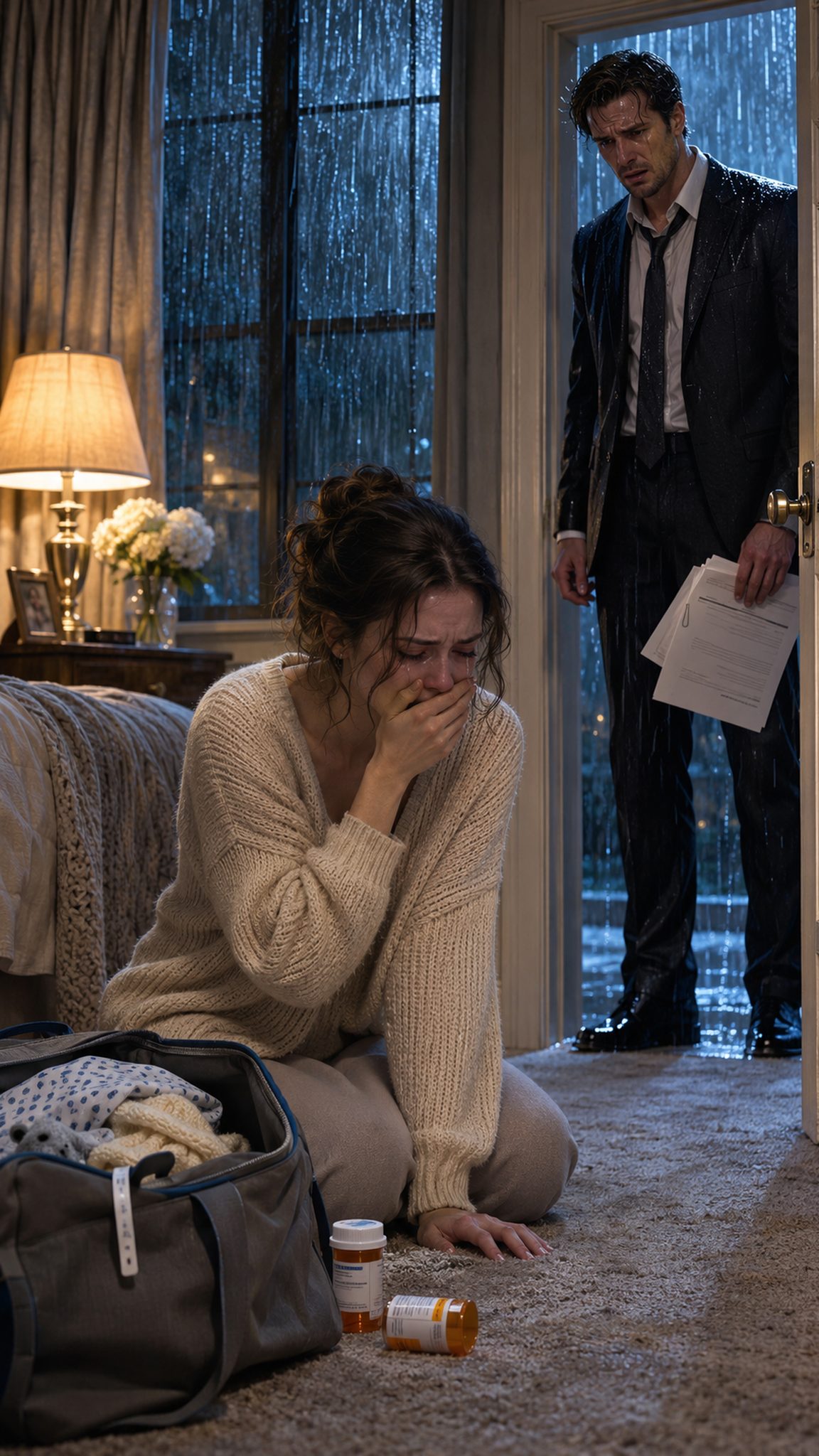
The storm had followed Adrian Cross all the way across Chicago.
Rain battered the windows of the black sedan as it turned through the iron gates of the house. The driver slowed beneath the covered entrance, but Adrian was already reaching for the door. He had spent the entire journey rehearsing what he would say. Ten minutes, perhaps less. He would put the papers in front of Claire, explain that the marriage had become impossible, and leave before either of them said something they could not take back.
The divorce papers were hidden inside his jacket.
He had expected anger. Tears, perhaps. A demand for explanations. He had prepared himself for all of it, because Adrian Cross was a man who prepared for every negotiation. He controlled freight yards, waterfront warehouses, construction companies, and private clubs across Chicago. Men twice his size fell silent when he entered a room. A single sentence from him could end a business partnership, ruin a career, or make a dangerous man reconsider his choices.
At home, however, he had not prepared for what waited upstairs.
The bedroom door stood partly open. A warm lamp illuminated the carpet, where a canvas hospital bag lay beside a small collection of prescription bottles. A folded gray sweater rested beside a phone charger. Near the bed, a white plastic hospital bracelet lay next to a stack of medical documents.
Claire was kneeling on the floor.
She looked smaller than he remembered. Her cream sweater hung loosely from her shoulders, and her long fingers moved slowly as she placed medication into the bag. Her cheeks were hollow. Dark shadows sat beneath her eyes. When she tried to reach for a zipper, she paused as though the movement had taken more effort than she expected.
For the first time in months, Adrian actually looked at his wife.
"Claire?"
She froze.
Then she glanced toward the jacket he was wearing.
"You could've sent Daniel."
Daniel Mercer was Adrian's attorney. The man who had prepared the documents in Adrian's pocket.
"The papers require your signature," Adrian said.
"Leave them on the desk."
She returned to packing.
He remained in the doorway. His eyes moved from the bag to the bottles, then to the bracelet. He had entered the room intending to end a marriage. Now he was trying to understand why his wife was preparing for another hospital visit.
"Where are you going?"
"The hospital."
"For what?"
Claire zipped the inside pocket of the bag. "That doesn't concern you anymore."
"I'm still your husband."
She looked up. "Yes. Until I sign."
Adrian's jaw tightened. He was about to answer when he noticed the medical documents on the bed. Beside them lay a small emergency contact card. Claire reached for it, but he had already read the four words printed across the top.
DO NOT CALL ADRIAN.
The room seemed to become unnaturally quiet.
He looked at her again.
"Are you pregnant?"
The question startled her. "No."
"Then what is going on?"
Claire tried to stand. A wave of dizziness forced her to steady herself against the mattress. Adrian took a step forward.
"Claire?"
She closed her eyes. There was no point hiding it anymore.
"I'm sick."
Thunder rattled the windows.
"How sick?"
"It doesn't matter."
"Claire. How sick?"
She gave a tired laugh. "You came home carrying divorce papers, Adrian."
"I asked you a question."
"And I'm not one of your employees."
For once, Adrian had no immediate response.
His voice softened. "What's wrong with you?"
Claire looked toward the rain streaking the windows. "I have an autoimmune disease. It attacks my connective tissue and sometimes my organs."
His gaze dropped to the medicine bottles.
"I've been receiving infusion therapy."
"How long?"
She said nothing.
"Claire, look at me."
She couldn't. If she looked at him, she might remember the man who had once promised to protect her from everything. She could not afford to fall apart before another hospital visit.
"How long?" he repeated.
Her throat tightened. "Long enough."
"That's not an answer."
She finally met his eyes. "Long enough to learn which hospital forms to fill out when your husband doesn't answer his phone."
Adrian went still.
Claire picked up her canvas bag. "Please move. I have an appointment."
He did not move. His eyes shifted from the hospital bracelet in her hand to the divorce papers inside his jacket.
"Why didn't you tell me?"
For a moment, she could only stare at him.
Then she turned toward the bedside drawer. The truth was that she had tried to tell him. More than once. And inside that drawer was something she had kept from every hospital visit.
She pulled out a thick folder and placed it on the bed.
"Before you ask me another question, Adrian, look at the dates."
He opened it. His eyes moved across the first page, then the second. When he reached the document marked EMERGENCY ADMISSION, his hands stopped moving.
"Claire," he whispered, "why didn't anyone call me?"
She looked at the man she had once trusted with her life.
"That's what I've been trying to tell you."
For several seconds, neither moved.
Adrian wanted to ask another question, but Claire had already lifted the bag. She adjusted the strap over her shoulder and reached for her coat. He watched her struggle with one sleeve before she managed to pull it over her arm.
"Let me take you."
"No."
"Claire—"
"I have an appointment. I don't have time to stand here explaining why I learned to go alone."
"You're not going alone tonight."
She looked at him with an expression he could not read. "You don't get to decide that now."
He stepped aside.
Claire walked past him. At the top of the stairs, she paused to catch her breath. Adrian followed, keeping several steps behind. He did not touch her. At the entrance, she took her keys from the small table.
"I'll call a car," he said.
"I already arranged one."
The words landed harder than he expected.
A moment later, headlights appeared beyond the front windows. Claire opened the door, and cold rain swept into the foyer.
Adrian stood beneath the chandelier as she crossed the threshold.
"Claire."
She turned once.
"Don't make this about the papers," she said. "You came here to end our marriage. I have somewhere more important to be."
Then she left.
The door closed, and the house returned to silence.
Adrian remained in the foyer, one hand still inside his jacket. The divorce documents pressed against his ribs. He took them out and looked at the neat legal language. A few minutes earlier, he had believed those pages represented the most difficult decision he would make that night.
Now he could not stop seeing the words on the emergency card.
DO NOT CALL ADRIAN.
He went upstairs.
The medical folder remained open on the bed. He began reading from the first page, then returned to the beginning when he realized he had skipped a date. There were appointment summaries, laboratory reports, treatment notes, hospital admission records, and medication lists. Some pages carried dates from months earlier. Others were recent.
He found a record of an emergency admission and a note indicating that Claire had arrived without a family contact present.
He checked the date.
Then he checked it again.
It had been a day when he remembered being in Chicago. He had attended a meeting at one of his private clubs and returned to the office afterward. He had not been out of the country. He had not been unreachable because of a crisis. He had simply been busy.
His phone was in his hand before he realized he had picked it up.
He called Daniel.
The attorney answered quickly. "Adrian?"
"Did you know Claire was ill?"
A pause.
"What?"
"Did you know my wife was receiving infusion therapy?"
Daniel hesitated. "I knew there had been a medical matter."
"What does that mean?"
"I received a message some time ago. It was marked personal and urgent. I understood that you were unavailable."
"Who told you I was unavailable?"
"I believe the office had instructions about personal calls during business hours."
"That isn't what I asked."
Daniel's voice grew careful. "I don't want to give you an inaccurate answer. I'll review the records."
"Do it tonight."
"Adrian, is Claire—"
"She's at the hospital."
The silence on the other end lasted several seconds.
"I'll find the records," Daniel said.
Adrian ended the call.
He returned to the folder. Several documents included dates that preceded the first message Daniel remembered. Claire had been receiving medical care for longer than Adrian had known. He looked at the emergency contact card again, then at the handwritten notes attached to the medical records.
There were details he did not understand. Medical terms he had never heard Claire use. References to monitoring, infusions, symptoms, and follow-up appointments. He could not diagnose her by reading the pages, and he knew enough not to pretend otherwise.
But he could understand the dates.
He could understand how many appointments had passed without him.
And he could understand that his wife had written his name out of her emergency plan.
He returned to the bedroom and opened the bedside drawer. Inside were older appointment cards, folded discharge instructions, and a small envelope containing receipts. One card had a date from months earlier. On the back, in Claire's handwriting, were three short reminders: bring medication list, ask about next infusion, arrange transport.
There was no note to Adrian.
He sat on the edge of the bed.
For the first time that night, the most feared man in Chicago felt afraid of something he could not threaten, negotiate with, or control.
He had to remember how they had arrived here.
Because there had been a time when Claire Cross had never needed to write instructions telling a hospital not to call her husband.
They had met at a charity event in Chicago, years before the Cross name became a regular feature in business pages and whispered conversations. Claire had been helping organize a fundraiser for a medical research foundation. She was not impressed by expensive watches or powerful introductions. She had spent the evening making sure elderly guests could find their seats and that the volunteers had enough food.
Adrian had noticed her because she was the only person in the ballroom who seemed unaware of how many people wanted his attention.
He had been standing near the terrace doors when she approached with a tray of untouched glasses.
"You're blocking the exit," she had told him.
He had looked at her, surprised.
"Am I?"
"Yes. People keep trying to get outside, and nobody wants to ask you to move."
A faint smile had touched his mouth. "You could have asked more politely."
"I could have. But then you might think I was asking permission."
He had moved.
Later, he found her near the quiet end of the ballroom. They spoke about the fundraiser, the foundation, and the way people behaved when they believed wealth made them important. Claire asked him what he actually did. Adrian gave her a carefully edited answer.
She listened, then said, "You make it sound as if you spend your entire life solving problems other people create."
"That is often the job."
"Does anyone ever ask what you want?"
He had not expected the question.
"Not usually."
"Then perhaps you should find someone who does."
He remembered that conversation long after the event ended.
Their courtship had not been simple. Adrian's world came with security arrangements, complicated business relationships, and people who considered his personal life a weakness to exploit. Claire understood that he was powerful, but she did not confuse power with character. She asked direct questions and expected honest answers.
He had been drawn to that honesty.
When he proposed, he did not arrange a public spectacle. He took her to a quiet restaurant overlooking the river, where they had shared their first long conversation after the charity event. He placed a ring beside her glass and told her that he wanted a life in which she never had to wonder whether she mattered.
Claire had laughed through her tears.
"You make very serious promises."
"I intend to keep them."
She had said yes.
Their wedding was elegant but intimate. Claire wore a simple ivory gown, and Adrian watched her walk toward him as though the crowded room had emptied. He remembered the way she held his hand during the vows. He remembered promising to protect her, but more importantly, he remembered promising to listen.
For the first years of their marriage, he had tried.
He came home for dinner when he could. He asked about her projects and remembered the names of people she worked with. They traveled when business allowed. Sometimes they stayed home, ordered food, and argued over films. Claire teased him about his habit of checking the security cameras even when they were supposed to be relaxing.
"You know nobody is attacking us during dessert," she had once said.
"That is exactly when people become careless."
"You're impossible."
"And yet you married me."
"One of my more questionable decisions."
He had laughed, and she had kissed his cheek.
There had been warmth in their home then. Not perfection, but companionship. Claire had never demanded that Adrian abandon his businesses. She knew the life he led before she married him. What she wanted was a place within that life, a place that did not disappear whenever the telephone rang.
The change came gradually.
Adrian's responsibilities expanded. A dispute at a freight yard became a week of negotiations. A construction project required his attention. A problem at one waterfront warehouse led to meetings that stretched past midnight. His private clubs demanded decisions, and his senior managers became accustomed to bringing every difficult matter directly to him.
At first, Claire accepted the delays.
She understood that the work was complicated. She understood that some calls could not wait. She even defended him when friends asked why he missed dinners.
But then the missed evenings became ordinary.
He stopped coming home for dinner. He stopped asking about her day. He stopped noticing when she was too tired to get out of bed.
Sometimes he arrived after she had fallen asleep. Sometimes he left before she woke. When she tried to tell him about something that had happened, he listened while reading a report on his phone.
"Can we talk after this?" he would ask.
Claire would nod.
Afterward, there was always another call.
They became two strangers living beneath the same expensive roof.
The first time she tried to tell him that something was wrong with her health, she had waited until they were both home. She had mentioned that she was unusually tired and that her doctor wanted to run additional tests.
Adrian had looked concerned.
"Have you scheduled it?"
"Yes. Next week."
"Good. Send me the details."
She had expected him to ask more. Instead, his phone rang, and he answered.
The next week, he was away from home when the appointment took place.
Claire did not tell herself that he did not care. She told herself he was busy. She told herself that the results might be nothing. She told herself she could explain everything when he had time.
But the illness did not wait for a convenient evening.
Appointments multiplied. Tests led to more tests. Her doctors explained that she had an autoimmune disease affecting her connective tissue and sometimes her organs. Infusion therapy became part of her treatment. Some days were manageable. Others left her exhausted and frightened.
She tried again to reach Adrian.
Once, she called his office and asked to leave a message. Another time, she sent a note explaining that a doctor wanted to discuss the next stage of treatment. She called when she was worried about a symptom and left another message when she was admitted for emergency care.
The calls did not produce the conversation she needed.
She learned that the office had been told to screen personal interruptions. She did not know exactly who had given the instruction or how it had been interpreted. She only knew that the messages did not reach Adrian in a way that brought him to her side.
After enough unanswered attempts, she stopped asking.
The decision had not been made in one dramatic moment. It had grown from embarrassment, disappointment, fear, and the exhausting work of trying to make an absent person understand that his presence mattered.
She began arranging transport herself. She kept her medical records in a folder. She learned which forms needed to be completed before an appointment and which questions she wanted to ask the doctors. She made sure her phone was charged and her bag was ready.
When the hospital asked whom it should contact in an emergency, she hesitated.
Then she wrote the instruction herself.
DO NOT CALL ADRIAN.
It was not because she wanted him to suffer. It was because she could no longer bear to wait for him to answer.
Back in the bedroom, Adrian turned another page.
The dates were unmistakable.
Claire had tried to reach him before he decided to end their marriage. She had tried while there was still time for him to stand beside her without being asked to repair months of neglect. She had tried before she stopped expecting him to come home.
He looked at the divorce documents lying beside the medical folder.
He had believed their marriage was empty because Claire had stopped reaching for him. He had not considered that she might have stopped because every attempt had hurt.
His phone rang again.
Daniel.
"I found the first record," the attorney said. "There was a message marked urgent. It came through the office several months ago."
"What did it say?"
"It indicated that Claire had a medical issue and needed you to contact her."
"And?"
"It was not passed to you directly. It was placed in the personal correspondence queue."
"Who placed it there?"
"I need to confirm the chain."
"Then confirm it."
"There is another entry. A later message was recategorized after an instruction was repeated by the office manager. I'm checking the original notes."
Adrian closed his eyes.
"Daniel, she was in the hospital."
"I understand."
"No. You don't. You had a message from my wife, and you let it wait."
Daniel did not defend himself.
"I'll bring you the records," he said.
"Tonight."
Adrian ended the call.
He returned to the medical folder and found the emergency admission document again. He imagined Claire sitting in a hospital room, answering questions without him. He imagined her signing forms, arranging transportation, and returning home with medication while he attended meetings and complained about interruptions.
He had not simply missed a phone call.
He had missed the person who had once trusted him more than anyone.
The sound of rain against the windows grew louder. Adrian stood and walked to the window. Across the dark garden, the security lights illuminated the wet stone path.
He thought about the first time Claire had asked him whether anyone ever asked what he wanted.
He had answered that they usually did not.
She had become the person who asked.
And he had slowly made her feel that her questions, her fears, and eventually her illness were inconveniences.
The front door remained locked. The bedroom was quiet. The divorce papers were still on the bed, but Adrian no longer knew what he intended to do with them.
He picked up his phone and called the hospital number printed on the latest appointment sheet. He identified himself and asked whether Claire had arrived. The person who answered explained that privacy rules prevented the staff from discussing her details without her authorization.
Adrian accepted that.
"Please tell her I'm here if she wants me," he said. "And please don't delay her care to contact me."
He ended the call and placed the phone on the bedside table.
For once, he would not demand access simply because he was her husband.
He would wait for her choice.
The folder remained open. On the final page, Claire had written a reminder for herself in small, careful handwriting.
Ask about next treatment. Confirm follow-up. Arrange ride home.
Adrian read the words twice.
There was no mention of him.
He sat beside the folder until the storm began to weaken. The man who had entered the house expecting to end his marriage now understood that he might already have lost the place he once held in Claire's life.
And somewhere across the city, his wife was receiving treatment without him.
For the first time, Adrian Cross had no business to negotiate, no employee to command, and no decision he could make on someone else's behalf that would undo what had happened.
There was only one thing left to do.
Find out why her messages had never reached him.
And then, if Claire allowed it, learn whether the man she had once married was still someone she could trust.