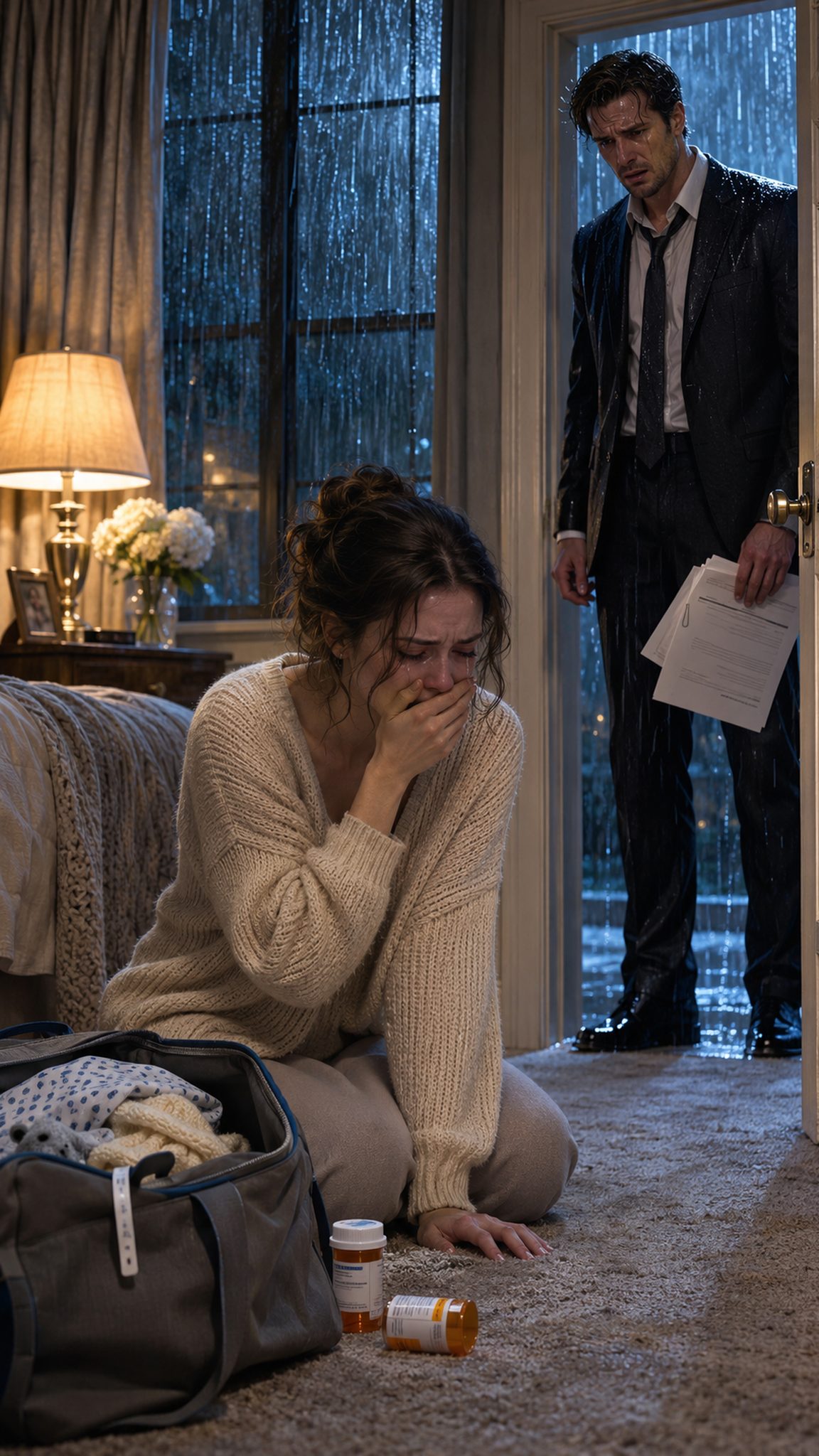
The hospital doors opened, and Claire stepped into the bright corridor with rain still shining on the shoulders of her coat.
The ride across Chicago had been quiet. She had watched the streets pass through the window, one familiar intersection after another, while the driver kept the radio low. Her canvas bag rested on her lap. Inside were the medications she needed, her current treatment papers, a charger, and the folded sweater she had packed before Adrian came home.
She had not expected him to follow her.
At the hospital entrance, she thanked the driver and walked toward reception. The automatic doors closed behind her, shutting out the storm. A receptionist looked up and greeted her by name. Claire confirmed her appointment and handed over the documents she had been asked to bring.
"Are you here for the scheduled review?" the receptionist asked.
"Yes. And I may need the infusion team to check something before they begin."
"Of course. Have a seat, and I'll let them know."
Claire sat near the window. The waiting room smelled faintly of disinfectant and coffee. A television played silently above the reception desk. People spoke in low voices, and a child in the far corner turned the pages of a picture book. Claire took out her phone, checked that it was charged, and placed it beside her.
There was no message from Adrian.
She had not expected one.
At home, Adrian was still standing beside the open medical folder.
He had read the emergency admission report three times. The dates did not change. The details did not become less serious. Claire had been admitted, assessed, and discharged without him knowing. The report listed the treatment team, the observations made during the admission, and the instructions given to her afterward.
He turned to the next page.
There were follow-up appointments, references to infusion therapy, and a list of medications. The handwriting in the margins was Claire's. She had marked questions for her doctors and underlined instructions she needed to remember.
One note read: "Ask whether fatigue is expected after treatment."
Another said: "Confirm what to do if dizziness returns."
Adrian stared at the second sentence. He remembered seeing Claire steady herself against the mattress before leaving the house. She had tried to stand, and her body had refused to cooperate. He had seen it, but until that night he had not understood how often she might have faced the same thing alone.
He turned to the emergency contact page.
His name had been crossed out in the section where a contact might ordinarily be listed. Above it, Claire had written the instruction he had seen on the card.
DO NOT CALL ADRIAN.
He set the page down carefully.
His phone rang. Daniel.
Adrian answered. "Tell me what you found."
"I'm pulling the archived messages now," Daniel said. "I have the initial office record, but the full history is stored separately."
"Start with the first time Claire called."
"That may take a little time."
"Then start now."
Daniel paused. "Adrian, I need to ask whether Claire is safe."
"She's at the hospital. I don't know anything beyond that."
"Do you want me to come there?"
"No. I want the records. And I want you to tell me why a message from my wife about a medical matter never reached me."
"I'll find out."
"Don't tell me you'll find out unless you intend to."
"I understand."
Adrian ended the call, picked up the folder, and left the house.
The driver was waiting near the entrance. Adrian told him the hospital address and sat in the back without speaking. During the drive, he opened the office archive on his phone. The records were incomplete, but he found a list of calls that had been tagged as personal correspondence.
Claire's name appeared more than once.
The first entry had been made several months earlier. It stated that Mrs. Cross had called requesting a private conversation with Adrian about a medical matter. The note included a request for a same-day return call.
The status was marked deferred.
Adrian read it again.
The second entry was shorter. Claire had called to ask whether the first message had been passed on. The note said she sounded concerned but did not provide additional details.
That message had been moved to a routine scheduling folder.
A third entry appeared on the date of the emergency admission. The household line had been used to contact the office. The message stated that Claire was at the hospital and needed Adrian to call.
There was no record of a call being made to him.
Adrian felt his jaw tighten. He took screenshots of the entries and sent them to Daniel.
"These are not routine messages," he said when Daniel called back. "Why were they deferred?"
"I don't know yet."
"Who marked the first one deferred?"
"I'm checking the account history."
"And the second?"
"The record shows it was moved by the intake account."
"Who had access?"
"Several people. The office assistant, the office manager, and the receptionist."
"Then speak to all of them."
"I will."
Adrian looked out at the rain-blurred city. "And Daniel, I want to know whether anyone told the hospital not to contact me."
There was a pause.
"Why would anyone do that?"
"Because Claire wrote that instruction herself. I want to know what happened before she decided it was necessary."
"I'll check the records."
The call ended as the car pulled into the hospital entrance.
Claire was still in the waiting area when Adrian arrived. She noticed him immediately. Her expression did not change, but her hand moved toward the strap of her bag.
He approached slowly.
"You came," she said.
"Yes."
"I thought you were going to read the folder."
"I did. Then I followed you."
"Why?"
"Because I wanted to know you arrived safely."
She looked at him for a moment. "I arrived safely before you got here."
"I know."
He did not argue. He sat in the chair beside hers, leaving enough space between them that she would not feel crowded.
A nurse called Claire's name. Claire stood, lifting the bag herself. Adrian rose too.
"Would you like me to carry it?" he asked.
She hesitated, then handed it to him.
The nurse led them to a consultation room. Claire answered the initial questions and described the dizziness she had experienced at home. The nurse reviewed her medication list and asked about recent symptoms. Adrian placed the folder on the table but did not open it until Claire asked him to find the latest treatment summary.
The nurse noticed the hospital bracelet in the outer pocket of the bag.
"Is this from your previous admission?" she asked.
"Yes."
"Would you like us to update your file with the details from that visit?"
"They should already have them," Claire replied. "But I brought the paperwork in case anything is missing."
The nurse nodded and checked the record.
Adrian watched the exchange. Claire knew exactly which documents to produce. She knew which questions to answer and which details to clarify. This was not her first time navigating the process. It was not even close.
The nurse reviewed the contact section.
"Your emergency contact instruction is still the same," she said.
Claire nodded.
"Would you like to change it?"
"No."
Adrian looked at the form but said nothing.
The nurse continued with the assessment. She explained that the doctor would review Claire before deciding how to proceed with the planned treatment. The recent dizziness needed to be considered, and the team would determine whether any further checks were necessary.
When the nurse left, Claire turned toward Adrian.
"Please don't ask them to change that card."
"I won't."
"I mean it. I wrote it."
"I understand."
"You didn't understand when I wrote it."
He looked down. "No. I didn't."
She folded her hands in her lap. "I don't want the hospital waiting for you if they need to act. I don't want anyone delaying care because they think they have to reach you first."
"They shouldn't delay care."
"Then we agree."
The doctor arrived a short time later. He reviewed Claire's recent symptoms and the information from her previous admission. He asked her to describe the pattern of fatigue and dizziness. Claire answered carefully, distinguishing between what she had experienced that evening and symptoms that had occurred earlier.
Adrian listened.
The doctor explained that the team would assess her current condition before proceeding with the planned infusion. He discussed the need to monitor her response and review any changes in symptoms. He did not offer a simple answer or promise that the treatment would be straightforward.
Claire asked what would happen if the dizziness returned. The doctor explained the warning signs that required immediate attention and the steps she should follow if symptoms worsened. He also reminded her that she should contact the treatment team rather than trying to manage a serious change alone.
Adrian wrote down the instructions.
When the doctor asked whether Claire had someone who could help her after the appointment, she glanced at Adrian.
"I have arrangements," she said.
Adrian kept his eyes on the notes.
The doctor acknowledged her answer and continued. The assessment would take some time. The team would decide whether the infusion should proceed that evening or be rescheduled after further review.
After the doctor left, Claire leaned back in the chair.
"You don't have to write down every word," she said.
"I want to remember the instructions."
"You can ask me later if you need them."
"I know."
She studied him. "You're trying very hard."
"I am."
"Don't make me responsible for rewarding you for it."
He put the pen down. "I won't."
A nurse returned to take Claire for another assessment. Adrian waited outside. He sat beneath a wall clock and looked again at the archived messages.
The first call had been made on a Tuesday afternoon. Claire had asked for a return call about a medical matter. Adrian remembered that day. He had been in a meeting about a warehouse contract. The meeting had ended before dinner. He had gone to a private club afterward and remained there late.
He could have called her.
The second message came several weeks later. He remembered that week too. He had been negotiating with a group that wanted access to one of his freight operations. He had spent long hours at the office and had complained to Daniel that personal interruptions were making it difficult to concentrate.
He could remember the exact words.
"Keep the personal calls off my schedule unless I ask for them."
At the time, he had meant ordinary calls and social requests. He had not imagined that the instruction could be applied to Claire's medical messages.
But he had said it.
And Daniel had been responsible for interpreting it.
Adrian opened the archive again. The second message had been recategorized by the shared intake account. He could not see the name of the person who had used it. The third message had been entered into a household contact log and then transferred to Daniel's office.
He called Daniel.
"Did you see the household message from the day of the admission?"
"I found it."
"Why wasn't it passed on?"
"I haven't established that yet."
"Was it in your inbox?"
"It was in the office queue. I saw a notification, but I don't remember opening the full message."
"You saw enough to know it was from Claire."
"Yes."
"And you didn't call me."
"No."
Adrian closed his eyes. "Why?"
"I thought it could wait until you were free."
"She was at the hospital."
"I didn't know that at the time."
"The message said she was at the hospital."
Daniel was silent.
"Read it again," Adrian said.
"I will."
"No. Read it now."
Adrian heard papers moving on the other end.
"It says: 'Claire Cross has contacted the office from the hospital. She requests that Mr. Cross return her call as soon as possible.'"
"And you let it wait."
"Yes."
"How long?"
Daniel checked the record. "Until the following morning, when it was marked closed."
"Who closed it?"
"I need to check."
Adrian ended the call.
He looked down the corridor toward the assessment rooms. He had spent years believing that the people around him understood his priorities. Now he was discovering that they had been making decisions about those priorities without asking him.
The nurse returned.
"Claire is ready for you."
He entered the room. Claire was sitting on the examination bed, looking tired. The doctor had completed the assessment and explained that they would continue monitoring her before making a decision about the infusion.
"How are you feeling?" Adrian asked.
"Exhausted."
"Do you want me to get you anything?"
"Water, please."
He brought it from the dispenser and handed it to her.
She drank slowly.
"Did you find something in the folder?" she asked.
"I found the messages."
Her expression tightened. "Which ones?"
"At least three calls to the office. One was marked urgent. Another was moved into routine scheduling. There was also a message from the day of your admission."
Claire looked away.
"What did they do with it?" she asked.
"It was left in the office queue. Daniel saw a notification but didn't call me."
She gave a small nod, as though the answer confirmed something she had suspected for a long time.
"Did he say why?"
"He thought it could wait until I was free."
Claire closed her eyes.
"Claire?"
"I remember that call."
"What happened?"
"I was in the car after an appointment. I had just spoken to the doctor. I was frightened, and I didn't know what to tell you. I called the office because I thought Daniel could get you to call me back."
She looked at the water in her hands.
"I told the receptionist it was medical. I said I needed to speak to you that day. She said she would pass it on."
Adrian felt his chest tighten.
"I waited that evening," Claire continued. "I checked my phone every few minutes. When you didn't call, I told myself you hadn't received the message. I thought perhaps the receptionist had forgotten."
"She didn't forget. The note was recorded."
Claire looked at him. "Then someone decided it wasn't important."
"Yes."
She put the cup down.
"I called again because I thought the first message had been lost. I asked whether you had received it. I didn't want to explain everything to someone in your office. I wanted to speak to my husband."
Adrian lowered his eyes.
"Did anyone tell you I was calling?" she asked.
"No."
"Did anyone tell you I was waiting?"
"No."
"Then you understand why I stopped."
He nodded.
She looked toward the window. "I didn't write those four words because I wanted to hurt you. I wrote them because I couldn't keep putting myself through that."
"I know."
"No. You know now. At the time, I was still hoping you would call."
Adrian sat beside the bed.
"I should have answered."
"Yes."
"I should have asked what was happening."
"Yes."
"I should have been there."
Claire looked at him. "You can't change those nights."
"I know."
The nurse returned to explain that the doctor wanted to continue observation and would decide whether the infusion should proceed after reviewing the latest assessment. Claire asked for a little time to rest before the next step.
Adrian moved his chair closer to the wall.
She closed her eyes.
He remained quiet.
After a while, her breathing became more regular. She had not fallen fully asleep, but the tension in her face eased. Adrian watched the monitor and listened to the quiet sounds of the hospital.
He thought about the first year of their marriage, when Claire had once fallen asleep on the sofa waiting for him to return from a late meeting. He had found her there after midnight, covered her with a blanket, and carried her to bed. The next morning she had teased him for waking her.
He had once noticed such things.
He had once considered them important.
His phone vibrated. Daniel had sent a message.
The first urgent note was entered by reception and moved to the personal correspondence queue. The second was recategorized by the shared intake account. The household message was received by the office and left pending. I am checking who changed the category and who closed the final entry.
Adrian typed back.
Preserve every original record. Do not delete or amend anything. I want the complete audit history.
He put the phone away.
The doctor returned and explained that Claire's assessment was continuing. The team would not rush the infusion decision. They wanted to make sure she was stable and that proceeding was appropriate.
Claire agreed to remain under observation.
Adrian asked whether he could stay.
"Yes," Claire said. "For now."
He sat beside her. She did not take his hand, but she did not ask him to leave.
Later, when the nurse brought a blanket, Claire thanked her and settled back. Adrian checked the time. It was well past midnight. He had not eaten, but he did not feel hungry.
Claire opened her eyes.
"You should go home."
"I can stay."
"I know you can. I'm telling you that you don't have to."
"I want to."
She studied him. "Is that because you feel guilty?"
"Partly."
"At least you're honest."
"But not only because of that."
She looked away.
He continued quietly. "I don't know how to make up for the time I wasn't here. I don't expect you to forgive me because I came tonight. But I don't want to leave you alone just because staying is uncomfortable."
Claire's eyes glistened.
"Don't make promises you can't keep."
"I won't."
She turned toward the window. "Then sit quietly."
He did.
For the next hour, they barely spoke. The nurses checked Claire's observations, and the doctor reviewed the plan. The infusion remained on hold pending the team's decision. Claire was tired but stable enough to rest.
At one point, Adrian noticed her hand moving toward the edge of the blanket. He waited. When she reached for the water, he passed it to her.
"Thank you," she whispered.
He nodded.
It was a small exchange, but it was the first time that evening she had accepted his help without hesitation.
Near dawn, Daniel called again.
Adrian stepped into the corridor.
"I found the closure record," Daniel said. "The household message was marked resolved by the office administrator the next morning."
"Who marked it resolved?"
"The account belongs to the office manager. I haven't confirmed who was using it."
"Why was it closed?"
"The note says the matter was considered handled through the personal correspondence process."
"Was it?"
"No."
"Then it was closed without being handled."
"Yes."
Adrian looked through the glass panel into Claire's room. "Who gave the instruction that personal calls should be kept off my schedule?"
"I don't know yet. The office manager remembers being told that you didn't want personal calls put through unless you requested them. She says she was repeating an instruction from the executive office."
"From me?"
"She says she believed it came from you."
Adrian remembered his own words. He remembered the frustration in his voice, the meeting he had been trying to protect, and the way everyone around him had learned to anticipate his irritation.
"Find out exactly what I said and who heard it."
"I will."
"And don't assume that explains everything."
"I won't."
Adrian ended the call.
He returned to Claire's room. She was awake, watching him.
"More records?" she asked.
"Yes."
"Did they find out who told the office not to put my calls through?"
"Not yet. The office manager says she was repeating an instruction from the executive office. They haven't confirmed who gave it or how it was worded."
Claire looked down.
"So someone may have decided that I wasn't allowed to reach you."
"It appears someone interpreted an instruction that way."
"Did you give that instruction?"
Adrian did not answer immediately.
"I told the office I didn't want personal calls interrupting my work during a difficult period. I didn't say your medical messages should be withheld. But I may have made it sound broader than I intended."
Claire's expression became distant.
"Then you gave them the words."
"I gave them a rule about interruptions. I didn't understand how it could be applied to you."
"But you didn't ask what happened to the calls."
"No."
She closed her eyes.
Adrian sat down.
The truth was not complete. The person who had recategorized the second message had not been identified. The office manager's recollection needed to be checked. Daniel still had to account for his decisions. But the first outline of the failure was visible, and Adrian could no longer pretend that it had happened without his involvement.
The doctor entered a few minutes later and explained the next steps. Claire would remain under observation while the team reviewed her response and decided whether the planned infusion should be delayed. The doctor answered her questions and reminded her to report any new symptoms immediately.
Claire listened and nodded.
Adrian listened too.
When the doctor left, Claire turned toward him.
"I need to rest."
"I'll be here."
She studied him for a moment. "Don't go through my folder again while I'm asleep."
"I won't."
"And don't call the hospital asking for information I haven't agreed to share."
"I won't."
She settled against the pillow.
Adrian moved his chair closer to the wall and put his phone on silent. He did not open the folder. He did not call the office again. He watched the early light appear beyond the hospital window.
For the first time, he understood that being Claire's husband did not automatically give him access to every part of her life. Trust had to be offered, and she had every reason to withhold it.
The storm outside was beginning to pass.
Inside the hospital, Claire slept.
Adrian stayed.
And in the office archive, the second message remained marked with an unexplained change: a medical request moved into routine scheduling by an account whose user had not yet been identified.
The answer was closer than it had been the night before.
But it was not complete.