Three months after Rose Bennett Moretti was born, Claire discovered that peace made very little noise.
It sounded like the slow creak of the rocking chair in her small house. Like her mother's laughter from the kitchen. Like Rose's indignant little sigh whenever a feeding ended before she was ready to surrender the warm place against Claire's shoulder.
Most mornings, peace arrived with a message from Alexander.
I'm here for the nine o'clock visit. No hurry. Let me know when you're ready.
He waited in his car rather than ringing the bell. The first time, Claire had almost been angry. Five years of marriage had taught her to expect Alexander to occupy every room as if the room belonged to him. Now he had begun to treat even her front steps as a boundary worth respecting.
Today she opened the door with Rose nestled against her chest.
Alexander's face softened immediately. “Good morning, little Rose.”
“Good morning,” Claire said.
He looked at her, not just the baby. “How did you sleep?”
“Almost four hours in a row. A modern miracle.”
“Your mother told me she has an appointment this morning. If you'd like, I can take the next shift while you rest.”
“I would.” Claire passed him the bag of fresh diapers. “She needs changing first.”
“Understood.”
There was no dramatic music, no diamond necklace, no line of cameras recording his effort. He simply washed his hands, carried their daughter to the changing table, and talked to her about the blue birds painted on the wall. He did the complicated work of fastening a tiny outfit over squirming feet, then checked with Claire before taking Rose into the garden.
Claire watched from the doorway. Alexander had learned to hold the baby while walking slowly along the path. When Rose fussed, he did not hand her back immediately or insist that his expensive belongings made him unfit for spit-up. He checked what she needed. Sometimes he guessed wrong. When he did, he listened.
The change had survived three months of sleeplessness, work emergencies, and inconvenient schedules. It did not erase the auction. It made a different future possible.
Daniel had warned Claire that possibility should not be mistaken for obligation.
“You are allowed to appreciate his progress,” her attorney had said, “without offering him a marriage as a reward.”
She had kept that sentence close.
The divorce petition remained active. Required financial disclosures had been exchanged. Alexander had cooperated with temporary parenting arrangements, and both parents had begun discussing a longer-term plan shaped by Rose's age and needs. There had been no threats, attempts to use money as leverage, or surprise visits. If he disagreed, he put the disagreement into words rather than issuing commands.
That afternoon, while Rose slept, Claire opened a letter from Daniel. It summarized the final corporate findings and the latest legal developments involving Olivia Hayes. The independent investigation had concluded that Olivia deliberately commissioned coverage meant to humiliate Claire, arranged the misleading media campaign, and coordinated through an outside consultant the intimidating nursery photograph. The findings rested on recovered messages, account records, and witness interviews rather than Olivia's angry words alone.
The technician had admitted entering the property without authorization. His case and the related harassment allegations were being addressed through the legal process. Olivia, represented by counsel, had agreed to a civil settlement with Claire that included compensation, a prohibition on further contact and harassment, and correction of specific false claims. The settlement was not a finding that every allegation was proved in criminal court. Claire knew the difference. She had insisted on it.
The false suggestion that Daniel had been secretly conspiring with Claire against the company was formally retracted by the publication that had amplified it. Nina Walsh had found new employment, and Mara Ellis had adopted stricter procedures for accepting private surveillance assignments. Not everyone received a perfect ending, but the lies no longer determined the public record.
Claire folded the letter and placed it inside the drawer beside her journal.
She felt no desire to see Olivia brought before a crowd, stripped of jewelry, and made to endure an equal humiliation. Claire understood that desire once; now it seemed like an invitation to let the ballroom keep governing her life.
When Alexander returned from the garden, she told him the settlement had been finalized.
“Daniel sent the summary,” she said.
Alexander nodded. “I received confirmation through counsel.”
“Olivia can't contact me again under the agreement.”
“I hope that gives you some peace.”
“It does.”
He studied Rose, who had fallen asleep against his shoulder. “I owe you an apology for something beyond the necklace.”
Claire waited.
“When you first questioned Olivia's gifts, I treated your concern as an inconvenience. I called her my assistant, as though a job title answered everything. I made you argue for attention you shouldn't have had to request.”
“You did.”
“I won't try to make that sound smaller.”
Claire regarded him carefully. “For a long time I thought if I could find the perfect words, you'd finally understand. It took me walking out in front of hundreds of people.”
“It shouldn't have.”
“No,” she answered. “It shouldn't.”
The conversation ended there. Neither tried to turn it into a declaration of love. Alexander returned Rose to her crib, kissed the baby's forehead with Claire's permission, and left at the agreed time.
That night Claire opened the page in her notebook where she had written: If he keeps choosing differently, could I choose again too?
She added an answer beneath it.
Only if I choose freely. Only if I can still say no.
A month later, Claire invited Alexander to dinner at the little house.
It was the first invitation unrelated to a parenting appointment. She had asked her mother to stay with Rose upstairs, not because she wanted an audience or an escape, but because she wanted space for an adult conversation without a baby interrupting every difficult sentence.
Alexander arrived carrying a loaf of bread from the bakery Claire liked. He left it on the counter without ceremony and helped set the table when she asked.
“I thought you'd bring flowers,” Claire said.
“I thought you might find that presumptuous.”
“Maybe. I still like flowers, though.”
He smiled faintly. “I'll remember that.”
They ate vegetable soup and bread at a wooden kitchen table that had cost less than one of the buttons on his old custom suits. Claire found she liked watching him in the ordinary light. There was nowhere for either of them to hide behind a public role.
“I need to ask something,” she said when the dishes were cleared. “Not about Rose. About us.”
Alexander set his glass down. “All right.”
“Have you changed because you want me back, or because you understand what was wrong?”
He considered the question before answering. “At first, I wanted you back. I would have done almost anything to stop losing you. Then I realized that trying to prevent you from leaving was part of how I had failed you. I began changing because I didn't like the man who had made that choice.”
“And if I finish the divorce?”
“I'll be sad. I'll still show up for Rose. I'll still keep the boundaries we agreed on. And I'll respect you.”
Claire nodded slowly. “That's the answer I needed.”
He did not ask whether it was enough.
“There is one thing you should know,” she continued. “Sometimes I look at you holding her and I feel the love I used to feel for you. Then I remember the stage, and it closes again. I'm not choosing between two different men. They're both you.”
“Yes,” Alexander said. “The man who held her and the man who hurt you. I have to live with both.”
“I don't want a marriage where every apology is followed by a grand gift.”
“Neither do I.”
“If we ever try again, there will be counseling. Separate financial decisions. No staff managing our private relationship. And I need a home where I'm your equal, not another thing your business protects.”
“I agree.”
“Don't agree just because you think it will bring me back.”
“Then let's put it into practice before deciding anything.”
That answer made Claire quiet. It offered no shortcut, and for that reason she believed it more than his old promises.
They began attending couples counseling without dismissing their separate parenting work. They spoke about loneliness, power, the difference between secrecy and privacy, and how easily a wealthy household could become a place where one person's schedule ruled everyone else's life. Some sessions were painful. Alexander sometimes became defensive, then stopped and began again. Claire sometimes expected betrayal in ordinary delays, and said so instead of conducting a silent investigation. Progress was neither smooth nor romantic. It was real.
When Rose was five months old, Alexander missed an agreed video call by twenty minutes. Claire stared at the clock, the old wound suddenly raw. He called as soon as he could, explained that a meeting had run over, and apologized without blaming anyone else.
“I should have warned you,” he said. “I knew it was running late.”
“Yes,” Claire said. “You should have.”
He moved the meeting on his calendar for future weeks. It was a small correction. Once, he would have argued that twenty minutes meant nothing. Claire noticed that he no longer needed to win an argument to keep his dignity.
Two months later, Daniel invited Claire into his office to discuss a choice no lawyer could make for her.
“The divorce can proceed,” he said. “Alexander has met his disclosure obligations, and we can finalize the outstanding terms. Or, if you have freely decided to reconcile, we can discuss the procedural steps to end the pending case. You should make that decision for your reasons, not because his behavior has improved.”
Claire looked at the familiar conference room where she had first met the photographer. She remembered arriving there convinced that every person near Alexander might be arranging her next humiliation. Now she could sit across from her attorney without fear.
“I want the petition withdrawn,” she said. “But only after we finish the written financial and parenting agreements we've been discussing. I want the protections to exist even if we have difficult years ahead.”
Daniel smiled. “That is a considered decision. I'll make sure you understand each document before you sign.”
She left his office and walked along the river, feeling the wind lift her hair. She had not promised Alexander anything yet. She wanted to tell him face-to-face, without a camera or an audience.
That weekend, she invited him to the house after Rose's afternoon nap. The garden was full of late-summer flowers. Rose lay on a blanket beside them, delighted by the movement of leaves overhead.
“I spoke to Daniel,” Claire began.
Alexander looked up. “Is everything all right?”
“Yes. I asked him to prepare the steps to withdraw the divorce petition after our agreements are completed.”
For a moment he did not move. Then his eyes filled, and he looked down at Rose as though he needed somewhere safe to direct the feeling.
“Claire,” he said softly, “are you sure?”
“I'm sure about trying. I'm not promising we'll never have problems. I'm promising I want to keep working beside you instead of apart from you.”
“I want that too.”
“You need to know I'm not returning to the old mansion.”
“I know.”
“I love this house. Rose loves the garden. I can breathe here.”
“Then this is where your life is,” he said. “I won't ask you to surrender it.”
She smiled for the first time during the conversation. “You could ask whether there's room for you.”
Alexander glanced toward the small house, the crooked gate, the potted rosemary Elena had insisted would survive winter. “Would there be?”
“Not tonight,” Claire answered, teasing gently. “But perhaps one day.”
He laughed, and the sound was free of calculation.
They did not rush. He continued living separately while they completed counseling and the agreements. When they eventually chose to share the house, he came with a few suitcases and books rather than a moving convoy or an army of decorators. He kept his office elsewhere. He learned which floorboard squeaked outside Rose's room and how Claire preferred the dishes stacked to dry. The house remained hers in every way that mattered, even as they made it theirs together.
One evening Rose reached for Alexander from her playmat and said something very like “Da.” He froze, then looked at Claire with such naked joy that she laughed.
“Don't get too confident,” she said. “Yesterday she called the lamp that.”
“Then the lamp and I have excellent company.”
He lifted Rose and spun only as much as she enjoyed, stopping when she wanted to settle against him. Claire watched them, remembering the man who had once run after her car shouting that he would not agree to a divorce. That man had believed love was a claim he could enforce. This one understood that a family was a relationship maintained through care.
On the anniversary of the auction, Claire received a letter from the children's hospital charity. The organization had reviewed its event procedures after learning how its stage and media access had been misused. Its board had introduced clearer rules for donor presentations, event photography, and personal data. The letter thanked Claire for bringing the matter to light and invited her to a small reception for supporters of the new program.
Claire set the invitation on the kitchen table. She had no wish to return to the ballroom where she had been humiliated. But she did care about the children the charity served. The event had never belonged to Olivia, no matter how she had used it.
“I think I'll go,” she told Alexander.
“Would you like me there?”
“Yes,” she said after a moment. “Beside me. Not ahead of me.”
They attended together, with Rose staying comfortably at home with her grandmother. The reception was held in a hospital garden rather than a ballroom. There were no auction paddles and no jewelry presentations. Claire spoke briefly with staff about programs for families whose children required long hospital stays. Alexander listened, then quietly asked whether they could contribute to practical support services through the foundation's ordinary process.
Claire appreciated that he did not announce a donation into a microphone or turn generosity into a performance.
When they returned home, Rose was asleep. Her grandmother had left a note saying the baby had refused her evening bottle for ten minutes, then reconsidered with great enthusiasm.
Claire stood with Alexander beneath the kitchen light. For months, she had been waiting for some grand sign that the past had finally released its hold. Instead she found it in the simplest possible fact: she could look at her husband and feel safe enough to tell him the truth.
“I love you,” she said.
Alexander's expression shifted, almost disbelieving. She had not said the words since before the auction.
“I love you too,” he answered. “And I know that isn't the end of the work.”
“No,” Claire said. “It's part of it.”
He reached for her hand, stopping just short of touching it. She closed the distance herself.
The ring she had removed at the auction remained in its small box. She had never wanted it restored as proof that nothing had changed. Now she took it out one evening, considered the familiar gold, and chose to wear it again. Alexander saw it when they were setting the breakfast table. He made no speech. He kissed her hand once and helped Rose retrieve a spoon she had dropped from her chair.
The pending divorce was formally dismissed after their agreements were completed and reviewed. The legal outcome did not mend their marriage by itself. Their everyday choices did the slower work. Alexander remained involved in Rose's care, including the unglamorous parts. Claire maintained her own finances, friendships, and decisions. They disagreed sometimes. They also learned to resolve disagreements without treating one another as opponents.
On Rose's first birthday, the garden filled with a small gathering of people who had helped Claire through the year: her mother, Elena, Daniel and his family, and a few close friends. Alexander's mother arrived carrying a homemade cake and told everyone that her granddaughter had inherited the most formidable stare in Chicago.
Rose wore a soft yellow dress and examined the candle with grave suspicion. Claire helped her blow it out, though most of the effort came from the adults. Everyone applauded, and Rose clapped because the others did.
After the guests had gone, Claire and Alexander sat on the garden steps while Rose slept inside. The sun dropped behind the trees, turning the windows amber.
“Do you remember what you said when I told you I was pregnant?” Claire asked.
Alexander looked at her. “I'll protect both of you.”
“I believed you.”
“I know.”
“And then I stopped believing anything you said.”
He lowered his eyes. “You had reason to.”
Claire squeezed his hand. “I believe you now, not because you've promised me the world, but because you've been here for the little things. You learned what she needs. You listened when I told you what I need. You stayed even when I couldn't tell you whether we'd be together.”
Alexander looked toward the house. “I finally learned that showing up is a promise you make again every day.”
Claire rested her head against his shoulder. “I like that promise better.”
Inside, Rose stirred and called for them with a delighted, incomprehensible shout. They rose together. Alexander held the door, and Claire took his hand as they crossed the threshold.
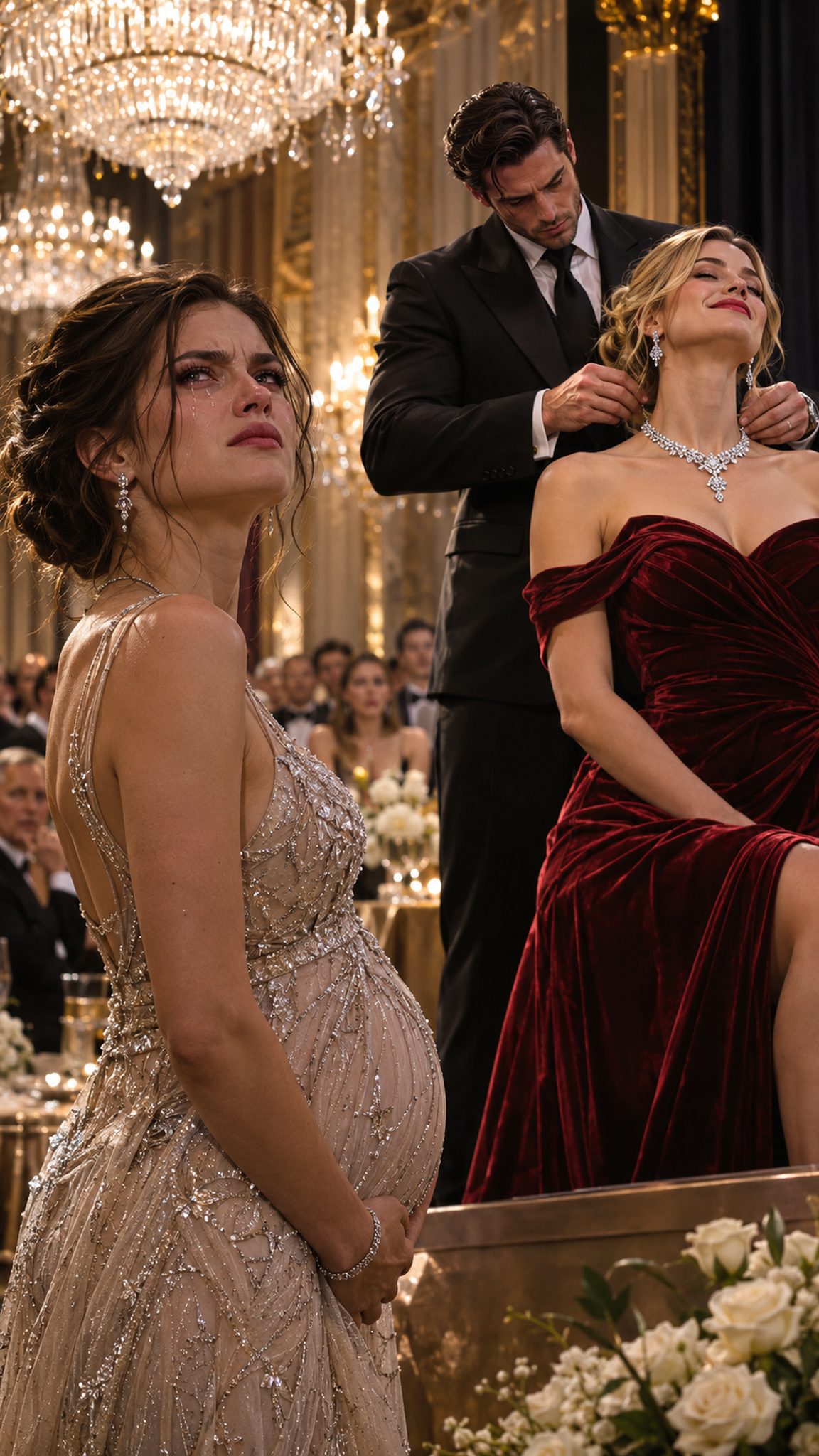
Once, a necklace worth three hundred thousand dollars had seemed capable of measuring how deeply a husband loved his wife. It had instead revealed how badly he had failed her. Now the necklace was gone from their story except as a reminder of a choice neither would repeat.
Their happiness had not come from forgetting. It had come from telling the truth, respecting each other's freedom, and doing the hard, ordinary work of becoming a family worthy of the child they loved.
Rose reached for both of them from her crib.
Claire lifted her daughter while Alexander steadied the blanket, and together they carried her into the warm light of their home.
(Chapter 7 word count: 3,065 words)
THE END