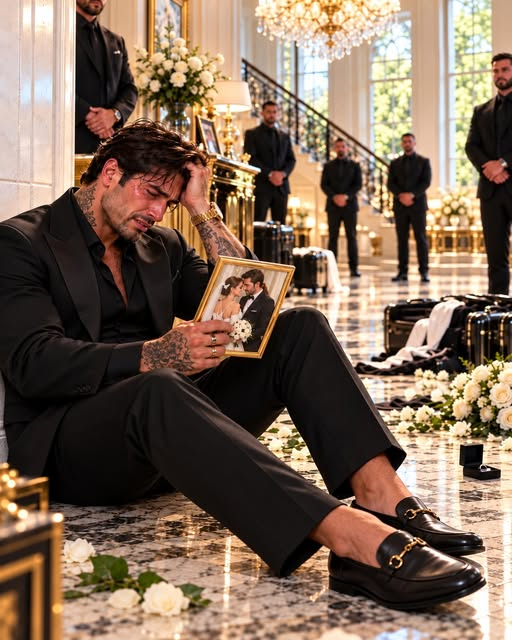
He came that night, as I knew he would.
I heard the car just after nine — not the family SUV with a driver, but his own car, the one he drove himself when the thing he was going to do was not business. I heard the door of it close on the quiet street. I heard his step on the little concrete path my father had poured the summer before I was born. And I sat in my father's chair with my cast propped on the ottoman and my crutches within reach, and I listened to my husband come up the two steps to my parents' door, and I did not get up to open it before he knocked. That had never happened before. In six years — in twenty years — I had never once let Adrian Moretti knock twice.
He knocked twice.
I got up on the crutches. It took time. I let it take time. When I opened the door he was standing on the step with his hands in his coat pockets, in the porch light, and the sight of him — unshaven, hollowed out, the great man reduced to a husband on a doorstep with his hands in his pockets like a boy — it went through me the way weather goes through a house with the windows open. I want that on the record, whatever record this is. I loved him standing there. I have never stopped being honest about that part, even when it would have been easier.
"Come home," he said.
Not hello. Not how is your ankle, how is your head, did you eat. Come home. He said it the way he said everything he had already decided — not as cruelty, but as a conclusion he had reached and was now delivering, like a verdict. The last three days rearranged themselves in my mind at the sound of it: the hospital, the flowers, the four minutes in the chair. He had come late to the hospital because he was deciding. He had come tonight because he had finished deciding. The decision was that this was over now, and we would go home, and it would be absorbed, the way everything difficult in that family was absorbed — silently, permanently, by me.
I looked at him from the doorway. I held on to the doorframe because of the crutches, and also because I wanted to be holding something that belonged to my father while I said what I said next.
"Are you asking as my husband," I said, "or ordering me as a boss?"
His jaw tightened. I knew that movement the way I knew my own name.
"I came to bring my wife home," he said.
My wife. He said it like a title. Like a deed. And something in me that had been a girl taken in out of debt, and a woman married out of a house she was raised in, and a hostage in a warehouse chosen second out of arithmetic, stood up in the middle of my chest and said, very quietly: enough.
I set one crutch against the frame so I could have a hand free. Slowly — because my fingers were not entirely steady, and because I wanted to be careful with this, to do it right and not in anger — I took hold of my wedding ring and worked it over my knuckle.
The ring had been on my hand for six years. It left a pale band behind, a line of skin that had never seen the sun.
Adrian's eyes dropped to my hand. I watched the understanding arrive — watched him, for once, be the last person in a conversation to know what was happening.
"What are you doing?" he said.
I held my hand out, palm up, the ring sitting in it. Six years of my life, and it weighed almost nothing. That was the obscenity of it. It weighed almost nothing.
"Take it," I said.
"Claire—"
"Take it, please. I don't want to drop it. It matters to me that I don't drop it."
He took it. Slowly, as if it might be hot. He held it in his palm and looked at it, and then at me, and I stepped back into the shadow of my own doorway with the crutch in my hand, and I said the thing I had come to this house to be able to say.
"I'm calling an attorney tomorrow."
His face changed. Not into anger — I had expected anger, had braced all day for anger, Adrian's anger being one of the great weather systems of Chicago. It changed into something I had never seen on it at point-blank range. It changed into fear.
"No," he said.
"Yes."
"We're not getting divorced."
"That isn't your decision."
He took a step forward — one step, onto the threshold, into the light, the beginning of the move he had made a thousand times toward me in doorways and rooms and arguments, the step that had always ended with his hand on my shoulder and the thing resolved his way. And I took one step back.
I want to be precise about that step, because Adrian was, afterward. He told his father about it once, I learned much later, in the way men like them confess to each other — sideways, months after the fact, in a car. He said: she had never backed away from me before. Not in anger, not in play, not in twenty years. And he stood on my mother's threshold in the porch light with my ring closed in his hand, and he froze, Adrian Moretti, with all his hundreds of men and all his reach, frozen by one small step backward on a crutch.
"I am doing exactly what you did," I said.
"What?"
"Choosing." My voice was almost gentle. It did not feel gentle from inside; it felt like holding a door shut against a flood with both hands. "In that warehouse, you had ten seconds, and you chose who came first. I am not angry about your ten seconds, Adrian. I want you to hear that. She was dying. I know why you did it. But you taught me something in those ten seconds, and I have been sitting in this house all day learning it. A person gets to choose who comes first in their own life. You chose. Now I am choosing. I'm doing exactly what you did."
His mouth opened. Nothing came out.
"Choosing myself first," I said.
I closed the door.
I did it slowly, because my hand was shaking and because he was standing close, and I did not slam it — I have never slammed a door in my life and I was not going to begin with the most important one. I closed it the way you close a book you have finished. Then I stood on the other side of it, in my parents' dark hallway, holding the crutch, listening.
He didn't knock again. He didn't call my name. For a long time — I couldn't tell you how long; the hall clock ticked, and my ankle throbbed in time with it — there was only silence on the other side of my father's door, and my own breathing, and the wild, unscathed discovery that I was not crying. Then, finally, the step on the concrete path. The car door. The engine, starting, and not leaving at once — idling, out there on the dark street, for a full minute — and then pulling away, slowly, like something being towed out of deep water.
I slid down, carefully, crutch and all, until I was sitting on the floor of the hall with my back against the door and my cast straight out in front of me on the boards my father had laid. And then, at last, I cried — not for the marriage, exactly. For the girl who had waited at windows. For how long she had waited, and how good she had been at it, and how nobody, including me, had ever once asked her what it cost.
In the morning, I called the attorney.
Her name was Margaret Hale. She had handled a friend's divorce — an ordinary divorce, an ordinary friend from my old life before the Morettis swallowed it, and Margaret's office was ordinary too, which was why I chose it: beige carpet, a water cooler, a plant making the best of it. She was sixty, unhurried, and she did not ask me a single question that was not necessary. She had read the newspapers' version of the week, I think. She never mentioned it.
"You're sure," she said once. Not as a challenge. As a formality she owed me.
"I'm sure," I said.
She slid the paperwork across. I signed where she showed me — a woman on crutches, in a borrowed chair, signing my name out of a six-year marriage in a beige office with a humming water cooler. It was not dramatic. That is what nobody tells you. The biggest doors in a life close with almost no sound at all.
Afterward, because the cab was late and my ankle had started its deep, warning throb, I sat a while in her waiting room and drank terrible coffee from a paper cup, and I felt — under the pain, under the fear, under the enormous ungrieved weather of it — something I had not felt in longer than I could remember. Not happiness. Lightness. The lightness of a person who has finally put down a bag she was never asked to carry and had carried anyway for twenty years.
While I was signing my name, three miles away, Adrian sat in his office with the after-action report.
It had taken four days to assemble — his own people were thorough; it was the one thing they were better at than speed. Every movement of that Wednesday, reconstructed. The ambush on the service road. The warehouse. The second warehouse, Lily's, across the river. The gunfire. The timeline, minute by minute, in the flat language men like his used to make horror into paperwork.
He read it twice. The second time, he read it with a pen, and under one paragraph he drew a line so hard the paper tore.
The kidnappers had taken Claire out of the first warehouse approximately eleven minutes after the video call ended. Not at random. Not in panic. The report pieced it together from a captured driver's statement: the order had come down a radio the moment the call cut. The wife was to be moved immediately and kept moving. Because the choice itself had told them everything they needed to know. On camera, in front of witnesses, Adrian Moretti had announced to anyone watching which woman his protection would reach first — and which woman would be waiting, undefended, in whatever time was left over.
They had designed it that way. That was the part he read a third time, standing at the window with the report hanging from his hand. The asthma, the tied chairs, the camera, the lying timer — the whole apparatus had been built to extract one thing from him: not money. A declaration. They had made him rank his own household on a screen, and then they had simply used his ranking as a map.
He had chosen Lily because Lily was dying. And because of that choice — the right choice, the only choice, the choice any decent man makes — Claire had spent four hours alone in the hands of men who knew, from his own mouth, that she was the one he had decided could wait.
He stood at the window for a long time. Down in the street the city was doing its evening, indifferent, glittering. His phone was in his hand. He opened it, and closed it, and opened it again, and each time the same knowledge stopped him, complete and airless:
If he called her now, it would not be to tell her. It would be to be forgiven for it. And she had already told him, on the doorstep, with one small step backward, exactly what she thought of being the person whose understanding he could always count on.
He put the phone face down on the desk. He picked up the report, and the torn page, and he put them in the drawer where he kept the things he could not repair.
On top of them, he set the ring.