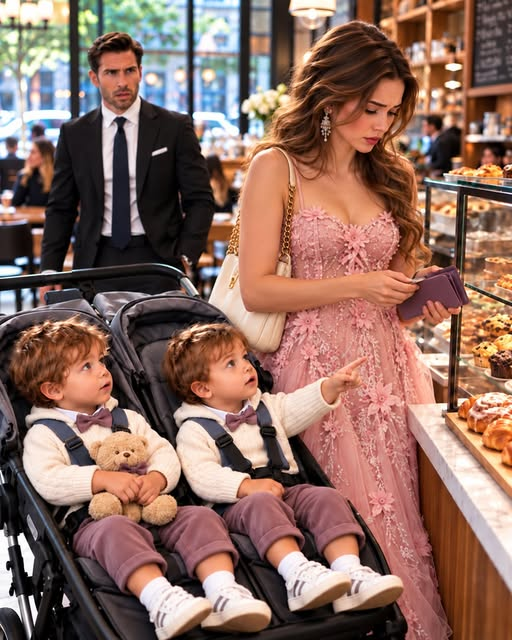
On Monday morning, Nathan Harrison did the largest kind thing of his life with the cold precision of a hostile takeover.
Marcus had the lawyers on a conference line by eight. By nine there was a structure: the money would move from a Harrison holding entity into an independent educational foundation with no Harrison branding, no Harrison board seat, no Harrison name anywhere in the paper trail that a school, a reporter, or a determined ex-wife could follow. The gift would be restricted — that was the one place generosity had to wear a uniform — restricted to the design and construction of a state-of-the-art science laboratory at one specific public middle school on Chicago's South Side.
Five million dollars.
"For the record," said the senior lawyer, a man who had papered over Nathan's sins for a decade and billed accordingly, "a donor of this size customarily—"
"The record," Nathan said, "is that there is no donor. If my name appears anywhere, in any system, in any email, in any man's memory after this call, I will consider it a breach of every agreement we have. Are we clear?"
The line was very clear. Men who built towers understood load paths; Nathan had just explained that his name was not to be one.
"Why the school, if I can ask?" the lawyer said. "For the memo."
"You cannot ask," Nathan said, "and there is no memo."
By noon the foundation's director was in a cab to the South Side with a letter. By one o'clock the letter was in the hands of a principal who read it three times standing up in a hallway, because her office chair had a broken wheel and she did not trust it with the moment.
Marcus stayed on the wall phone in Nathan's office until the last confirmation came back, reading out the chain like a man defusing something. "Holding entity to the foundation. Foundation's board approved by phone — they think it's a legacy donor out of Ohio, which the director believes because I told him to believe it, which he will go on believing, because I have never once given him a reason to check. The school gets a letter and a wire schedule. No press release. No naming rights. I asked about naming rights twice, very loudly, like a man whose client wanted them, and then let myself be talked out of it."
"Why?" Nathan said.
"Because no one hides a thing they never asked for," Marcus said. "Anyone who ever looks will find a donor who wanted his name on a building and got outvoted. It's a better story than a blank. Blanks get investigated. Stories get repeated."
Nathan looked at him with something that, in another man, would have been gratitude and in Nathan was structural respect. "And the contractor?"
"Bids through the foundation's program manager. Crew's told it's a community foundation job, donor's an estate, paperwork's sealed." Marcus paused. "The crew chief's a Harrison man from the old days, though. He knows your voice. I'll handle him."
"Handle him how?"
"I'll remind him," Marcus said, "that the last man who said your name in the wrong room now pours concrete in another state."
By two o'clock, the school knew.
Schools are rumor's native country, and five million dollars is not a rumor that walks. It ran. It hit the teachers' lounge before the copier had finished its morning warmup; it hit the cafeteria by lunch; by the last period there were students — eighth graders, who feared nothing — explaining compound interest to each other in the stairwell, incorrectly, at top volume. The science wing, such as it was — two tired rooms with cloudy aquariums and faucets that hadn't run since the previous administration — acquired, by three o'clock, the hushed glow of a cathedral awaiting a relic.
Emma heard it the way everyone heard it: in fragments, at speed, none of them sane. *Five million. Anonymous. The lab. The LAB, Emma. It's for the lab. It's restricted to the lab.*
She was writing the week's objectives on a whiteboard that had been ghosted by a decade of markers when Dana from English appeared in her doorway holding a printout like a winning lottery ticket and already crying a little.
"Tell me that's your room," Dana said. "Tell me the new lab goes in your room."
"The district doesn't have five million dollars to give me a room," Emma said, because her disbelief had seniority. "The district owes our copier money."
"Not the district. A foundation. Anonymous donor, restricted gift, science lab, this school, *your* wing. Principal's got the letter. Emma. Emma." Dana seized her by both shoulders with the authority of a woman delivering prophecy. "You are getting a lab with faucets that work."
Emma sat down in a student desk, because her knees had filed a protest.
She thought about the condemned back room with its dead burners, where she had taught chemical reactions using vinegar, baking soda, and pure theater for six years. She thought about Noah — no. She stopped that thought with the discipline of long practice and thought instead about twenty-six eighth-graders and a volcano that would no longer have to be a metaphor. Working faucets. Vent hoods. Microscopes that had been manufactured in this century. A periodic table with the noble gases present and accounted for, like guests who had finally accepted an invitation.
"It doesn't happen," she said, to Dana, to the printout, to the universe generally. "Things like this do not just happen."
"They just did," Dana said.
That was the moment — brief as a struck match — when suspicion moved in her. Because Emma Parker knew the exact market price of miracles; she had been paying one off at $310 a month for four years, and she knew that five million dollars did not fall out of the sky onto a South Side middle school without a hand somewhere above it, opening. The timing. The restriction. A science lab — not a gym, not a library, not the roof that actually leaked. A science lab, at *her* school, in *her* wing, one week —
She stopped. One week after what? She had seen no one. Nothing had happened. She had counted coins in a bakery and taken home bread, and the world had not changed — she would have noticed the world changing; noticing was her whole job.
Coincidence, she decided, with the sternness of a scientist discarding a beautiful hypothesis. Rich people gave money away in October the way geese flew south. It meant nothing about her. She would not make it about her. She had survived five years by refusing to make anything about him.
"When do they start?" she asked, and Dana screamed a little, and the day went on being impossible.
There was an assembly last period, because the principal was not a woman to let five million dollars go un-assembly'd. Six hundred students in a gym that smelled of floor wax and adolescence, and the woman stood under the basketball hoop with the letter held up like a treaty and said the words *five million dollars* into a microphone that fed back, proudly, at exactly the wrong moment, and the sound the children made was the sound of a building deciding to be happy all at once.
Emma stood at the back with her homeroom, where teachers stand, and watched her students lose their minds with professional envy and personal joy in about equal measure. A girl in the third row — one of hers, a volcano enthusiast, a future engineer if the world behaved — turned around in her seat, found Emma's face over the crowd, and mouthed, with enormous clarity: *MISS PARKER. THAT'S YOUR LAB.*
Emma laughed, out loud, in public, with her hand over her mouth. She could not remember the last time joy had arrived without paperwork attached.
That night she told the boys at dinner, because some news is too big to grade quizzes through.
"Somebody gave my school a present," she said. "A big one. A whole new science room, with — " she counted on her fingers the way they liked, " — faucets that work, and microscopes, and a table that goes *whoosh* so the smoke goes away."
"Who gave it?" Noah asked, around a mouthful of rice.
"Nobody knows, baby. A person who didn't say their name."
"That's the best kind," Ethan declared. "Like Mr. Russo's special bread. You just get it and you say thank you to the air."
"Out of the mouths," Emma said softly, "of astronaut-bakers."
She said thank you to the air that night, at the kitchen table, alone with the lesson plans. Under her breath, so the universe wouldn't hear her being superstitious, she thanked whoever it was — some estate in Ohio, the foundation woman had said, some dead rich man's last good idea — and she meant it completely, which is the detail that would matter later. She meant it completely for three days.
—
The contractors walked the science wing on Thursday with clipboards and laser measures, already arguing happily about demolition.
Emma was in the hall outside her classroom between periods, holding a stack of quizzes and a cup of tea gone cold, when one of them — a big man in a Harrison-era hard hat, though she did not know enough about hard hats to know that, and would have minded very much if she had — stepped half out of the condemned lab doorway with his phone to his ear and said, in the clear carrying voice of a man who spends his life in loud places:
"Yes, Mr. Harrison. Ms. Parker loved the new lab. Nobody knows you paid for it."
Emma went completely still.
The quizzes did not fall. She was proud of that later, remotely, the way you are proud of a dog that didn't bark. The tea did not spill. The hallway went on being a hallway — lockers, bells, somebody's lost shoe — and she stood inside it holding her entire ordinary Thursday while the sentence reassembled the world around her.
*Mr. Harrison. Ms. Parker loved the new lab. Nobody knows you paid for it.*
Friday. The bakery. She had known — she had *known*, with the part of her that had been keeping her children fed and hidden and safe for five years, that the coins had been witnessed. She had told herself the bakery was anonymous, that the man in the good coat by the pastry case was nobody, that she had imagined the shape of a familiar shoulder in the corner of her eye because she was tired. Because she was always tired.
He had been there. He had watched her count coins. And then — this was the part her hands were doing something about, crushing the quizzes slowly against her ribs — he had done what Nathan Harrison had always done instead of the thing that was asked of him. He had not come to her. He had not knocked. He had not said *Emma.* He had gone home and moved money, the way weather moves, from very high up, and arranged for her to be grateful to nobody.
*You still have absolutely no idea what you've done.*
She thought it then, in the hallway, before she ever said it. She thought it with total clarity, the way she had once, at twenty-six, understood an exam question all at once. Because what he had done — the gift, the beautiful anonymous gift — was drag his money, and with it anyone who ever came looking for his money, into the one life in Chicago that could not afford to be looked at. He had aimed five million dollars at her hiding place and called it mercy.
She got through the school day the way she got through everything: by continuing. She taught the volcano. She graded at the kitchen table that night with Noah's inhaler in her eyeline and the boys asleep behind the thin wall, and the arithmetic on the page in front of her was not sums. It was what a traced gift did to a woman with an old hospital debt and two sons whose father's name was nowhere. It was what *found* meant, when you had spent five years being unfindable.
Once, in the hall by the water fountain, the crew chief — the big man with the phone, gray at the temples, a face like a closed door — had passed her and nodded, polite as anything, and said, "Afternoon, Ms. Parker," in a voice pitched carefully at nothing, and she had understood, with the cold clarity she trusted most, that he had been told to say exactly that much and no more. Men did not handle Emma Parker with that kind of care by accident. They handled her that way on instructions. She had been an instruction in somebody's briefing, in some office, attached to a plan.
She had been, for three days, the happiest she could remember being. She held that up in her mind next to the crew chief's careful nod, and hated how well the two things fit together.
At nine-forty, with the boys asleep, her phone rang.
She knew before she answered. She had known, if she was honest, since the bakery — since the shoulder in the corner of her eye — that this call had been coming for five years and had only been waiting for him to be brave enough to dial.
"Nathan," she answered coldly.
"Emma," he said. "We need to talk."
She glanced toward the apartment door. Almost as if she already knew he was downstairs.
"Come up," she replied. Then her voice hardened. "But understand something first."
"What?"
"You still have absolutely no idea what you've done."