The stairwell smelled of bleach and other people's dinners.
Nathan Harrison climbed three flights in a suit that cost more than the building's monthly rent roll, and he counted every step the way he had counted everything for five years — precisely, and as a way of not feeling it. Marcus had offered to wait in the car. Nathan had not answered him, which Marcus, after eleven years, understood to mean stay, and also meant go. The car was gone by the time he reached the second landing.
Emma's door was the color of weak tea. The paint had been touched up so many times the brush strokes stood out like scar tissue. From inside came the low hum of a refrigerator and nothing else. The boys were asleep. She had told him that on the phone — come up, they are asleep, keep your voice down — in the tone of a woman issuing terms to a head of state.
He knocked once, quietly, with two knuckles.
She opened the door before the sound had finished traveling. She must have been standing behind it. She was barefoot, in a faded university sweatshirt and leggings, her hair loose and damp at the ends, and she looked at him the way she might look at a weather report she already knew was bad.
"You came up fast," she said.
"You said come up."
"I said it ten minutes ago. You've been standing in the stairwell."
He had no defense for that, so he stepped past her when she moved aside, and the door closed behind him with a soft, careful click that told him more about her life than anything else had yet. People with sleeping four-year-olds learned to close doors like that. He had never closed a door like that in his life.
The apartment was small and aggressively clean. A couch with a fitted sheet over worn upholstery. A kitchenette with two stools. On the refrigerator, held by magnets shaped like planets, were drawings — rockets, rings of Saturn, a sun with a face — and two appointment cards and a school lunch menu annotated in pencil. On the narrow counter beside the sink sat a nebulizer, its mask coiled neatly in a zip bag, next to a row of small amber bottles with pharmacy labels.
Nathan's eyes went to the closed door at the end of the short hall and stayed there.
"Don't," Emma said.
"I wasn't—"
"You were deciding whether you could look. You can't. Sit down."
He sat on the couch, which received him with the resignation of furniture that had held many worse men, and Emma did not sit. She went to the kitchenette, took a thin folder from the top of the refrigerator — she had to rise on her toes for it, and he remembered, suddenly and completely, her reaching for the high shelf in their first kitchen, laughing — and she came back and laid three documents on the coffee table in front of him, one at a time, like a dealer who is very sure of her cards.
"Read," she said.
The first was on district letterhead. It used words like anonymous benefaction and irregular procurement and conflict-of-interest review. It informed Ms. Emma Parker that, pending an ethics audit into the five-million-dollar donation that had funded the Whitfield Middle School science laboratory, and into her relationship, if any, with the donor, she was suspended from teaching duties, with pay withheld pending the outcome, effective immediately.
The second was from a law firm whose name Nathan recognized because his own company had once used them for collections, years ago, before he had decided he did not enjoy knowing about it. It notified her that her creditor, acting on newly verified employment and address information, had filed for wage garnishment in the matter of an outstanding medical balance of one hundred nineteen thousand, six hundred and forty dollars.
The third was not a letter. It was a printout of the audit hearing notice. A date. A room number downtown. Ten days from now.
Nathan read them all twice. His face did what it had been trained to do in a thousand negotiations, which was nothing.
"Now," Emma said, in a voice so level it frightened him more than shouting would have, "explain to me again how you were helping."
"Emma. The donation went to the school's foundation. It was structured—"
"It was structured by you, which is the problem." She sat at last, in the chair opposite, as far from him as the room allowed. "Five million dollars does not fall out of the sky into a public school in the poorest district in this city without someone asking where it came from. A reporter asked. A board member asked. The district opened an audit, and the audit needed a thread to pull, and the thread was the teacher whose classroom the lab was built around. Me. They think I solicited it. They think there may have been — the word they used was consideration. They are deciding whether I am a woman who traded something for five million dollars for her school."
"That's insane. There's a paper trail. The foundation—"
"And the paper trail has your name on it now, Nathan, which is worse." Her hands were folded so tight the knuckles had gone white. "Do you understand what you did? You didn't just give money. You lit a lamp over my life. The district found me. The newspaper found me. And then — this is the part I need you to hear — the hospital's lawyers found me. I have kept that debt in a box for four years. I paid what I could, when I could, and they left me alone because I was a substitute's salary and a forwarding address that went nowhere. Your donation put my name, my school, and my address in a public filing. They garnished me in nine days. Nine. It took you nine days to spend five million dollars loudly enough to cost me my job and my paycheck at the same time."
The refrigerator hummed. Down the hall, behind the closed door, one of the boys made a small sound in his sleep and then was quiet.
"How much do you need," Nathan said, "to make the garnishment go away. All of it. Tonight. I'll pay the entire balance, I'll retain counsel for the audit, I'll—"
"No."
"Emma—"
"No." She said it without heat this time, which was worse. "Listen to me very carefully, because this is the part you have never once understood. You do not get to fix this the way you fix a zoning problem. My name is in an audit because of money I did not ask for. If you pay my debt tomorrow, the auditors will find that too — a six-figure personal debt, erased, the same week. What does that look like, Nathan? What does 'consideration' look like, if not that? Every dollar you throw at this makes the story they are telling about me more true."
"I'll make a statement. I'll go to the district myself—"
"And say what? That my ex-husband felt guilty? That will read beautifully in the hearing." A sound escaped her that was almost a laugh. "You still think this is a problem of amounts. It was never a problem of amounts. It was a problem of you deciding, alone, in your office, what my life needed — exactly the way you decided, alone, in your office, that our marriage was an acceptable loss during a merger."
There it was. He had known it was coming the way you know a floor is coming.
"Say it, then," he said quietly. "All of it. I came up the stairs. Say it."
Her eyes changed — not softening; focusing. "I found out I was pregnant two weeks after the divorce was final. Two weeks, Nathan. I sat on the bathroom floor of a studio apartment I could barely afford and I did the math on a napkin, because that is what my life had become, math on napkins. They were conceived before you signed. They were born seven months after. I want you to have the dates exactly, because I know you will check them, and I want you to know that when you check them, they will hold."
"Why didn't you tell me."
"Because you had already told me." She leaned forward. "Not in words. You told me in a signature. You signed divorce papers between a valuation call and a site walk, Nathan. Your assistant put them in a folder with the Hartman contracts and you signed the whole stack standing up. I know because I asked him, later, whether you had hesitated. Do you want to know what he said? He said you asked if there was anything else that needed a signature before lunch." Her voice did not rise. It lowered, which was somehow unbearable. "So no. I did not call the man who had already filed me under 'anything else' and tell him I was carrying his children. I decided my sons would not grow up as a line item someone signed for between meetings."
He could not speak. The room seemed to have lost a dimension.
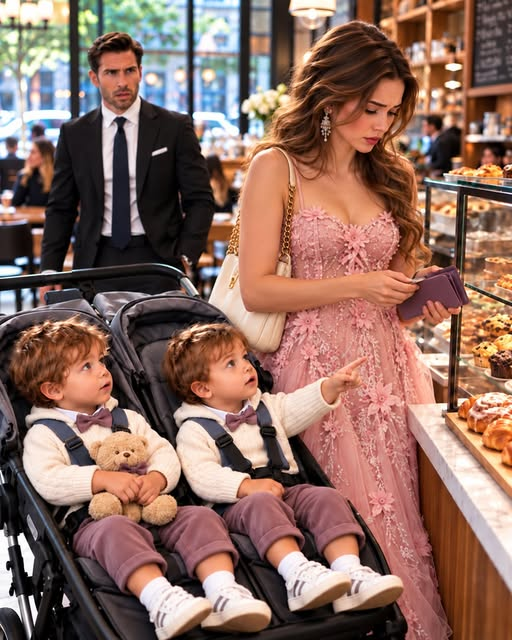
"They came at thirty-two weeks," she went on, because she had clearly decided, long before tonight, exactly how this would be said if it was ever said, and she was going to finish it. "Noah first, then Ethan, four minutes apart, and they were so small the nurses used words like if for the first three days. I was alone for most of it. My mother drove down from Milwaukee for the first month and then she had to go back to work, because everyone in my life has to go back to work. Noah's lungs — you saw the nebulizer. That is premature birth, Nathan. That is a machine my son breathes through when the air turns on him, possibly for years, and it is a bill, and the bill became a hundred and twenty thousand dollars because I had a teacher's insurance plan and a complicated delivery and two infants in intensive care for six weeks. I have paid it down, slowly, out of a salary you could lose in a coat. I was managing. Do you hear me? I was managing. My sons eat. They have a school they love. They have a mother who is not a scandal. And then you walked into Russo's bakery, and you saw us, and you could not leave it alone, because leaving things alone is the one deal you have never been able to close."
"I know their names," Nathan said, very quietly. "Ethan and Noah. I know Noah has the asthma. I know where they go to school. I paid for a report, Emma. Before the donation. I told myself it was due diligence."
Something in her face closed like a door. "Due diligence," she repeated. "Four years they existed in this city, breathing the same air as you, and you never once knew — and the moment you did know, you did to them what you do to a parcel of land. You ordered a survey." She shook her head slowly. "Ethan is the loud one. He points at things and demands the world explain itself. Noah watches first. He draws — planets, rockets, he draws Saturn with eleven rings because he says ten is showing off. He has a bear with one ear half gone and he sleeps with it against his chest because the weight helps him breathe easier, or he believes it does, which at four is the same thing. That is what a father knows, Nathan. Not a file. You bought the file because the knowing would have required you to be somewhere, every day, being bored and tired and present, and you have never once in your life chosen present over important."
"I saw my sons eating bread I couldn't—" He stopped. Started again. "I saw you counting coins, Emma. Coins. For rolls. You were married to me. Do you know what that did—"
"Yes," she said. "I know exactly what it did. It hurt your pride. It made the King of Concrete feel poor in the one currency he actually keeps." She stood up, and he understood the conversation had reached the part she had built the whole night around. "Here are my terms, and they are the only ones on the table. Ethan and Noah do not know you exist. You are not a story I have told them yet, because I have not decided what kind of story you are — and after this week, Nathan, you have not improved your application. You will not come near them. Not the school, not the bakery, not this building. Not until I decide. If you break that, I will take the audit, the garnishment, and the restraining order, and I will still have lost less than I would lose letting you buy your way into their lives on your schedule instead of mine."
"Emma. Please."
"The hearing is in ten days." She walked to the door and opened it, and the stairwell air came in, bleach and other people's dinners. "Whatever you are going to do about the wreckage, you will do it where I cannot see it, and it will not have my name or my boys' names anywhere near it. Goodnight, Nathan."
He stood on the landing for a long time after the door closed — softly, carefully, the way people with sleeping children close doors — and his phone lit up in his pocket with three messages from Marcus about the Crown Meridian term sheet, and he read none of them.