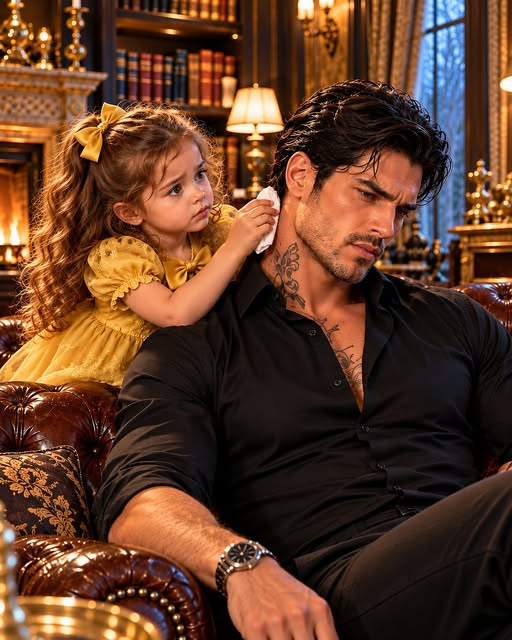
The dining room at the Moretti estate had hosted treaty dinners, a senator, two funerals, and one wedding that ended with the bride's uncle being carried out through the kitchen by four men, and it had never once looked inadequate to the occasion.
Friday night, it gleamed.
Forty guests. The Romano family down one side of the long table like a visiting monarchy, the Morettis and their allies down the other, candles in cut glass, the engagement portrait of Dante and Isabella propped on an easel by the doors, smiling with the polished, varnished happiness of a merger announcement.
Anna Miller had not been meant to work the dinner.
The catering staff had it. But at five o'clock, Victor Hale had appeared in the service corridor with his clipboard and his mild, immovable smile and informed her that the house staff would assist after all — "Mr. Moretti prefers familiar faces around him at stressful events, Mrs. Miller" — and that Sophie could wait in the old servants' pantry off the kitchen, where the thick stone walls had once kept butter cool and now kept a five-year-old quiet with a coloring book and a plate of cut fruit.
Anna had not liked it.
She had liked even less the way he said it: *familiar faces*. As though he were arranging furniture.
Now she stood against the wall with a water pitcher in her hands, invisible the way staff are invisible, and watched the head of the table the way you watch a man walk a roofline.
Dante had been magnificent for two hours. That was the cruelest part, and Anna understood later that it was meant to be cruel, that the height was part of the design of the fall. He had been funny. He had been precise. He had remembered the name of Salvatore Romano's youngest grandson and asked after the boy's boat. Isabella, beside him, had begun to glow with something that was not performance — relief, arriving like spring — and had twice touched his hand on the table, and he had turned his hand over, both times, and held hers.
At nine o'clock, Salvatore Romano rose with his glass, and the room rose with him, and the old lion made his speech about two families and one future and the port contracts that would be signed at the wedding like a sacrament.
Then he sat, and forty glasses turned toward Dante, and Dante stood.
Anna saw it before anyone else did because she was the only person in the room who was watching Victor.
Victor Hale sat four chairs down, in the seat of honor that advisers grow into like trees through fences. His hands were in his lap, below the table's edge. He was smiling up at Dante with the fond pride of a father.
His right thumb moved.
It was nothing. A small motion, under the table, against something he held in his palm — the way a man clicks a pen, or presses the button of a thing. Less than a second.
Isabella saw it too. She would deny it to herself for a week, but she saw it: her eyes flicked to Victor's lap and back to Dante, quick as a bird startling.
And at the head of the table, in the middle of the sentence — "My family has kept this harbor for sixty years, and tonight—" — Dante Moretti stopped.
The color went out of his face the way light goes out of a house, floor by floor.
He put one hand flat on the table.
"Tonight," he said again, and the word came out thick, wrong, dragged sideways. His other hand rose, shaking, toward the back of his neck, and stopped halfway, as if the arm had forgotten its instructions. "Tonight, I — I want to—"
The glass in front of him went over. Water ran across the contracts folder.
"I can't—" he said. "The words. Where are the—"
Forty people watched the most controlled man in Chicago come apart at the head of his own table in the space of twenty seconds. It was not noisy. That was the horror of it. It was a drowning performed in perfect silence, in evening dress, under candlelight.
Victor was on his feet. Victor was at his side, a hand under his elbow, a handkerchief appearing, his voice pitched low and ringing with practiced sorrow.
"Forgive us. Forgive him. The old injury — the doctors warned of episodes. He has overtaxed himself. Bruno, the car. Dr. Webb is waiting."
And Isabella — Isabella was standing too, white to the lips, and Salvatore Romano was looking at his daughter's fiancé the way a man looks at a foundation crack in a house he has just agreed to buy, and the whispers started at the far end of the table and ran up it like fire in grass.
*Episodes. Doctors. Is he sound? Is the family sound? Who actually runs the Morettis these days?*
Dante heard all of it through the fog, through the gray weather that had swallowed the room's edges, and the worst of it — the part he would carry like shrapnel, real shrapnel, for the rest of his life — was the last thing that happened before Bruno took his other arm.
Sophie had come out of the pantry.
She must have heard the silence, the strange heavy silence, and come to the kitchen door in her socks with her hands over her ears — Anna saw her there at the exact moment Dante, turning blindly, also saw her, small and scared at the wrong end of a room full of gowns.
And the fog spoke with his mouth.
"Get that child—" Dante heard his own voice, ragged and furious and terrified, say, "Get that child away from me. Away. I don't want it near me, I don't—"
Sophie's face crumpled.
Anna crossed that dining room faster than she had ever moved in her life, in front of both families, in front of the portrait and the candles and the ruined contracts, and she scooped her daughter up and carried her out with the child's face buried in her neck, and she did not look back at the head of the table.
If she had looked back, she would have seen Dante Moretti's face in the second after the fog released him — the horror arriving, the understanding — a man watching himself commit a crime from the bottom of a well.
The doctor — Victor's doctor, Dr. Webb, a soft man with soft hands who had been flown in like a part for a machine — pronounced exhaustion and over-stimulation and administered a sedative that Dante, in the three minutes of clarity he had left, did not resist, because Victor was holding the syringe, and forty guests were downstairs writing the story of the evening in their heads, and resistance would only have been more story.
He slept for eleven hours.
He woke at noon to a silent house, an ache behind his eyes like a kicked door — and a drawing, slipped under the library door sometime in the night by a small hand, waiting on the carpet where his foot would find it.
Sophie had drawn him.
A stick figure man at a long table, with the oval on his neck drawn big and black and the red eye open wide. And beside him, in purple crayon, a tall thin figure with gray hair, smiling, holding a small black box with a red dot on it — and from the box, a line of red dots running across the page, through the air, into the oval on the man's neck.
She had written along the bottom, in her new kindergartner capitals, with the letters getting bigger as she ran out of room:
THE BUG'S DADDY MAKES IT SING.
And under that, smaller, in pencil, in the hand of a woman who had not slept — Anna's hand, steady and furious and precise:
*They moved us out of the cottage at 8 a.m. Mr. Hale says staff with children are a "distraction risk." We are at the Starling Motel on Route 41 until Friday. I am not asking for anything. I just thought you should know what she drew. — A.*
Dante read it four times.
Then he did something he had never done in three years of fog. He did not ask Victor what had happened at the dinner. He did not ask Victor what he had said, or to whom, or what should be done about it, or whether an apology was advisable, or what the Romanos thought, or whether he was fit to run his own family.
He put the drawing in the drawer with the first one. He washed his face in cold water until his hands stopped shaking. He wrote, on the fresh sheet, in block capitals: ROUTE 41. STARLING MOTEL. FRIDAY. SHE DREW THE REMOTE. HE CAME WITHIN INCHES, IN FRONT OF EVERYONE, BECAUSE NOW HE NEEDS THEM TO BELIEVE I AM BROKEN. THE CLAUSE. ASK BRUNO ABOUT THE CLAUSE.
Then Dante Moretti dressed in the rain, declined the car and the umbrella and the driver with a politeness that frightened the staff considerably more than shouting would have, and drove himself, alone, for the first time in three years, down the lake road to a motel with a flickering sign, where a woman who owed him nothing opened the door of room 6 on its chain and looked at him through the gap.
"You said it," Anna said. Her eyes were dry and exhausted and utterly without mercy. "In front of everyone. She cried for an hour."
"I know," Dante said. "I heard myself say it. That's why I'm here and not him. Anna — I know what it is. I know what it does. I know whose hand is on it." Rain ran off the awning in a bright curtain between them. "I can't ask you to come back to that house. I'm asking you to let me fix what I said to her. And then I'm asking—" he stopped, and began again, choosing the words the way you choose footing on ice, "—I'm asking you to help me take my life back from the man who stole it, because your daughter is the only witness I have, and you are the only person I trust to tell me when I'm lying to myself."
The chain stayed on for a long moment.
Then Anna Miller closed the door.
Dante stood in the rain and thought, with the clarity of the ruined: *Of course. Of course. Why would she—*
The chain rattled. The door opened wide.
"One condition," Anna said. "Sophie is never — never — alone in a room with Victor Hale. Not for one second. Not for any reason. If I ever find that rule broken, I will take her so far that your money and your name will never find us. Do you understand me, Mr. Moretti?"
"Completely," Dante said.
"And if you're wrong?" Anna said. "If it's scar tissue and a little girl's imagination and a sick man who shouldn't be driving in the rain? What happens to us then, Mr. Moretti? Because I have stood in exactly one doorway like this before, in another man's house, being told I was valued, and I know how the story goes for the staff when the master changes his mind. We end up in rooms like this one. We end up with our things in bags. I can't afford your delusions, even kind ones."
"You can't afford them," Dante said. "That's why I'm not asking you to believe me. I'm asking you to look at the evidence and tell me what *you* see. Nobody in my life says no to me, Anna. It's the loneliest thing in the world, and it's how he did it — a whole house that can't say no is a cage with good furniture. I need one person who can. Sophie did it with a crayon. I'm asking you to do it with your eyes open."
Through the gap in the door came the small sounds of room 6: a television murmuring to no one, a child's crayon working steadily against paper, pausing, working. Sophie was drawing. She was always drawing now, Anna would tell him later — drawing the same thing the way other children draw the sun, as a fact of the visible world.
"Then come in," said Anna, "and tell me everything. From the beginning. And this time—" she stepped aside, and over her shoulder he could see a small girl at a motel table, frozen mid-crayon-stroke, watching him with enormous eyes, "—you can start by telling *her* you're sorry. If she'll listen."