Dr. Miriam Osei had a waiting list of four months, a reputation built like a fortress, and a policy — famous in Chicago medicine — of never, ever taking a patient because of his name.
She took Dante Moretti at 1:40 on a Friday morning because of a five-year-old's crayon drawing, which Bruno Keller faxed to her office from a police station.
"I've seen three of these in my career," she told Anna, in the corridor outside the operating suite, while the anesthesiologist was still arguing with the night administrator. "All in soldiers. Never in a civilian. Never with an audio array." Her eyes were tired and furious and completely awake. "Whoever did this to him knew anatomy like a pianist knows keys. The removal is not the hard part, Mrs. Miller. The hard part is that the device sits against the vertebral artery, and it has been *growing in* for three years. Scar tissue loves a foreign body. It marries it."
"What does that mean?" Anna said. "In ordinary words."
"It means I might open him up and have to choose between taking it out and keeping him." Osei held her gaze without flinching, which Anna would remember, later, as the moment she decided to trust her. "If that moment comes, I keep him. You understand me? He walks out of here with it in his neck before he doesn't walk out of here at all."
"Yes," Anna said.
"Good. Then sit there—" she pointed at the orange chairs, "—and be the person he comes back to. It matters more than the families believe and less than the surgeons admit."
The surgery took six hours.
Anna sat in the orange chairs for all six of them, with Sophie asleep across two seats and a paper cup of coffee going cold in her hand, and she counted things the way she had counted nothing since the night her husband didn't come home: ceiling tiles, rosary decades on a borrowed set of beads from a night nurse, the small hand of the wall clock completing its patient circles.
At hour four, a door opened somewhere and a voice said something with the word "pressure" in it, in the tone that makes waiting rooms go silent, and then there were forty seconds — Anna counted them, she would always be able to count them — in which the clock was very loud and the machines beyond the glass made one long level note that she would hear in the walls of her sleep for a year.
Then the note broke up into rhythm again.
At dawn, Dr. Osei came out with her mask down and her cap in her hands and sat — actually sat, in the orange chair beside Anna, like a person, not a verdict.
"It's out," she said. "All of it. The capsule, the leads, the little red eye." She turned her palm up. "Artery held. He held. He's going to sleep for a while, and when he wakes, he's going to have the first honest headache of his life — an ordinary one, from surgery, that means nothing and goes away. Do you understand what I'm telling you? For three years every pain he had was a message. This one is just pain. It's his."
Anna Miller put her face in her hands, in the dawn corridor, and cried like a woman setting down a piano.
He woke in pieces, the way a shoreline returns.
First there was light, and it did not hurt, which confused him. Then there was a ceiling he didn't know, and a window with rain on it, and a bandage pulling at the back of his neck when he tried to turn toward the sound of paper — a crayon, working steadily against a page, pausing, working.
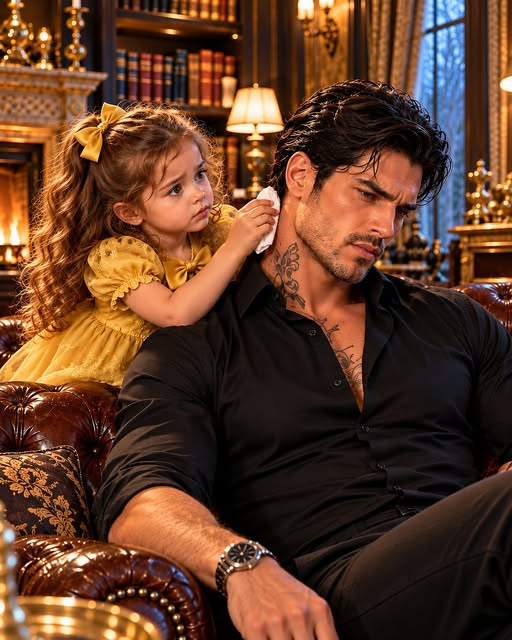
Sophie was in the visitor's chair with her feet tucked under her, drawing on the meal tray. She was wearing a paper crown the nurses had made her. On the tray, in a jam jar of water from the bathroom tap, sat a single flower she had clearly liberated from somebody's get-well arrangement.
"You're awake," she observed. "Mommy said you'd be boring for a long time, but you're awake already."
"Sophie," Dante said, through a throat like gravel. "What day is it?"
"Saturday."
"And yesterday?"
"Friday. You had your operation. I stayed with the orange chairs." She said it the way she said all facts, as a report. "The doctor lady took the bug out. It was in a bowl. I wasn't allowed to see, but Bruno described it. He said it was smaller than a grape and uglier than a raisin." She returned to her drawing with the air of a person whose work here is nearly done. "I drew it in the jar so it knows it's caught."
"Where's your mother?"
"Getting coffee that she won't drink." Sophie slid the finished drawing across the blanket toward him: the oval, the legs, the red eye — sealed this time inside a carefully ruled jar, with a lid drawn in double lines and a label in large triumphant capitals: DEAD. "You can keep it. It's the last one. I don't have to draw it anymore."
Dante Moretti, thirty-six years old, with thirty-one stitches and an FBI detail outside his door, held the drawing with both hands and discovered that his memory — his traitor memory, his stolen country — had kept every word of the conversation, perfectly, like a held breath finally let go.
He remembered. He remembered all of it.
They kept the device in a steel specimen tray, and the FBI's technical people — who arrived at nine with a warrant and a lead-lined case — went very quiet when they powered it in the lab two floors down.
Because the bug, it turned out, had been keeping secrets of its own.
The NS-2's audio array buffered locally: a rolling store, overwritten in cycles — except for its diagnostic partition, which Victor Hale, a man of systems, had configured to keep a permanent log of every command test ever run against the unit. Evidence, catalogued by its own keeper. Forty-one voice recordings, time-stamped, in a familiar voice, mild as milk:
*Trial twelve. Pulse modulation at forty. Subject reports migraine, disorientation. Subject compliant.*
*Trial nineteen. Wedding protocol rehearsal. Increase fog during contract review.*
*Trial twenty-six. If the panel moves for guardianship, sustain episode until instruments are signed.*
*Trial thirty-one. Note: the subject asked about the scar today. Increase evening dose. He is becoming curious. Curiosity is the one symptom I will not permit.*
The detective in charge of the case listened to the last one twice, and then he looked up at the tray and said, in the tone of a man watching a long trial assemble itself, "Well. That'll do it."
Victor Hale was charged before the weekend was out. The charges had long names and longer numbers — wire fraud, conspiracy, aggravated battery by medical means, attempted unlawful guardianship, a tail of financial crimes reaching back through three years of other men's signatures — and behind the charges, like a second tide, came the state's attorney's audit of every contract the Moretti family had signed since the bombing. Some held. Some dissolved overnight like sugar in rain. The ports went back. The warehouses went back. Dr. Webb's license went into a shredder of hearings. The clinic administrator who had taken the cash took a deal and sang like the dawn chorus.
And Isabella Romano came to the hospital on the third day, in a gray coat, without her father, and sat in the vinyl chair by Dante's bed while he slept, and when he woke she was still there.
"I owe you the truth in person," she said. "I saw his thumb at the engagement dinner. I told myself it was nothing. Then I told myself it wasn't my place. Then, the night of the signing, I took my father's copy of the side agreement out of his safe and put it in my bag, and I still almost didn't—" She stopped. Her hands were steady. Her voice was not. "I was raised to be an excellent wife for a powerful man, Dante. Nobody in my house ever taught me to be a witness. I'm sorry it took me so long to learn the job."
Dante, who had a bandage at the back of his neck and thirty-one stitches of honesty in him, looked at her for a long moment.
"You learned it in time," he said. "That's the only deadline that counts."
The engagement was dissolved the following week, in a joint statement of six lines that used the word "amicably" twice and fooled nobody, and unleashed a month of Chicago gossip that Dante Moretti read about himself — every word of it, clear-eyed, over morning coffee — with the light, floating amazement of a tourist in his own discontinued life.
Salvatore Romano, for his part, sent no apology and one crate. It arrived at the estate without a card: a case of the Barolo that had been meant for the wedding, and a single line in the old man's hand, delivered by his driver, who reported it with the awe of a man who had carried a live grenade:
*My daughter is worth more than two ports. So, it turns out, is your harbor. We are done. God keep you.*
Dante, when he was told, laughed until the stitches pulled — his first laugh of the new world, Anna noted, and it was rusty, and it was real, and it did not trail off into fog at the edges searching for anyone's permission.
Bruno came on the fifth day, with a folder instead of flowers, because Bruno understood him. Sixty-one relay boxes, itemized: photographed, bagged, surrendered. The house was clean from the boathouse to the chapel. "And Mrs. Delgado," Bruno said. "Rosa. The state's attorney flew her in. She identified a photograph, sir. She identified *him*. All those years she kept that paper in a tea towel — she cried when she signed the statement. Said her husband could rest now." He closed the folder. "Whatever else comes out in the audit, sir, I want it in a record somewhere that my men answer to you and the Director. Nobody else. I should have seen it. I carried the ladder."
"You saw it when it counted," Dante said. "At the wall. You can spend the rest of your life on some other debt, Bruno. Not that one."
Recovery, Dr. Osei warned him, would not be a staircase. It would be weather. The body had spent three years being played like an instrument and would take time to believe the hands were gone. There were migraines — ordinary ones, liars no longer, that bloomed and spent themselves and left nothing missing behind them. There were mornings when a shadow crossed a doorway and his shoulders rose before his mind did. There was a therapist, a blunt woman named Dr. Ito, whom Victor would never have chosen, who told him in their second session that he was not a broken man but a robbed one, and that there was a difference, and that the difference was going to be the work of his life.
And there was the first morning — four weeks after the surgery, a Tuesday, rain on the glass the way it had rained on all the important days — when Dante Moretti sat down at his desk with his coffee and the day's folder, and worked through it, page by page, and came at last to the final sheet, and realized, with his pen still moving, that he remembered every single thing he had read.
Not most of it. Not the shape of it.
All of it. The figures. The names. The clause on page six that he disagreed with, and why.
He sat in the quiet study with the folder finished and the coffee gone cold, and he put his face in his hands — one of them, lightly, wonderingly, against the fresh scar at the back of his neck, where a child's fingertip had started all of it — and he wept, briefly and without shame, the way a man weeps at a graveside when the person in the ground turns out, against everything, to be alive.
It was himself he had been mourning.
He had come back.