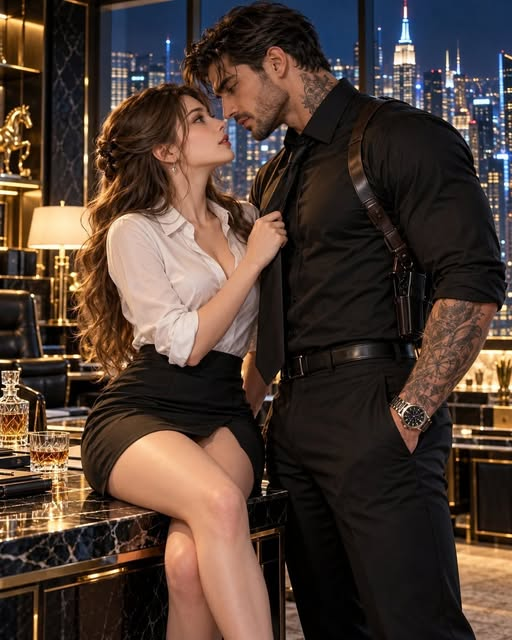
The week that followed was the most professional week in the history of the Blackwood Group.
Jenna arrived each morning at eight with my calendar rebuilt into something a sane man could survive, and coffee, and no reference whatsoever to engagement dinners, folders, stoops, or cars at midnight. I signed what she put in front of me. I attended the meetings she had previously described as invented by owls and did not say so. Twice, Petrov came — quarterly routes, a dull thunder of a man — and Jenna set down his water and told him his manners had improved, and Petrov, who feared nothing on two continents, had looked at me over her head with the bewildered respect of a man watching someone housetrain a wolf.
We were perfect. It was unbearable. It was exactly what she had asked for, in writing, in a car: the paperwork, clean.
By Wednesday I'd caught myself, twice, standing in my own doorway watching her work — the pen behind her ear, the phone against her shoulder, my whole empire reduced, apparently, to a man hoping a woman would look up. Both times she did. Both times she looked back down again, a half-second too slowly to be professional, and I went back to my desk with the information that we were, both of us, serving a sentence we'd imposed on ourselves and neither of us had the standing to shorten.
On Wednesday, an envelope arrived at the office by courier, cream card, engraved — the wedding of Matthew Robert Hart and Natalie Elaine Brooks, in October, at a vineyard in the foothills. My name was on the outer envelope in handwriting I knew better than my own. On the card inside, below the printed invitation, Jenna had written nothing at all. But clipped to it was a second, smaller card, in Matt's square engineer's hand: Plus one is assumed, Evan. Don't be an idiot. — M.
I put it in the drawer with Daniel's report, where I keep the things my life is made of that don't fit in the other drawers.
On Tuesday, Matt Hart called my office — my office, on the line Jenna answered fifty times a day — and when she put him through, which she did with the expression of a woman handing a man a live wire, he said, "I just wanted the man himself to hear it. My mother has been crying and cooking in rotation for three days. She's made four pies, Evan. Four. My father says it's how she processes, and that the neighborhood is processing with her because she keeps giving them away. Whatever happens with you and my sister — and it's none of my business, and Natalie has already named the wedding colors, so God help us all — thank you for the way you did it. You could have destroyed him. I've seen men destroyed at tables for less. You just… told the truth and opened the door."
"He destroyed himself, Matt. I only turned on the light."
"Yeah," he said. "My sister's been saying that for two years about her boss, and I never believed her until Thursday." A pause. "She put your wedding invitation in the office mail herself, you know. Hand-carried it to the courier. For an envelope going to her own building."
On Wednesday afternoon, a courier brought Jenna a box — long, white, the kind florists use. She opened it at her desk while I was in the doorway pretending to review a manifest, and I watched her read the card inside twice, with an expression that rearranged itself slowly, like a room being put back in order. She didn't show me. She didn't have to. She stood, and carried the box — white roses, I could see from the doorway, her mother's all along, the apology species — into her office, and set them where the light was, and went back to work with her shoulders doing something new.
What I know about the card, I know because she left it on my desk on Thursday morning, under my coffee, in the spot where she'd have left an urgent contract: three lines, in handwriting that had clearly been practiced and then abandoned for honesty. Jenna — I gave a stranger the keys to your life because I missed the daughter I understood. I am learning to knock. — Mom. And beneath it, in Jenna's own hand, in the margin, one line, initialed like a minute of a meeting she was chairing: Filed. Not forgiven. Not nothing. — J.
I put the card in the drawer too. The drawer was becoming the truest biography I owned.
Thursday, I stayed late. There was no reason to stay late. The Halvorsen contracts were signed; Colorado Springs was a solved problem; the week had been so aggressively professional that there was nothing left in it to fix. I stayed because the office at dusk was mine in a way nothing else was, and because I am, at the end of all the freight and the fear and the thirty years of weather, a man who would rather sit in a quiet room with his wanting than go home and want in a bigger one.
At 5:42, Jenna Hart appeared beside my desk.
I know the time because I looked, the way you look at a thing you intend to remember in the order it happened. She wasn't clutching a phone this time. She was holding two coffees — mine, and hers, the one I was apparently no longer permitted to steal the last sip of, traditions having been formally renegotiated. She set mine down in its place, precisely, the way she set down water for dangerous men.
"Boss," she said. "I need a boyfriend."
I slowly lowered the documents in my hand. They were the Halvorsen contracts. I had been pretending to read them for some time.
"Care to repeat that?" I said, and my voice, for once in my life, did not entirely do what I told it.
"For the record, this time." She came around the desk — my desk, the moat of it, the frontier no one crossed — and sat, not across from me where clients sat, where she had sat a week ago with her whole life coming apart in her hands, but on the edge of it, near enough that the evening light from the windows did all the kind things it does. "I have notes. Do you want the notes?"
"Jenna—"
"I rehearsed this in the car with Marcus, who is a traitor and charged me one secret per rehearsal, so I owe that man knowledge about your coffee order that could end governments." She took a breath. "Item one. Last Thursday I asked you to pretend, and you did, and you were — you were so careful with it, Evan. You held my hand like it was evidence. You told the whole room the truth and let me keep every inch of my own dignity that I came in with, which was more than I walked in with, actually. Item two. You had a man watching my building and you told me so, to my face, in a bar, with the folder still warm. Item three." Her voice softened, and so did everything else. "You gave it back. In the car. All of it. You could have kept that evening like a debt and you handed it back and said whatever happened next was mine. Do you know what kind of man does that?"
"A patient one," I said.
"A good one," she corrected. "A good one pretending, extremely unconvincingly, to be a monster at a desk. Two years I've worked for you, and you know what I figured out this week, in all that professionalism? It wasn't the dinner. The dinner just proved it in public. I'd already decided. I think I decided the night you fired Petrov's voice out of this office by giving him a chair and a glass of water and eleven minutes — no. Earlier. I decided the first month, when you found out I'd rearranged your calendar and you looked at it and said, 'Hm. Better,' and never mentioned it again. Men don't do that, in my experience. Men rearrange it back, louder."
"Where is this going, Miss Hart?"
She smiled — the real one, the rare edition, the one that had been doing renovations in my chest for two years.
"This time, I'm asking," she said. "Not for one night. Not for pretend. Evan Blackwood — will you be my boyfriend? The actual kind. The kind my mother has to learn in public, at her own speed, and my brother gets to say 'finally' about, and Natalie gets to be unbearable about forever. The kind with Mondays in it."
"There are conditions," I said.
"I knew there'd be conditions."
"One condition." I stood — slowly, the way I had stood a week before to reach for my jacket and a war — and this time there was no war, only Jenna, close, with the whole lit city going gold behind her. "If I'm not pretending to be your boyfriend, I'm not taking responsibility for how convincing I become."
Her cheeks turned pink. The fearless Jenna Hart, turning pink at my desk like a schoolgirl — some things, it turns out, are load-bearing.
"Meaning?" she said.
"Meaning I'll hold your hand. Keep you close. Make absolutely certain nobody questions whether you're mine."
"And kissing?"
I held her gaze. It was the easiest thing I had ever done, and I had been practicing for it, apparently, for two years.
"Only if you want me to."
"I want you to," Jenna said. "That's the whole speech, Evan. I want you to. I have wanted — for an embarrassing amount of time, which we will be discussing, because two years of you being a locked door is going to come up in couples counseling — I want you to."
So she kissed me. Let the record show — and in my world, the record always shows — that she closed the distance herself, standing up off the edge of my desk into it, one hand flat against my chest like she was checking the work, and that the most feared man in Denver stood in his own office at 5:42 on a Thursday evening and was kissed by his secretary with his hands, for the first full second, absolutely nowhere, because he had forgotten — entirely, professionally, historically — what hands were for.
Then I remembered. Both of them. I held her the way I had promised the room I would: like a promise in view. Like the truest thing in a life that had not previously specialized in true things.
When she finally leaned back, her forehead against mine, she was laughing a little, and out of breath, and entirely un-pink — composed, of all things, the way she was composed in boardrooms and crises, as if this too were a situation she intended to handle at high speed while telling me I was welcome.
"Well," she said. "That was extremely convincing, boss."
"You have no idea," I said, "how long I've been convincing."
"Two years," she said. "I did the math. Marcus confirmed it. Like I said — a traitor. I'm doubling his Christmas bonus and you can't stop me."
"I wouldn't dare."
She picked up her coffee then, and drank the last sip of it herself, looking at me over the rim with the expression of a woman closing a negotiation she'd won on points. Then she set the cup down, and took my hand, and threaded her fingers through mine the way you sign something you intend to keep.
"Walk me out," she said. "Boyfriend's duties. There's a list. I made it during the week — it's very professional, you're going to hate how organized it is."
"I built an empire," I said, as we went out of my office together, past the desk, past the chair by the door where dangerous men had learned their manners, into a corridor I had walked alone for thirty years. "I doubt your list frightens me."
"Evan."
"Jenna."
"You are so scared of my list."
"Terrified," I said, and held the door for her, and meant every word of all of it.