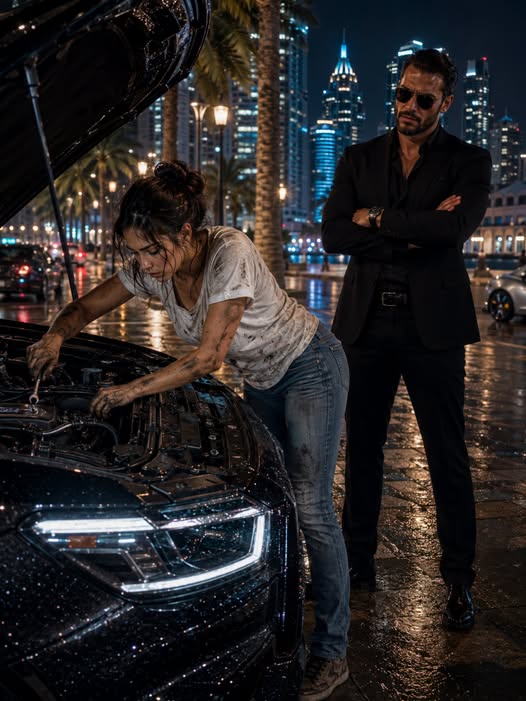
Emma Carter had learned a long time ago that trouble rarely arrived at a convenient hour.
Sometimes it came in the form of an overdue electricity bill wedged beneath the apartment door, the paper damp at the edges, the amount printed in a typeface that seemed designed to look calm while it delivered bad news. Sometimes it arrived as a phone call from her mother's doctor explaining that another prescription had changed, which usually meant another expense Emma had no idea how to cover, and another careful conversation in which Emma said, "We'll manage," because there was no other sentence that helped. And sometimes, apparently, trouble looked like a black luxury sedan steaming beneath an open hood on the side of a rain-soaked Chicago road.
It was close to midnight when Emma noticed the car.
She had just finished fourteen hours at the Sunrise Diner and still had another office-cleaning shift waiting for her the following evening. Two grocery bags hung from her aching fingers, the plastic handles cutting thin lines into her skin. Her sneakers were soaked through, and she could feel the cold water moving with every step. Her dark hair, twisted into a messy bun before sunrise, had surrendered completely to the rain, strands sticking to her neck and her forehead. The streetlights on this stretch of road were broken in places, so the rain fell through cones of yellow light and then disappeared again into the dark.
She should have kept walking.
Every practical part of her knew that. She was tired enough that her thoughts were coming a half-second late. She had groceries to put away, a mother waiting at home, an alarm that would ring far too early, and no room in her evening for a stranger's car. A sensible woman would have looked at the open hood, looked at the empty road, and kept her head down.
Instead, she saw the man standing beside the car.
Tall. Broad-shouldered. Expensive black suit ruined by the weather, the shoulders dark with rain, the trousers sticking to his legs. Dark hair plastered back by rain. A dead phone rested in one hand, its screen black no matter how he turned it, while the expression on his face suggested he was accustomed to having problems disappear before they became inconveniences. He did not look like a man who waited. He looked like a man for whom waiting was an insult.
Emma slowed.
The stranger looked toward the empty road, as if a solution might still arrive from that direction if he stared hard enough. For one brief moment, his frustration disappeared, the way a mask slips when no one important is watching.
What replaced it surprised her.
Loneliness.
It was not the loneliness of a man who was merely alone on a road. It was older than that, quieter, the kind that lives behind a face that is used to being obeyed. Emma recognised it because she had seen a version of it in her own mirror on nights when the apartment was quiet and her mother was asleep and the bills were still waiting on the table.
"Car giving you trouble?" Emma called.
The man turned sharply, his whole body shifting toward the sound, alert in a way that had nothing to do with surprise and everything to do with habit.
His eyes studied her with the alertness of someone who did not enjoy being approached unexpectedly.
"You could say that."
Emma walked closer and glanced beneath the raised hood. Steam was still rising in the cold air, and the smell of hot metal and rain filled the small space under the metal.
"What happened?"
"If I knew, I probably wouldn't still be standing here."
She looked at him.
"You don't know anything about cars?"
His expression tightened.
"I employ people who do."
Emma gave a tired laugh. It was not a polite laugh. It was the laugh of a woman who had been on her feet for fourteen hours and had just met a man who could buy a garage and still could not find his own battery.
"Looks like they took tonight off."
A tiny change passed across his face.
Not quite a smile.
But close.
"What’s your name?" she asked.
"Lucas."
Emma had no reason to doubt him. He said it easily, the way people say a name they have used before, and she filed it away without suspicion. She could not have known that Lucas was only half a truth.
His real name was Luca Romano.
And men with considerably more power and money than Emma had ever seen changed their behaviour when Luca entered a room. The Romano name appeared on hotels, restaurants, construction projects, freight companies, and charitable foundations throughout Chicago. But there were other businesses carrying no signs at all, businesses discussed in whispers and handled behind locked doors, businesses whose names were never printed on anything a waitress would hold.
Emma knew none of that.
At that moment, Luca was simply a stranded man who clearly had no idea where his battery was.
"Move over, Lucas."
His eyebrows lifted.
"Excuse me?"
"You’re blocking the engine."
Few people spoke to Luca Romano that way. People asked him for things. People waited for him to speak first. People measured their words before they offered them to him, and then measured them again.
Emma did not know enough to be afraid.
And Luca, strangely, moved.
She set her grocery bags near the curb, carefully, so the eggs would not roll and the bread would not get soaked, and leaned beneath the hood. Within seconds, grease streaked her fingertips, dark against her skin, familiar in a way that made her chest ache for a half-second before she pushed the feeling aside.
Luca watched her inspect the connections, his rain-wet suit forgotten, his dead phone forgotten, his attention fixed on her hands as if she were doing something he had never actually watched anyone do.
"You do this often?"
"My dad was a mechanic."
"Was?"
Emma paused.
Only for a moment. It was the kind of pause people learn when a question touches something that still hurts, a pause just long enough to choose the shortest true answer.
"He died six years ago."
Something in Luca’s expression softened, not into pity, which Emma would have hated, but into something quieter and more respectful.
"I’m sorry."
"Thanks."
She did not elaborate.
Emma had spent years learning how to move past questions that hurt. She had learned it at the diner, where customers asked cheerful questions and expected cheerful answers, and at home, where her mother asked careful questions and Emma gave careful answers so neither of them would have to say the hardest things out loud at midnight.
She touched the battery connection, wiggled it gently, and felt the looseness at once. It was the kind of small failure that could stop a whole machine, the kind her father would have found in under a minute and then explained while he worked, his hands sure, his voice patient.
"There."
"What?"
"Loose terminal."
"That caused all this?"
"It can."
Emma opened one grocery bag and removed a compact wrench from the bottom, where it had been sitting beneath the milk and the bread, wrapped in a cloth so it would not tear the bag. She had carried it the way other people carried a phone charger: without thinking, because it belonged with her.
Luca stared.
"You keep tools with your groceries?"
"I keep tools everywhere."
"Why?"
"My father believed depending completely on strangers was a dangerous habit."
Luca almost laughed at the irony. If only she knew who she was speaking to. If only she knew that the man standing in the rain beside her was the kind of stranger other people were warned not to depend on, and also the kind of stranger who could make a problem vanish with a phone call, if his phone had not died.
"Hold this cable," Emma said.
He did. He held it the way she told him to hold it, his large hand steady, his expensive sleeve brushing the wet metal, and for a moment the strangeness of it struck them both: a man who commanded rooms, holding a cable in the rain because a tired waitress had told him to.
She tightened the connection while rain struck the metal hood above her, a sharp, constant sound, and water ran down her arms and into her sleeves. Neither of them noticed the black SUV turning onto the road several blocks away, its headlights cutting through the rain, moving slowly, searching.
Luca’s security team had finally located him.
Emma stepped back, wiped her hands on the cloth, and nodded toward the driver's seat.
"Try starting it."
Luca climbed behind the wheel.
The engine struggled once, a rough, unhappy sound that made Emma hold her breath.
Then it came alive, steady and strong, and the headlights illuminated the rain, turning the falling drops into bright, falling lines.
Emma gave a satisfied nod.
"See? Not dramatic."
Luca stepped out again, rain still falling, his suit still ruined, his expression changed in a way Emma could not quite name. He reached for his wallet.
"How much?"
Emma frowned.
"For what?"
"For fixing it."
"You don’t owe me anything."
He removed several hundred-dollar bills, folded, clean, the kind of money Emma handled only when she counted a till at the end of a shift and then locked it away.
Emma stared at them.
Then at him.
"You’re serious?"
"You helped me."
"That doesn’t mean I’m sending you an invoice."
"Take it."
"No."
Luca was not accustomed to hearing that word.
Especially when money was involved. In his world, money solved the awkwardness after a favour. Money closed the conversation neatly. Money made sure no one could later say he owed them anything, or that they owed him.
He extended the bills again.
Emma pushed his hand gently away, not roughly, not angrily, just firmly, the way she might push a plate back across a counter.
"I stopped because you needed help. That’s all."
For a moment, Luca said nothing.
In his world, generosity almost always carried conditions. Every favour created debt. Every gift demanded loyalty. Every handshake concealed calculation. People smiled while they counted what they would get back. People remembered exactly what they had given, and they expected to be remembered in return.
Yet Emma looked genuinely confused by the idea that kindness should be purchased. She did not look proud, or defiant, or clever. She looked like a woman who had simply done the obvious thing and could not understand why it needed a price.
Luca slowly returned the money to his wallet.
"Then let me drive you home."
"No."
His eyebrows rose again.
"It’s pouring."
"I noticed."
"It isn’t safe for you to walk alone."
Emma picked up her grocery bags, adjusting her grip, feeling the weight settle back into her tired hands.
She looked at his car.
His watch.
His suit.
Then his face.
"With respect, mysterious rich men on empty roads aren’t exactly considered safe either."
Luca laughed.
Actually laughed, a real, startled sound that cut through the rain, and the sound surprised him more than it surprised her. He had not laughed like that in a long time, not without first deciding whether laughter was appropriate, useful, or safe.
Emma turned away.
"Good night, Lucas."
"Emma."
She looked back, sharply.
She had never told him her name. She was certain of that. She had told him about her father, about tools, about loose terminals, but she had never said Emma.
Her expression changed, wariness returning all at once.
Luca immediately realised his mistake.
One of the grocery bags had a diner receipt stapled near the top, the paper damp but still readable, the ink a little blurred by rain.
Employee: Emma C.
He nodded toward it.
"Receipt."
Emma relaxed, a small breath leaving her, her shoulders dropping a fraction.
"Right."
Then she disappeared beneath the broken streetlights, her soaked sneakers making soft sounds on the wet pavement, her grocery bags swinging, her dark hair dripping, until the rain and the dark took her shape apart piece by piece.
Luca remained beside his car, standing in the rain long after he needed to, staring at the empty road in the direction she had gone, as if he were trying to memorise something he had only just seen.
The SUV finally stopped behind him, its engine low, its headlights washing over the wet road.
Three men stepped out.
His security chief, Marco Bellini, approached quickly, his face tight with relief and professional worry.
"Boss, are you hurt?"
"No."
"We lost contact for forty-three minutes."
"My phone died."
Marco looked at the repaired engine, then at Luca, then back at the car, putting the facts together the way a security chief does.
"You fixed it?"
Luca stared toward the direction Emma had gone, his voice quieter than usual.
"No."
Marco followed his gaze into the empty, rain-washed street.
"Who did?"
"A woman."
Marco waited.
Luca offered nothing more.
That usually meant the conversation was finished, and Marco, who had worked for Luca long enough to understand his silences, did not press him.
But twenty minutes later, inside the back of the SUV, the city sliding past the rain-streaked windows, Luca asked, "Find out where the Sunrise Diner is."
Marco looked at him.
"The what?"
"Sunrise Diner."
"Why?"
Luca turned his head, just slightly, just enough.
Marco immediately corrected himself.
"I’ll find it."
Yet Luca did not sleep much that night. In the quiet of his apartment, with the rain still tapping at the windows, he kept remembering grease on Emma’s hands, dark lines on tired fingers that knew exactly what they were doing. He kept remembering the holes beginning to form in her sneakers, the way her shoulders had sagged under the grocery bags, her exhausted eyes that had still managed to be kind. And he kept remembering the way she had refused enough money to cover groceries for weeks without hesitating, as if the money had been the strangest part of the whole encounter.
At 5:45 the next morning, Emma’s alarm rang, harsh and familiar in the small, dark apartment.
She dragged herself out of bed inside the small apartment she shared with her mother, her body protesting every movement, her feet finding the cold floor.
Her mother, Diane, was already awake, sitting at the kitchen table with a cup of tea going cold, her face pale in the early light but her eyes watchful.
"You’re exhausted," Diane said.
"So are you."
"That isn’t an answer."
Emma poured coffee, the smell filling the small kitchen, and leaned against the counter for a moment, gathering herself for the day.
"It’s the answer we have."
Diane Carter had kidney disease, and although she tried desperately not to become a burden, every medical bill seemed determined to remind Emma how expensive illness could be. The numbers arrived in envelopes Emma opened at the kitchen table after her mother was asleep, and she paid what she could, and worried about the rest in the hours when she should have been sleeping.
"You’re working too much."
"I’m twenty-four. I’m supposed to be tired."
"At twenty-four, you’re supposed to stay out too late because you’re having fun."
"I stayed out late."
"Cleaning offices doesn’t count."
Emma smiled, a real smile this time, and kissed her mother’s forehead, breathing in the familiar smell of tea and the apartment.
"I’ll be home tonight."
At 6:33 a.m., she arrived at Sunrise Diner, pushing through the door with the bell ringing above her, the smell of coffee and bacon and cleaner wrapping around her like a second uniform.
Her manager, Rick Dawson, checked the clock dramatically, pointing at it as if the clock itself were a witness.
"Three minutes late."
"Good morning to you too."
"Table four."
"Coffee first."
"Table four first."
Emma grabbed menus, tied her apron, and fell into the rhythm she knew by heart: coffee, orders, refills, smiles that were real even when she was tired, because the regulars deserved that much.
By eight, the diner was packed.
Truck drivers coming off long hauls, their jackets smelling of diesel and cold air. Night-shift nurses still in their scrubs, drinking coffee like it was medicine. Construction workers with dust on their boots. Retirees who treated a cup of coffee as permission to occupy a booth until lunch, reading newspapers slowly, arguing gently about sports.
Emma moved quickly between them, balancing plates, remembering who took sugar and who did not, who wanted the corner booth and who wanted to be left alone.
The stranger from the night before had almost disappeared from her thoughts.
Almost. In the quiet seconds between orders, she found herself remembering the rain on a black hood, and a laugh that had sounded surprised at itself, and she pushed the memory aside and went back to work.
At 8:07 a.m., Mr. Harrison looked toward the front windows, his coffee cup stopping halfway to his mouth, his newspaper forgotten.
"Emma?"
"Yeah?"
"You expecting somebody?"
She turned.
One black SUV had stopped outside.
Then another.
A third.
A fourth.
The diner slowly became silent, the way a room does when everyone notices the same thing at the same time and no one wants to be the first to say it. Forks paused. Coffee cups hovered. Conversations thinned to whispers and then to nothing.
Doors opened.
Men in dark suits stepped out, moving with the practised ease of people who were used to being noticed and used to not caring.
Rick appeared from the kitchen, his face flushed, his apron still on.
"What in God’s name is this?"
Emma felt something cold settle in her stomach, a weight that had nothing to do with tiredness.
The final SUV door opened.
The man from the rainy road stepped onto the sidewalk.
Only now he looked nothing like Lucas. His suit was perfectly tailored, every line clean, every fold deliberate. His coat was dark and immaculate. Men positioned themselves around him instinctively, not because he had told them to, but because that was what they did when he moved.
Power moved with him, the way weather moves ahead of a storm.
Someone near the counter whispered a name.
"Romano."
Another customer immediately lowered his voice, as if even repeating the name required care.
Emma stared.
Luca entered the diner.
The bell above the door gave one cheerful little ring that felt absurdly out of place, a bright sound in a room gone suddenly quiet.
His eyes found Emma immediately, across the tables, across the staring customers, as if there had never been anyone else in the room.
Rick hurried forward, his voice too loud, too eager.
"Mr. Romano, sir, welcome. Anything you need."
Luca walked past him.
He stopped directly in front of Emma.
She still held the coffee pot, her fingers tight around the handle.
"You lied about your name."
"Only slightly."
"You said Lucas."
"My mother calls me Lucas when she’s angry."
"That does not make it your name."
Another flicker of amusement crossed his face, there and gone, familiar now, the same almost-smile from the rainy road.
"You left before I could thank you properly."
"I thought we finished that conversation."
"We didn’t."
Emma glanced outside at the line of black SUVs, at the men standing on the sidewalk, at the customers pretending not to stare.
"So you brought an entire motorcade to continue it?"
One of Luca’s guards looked down to hide a smile.
Luca ignored him.
"My mother would like to meet you."
Emma nearly dropped the coffee pot.
"Your mother?"
"Yes."
"Why?"
"I told her what happened."
"You told your mother about me?"
"Yes."
"That is extremely strange."
"Possibly."
Rick leaned toward Emma, his voice low and urgent.
"Would you stop talking to him like that?"
Luca turned his head, slowly, and Rick went pale, his words drying up in his throat.
Emma immediately stepped between them, not because she was afraid for herself, but because she was not going to let Rick be frightened on her account in her own diner.
"I’m working."
"I can wait," Luca said.
"You?"
"Yes."
"You wait?"
Luca walked toward booth six, his coat moving with him, his men settling at a respectful distance.
"Apparently I do now."
And for the next forty minutes, one of Chicago’s most intimidating men sat beneath a faded advertisement for blueberry pancakes while Emma refilled coffee, cleaned syrup from tables, and argued with a toaster that had decided to burn one side of everything. She tried not to notice him watching, tried to keep her attention on plates and orders and the regulars who needed her.
But Luca noticed everything.
He saw Emma quietly pay for an elderly customer’s breakfast when the man came up short, slipping the money to the till without making a show of it, without letting the man feel small.
He watched her hand a bag of food to a homeless woman outside, quickly, kindly, as if it were the most normal thing in the world.
He saw Rick snap at her twice, sharp words born of stress, and Emma never complained, never answered back in kind, just kept working, her shoulders steady, her voice even.
Finally she approached booth six, coffee pot in hand, her heart beating faster than she wanted to admit.
"Your mother really wants dinner with me?"
Luca nodded.
"She believes anyone willing to refuse my money is either reckless or interesting."
"Which one does she think I am?"
"She hasn’t decided."
Emma narrowed her eyes.
"And what do you think?"
Luca held her gaze, steady, serious, without the armour of amusement.
"Interesting."
The word landed differently than she expected. It did not feel like flattery. It felt like a conclusion someone had reached after thinking, and that made it harder to dismiss.
Emma looked away first.
Against every instinct she possessed, against every sensible voice in her head telling her to stay in her own world, she agreed to dinner.
That evening, a car carried her through iron gates toward the Romano estate, the gates opening smoothly, the driveway curving through grounds Emma had never imagined.
The mansion overlooked the lake, all white stone, warm lights, and intimidating security, the kind of house that looked beautiful in photographs and a little frightening in person, because it was too large and too quiet and too perfect.
Emma had never seen anything like it. She had seen houses on television, and houses in magazines left in the diner, but she had never stood in front of a house that seemed to have its own weather.
She expected Luca’s mother to be cold. She expected a woman in pearls and judgement, a woman who would look at Emma’s simple dress and her tired eyes and decide she did not belong.
Instead, Sofia Romano walked directly toward her, took both her hands in warm, steady hands, and smiled, a smile that reached her eyes.
"So you’re Emma."
Emma glanced toward Luca.
"That depends. What exactly did he tell you?"
"That you saved my stubborn son."
"I tightened a battery connection."
Sofia laughed, a full, delighted laugh that filled the entrance hall.
"In this family, we prefer dramatic versions."
Dinner was surprisingly normal.
Sofia asked about Emma’s father, and Emma found herself talking about a man who had taught her to listen to an engine the way other people listened to music. Sofia asked about her childhood, about the diner, about things she loved and things she missed, and Emma answered honestly, because Sofia asked honestly.
Eventually, the conversation reached Emma’s mother.
"She has kidney disease," Emma admitted, the words coming out more quietly than the rest.
Sofia’s expression changed, warmth deepening into sympathy.
"I’m sorry."
"We manage."
"You work at the diner to support both of you?"
Emma hesitated, then told the truth, because Sofia deserved the truth and because Emma was tired of pretending her life was simpler than it was.
"And I clean offices."
Across the table, Luca stopped moving, his fork halfway to his plate, his attention suddenly complete.
"You clean offices after working at the diner?"
Emma looked at him, steady, unashamed, a little defiant.
"Some people don’t have four SUVs, remember?"
Silence followed, the kind of silence that can mean offence or awe, and Emma held her breath, waiting to see which one it would be.
But Luca was not offended.
He was staring at Emma as though, for the first time in years, something had entered his life that he did not know how to control, something that could not be bought, or ordered, or protected by a line of black SUVs, and he did not know whether to be frightened or grateful.
And Emma had no idea that before the week ended, helping a stranger beneath a broken hood would place her directly in the center of Luca Romano’s dangerous world.