Six months later, on a Saturday morning in early spring, Emma Carter woke to the smell of coffee and the sound of lake water moving against the shore outside a modest house with white window frames and a small porch that caught the morning sun. It was not a mansion. There were no gates, no guards at the door, no long driveway designed to impress anyone. It was a two-bedroom house on a quiet street near the lake, with a kitchen just big enough for four people to cook in at once and a garage where Emma kept her tools in the same battered red toolbox her father had used. Luca had offered her something grander, once, early on, and she had laughed and said she would rather have a house where she could hear the rain on the roof. So this was the house they had chosen together, and Emma loved it the way she loved all honest, ordinary things: completely, and without apology.
Luca was already up, standing at the kitchen counter in a plain shirt with his sleeves rolled up, pouring coffee into two mugs. He looked different than he had on the night they met, though Emma could not always say exactly how. He was still tall, still broad-shouldered, still dark-haired, but there was a looseness to him now that had not been there before, as if some weight he had carried for years had finally been set down. He ran legitimate businesses now: the Romano hotels, where the staff knew him by name and the books were audited without anyone flinching; the restaurants, where he ate at a corner table like any other customer; the construction crews, who built things people could point to with pride. It was good work, and it was busy work, and it left him tired at the end of the day in the ordinary way that honest work leaves a person tired. Emma liked that kind of tired. It was the kind that slept well.
"Morning," Luca said, handing her a mug. "Your mother called. She wants to know if we are still coming for Sunday dinner tomorrow, and she wants to know if Sofia is bringing her lemon cake."
"Tell her yes to both," Emma said, smiling into her coffee. "And tell her she does not need to clean the whole apartment before we get there. She always does, and then she is exhausted by the time we sit down."
"I have told her that three times," Luca said. "She cleans anyway. I think it is her way of saying she is still in charge of her own home, and I respect that."
Diane Carter was doing well. That was the honest word for it, and Emma used it carefully, because she had learned not to dress the truth up in prettier clothes than it could wear. Her mother's kidney disease had not gone away. It would not go away. She was still on the transplant waitlist, still went to her regular appointments, still had good weeks and tired weeks, and still took her medication with the same stubborn discipline she brought to everything else. But her treatment was stable now. Her numbers were steady. The dialysis sessions came on a predictable schedule, the medication costs were covered by the transparent foundation grant Emma had accepted openly, and the fear that had once sat at their kitchen table like an uninvited guest, the fear of an unpaid bill arriving at the worst possible moment, had finally lifted. Diane coped well at home. She cooked her own meals, she kept her little apartment tidy, she called Emma every morning to ask about the weather, and on the days when she was tired she said so plainly and rested without apology. That, Emma thought, was not a miracle. It was something better. It was a life, lived steadily, with dignity intact.
Emma still worked at the Sunrise Diner, and she did it by choice. Three mornings a week she tied on her apron, pinned her hair back, and walked through the same door she had walked through for years, and Rick Dawson still greeted her the way he always had, with a nod and a gruff, "Morning, Emma," and a list of the regulars who were already waiting. She did not need the money the way she once had, not desperately, not with rent and bills no longer a nightly worry, but that was not the point. The point was the work itself: the coffee poured the same way for the same people, the jokes with the truck drivers at the counter, the feeling of being useful in a room full of neighbours. She chose her shifts now. She did not take the punishing doubles anymore, and she did not work evenings when Diane needed her or when Luca came home late from a hotel inspection. She worked the mornings she wanted, and she left at noon with her apron folded neatly and her day still her own, and that freedom, earned and chosen rather than given, tasted sweeter than any luxury Luca could have bought her.
But the best part of her week, the part she looked forward to more than anything, was Saturday morning in the garage.
It had started small, the way good things often do. A neighbour, a single mother named Rosa with an old sedan that rattled every time it turned left, had asked Emma to listen to it one Saturday, and Emma had looked under the hood, found a loose belt, tightened it, and refused to take any money for it. Rosa had told another neighbour, who had told another, and within a month there was a quiet line of cars outside Emma's garage on Saturday mornings: neighbours, single mothers, older folks on fixed incomes, people who could not afford a dealership and did not trust a shop that charged them for work they did not need. Emma called it her Saturday car-check morning. There were no signs, no fees, no appointments. She checked oil and tyres, tightened loose connections, topped up fluids, listened to engines the way her father had taught her to listen, with her head tilted and her hands still, and she told people honestly what needed fixing right away and what could wait. When something was beyond a Saturday-morning fix, she wrote down the name of an honest mechanic and sent them on their way with a clear explanation, not a frightening one.
Her father would have loved it. Emma thought about him every Saturday, the mechanic who had died six years ago and left her his tools, his patience, and his belief that a car was not a mystery but a machine that would tell you what was wrong if you listened properly. She kept his photograph on the garage wall, tucked beside the shelf of wrenches, and sometimes, when she was under a hood with grease on her hands, she could almost hear his voice saying, "Slow down, Em. Look again. It is always simpler than it looks." It was her way of honouring him, not with a grand gesture but with a useful morning, week after week, and it made her feel closer to him than any speech ever could.
This Saturday was no different, except that Luca was there too, which had become its own kind of tradition. He had learned, over the months, to be useful in the garage without getting in the way: he held the flashlight, he fetched tools, he kept a list of the cars in a little notebook, and he made coffee for the people waiting. He was not a mechanic, and he did not pretend to be one, but he had good hands and a willingness to learn, and Emma liked having him there, liked the easy rhythm they had found together in a place that smelled of oil and coffee and spring air.
The first car that morning was an old blue hatchback belonging to Mrs. Alvarez, a widow from two streets over, who worried about her brakes every time she drove to the shops. Emma slid under the front of the car with a torch, checked the pads, checked the fluid, and came out smiling.
"Your brakes are fine, Mrs. Alvarez," she said, wiping her hands on a rag. "Good for months yet. But your front tyre is low, so let me top that up before you go."
Mrs. Alvarez beamed. "You are a blessing, Emma. Your father would be so proud."
Emma felt the words land, warm and true, and she nodded, because she believed them. "Thank you," she said quietly. "I hope so."
The next car was Rosa's sedan again, and this time the rattle was a heat shield that had worked itself loose. Emma tightened it, Rosa laughed with relief, and Luca handed Emma a wrench without being asked, holding it out handle-first the way she had taught him, and Emma took it with a grin that said she had noticed, and that she was pleased.
"You are learning," she said.
"I have a good teacher," Luca said, and he meant it, and the ordinary sweetness of the exchange, a wrench passed between two people in a garage on a Saturday morning, felt to Emma like the truest kind of romance. Not a grand gesture. Not a display of power. Just a man who had learned to hand her the right tool, at the right moment, without making a performance of it.
By noon the cars were gone, the garage was tidy again, and Emma and Luca walked back into the house hand in hand, grease still under Emma's fingernails and coffee still warm in the pot. They ate lunch at the kitchen table, simple food, bread and soup and fruit, and talked about the week ahead: Emma's diner shifts, Luca's hotel inspections, Diane's appointment on Tuesday, Sofia's lemon cake on Sunday. It was the kind of conversation married couples had in kitchens all over Chicago, and Emma loved it precisely because it was unremarkable. No threats. No rivals. No late-night phone calls about freight schedules or informants. Just a life, planned together, one ordinary week at a time.
Sunday dinner was at Diane's apartment, as it had been for the last few months, because Diane liked hosting in her own home and Sofia liked being a guest who brought cake and did not fuss. Sofia Romano arrived first, warm and direct as always, carrying the lemon cake in a tin and kissing Diane on both cheeks as if they had been friends for years instead of months. "Diane, you look wonderful," she said, and she meant it, and Diane laughed and said, "Sofia, you say that every week, and every week I believe you a little more."
Emma and Luca arrived with salad and bread, and the four of them sat down at Diane's small table, which was barely big enough for four plates but somehow always managed, with a little shuffling and a lot of laughter, to hold everything. They talked about the diner, about the hotels, about Mrs. Alvarez's brakes and Rosa's heat shield, about the spring weather and the lake and the price of lemons, which Sofia insisted had gone up unfairly and Diane insisted was worth it for a good cake. Those things were over, settled in daylight months ago, and they did not belong at this table. What belonged here was simpler: four people who had chosen each other, in different ways, eating together on a Sunday evening while the light faded outside the window.
After dinner, Sofia helped Diane clear the plates, refusing to let her do it alone, and Luca washed up while Emma dried, and the kitchen filled with the comfortable clatter of people who were at ease with each other. When it was time to go, Diane hugged Emma tightly at the door, the way mothers do when they want to say everything at once without saying anything at all.
"You look happy, sweetheart," Diane said quietly. "Really happy. Not the brave kind of happy you used to wear when things were hard. The real kind."
"I am, Mum," Emma said. "I really am."
On the drive home, with the Chicago skyline lit up ahead of them and the lake dark beside the road, Luca reached over and took Emma's hand. They did not speak for a while, and they did not need to. The silence was comfortable, the way silence is between people who have nothing left to prove.
When they got home, Emma went out to the garage, not because anything needed fixing, but because she liked to end the day there sometimes, checking that the tools were put away and the door was locked, the way her father had always done. Luca followed her, and together they stood in the doorway of the little garage, looking at the red toolbox and the photograph on the wall and the clean, empty space where the morning's cars had been.
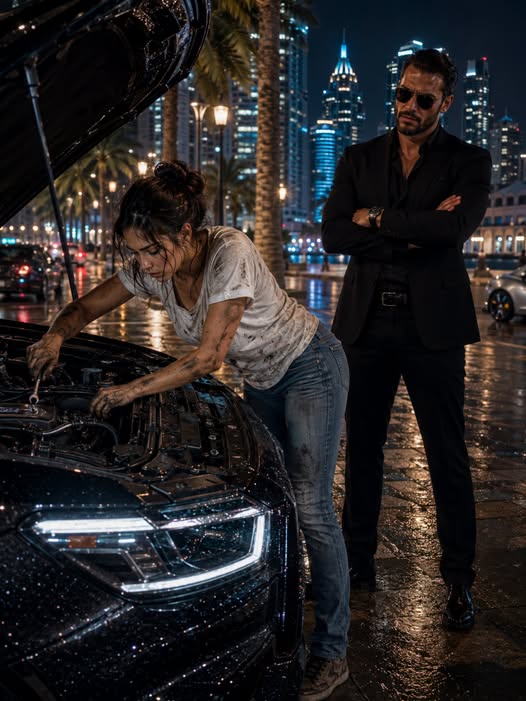
"You know what I was thinking about today?" Emma said, leaning against the doorframe. "That first morning. In the rain. Your car would not start, and I was just a waitress with grease under her nails, and you offered me money and a ride, and I said no to both."
Luca smiled. "I remember. You were the first person in years who looked at me and did not see what I could give them. You just saw a man with a broken car."
"And you were the first person who came back the next day and listened when I said no again," Emma said. "That was the beginning, really. Not the car. The listening."
Luca took her hand, and for a moment they stood there in the quiet garage, two people who had come a long way from a rainy Chicago street, not through power or money or grand gestures, but through the slow, ordinary work of choosing each other, day after day, and telling the truth.
Then Emma laughed, a small, happy sound in the evening air. "Come on," she said, pulling him gently toward the house. "Dinner is simple tonight, just what we have in the fridge, and I am hungry. And tomorrow I have the diner in the morning, and you have a hotel to run, and Mum has her appointment on Tuesday, and life goes on, the way it should."
Luca followed her inside, and Emma closed the garage door behind them, and the house glowed warm against the darkening sky, a modest lake-view house full of ordinary things: coffee mugs in the sink, a red toolbox in the garage, a photograph on the wall, and two people sitting down to a simple home dinner together, not because they had conquered anything, but because they had learned, at last, that love is not power. Love is showing up, handing over the wrench, and staying for dinner.