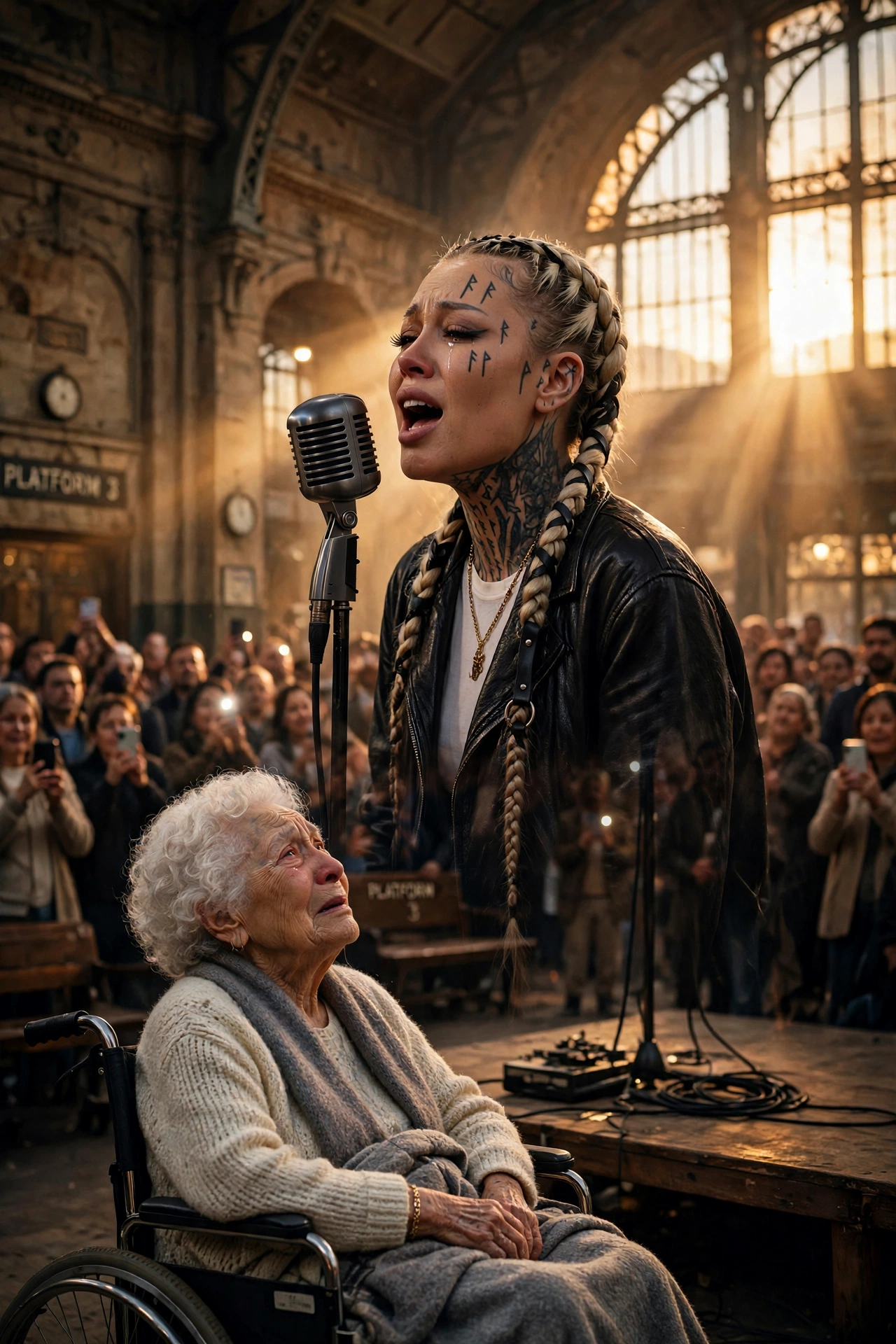
The first no came when Mara was nineteen, in a room with fluorescent lights that made everyone look tired before they had even begun. She had worn her best dress, a dark blue one Anna had ironed the night before, and she had sung the first verse of the song she wrote at eighteen, the one about a kitchen window and a mother who stayed up too late. The man behind the table did not look up from his phone until she finished. Then he said, "Thanks, love. We'll be in touch," in the flat voice people use when they have already decided. Mara walked out into the afternoon sun and stood on the sidewalk for a long time, holding her folder against her chest, waiting for the disappointment to turn into something she could name. It did not. It only settled, quiet and heavy, like a coat she would wear for years.
She told Anna that night that it had gone fine, that they would call. Anna nodded and put a bowl of soup on the table, steam rising in the small kitchen, and asked if Mara wanted bread with it. Mara said yes, though she was not hungry. She ate because Anna had made it, and because the warmth gave her hands something to do besides shaking. Later, after Anna went to bed, Mara sat at the table and listened to the refrigerator hum. She thought about quitting. She thought about it clearly, the way you think about a door you could walk through and never come back. Then she thought about the song still sitting in her throat, unfinished, and she knew she would go to the next audition anyway. Not because she was brave. Because she did not know how to stop singing any more than she knew how to stop breathing.
The second year brought more auditions, and the nos began to take different shapes. Sometimes they were polite. Sometimes they were careless. Once, a woman with a clipboard glanced at the small inked stars near Mara's hairline and the thin vine that curved along her jaw, and said, "Sweetheart, the camera will never love that face. Have you thought about covering it up?" Mara smiled, because she had learned already that arguing in an audition room only made the no arrive faster. On the bus home she stared at her reflection in the dark window and touched the tattoos with her fingertips. She had gotten the first one at eighteen, a tiny star for every year she had believed she would be heard. She did not regret them. But that night she stood in front of the bathroom mirror for a long time, wondering what it would cost to become someone else, and whether the price would be the only part of herself that had never lied to her.
By the third year, the auditions were no longer the whole story. The bars came next, because rent did not wait for a dream to become reasonable. Mara sang in places with sticky floors and neon signs that buzzed all night, places where the audience talked over the first song and only quieted, sometimes, by the third. She sang old songs people knew and her own songs people did not, and she learned the strange mathematics of a tip jar: a good night meant she could pay the electricity bill and buy groceries; a bad night meant instant noodles and a careful count of the coins in her coat pocket. The owners paid her in cash at the end of the night, counting bills with wet fingers, and sometimes they paid less than they had promised, saying the crowd had been thin. Mara never argued. She took the money, thanked them, and walked home through streets that smelled of rain and fried food, her voice hoarse, her shoes hurting, her heart still stubbornly beating in time to the last song.
People were cruel in ways that had nothing to do with music. A regular at one bar told her she was wasting her life, singing for drunks at midnight when decent women were home asleep. A girl she had known in school posted a photo of Mara onstage, hair damp, makeup smudged, and wrote beneath it that some people never grew up. Strangers in comment sections called her a bar girl, as if the place where she sang decided the worth of the song. Mara read those words at two in the morning, when tiredness made everything sharper, and she felt them land exactly where they were meant to land. She told herself she did not care. She told herself that so many times that the lie wore thin, and underneath it was a simpler truth: she cared, and she sang anyway, because the alternative was silence, and silence felt like a kind of dying.
Anna never said any of that. Anna never criticized Mara, never asked when she would get a real job, never suggested that the tattoos be removed or the nights be traded for days. Instead, Anna did small things that Mara only half noticed at the time. When Mara came home exhausted, her throat raw and her feet aching, there was soup on the stove, kept warm under a lid, with a note in Anna's careful handwriting: "Eat first. Sleep after." When Mara played a bar three towns away and came home at dawn, Anna was already awake, making tea, pretending she had not waited up. When Mara left flyers on the kitchen counter, printed cheaply on thin paper with her name misspelled once, Anna smoothed them flat and put them in a drawer. Mara thought Anna threw them away. Anna did not. She kept them in a shoebox in her bedroom, stacked in order, the corners soft from handling, each one a small proof that her daughter had stood up and sung.
In the fifth year, Mara almost quit for real. She had been rejected by a talent show in front of cameras, the judges smiling while they told her she was "not marketable," a word that sounded clean and meant ugly in the particular way the industry preferred. She had sung three notes before one of them raised a hand. Three notes. On the train home, Mara cried without making a sound, because crying loudly felt like giving them something else to judge. She came home and told Anna she was done. Anna listened without interrupting, which was her way. She made soup. She sat across the table while Mara ate, and then she said, very quietly, "You sang when you were small and nobody was listening, too. You sang to the radio in the kitchen. I used to stand in the doorway and listen." Mara stared at her. She did not remember that, or she remembered it only as a feeling, warm and far away. Anna did not make a speech. She did not say Mara would be famous. She only washed the bowls and said, "Rest, Mara. Tomorrow is tomorrow." Mara stayed. She did not know, then, that she would stay for fifteen more years because of a sentence like that, repeated in different forms, on different tired nights.
The years folded into each other after that. Mara turned twenty-five, then twenty-eight, then thirty, and the auditions kept coming, like seasons. She learned to arrive early, to warm up in stairwells and parking lots, to smile at receptionists who would forget her name before lunch. She learned the names of the songs that made a room go quiet and the songs that made a room order another drink. She sang at weddings where nobody listened, at a diner where the owner paid her in sandwiches, at an open mic where only four people stayed until the end, and one of them cried during her last song and pressed a crumpled five-dollar bill into her hand and said, "Thank you. I needed that." Mara kept that bill for a month, folded in her wallet, not because she needed five dollars, though she did, but because it was proof that a song could reach someone even when the room was almost empty.
Rent worried her constantly, in the background, like a low note that never resolved. Some months she paid it on time and felt rich for a day. Other months she called the landlord and asked for three more days, her voice steady, her stomach tight, and then she sang two extra gigs that week to make up the difference, her throat burning by Sunday night. She moved apartments three times, each one smaller, each one farther from the center of town, until she lived in a one-room place above a laundry, where the machines hummed until midnight and the smell of detergent drifted up through the floor. She hung her dresses on a rail by the window and her guitar in the corner, and she told herself it was enough. It was not enough, but it was hers, and on nights when she came home and found soup waiting on her own small stove, because Anna had come earlier with a pot and left it without a fuss, she understood that enough had more than one meaning.
Anna's support stayed silent, but it was not invisible if you knew where to look. Every night, after Mara left for a gig, Anna watched videos of her daughter singing. Mara sent them sometimes, short clips recorded on phones by friends, shaky and dark, the sound half drowned by bar noise. Anna watched them on her old tablet at the kitchen table, the volume low so the neighbors would not complain, and she watched them twice, three times, leaning close. She never left a comment. She never told Mara, "I watched your video four times tonight." She only said, the next day, "You sounded strong last night," and Mara would frown and ask how Anna knew, and Anna would smile and say, "A mother knows." Mara laughed at that, the way daughters laugh at something they think is only a saying. She did not know about the tablet, or the shoebox of flyers, or the way Anna saved every newspaper clipping that mentioned Mara's name, even the unkind ones, folded carefully, as if keeping them meant keeping Mara safe from them.
There were letters, too, though Mara only half understood them at the time. Anna was not a woman of long speeches, but once or twice a year she left a short note on Mara's pillow or tucked it into her coat pocket. "I am proud of you," one said, in plain words, without explanation. Another said, "Sing the song you wrote at eighteen sometime. I still remember it." Mara read those notes quickly, embarrassed by tenderness, and tucked them into a drawer without answering. She thought Anna meant she was proud in the general way mothers are proud, the way they are proud when a child eats her vegetables or passes a test. She did not hear, underneath the plain words, the deeper pride: that Anna had watched her daughter be rejected, mocked, underpaid, and exhausted, and had watched her get up the next day and sing again, and thought that was the bravest thing she had ever seen. Mara would understand that later. In those middle years, she only felt the notes like a hand briefly on her shoulder, and then she went back to work.
By thirty-five, Mara was tired in a way that sleep did not fix. Her voice was still strong, but it carried a roughness now, earned in smoky rooms and cold walks home. Her face had lines around her eyes, and the tattoos, once shocking to strangers, were simply part of her, like the scar on her knee from childhood. Younger singers arrived at auditions with brighter clothes and managers and social media followings, and Mara felt old beside them, though she was not old. She felt, sometimes, like a story people had already finished reading. On her thirty-seventh birthday, she sang in a bar where only six people came, and the owner apologized and paid her half, and she walked home in the rain and stood outside Anna's house for a moment, looking at the lit kitchen window. Anna opened the door before Mara knocked, as if she had been waiting, and said, "Come in. Soup is hot." Mara sat at that table, the same table where she had eaten soup at nineteen after her first no, and she cried, finally, not quietly this time, but with her face in her hands, because twenty years of no had accumulated in her chest like stones. Anna did not ask what was wrong. She put her hand over Mara's hand and left it there, warm and steady, until Mara's breathing slowed. Then Anna said, "You are still here. That matters." Mara nodded, though she did not yet believe it. She went home that night and wrote a new verse to the old song, about a woman who kept singing even when the room was empty, and she sang it the next night to six people, and then to sixty, and then, years later, to more people than she could count. But that was still ahead of her. In the middle years, what mattered was simpler: she kept singing, Anna kept waiting with soup, and the song, stubborn as both of them, refused to die.