The dressing room smelled faintly of roses and warm light, and for a long time Mara simply sat in front of the mirror and looked at herself without quite believing the reflection. The woman looking back at her wore a deep blue dress that caught the light every time she moved, her hair falling in soft waves around her shoulders. The tattoos on her face, the ones so many people had stared at and whispered about over the years, were still there, untouched by makeup. No one had asked her to cover them or to be smaller, quieter, or different. That, more than the dress or the lights, told her that tonight was real.
Outside, the theater hummed like a living thing: thousands of voices settling into seats, the rustle of programs, the swell of music from the orchestra as it tuned. For twenty years she had imagined this sound in empty bars after closing time, in kitchens where she washed dishes to pay rent, and in audition rooms where a panel looked at her for ten seconds and then looked away. She had imagined it so often that she had almost stopped believing it could belong to her. Tonight it did.
A soft knock came at the door, and then it opened just enough for her mother to step inside.
Anna stood in the doorway in a simple dark green dress, her hair pinned back, her hands folded in front of her. She was not in a wheelchair. She had walked down the corridor herself, slowly and carefully, holding the rail at first and then letting go, because she had wanted to come to her daughter on her own two feet. Mara rose so fast that her chair scraped against the floor, and for a moment neither of them said anything at all.
"You look beautiful," Anna said, and her voice trembled only a little.
Mara laughed, and the laugh turned halfway into a sob before she could stop it. "So do you, Mom. You look… you look strong."
Anna crossed the room and took Mara's hands in hers. Her hands were thinner than they had been before the illness, but they were warm, and her grip was steady. "I am here," she said. "That is all that matters tonight. I am going to watch my daughter sing on the big stage she always dreamed of."
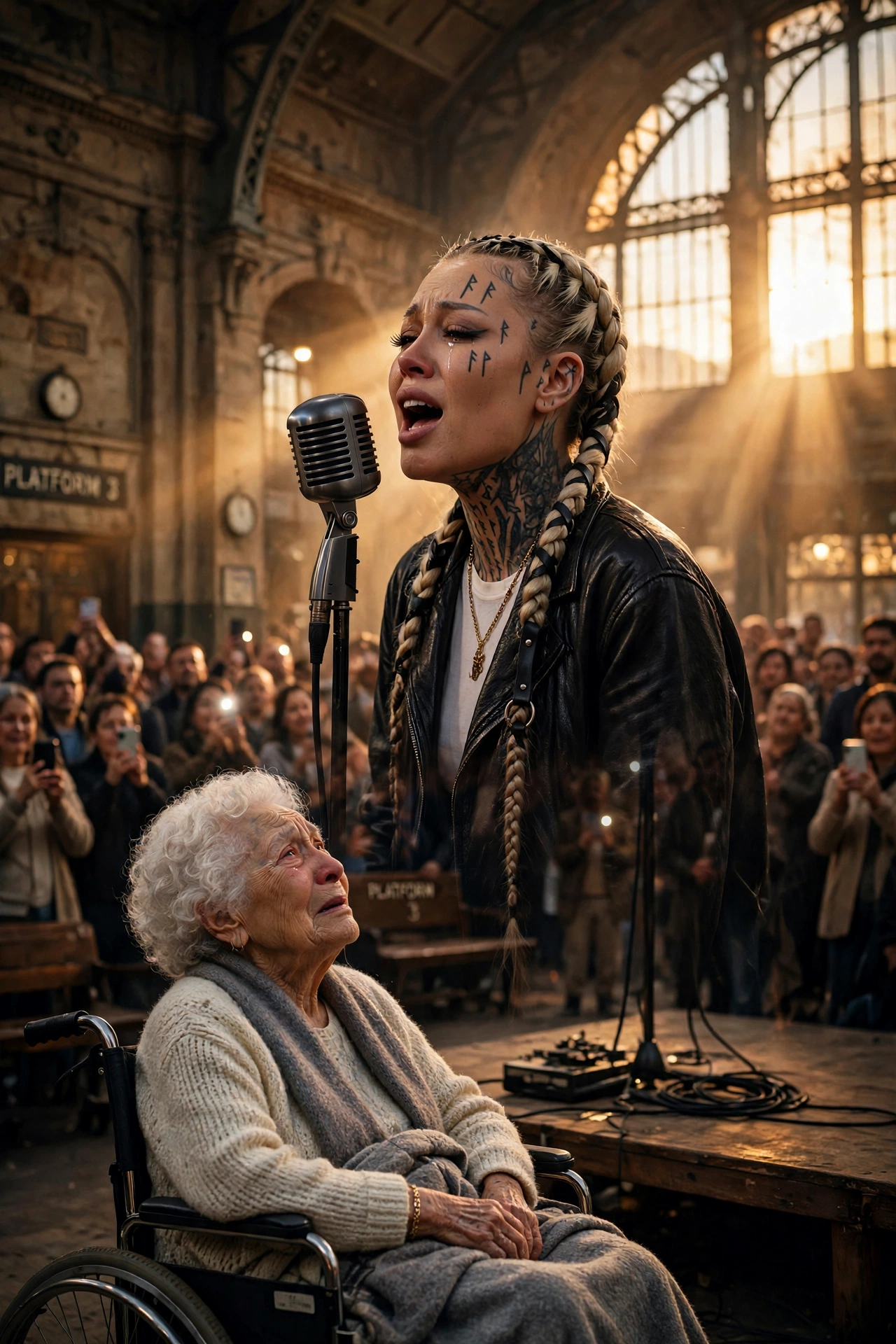
Mara pressed her forehead gently against her mother's, just as she had done that night at the old train station, and closed her eyes. She remembered that night with a clarity that still made her chest ache: the cold air, the worn wooden platform, and her mother in the front row in a wheelchair, crying quietly while Mara sang the song she had written at eighteen. She remembered stepping down, kneeling before the wheelchair, and holding her mother's hands. She had not known that someone was filming. She had only been singing for her mother.
That video had changed everything. It had traveled across the country overnight, and by morning a producer had called. The contract that followed had felt like a dream, but it had been real, and the money from it had been real too. It had paid for the surgery, the long weeks of treatment, and the quiet room where Anna had learned, step by step, to stand again. Mara had sat beside that hospital bed night after night, holding the same hands she was holding now, whispering the same promise: we will get through this, and one day you will walk into my concert on your own feet.
Now that day had come.
A stage manager knocked and said softly, "Five minutes, Mara."
Anna squeezed her hands once more. "Go," she said. "They are waiting for you."
"I will look for you," Mara said. "I will find you in the crowd."
"I will be right there," Anna answered, smiling through tears that she did not try to hide. "I have always been right there."
Mara walked with the stage manager down a narrow corridor toward the wings, and with every step the sound of the audience grew louder. Someone whispered, "Good luck," and she whispered, "Thank you," back, because she had learned, after all those years of being dismissed, never to take kindness lightly. Then she stood in the wings, in the dark just beyond the curtain, and waited for her cue.
The lights went down, and the audience fell into a hush so complete that Mara could hear her own breathing. The orchestra began to play, low and slow, and the curtain rose like a slow breath being let out. Light poured across the stage, warm and golden, and for a heartbeat Mara could see nothing but brightness. Then her eyes adjusted, and she saw them: row after row of faces, thousands of people, filling the theater from the orchestra seats to the highest balcony. Some were already wiping their eyes, and she had not sung a single note yet.
She walked to the center of the stage, and the applause rose around her like a wave, loud and long and full of warmth, carrying her forward until she stood at the microphone. She took a breath, closed her eyes for just a second, and thought of all the rooms where she had sung before: the bars where only three people listened, the street corners where rain soaked her shoes, the audition rooms where she was told she did not fit. She thought of every no, every laugh, and every night she had come home exhausted to find a bowl of hot soup waiting for her on the kitchen table, left there silently by a mother who never once told her to give up.
She opened her eyes and looked out at the audience, and then she found her mother.
Anna stood in a reserved place just below the stage, close enough that Mara could see her face clearly. She was standing, not sitting, her shoulders straight, her hands clasped together in front of her chest. Her eyes were bright with tears, and her smile was wide and trembling and proud, the smile of a mother watching the dream she had quietly believed in for twenty years finally come true. Mara felt her own tears rise, but she did not look away. She held her mother's gaze, and she nodded, just once, as if to say: this is for you.
The orchestra softened, and Mara began to sing.
She sang the song she had written for her mother at eighteen, the same song she had sung at the old train station, but tonight it sounded different. It sounded fuller, carried by the orchestra and by the great open space of the theater, and yet at its heart it was still the same simple song: a song about a girl who wanted to sing, and a mother who never stopped believing, even when no one else did. Her voice was steady at first, then it swelled, filling every corner of the hall, and when she reached the chorus, the audience leaned forward as one, as if they were holding their breath with her.
She sang about the nights she had come home tired, and the soup waiting on the table, and the old flyers her mother had kept in a drawer from every small show Mara had ever played. As she sang, she saw Anna press a hand to her heart, tears running freely down her mother's cheeks, and she knew that every word was landing exactly where it belonged.
Halfway through the song, the audience began to sway gently, and here and there, people began to sing along softly to the chorus they had learned from the video that had gone viral. It was like a hum beneath her voice, a thousand strangers joining a song that had once belonged only to a mother and a daughter. Mara's voice caught for a moment, and she laughed softly into the microphone, and the audience laughed with her, warmly, and then she sang on, stronger than before.
When she reached the final verse, her voice dropped to something quiet and tender. She sang the last lines directly to her mother, her eyes never leaving Anna's face, and when the final note faded, she held it for a heartbeat longer than the music.
For a second there was silence. Then the theater erupted.
The applause was thunderous, a roar that seemed to shake the floor beneath her feet. People rose to their feet in waves until every person in the theater was standing. Flowers flew onto the stage, roses and lilies landing softly at her feet. Mara stood in the center of it all, her hands pressed to her mouth, tears streaming down her face, overwhelmed by a sound she had waited twenty years to hear.
She bowed, and bowed again, and when she straightened, she looked down at her mother once more. Anna was clapping with all her strength, laughing and crying at the same time, her face shining with pride. Mara stepped to the edge of the stage, knelt down just as she had at the train station, and reached out her hand. Anna took it, and for a moment, in front of thousands of people, they were simply mother and daughter again, hands held tight, exactly as they had always been.
"Mom," Mara said into the microphone, her voice shaking but clear, "this stage is mine tonight, but this song has always been yours. You never told me to stop dreaming. You never told me I was too much, or too different, or too late. You just kept the soup warm, and you kept believing, and you kept loving me through every failure. So this is for you, and it always will be."
The audience cheered again, louder than before, and Anna nodded, unable to speak, her smile breaking through her tears. Mara blew her a kiss, and Anna caught it with both hands and pressed it to her heart.
The rest of the concert passed like a dream made of light and music. Mara sang other songs, songs of hope and home and starting again, and the audience stayed with her for every one. She sang with a freedom she had never felt before, because she no longer sang to prove herself to anyone. She sang because she loved it, and because the person who had loved her voice first was standing below the stage, alive and well, listening with proud eyes.
When the final song ended and the lights came up, the applause went on and on, and Mara took one last bow, her dress catching the light, her heart so full it felt as if it might spill over. She waved to every corner of the theater, and then she walked offstage into the wings, where her mother was waiting for her.
Anna was there, her arms open, and Mara ran to her and held her close. They stood like that for a long time, neither of them speaking, while the sound of applause still rolled faintly through the walls behind them. Anna stroked Mara's hair the way she had when Mara was a little girl, and Mara rested her head on her mother's shoulder and breathed in the familiar, comforting scent of home.
"You did it," Anna whispered at last. "My girl, you did it."
"We did it," Mara whispered back. "I could never have done it without you."
Later, after the flowers had been gathered and the stage lights dimmed, mother and daughter walked out of the theater together, arm in arm, into a night filled with soft air and city lights. Fans waited outside, calling Mara's name, and she stopped to sign and thank them, with Anna standing proudly beside her. A young girl in the crowd looked up at her with wide eyes and said, "I want to sing too," and Mara knelt down and said, "Then never stop. Someone believes in you, even on the nights you cannot see it."
As they walked home together beneath the streetlights, Anna's steps were slow but steady, and Mara matched her pace without hurry, because there was nowhere else she needed to be. The future stretched ahead of them, bright and open: more concerts, more songs, and more quiet evenings together, sharing soup at the kitchen table like they always had. Anna's treatment had worked, her strength was returning a little more each week, and the doctors had smiled when they told her she could live her life fully again. There would be checkups and care, but there would also be laughter, travel, and front-row seats at every concert Mara ever gave.
That night, when they reached home, Anna put a pot of soup on the stove, just as she had done for so many years, and Mara sat at the kitchen table and watched her mother move about the kitchen, alive and smiling and free. Mara thought of the girl she had once been, singing alone in her bedroom, dreaming of a stage she feared she would never reach. That girl would not believe tonight if she saw it: the big stage, the bright lights, the full audience, and her mother standing below it all, no wheelchair, proud tears in her eyes.
But Mara believed it now, because she had lived it, and because the woman standing in her kitchen was proof that love, held quietly and faithfully for twenty years, could carry a person all the way home. She had found her stage, she had found her voice, and she had never lost the one person who had believed in her from the very beginning. That, more than any applause, was the happy ending she had always dreamed of.