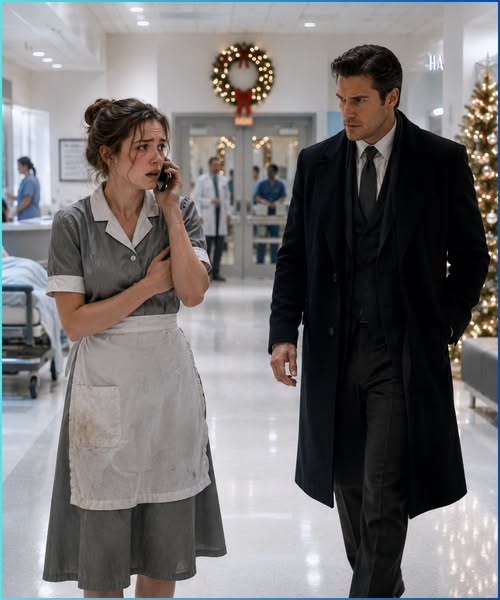
The car Callum Vale drove away from St. Brendan's Hospital was not the car anyone at the mansion would have expected. It was a dark, unremarkable sedan with no driver, no second vehicle behind it, and no crest on the door. Maeve Donnelly noticed that at once, because she had spent three years watching expensive cars arrive at the Beacon Hill mansion in formation, as if importance had to travel in pairs. Tonight there was only Callum, his hands steady on the wheel, and the low sound of Christmas music leaking from a shop doorway they passed too quickly to name.
"Where are we going, sir?" she asked, and then winced at herself, because the question sounded like a challenge when she had only meant it as a practical matter. Her left wrist throbbed inside its splint. The hospital had given her a sling, but she had refused to wear it in the corridor, not wanting to look more helpless than she already felt. Now, sitting in the passenger seat with her coat folded carefully over her lap to hide the tear at the shoulder, she wished she had accepted it.
"Somewhere no one on my staff knows about," Callum said. He did not look at her while he spoke. His eyes stayed on the wet road, on the reflections of coloured lights sliding across the windscreen. "Not the mansion. Not a hotel where a name has to be written down. A small apartment I keep near the harbour. I have never taken staff there. I have never held a meeting there. As far as my organisation is concerned, it does not exist."
Maeve turned that over in her mind. A man like Callum Vale, she thought, must have secrets the way other men had hobbies. And yet the fact that he was telling her about this one, on Christmas Eve, while she sat beside him with a bruised face and a splinted wrist, felt less like a display of power than like a confession. He was trusting her with something he had trusted to no one else, and he was doing it because the alternative — taking her back to a house where someone had already learned too much, too quickly — was worse.
"Mr. Vale," she said quietly, "you do not have to explain yourself to me."
"I think I do," he answered. "You were hurt because of my family. You deserve to know why I am making the choices I am making tonight, even if you do not agree with all of them."
She did not answer at once. The streets grew narrower as they left the hospital district behind. Snow had begun again, thin and slanting, and it settled on the bonnet in a fine white dust that the wipers cleared in slow, patient arcs. Maeve watched the harbour appear between buildings, a dark stretch of water broken by the lights of moored boats. She had always loved Boston at night in winter, when the cold made everything look sharper and more honest, but tonight the beauty felt edged with something else. Every parked car made her shoulders tighten. Every figure on a pavement made her glance twice, then scold herself for glancing at all.
Callum seemed to notice without staring at her. "We are not being followed," he said. "I checked twice before we left the hospital car park, and once more at the second junction. If someone was behind us, they are very good, and I do not believe they are, because the people who hurt you were not careful. They were hurried. Hurried people make mistakes."
Maeve nodded, though she was not sure whether she believed him or simply wanted to believe him. "I am sorry," she said, and then stopped herself, because he had asked her in the hospital to stop apologising, and she had heard the weariness underneath his firmness. She tried again. "I mean — thank you. For coming. For not leaving me to take a cab home alone."
"You are welcome," he said, and the simple courtesy sounded almost unfamiliar in his voice, as if he had not said it often enough in recent years to make it smooth. "We are almost there."
The apartment building was older than Maeve had expected, brick, with a plain black door and no doorman. Callum parked in a small underground garage, took a lift that smelled faintly of salt and old paint, and unlocked a door on the third floor with a key from a separate ring he kept apart from his mansion keys. Inside, the apartment was small and startlingly ordinary. A sitting room with a worn sofa, a kitchen barely large enough for two people to stand in without bumping elbows, a bedroom with a single narrow bed and a second, smaller room that had clearly been used as a study. There were books on the shelves, not arranged for display but read, their spines cracked. There was a kettle, a chipped mug, a blanket folded over the arm of the sofa. Nothing about the place announced wealth. Everything about it announced privacy.
"This is yours?" Maeve asked, before she could stop herself.
"Since before Gabriel died," Callum said. "He used to tease me about it. He said a man who owned half the waterfront should not live like a student in a room above a chandlery. I told him that was exactly why I kept it."
He said Gabriel's name without flinching, and Maeve noticed that, too. In the mansion, Gabriel's name was rarely spoken aloud. His room at the end of the west hallway was cleaned and kept, but the staff spoke of it in lowered voices, if at all, as if grief were something that could be disturbed by being named. Here, in this small harbour-side room, Gabriel sounded like a brother again, not a subject to be avoided.
Callum set her coat on a chair and went at once to the kitchen. "The nurse said you need to be checked through the night," he said, in the practical tone of a man giving himself a task so that he would not have to think about anything larger. "Every two hours. I will wake you, ask you your name and where you are, and check that your pupils look normal. If you vomit, or if the headache worsens sharply, or if you cannot be woken properly, we go straight back to St. Brendan's. No argument."
Maeve almost smiled. "You listened to the nurse more carefully than I did."
"I listened because I was afraid I would miss something important," he admitted. "Sit down, Maeve. Please. You have been standing in a hospital for hours, and you have a concussion. The sofa is more comfortable than it looks."
She sat, carefully, cradling her splinted wrist against her stomach. Callum brought her water, a packet of the pain relief the hospital had prescribed, and the blanket from the sofa arm. He did not hover, which she appreciated. He moved with the quiet competence of someone who had once looked after another person and had not forgotten how, even if the habit had been buried under years of meetings and hard decisions. When he had settled her, he took the armchair opposite and looked at his phone for the first time since they had left the hospital.
The screen lit his face. Maeve watched his expression change, not dramatically, but in the small tightening around his mouth that she had learned to read over three years of watching him listen to bad news without reacting to it in front of others.
"Marcus again?" she asked.
Callum nodded slowly. "He wants to know where you are. He says the household is worried, and that he can send a car and a nurse to wherever we are, if I will only tell him the address."
Maeve felt cold, and it had nothing to do with the snow outside. "But you did not tell him we left the hospital together. You did not tell anyone."
"No," Callum said. "I told no one. The nurse at reception knew you had a visitor, because I gave your name at the desk. The officer knew I was there. But no one in my household was told. I left the mansion this evening without speaking to Marcus at all. I drove myself. I did not call ahead."
"Then how did he know to message you at the hospital?" Maeve asked, and then answered her own question in a quieter voice. "He knew before we even left. He knew while we were still in room six."
"Yes," Callum said. He set the phone face down on the small table between them, as if putting distance between himself and the message would make the meaning of it clearer. "There are only a few ways that can happen. Someone at the hospital called him, which is possible but unlikely so quickly, and without a reason. Someone followed us, which I do not believe. Or someone in my organisation was already watching for news of you, and passed it to Marcus the moment you were admitted, or even before that."
Maeve thought about the afternoon, about leaving the mansion shortly after four o'clock with medicine for Mrs. Kelleher in the North End. She had told Marcus where she was going because he had asked, in what had seemed at the time like ordinary concern, why she was not heading straight home. She had not thought twice about it. Why would she? Marcus Wynn had worked for the Vale family for nearly a decade. He knew the routines of the house better than most of the staff. He was the man Callum trusted with security, with gates and schedules and the names of visitors.
"Mr. Vale," she said slowly, "are you saying Mr. Wynn is the person who sent those men?"
"I am saying I do not know yet," Callum answered, and Maeve respected him for not rushing to a conclusion, even though the suspicion was plain in his face. "Marcus may have been told by someone else. He may be asking because he is genuinely concerned and someone else told him. But I cannot ignore the pattern. He knew you had left for Mrs. Kelleher's. He knew about the hospital without being told. Now he is asking where you are, twice, with increasing urgency. A man who is simply worried does not need an address at midnight on Christmas Eve when he has already been told, by me, that you are safe. A man who needs to pass that address to someone else does."
The words settled between them like snow on a windowsill, quiet and accumulating. Maeve pulled the blanket closer around her shoulders with her good hand. She was not a woman who frightened easily — three years in the Vale mansion had taught her to keep her composure when powerful men raised their voices in the next room — but this was different. This was not a raised voice behind a closed door. This was the realisation that the danger might not be outside the house at all, but inside it, wearing a familiar face and knowing the household routines as well as she did herself.
"I am not a burden," she said suddenly, and her voice was firmer than she had expected it to be. "I know I said that in the hospital, and I know you told me not to apologise, but I need you to hear me properly this time. I am not asking you to protect me because I cannot look after myself. I am telling you that I will not be hidden away like a problem to be managed while other people decide what happens to me. If someone in your organisation is leaking information, then I am part of this now, whether I want to be or not, because they already made me part of it when they stopped me on the street."
Callum looked at her for a long moment. Maeve held his gaze, even though her head ached and her wrist throbbed and part of her wanted very much to lie down and let someone else carry the weight of the night for a few hours. She would rest, because the nurse had told her to rest, and because Callum would insist on waking her every two hours anyway. But resting was not the same as disappearing, and she wanted him to understand the difference.
"You are right," he said at last. "And I am sorry I made you feel as though you had to argue for that. You are not a burden, Maeve. You are the only person who has told me the truth tonight without trying to manage what I hear. The officer wanted a neat statement. Marcus wants an address. You told me about an envelope you could have kept to yourself, and you told me even though you were frightened. That is not a burden. That is the reason I have any chance at all of understanding what happened to Gabriel."
Maeve felt tears come to her eyes, and she blinked them away, embarrassed. She did not want him to think she was crying from the pain, though some of it was pain. Mostly it was relief, sharp and unexpected, at being believed without having to prove herself first.
"Can I tell you something else?" she asked. "About tonight. Not the whole thing. Just the part I remember most clearly."
Callum nodded. "Only if you want to. You do not have to relive it for me."
"I want to," she said, "because I think it matters, and because I do not want to carry it alone in my head all night. I do not remember their faces well. It was dark, and wet, and everything happened too fast for faces. But I remember their voices. One of them was impatient. He kept asking the same question, as if he thought I was deliberately withholding an answer I already had. 'Did you find it?' he said. 'Did you find it in his room?' And the other one was quieter. He was the one who said 'the red book.' He said it like a name he had been told to use, not like something he understood. Like someone had given him a phrase and told him not to forget it."
She stopped, breathing carefully. Callum did not interrupt. He did not ask her to go further, or to describe anything she had not offered. He simply listened, and that listening made it possible for her to continue without feeling as though she were performing her own fear for someone else's benefit.
"That is why I think they were not the people who wanted the book," Maeve said. "They were people who had been sent. And if they were sent, then someone told them where to find me, and someone told them what to ask. That someone knew I worked in Gabriel's room. That someone knew I cleaned the writing desk. That is not a stranger guessing. That is someone who knows the house."
Callum's jaw tightened. "Yes," he said softly. "That is exactly what frightens me. Whoever sent them knew your routine. They knew you would be out late for Mrs. Kelleher, or they were told in time to be waiting. They knew to ask about Gabriel's room. And now someone in my organisation knows you were in hospital before I told them. I have spent five years telling myself that Gabriel's death was an accident because the people around me told me to stop asking questions. Tonight I understand that I may have been told to stop asking by the very people who benefited from my silence."
He stood and walked to the window. Outside, the harbour lights trembled on black water. Snow fell steadily now, softening the edges of the boats and the warehouses. It was Christmas Eve, and somewhere across Boston, families were gathered around trees and tables, unaware that in a small apartment above a chandlery, a businessman feared by half the city was standing with his back to the room, trying not to let his hands shake.
"I have protected this organisation for years," he said, more to himself than to her. "I told myself I was protecting jobs, and families, and the people who depended on the Vale name for their livelihood. But if there is a leak inside it — if someone close to me has been selling information, or covering up what happened at Pier Nine — then protecting the organisation and protecting the truth are no longer the same thing. I have to choose. And tonight, I choose the truth, even if it costs me people I trusted."
Maeve watched him, and for the first time that night she saw not the feared businessman, but a man grieving his brother all over again, five years late, because the grief had never been allowed to finish its work. She wanted to say something kind, but kindness that sounded like pity would have been wrong. So she said something practical instead, because practical things were what she knew how to offer.
"Then we need the envelope," she said. "Before anyone else gets to it. If the mole knows I found something behind that drawer, or even suspects I did, they will not wait until after Christmas. They will go to Gabriel's room first, and they will take whatever is there, or destroy it. We cannot let that happen."
Callum turned back from the window. "I agree. First thing in the morning, I will go to the mansion and retrieve it myself."
"No," Maeve said, and she sat up straighter despite the pain in her wrist. "Not by yourself. You need me."
He frowned. "Maeve, you have a concussion. You should not be going back to the mansion tomorrow morning. I can find a stuck drawer on my own."
"You cannot," she said, with a certainty that surprised even her. "Not that drawer. Not the way it sticks. It is not simply stiff, Mr. Vale. It catches on one side if you pull it straight, and if you force it, you will jam it completely, or you will push whatever is behind it further back where no one can reach it. I know because I have cleaned that desk for three years, and I know the exact angle — lift slightly on the left, ease it out, then press down gently before you pull again. I am the only person who knows that trick, because I am the person who discovered it by accident last Thursday when I was changing the flowers. If you go alone and force that drawer, you could lose the envelope entirely. I must be the one to show you."
Callum opened his mouth, and then closed it again. Maeve could see the argument forming in his mind — that she was injured, that she needed rest, that he could not risk her — and she could also see it faltering against the simple fact she had just stated. He was a man accustomed to solving problems by sending other people to solve them, or by using force where patience would have worked better. This problem would not yield to either method. It would yield only to knowledge, and the knowledge belonged to her.
"You are asking me to take an injured woman back into a house where there may be a traitor," he said slowly.
"I am telling you that without me, you may come back empty-handed," Maeve replied. "And I am telling you that I would rather go with you, carefully, in daylight, with a plan, than sit here alone wondering whether someone else has already taken what Gabriel left for you. I am not being reckless, Mr. Vale. I am being useful. Let me be useful."
For a long moment, neither of them spoke. The clock on the wall ticked. The snow thickened outside. Somewhere in the building, a pipe knocked softly, and then fell silent.
At last, Callum nodded. "All right," he said. "Tomorrow morning, Christmas morning, we go together. By the service entrance, quietly, before the household is fully awake. You show me the drawer. I do everything else. And if at any point you feel dizzy, or your wrist worsens, or you tell me to stop, we stop immediately. That is my condition."
"Agreed," Maeve said, and she felt a steadiness return to her that had been missing since the hospital. She was not merely being kept safe. She was part of the plan, and the plan depended on her.
Callum glanced at his phone again. Another message from Marcus had arrived while they were talking, shorter this time, and more pointed. Maeve could not read it from where she sat, but she saw Callum's expression harden as he read it, and then deliberately set the phone aside without replying.
"I will not answer him tonight," he said. "Let him wonder. Tomorrow, before the mole does, we retrieve the envelope. That is my resolution, and I will keep it."
Maeve nodded, and as Callum dimmed the lights and prepared to keep watch through the night, waking her gently every two hours to ask her name and where she was, she understood that Christmas Eve had not ended the way either of them had expected. It had ended with a promise, made in a small harbour-side apartment no one else knew about, between a feared man and the housemaid he had once barely noticed — a promise that whatever Gabriel had left behind, they would find it together, before anyone else could take it away.