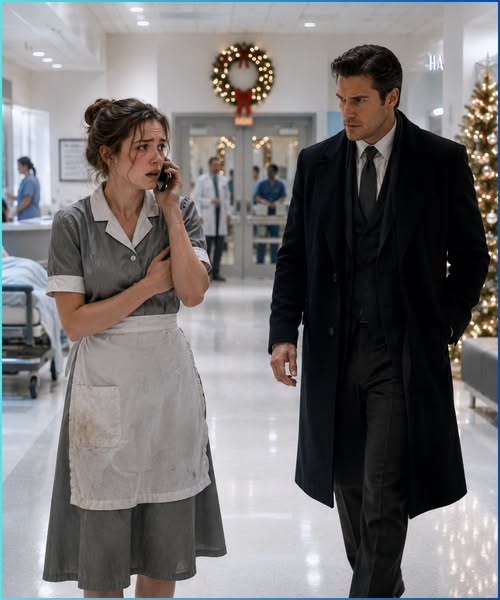
Christmas morning arrived in Boston with a pale, clean light and a silence that felt almost held in place by the snow. Maeve Donnelly woke in the small harbour-side apartment to the sound of Callum Vale moving quietly in the kitchen, and for a moment she did not know where she was. Then the ache in her left wrist reminded her, and the blanket around her shoulders, and the memory of being woken every two hours through the night by a gentle voice asking her name and where she was, and whether her headache had worsened. She had answered correctly each time, or so Callum had told her, and she had fallen back asleep each time feeling safer than she had any right to feel in a stranger's apartment on Christmas morning.
"Maeve?" Callum said from the doorway, holding a mug of tea he had made too strong and then, she suspected, worried he had made too strong. "How is your head? Honestly."
"Better than last night," she said, sitting up slowly. The room tilted only slightly, then settled. "The headache is dull, not sharp. My wrist aches, but the splint is holding. I am not dizzy, as long as I do not stand up too fast."
He studied her face with the same careful attention he had given the nurse's instructions. "And if that changes, you tell me at once, and we stop. That was the agreement."
"That was the agreement," she confirmed. She took the tea with her good hand and wrapped her fingers around the warmth of the mug. Outside the window, the harbour was white at the edges, boats rimmed with snow, gulls crying thinly over the water. It was Christmas Day, and in any other year she would have been at the mansion by now, polishing silverware and changing the water in the dining room flowers, preparing breakfast for guests who would arrive in coats smelling of cold air and perfume. This year, there would be no breakfast preparation, no flowers, no guests she was expected to serve without being seen. This year, she was going back to the mansion for a different reason entirely, and she was going as something other than a housemaid.
Callum had already laid out a plan, and he explained it to her while she drank her tea, in the plain, unhurried way of a man who had spent the night thinking instead of sleeping. They would drive to the mansion, but not to the front entrance, where a visitor would be noticed and logged. They would use the service entrance at the rear, the one the delivery drivers and the morning cleaning staff used, the one Maeve knew better than anyone because she had let herself in through it hundreds of times before the household woke. The house would be quiet, because Callum had sent the guests home on Christmas Eve and had told the remaining staff they were not expected until later on Christmas Day. Marcus Wynn, Callum said, would not be on duty until the afternoon, or so the roster claimed, but they could not rely on that. They would go in quickly, go directly to Gabriel's room at the end of the west hallway, retrieve the envelope, and leave the same way they had come. No one would be told they had been there at all.
"And if someone is there?" Maeve asked.
"Then we leave," Callum said at once. "We do not argue. We do not explain. Your safety comes before the envelope, even though I said last night that the envelope comes before the mole. I meant that we must act before the mole does, not that we must act recklessly. If the hallway is not clear, we turn around and find another way."
Maeve nodded. She appreciated that he had said it without hesitation, and without making her feel as though caution were cowardice. She dressed carefully, favouring her splinted wrist, and Callum helped her with her coat, taking care not to pull at the torn shoulder. The tear was still there, a reminder of the night before, but in the daylight it looked less frightening and more ordinary, like any coat that had caught on a nail. She smoothed it down with her good hand and decided, with a small, private firmness, that she would mend it herself when this was over, rather than asking anyone to replace it. It was her coat. She would decide what happened to it.
The drive to Beacon Hill was short, and Callum drove the same unremarkable sedan, by a route that avoided the main streets where Christmas morning traffic would already be gathering. Maeve watched the city pass — shop windows dark, churches filling, a family carrying a box of presents across a snowy pavement — and felt a strange ache that was not quite sadness and not quite envy. She had no family waiting for her on Christmas Day, except Mrs. Kelleher in the North End, who would be worrying about her medicine and about why Maeve had not returned. Maeve made a mental note to call Mrs. Kelleher as soon as they were safely away from the mansion, to tell her she was all right, without explaining more than was necessary. Mrs. Kelleher was old and alone, and she did not need to carry Maeve's fear on top of her own.
When they reached the mansion, Callum parked two streets away, in a place where the car would not be recognised as his, and they walked the last distance on foot. The snow crunched under their shoes. The mansion, when it came into view, looked almost peaceful in the morning light, its windows dark, its front steps swept clean. Maeve had always thought it beautiful from the outside, in the way that grand houses are beautiful when you do not have to clean them. Today it looked different to her, not because the house had changed, but because she knew something about it that she had not known the day before: that inside it, behind a stuck drawer in a room no one used anymore, her employer's dead brother had left a message that someone was willing to hurt a housemaid to find.
They entered by the service entrance, just as planned. The door was unlocked, as Maeve had known it would be, because the morning delivery of milk and bread had already been made and the latch had not yet been reset. The service corridor smelled of cleaning fluid and cold air. Their footsteps sounded loud to Maeve in the quiet house, and she found herself walking on the balls of her feet without quite deciding to do so, the way she had walked as a child when she did not want to wake her parents. Callum followed her, silent, letting her lead. That, too, felt significant. In his own house, the feared businessman was following his housemaid, because she knew the way and he did not, not in this quiet, early-morning sense.
They climbed the back stairs and turned into the west hallway. The carpet was thick and muffled their steps. Portraits of Vale ancestors looked down at them from the walls, men and women in dark clothes with serious faces, and Maeve wondered, not for the first time, what those ancestors would have thought of a Christmas morning like this one. Gabriel's room was at the very end, its door closed, its brass handle polished by Maeve's own hand the previous week. She paused before it, her good hand on the handle, and took a breath.
"Are you all right?" Callum whispered.
"Yes," she said. "I just need a moment. I have cleaned this room for three years without ever thinking it would become the most important room in the house. It feels strange to enter it now as if it were a place I might be caught in, when I have always had every right to be here."
"You do have every right," Callum said. "It is my brother's room, and you are here at my request, with me beside you. No one can take that away from you."
Maeve nodded and opened the door.
Gabriel's room looked exactly as she had left it. The bed was made, the curtains were drawn back to let in the pale morning light, the books on the shelves stood in their familiar order. The writing desk stood against the wall beneath the window, old and dark, with its drawers in a neat row and a small vase of dried flowers on top that Maeve herself had placed there last Thursday. For a moment, the ordinariness of the room made the whole night seem unreal. Then Maeve walked to the desk, and the reality returned, sharp and clear.
"This is it," she said, pointing with her good hand to the bottom drawer. "The bottom drawer. It sticks. If you pull it straight, like this —" she demonstrated the motion without actually pulling, her hand hovering in the air — "it catches on the left side, about halfway out, and it will not move further. Most people would assume it is locked, or that something is blocking it from behind. But it is not locked. The runner on the left is worn, and the drawer sags slightly when it is pulled. You have to lift it, just a little, on the left side, ease it out slowly, and then press down gently before you pull it the rest of the way. I discovered it by accident when I was cleaning underneath last Thursday. The drawer would not close properly, and when I lifted it to see why, I saw the paper behind it."
Callum listened without interrupting, and Maeve was grateful for that, because explaining a small, physical trick requires patience from the listener, and impatience would have made her hands shake. She knelt carefully beside the desk, favouring her wrist, and Callum knelt beside her, not taking over, not reaching past her, simply waiting for her to show him.
"Like this," she said, and she placed her good hand under the left side of the drawer, lifted it by a fraction, and eased it outward. The drawer moved, stiffly at first, then more freely, exactly as she had described. She pressed down gently, as she had said, and pulled it the rest of the way. The drawer slid open, revealing its ordinary contents: old pens, a letter opener, a bundle of blank writing paper tied with string.
"And now," Maeve said, "you have to look behind it, not inside it. The envelope was not in the drawer. It was behind the drawer, in the space between the back of the drawer and the back of the desk. When the drawer sticks, that space opens up just enough for something thin to slip down behind it. That is why no one found it. Everyone looks inside drawers. No one looks behind them."
She reached carefully into the space behind the drawer with her good hand, feeling for the shape she remembered. For a terrifying second, she felt nothing, and her heart sank. Had someone already been here? Had the mole already taken it? Then her fingers brushed paper, stiff and sealed, tucked against the back panel of the desk. She drew it out slowly, and held it up in the morning light.
It was a sealed envelope, cream-coloured, slightly yellowed at the edges, with two initials written on the front in faded ink: C.V.
Callum stared at it as if he had forgotten how to breathe. "That is Gabriel's handwriting," he said quietly. "I would know it anywhere. He always wrote his letters with a fountain pen, and he always pressed too hard on the first letter."
Maeve handed the envelope to him with her good hand, and he took it with both hands, as carefully as if it were made of glass. For a moment, neither of them moved. Then Callum looked at her, and Maeve saw in his face a mixture of grief and gratitude so plain that she had to look away, not from discomfort, but from respect, because some emotions are too private to be watched too closely.
"Open it," she said softly. "Not here, perhaps, but somewhere safe. Or here, if you want. It is yours. It was addressed to you."
Callum shook his head slowly. "Not yet. Not until we are away from this house. If someone comes down this hallway while I am reading my brother's last letter, I will not be able to think clearly about what to do next, and I need to think clearly. We take it with us, and we read it where no one can interrupt us."
Maeve agreed at once. She closed the drawer carefully, reversing the trick — pressing down, easing it back, letting it settle into place so that no one would know it had been opened. She checked that the desk looked exactly as it had when they entered, that the vase of dried flowers had not been moved, that no trace of their visit remained. Only when she was satisfied did she nod to Callum, and they left Gabriel's room together, closing the door softly behind them.
They retraced their steps down the west hallway, down the back stairs, and out through the service entrance, without meeting anyone. The snow outside was brighter now, the sun higher, and the city sounds of Christmas morning had grown louder. Maeve felt a rush of relief so strong that her knees almost weakened, but she kept walking, because Callum was walking beside her, and because the envelope was safe in the inside pocket of his coat, where no one could see it or snatch it away.
They did not go back to the harbour-side apartment at once. Callum drove instead to a quiet café near the water, the kind of place that opened early on Christmas Day for fishermen and night-shift workers, where no one would look twice at a man and a woman sitting in a corner with tea. He chose a table at the back, away from the window, and only when they were seated, with the door in view and the envelope on the table between them, did he break the seal.
Inside the envelope were three things, and Maeve watched as Callum laid them out one by one, with the same care he had shown in the mansion. First, a letter, written in Gabriel's familiar hand, on several sheets of paper folded together. Second, a torn page, its edges ragged, covered in columns of figures and names, with a heading at the top that read, in Gabriel's handwriting, Harbour Ledger — Private Copy. Third, a small brass key, no larger than Maeve's thumb, with no label and no marking, bright despite its age, as if it had been kept wrapped and protected for years.
Callum's hands trembled slightly as he unfolded the letter. "Will you read it aloud?" he asked, looking up at Maeve. "I think I need to hear it in another voice, or I will not take it in properly. My eyes keep skipping ahead, and I am afraid I will miss something important."
Maeve hesitated. "It is your brother's letter to you, Mr. Vale. It is private."
"It is private," Callum agreed, "and I am asking you to share it with me, because you are the person who found it, and because I trust you to read it honestly, without softening the parts that are difficult. Please."
Maeve nodded, and took the letter with her good hand, holding it so that Callum could follow along if he wished. She cleared her throat, and began to read aloud, in a steady voice that surprised her with its calmness.
"My dear Callum," the letter began, "if you are reading this, then something has happened to me, or something has happened that made you look for what I left behind. Either way, I am sorry to write to you like this, in secret, instead of saying these things to your face. I tried, more than once, and each time I was told I was mistaken, or that I did not understand the business, or that I should leave the harbour accounts to men who knew better. So I am writing it down, because writing cannot be interrupted, and cannot be talked over, and cannot be made to doubt itself in the way I was made to doubt myself."
Maeve paused, glancing at Callum, who was listening with his eyes fixed on the table, his jaw set. She continued.
"The harbour ledger has been falsified. I do not write that lightly, and I do not write it without proof. The official ledger, the one shown to auditors and to the harbour authority, does not match the private copy I kept. Shipments have been recorded under false names. Payments have been entered twice, or not at all. Money that should have gone to the families of dockworkers has gone elsewhere, and I do not know where, because the trail stops at names I do not recognise, names that appear only in the falsified version. I kept a page from the private ledger — the torn page you will find with this letter — because I knew that if I kept the whole book, it would be found and destroyed. A single page, hidden where only someone who cleans this room would think to look, was safer than a book on a shelf."
Callum closed his eyes briefly. Maeve read on.
"I am afraid for the Pier Nine records. Pier Nine is where the falsified shipments were stored, and where the original records were kept. If anyone discovers that I have kept a copy, they will try to destroy the originals at Pier Nine as well, to leave no trace. I do not know who is behind the falsification. I suspect someone inside our own organisation, someone who has access to the harbour accounts and to the warehouse records, and who benefits from the confusion. I do not want to accuse a man without proof, and so I will not name a name I cannot prove. But I ask you, Callum, to look closely at the people closest to the accounts, and to the people who told you, after I am gone, that you should stop asking questions about the fire. Ask yourself who benefited from your silence. That question frightened me, and I believe it will frighten you too, but it is the right question, and it is the one I could not ask aloud while I was alive."
Maeve's voice faltered on the last sentence, and she had to pause to steady herself. Callum reached across the table and touched her good hand briefly, not to hurry her, but to tell her to take her time. She nodded, and finished the letter.
"I leave you this key because it opens a locked box at Pier Nine, in the small office above the warehouse floor, where I kept my own notes and the second copy of the private ledger page. If the warehouse still stands, the box may still be there. If it does not, then this letter and the torn page are all I can give you, and they will have to be enough. Do not seek revenge for me, Callum. I know you, and I know your temper, and I know how easy it would be for you to settle this privately, in the way our family has always settled things. I am asking you not to. Take this to someone outside the organisation, someone who cannot be bought or threatened by the people inside it. Let the truth be heard in a place where it cannot be buried again. I would rather be remembered for telling the truth than for starting another war. Your brother, Gabriel."
Silence fell over the table. Outside the café window, snow drifted past in slow, white flakes. Inside, the smell of tea and toast filled the air, ordinary and comforting, in sharp contrast to the words Maeve had just read. Callum sat very still, staring at the torn ledger page, at the columns of figures that proved his brother had been right all along, and that the fire at Pier Nine five years ago had not been a simple accident, or at least had not been allowed to remain a simple accident in the minds of the people who benefited from it.
At last, Callum spoke, and his voice was low and rough. "He knew. All along, he knew, and he tried to tell me, and I let other people talk me out of listening. I told myself I was protecting the family by moving on. I was protecting the people who falsified the ledger."
"You did not know," Maeve said firmly, because she would not let him rewrite the past into a guilt he had not earned. "You were grieving, Mr. Vale. You had just lost your brother. People you trusted told you to stop asking questions, and you believed them because you had no reason not to. That is not the same as choosing to protect a lie. What matters is what you do now that you know the truth."
Callum looked at her, and Maeve saw the decision forming in his face, not as a sudden flash of anger, but as a slow, deliberate settling, like a man choosing a path and accepting its cost. "Gabriel asked me not to seek private revenge," he said. "And I will honour that. I will not send men to settle this. I will not threaten anyone, or arrange for anyone to disappear, or handle this in the way people expect Callum Vale to handle things. I will go through my attorney, and through the police, with this letter and this page and this key. I will give them the evidence, and let them investigate, even if that investigation leads inside my own organisation, even if it leads to Marcus, even if it leads to people I have trusted for years. That is what Gabriel wanted, and that is what I promise you, here, on Christmas morning."
Maeve felt a weight lift from her chest that she had not realised she was carrying. She had feared, without quite admitting it to herself, that finding the envelope would unleash something violent, that Callum's grief would turn into retribution and that she would have helped start something she could not stop. Instead, he had chosen the harder path, the lawful path, the path his brother had asked for. That choice, she thought, was a kind of courage she had not expected from the most feared man in Boston, and it made her respect him in a way that fear never could.
But Maeve was not finished. She had listened to the letter, and she had heard something else in it, something practical that Gabriel had understood even better than Callum had in that moment. A single envelope, kept in a single place, could be taken or destroyed just as easily as the ledger at Pier Nine could be. She leaned forward, her good hand flat on the table, her voice steady.
"Then we must also make a copy," she said. "Not later. Today. Before we give anything to your attorney or to the police, we must keep a copy outside the mansion, somewhere safe, somewhere no one in your organisation knows about. A photograph of the letter, a photograph of the torn page, a written copy in my own hand if necessary. If the original is lost, or stolen, or challenged, the copy will remain. Gabriel hid a single page because he thought a single page was safer than a book. He was right, but he was also alone. We are not alone. We have each other, and we have this café, and we have the harbour apartment, and we have the chance to make sure that what he wrote cannot be buried a second time."
Callum stared at her, and then, slowly, he smiled — not a broad smile, but a small, genuine one, the first Maeve had ever seen on his face. "You are right," he said. "Again. I would have taken the envelope straight to my attorney and assumed that was enough. You are thinking further ahead than I am, and that is exactly why I needed you this morning, not just for the drawer, but for everything that came after it."
He took out his phone, and together, carefully, they photographed each page of the letter and both sides of the torn ledger page, in clear, bright light, checking each image to make sure the handwriting was legible. Maeve wrote a short note in her own hand, on a page from the café's notepad, recording the date, the place where the envelope had been found, and the fact that she had retrieved it from behind the bottom drawer of the writing desk in Gabriel's room, with Callum present. She signed it, and Callum signed it too, as a witness. Then Callum sealed the originals back into the envelope, placed the envelope in his coat, and placed the phone with the photographs in a separate pocket, so that the original and the copy would never travel in the same place again.
As they left the café and walked back toward the car, snow falling softly around them, Maeve thought about Christmas morning, and about how different it was from the Christmas morning she had expected. She had expected to be polishing silverware. Instead, she had opened a drawer that no one else could open, read a dead man's letter aloud to his brother, and helped decide how the truth would be protected. She was still a housemaid, still injured, still wearing a coat with a tear at the shoulder. But she was also, unmistakably, a woman who had acted, who had insisted, who had chosen, and who would not be made small again by the people who had tried to frighten her into silence.
Callum opened the car door for her, and before she got in, he said quietly, "Thank you, Maeve. For the drawer. For the letter. For not letting me do this alone, or do it wrong."
Maeve nodded, and got into the car with her good hand holding the notepad note, and her splinted wrist held carefully against her side. Christmas morning had given them an envelope, a torn page, and a small brass key. What they did with those things next would determine whether Gabriel's warning had been heard in time, or whether the harbour ledger would be falsified once more, in silence, by people who believed no one would ever look behind a stuck drawer. Maeve intended to make sure it was heard. And for the first time since Christmas Eve, she believed it would be.