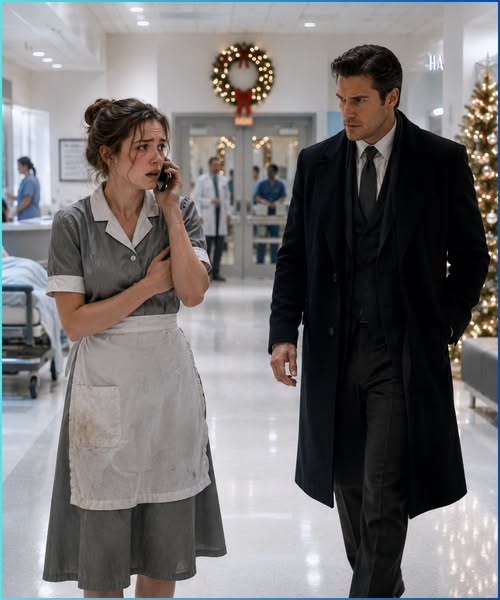
The morning after Christmas had a thin, clean light to it, the kind that came off the harbour and laid itself flat across the kitchen table of the small apartment where Callum had brought her. Maeve sat with her good hand wrapped around a mug of tea that had already gone lukewarm, and with her splinted left wrist resting on a folded towel, and she looked at the three things Gabriel Vale had left behind in the sealed envelope: the letter, the torn page, and the small brass key. She had read the letter twice the day before, once aloud in Gabriel's room with dust in her throat and once silently in the car on the way back, and both times she had felt the same complicated ache, as if she were intruding on a conversation between two brothers that had never been finished. Now, in daylight, she did not want to intrude. She wanted to understand.
Callum stood by the window with his phone face down on the sill, which for him was a kind of discipline. He had promised her, and he had promised himself, that he would not make a single call about Gabriel's envelope until they had read everything properly and decided together what it meant. That promise was harder for him than he admitted. Maeve could see it in the way his shoulders held themselves, in the way he kept glancing at the harbour as though answers might come in on the tide. He was a man accustomed to acting first and explaining later, and the restraint cost him. She liked him better for paying it.
"Read it to me again," she said. "Slowly this time. Not the whole letter. Just the part about the ledger."
Callum came back to the table and unfolded the letter with a care that surprised her, his fingertips barely touching the creased paper. Gabriel's handwriting was quick and slanted, the writing of a man who thought faster than his pen could follow. "He says here," Callum read, "'The harbour ledger is not the ledger. The real entries were kept in the red book, and the harbour ledger was rewritten to match whatever story they wanted told.' And then, further down: 'If anything happens to me, do not trust the copies they show you. The copies are clean because someone cleaned them.'"
Maeve nodded. She had remembered those lines, but hearing them again in Callum's voice made them heavier. "And the part about the fire?"
"'Pier Nine was not only a fire,'" Callum read. "'A fire does not choose which boxes burn.'"
She sat with that for a moment. A fire does not choose which boxes burn. It was the kind of sentence Gabriel would have written, plain and stubborn, and it told her more than any accusation could. If the fire had been an accident, the destruction would have been random. If the records that mattered were the ones that burned, then someone had decided in advance what needed to disappear.
"Let me see the torn page," she said.
Callum slid it across the table, and Maeve studied it as she would have studied any difficult thing in her life: patiently, without rushing to a conclusion, letting the details accumulate until they formed a shape. The page was torn along one edge, and the paper was thicker than ordinary notebook paper, with a faint ruled grid that suggested a ledger rather than a diary. The handwriting on it was Gabriel's, but tighter than in the letter, compressed by the need to fit a great deal of information into a small space. There were columns, and dates, and a series of short codes that at first looked like nothing at all: a letter, a number, a dash, another number, and then a brief note in a shorthand she did not recognise.
She stared at it for a long time, and then something in her memory shifted. She had seen shorthand like this before, not in a book but in a house. When she had first come to work at the Beacon Hill mansion, the previous housekeeper, an older woman who had since retired to live with her daughter in Quincy, had kept her own notes in a quick, private script, and had once shown Maeve how she abbreviated the names of rooms and the days of the week so that a whole week's work could fit on a single index card. The marks on Gabriel's page were not identical to that woman's system, but the principle was the same: a letter for a place, a number for a quantity, a symbol for a direction. And Gabriel, she realised, had been even more careful than that. He had not invented a code to hide his meaning from everyone. He had invented a code to hide it from the wrong people, while leaving it readable to anyone who knew the harbour and knew his habits.
"Callum," she said slowly, "I think I can read this. Not all at once, but I think I can work it out."
He looked at her, and she saw the doubt in his face, and also the hope he was trying not to show. "Maeve, you do not have to prove anything. We can take it to the attorney and let him—"
"No," she said, and her voice was firmer than she expected. "I want to do this myself. Gabriel left this for you, but he left it in a room I cleaned every week for three years. I knew that room better than anyone in that house except Gabriel himself. If there is a way into this page, I should be the one to find it."
She said it not as a challenge but as a fact, and after a moment Callum nodded and pushed a clean sheet of paper and a pencil toward her with his good hand, careful not to crowd her. Maeve began to work.
She started with the dates, because dates were the least ambiguous thing on the page. Gabriel had written them in a compact form, month and day without the year, but the sequence ran across the top of the page in order, and she could see that they clustered tightly in the weeks before the Pier Nine fire. There were five dates in particular that repeated, with small marks beside them, and as she copied them out in her own handwriting, she began to see a pattern that made her stomach tighten. Three shipments were listed as arriving at Pier Nine on days when, according to the rest of the page, no ship had docked there at all. Two other shipments were listed as leaving the warehouse on days after the fire, when there had been nothing left to leave.
"This is wrong," she murmured, half to herself. "Look. This one says a shipment arrived on the fourteenth, but the note beside it says the berth was empty. And this one says a shipment was moved out on the morning after the fire, when the whole pier was still closed."
Callum leaned over her shoulder. "Are you sure you are reading the dates correctly?"
"I am sure about the order, even if I am guessing at one or two of the marks," Maeve said. "Gabriel wrote the dates in the same hand as the letter. The numbers are clear. It is the notes beside them that are shorthand, but the dates themselves are plain."
She worked on the shorthand next, and this was slower, more like picking a lock than reading a page. The first code repeated beside every shipment that did not make sense: a small circled letter, followed by a number. She tried it as an initial, then as a berth number, then as a warehouse bay, and none of those readings fit until she remembered something Gabriel had once said to her in passing, years ago, when she had been dusting the shelves in his room and he had been sorting papers. He had said that the harbour men used letters for the piers and numbers for the sheds, and that Pier Nine had three sheds, not one, and that most people who talked about Pier Nine as if it were a single building did not understand the place at all. The circled letter, she realised, was not a pier. It was a shed. And the number beside it was not a quantity. It was a bay within the shed.
Once she had that, the rest began to unlock, piece by piece, the way a familiar room reveals itself when you finally turn on the right lamp. A short diagonal stroke meant a shipment had been moved inland rather than loaded onto a ship. A small cross meant a record had been altered after the fact. A double line under a date meant the entry had been copied from somewhere else, not written on the day itself. And beside three of the falsified entries, in a hand that was not Gabriel's, there was a short, looping sign-off, a scrawl of initials and a date, written in a different ink, as if someone had checked the page and approved it without reading it closely enough to notice what Gabriel had recorded.
Maeve stared at that sign-off for a long time. She had seen that handwriting before, and not on paper. She had seen it on the staff rota pinned to the kitchen wall, on delivery notes left by the back door, on the small whiteboard in the security office where the night shifts were assigned. It was a quick, impatient hand, the letters leaning forward as if they were in a hurry to be finished. It was the hand of Marcus Wynn.
"Callum," she said quietly, "come and look at this."
He came around the table and stood beside her, and she pointed to the sign-off with the tip of her pencil, careful not to touch the page itself. "That is not Gabriel's writing," she said. "Gabriel's letters stand up straight, even when he is writing fast. These lean forward. I have seen this hand on the rotas. I think it is Marcus's."
Callum went very still. He did not speak for several seconds, and Maeve understood why. Marcus Wynn had been his head of security for years. Marcus was the man who had messaged him about Maeve's hospital visit without being told, the man who had known where she was before Callum himself had been told. Until now, that message could have been explained, however thinly, as a security man doing his job too well. A sign-off on a falsified page was harder to explain. It suggested not vigilance but involvement.
"Are you certain?" Callum asked at last, and his voice was careful, as if he were handling something fragile.
"I am certain enough to say it should be checked by someone who compares handwriting for a living," Maeve said, because she would not claim more than she knew, and she would not claim less either. "But I am not guessing. I have looked at Marcus's writing on the rotas for three years. The way he makes his M, with the second stroke longer than the first, and the way he crosses his date with a single slash instead of writing it out. It is here. On three entries. All three are entries that do not match the real shipments."
She turned the page slightly, so the light fell across it differently, and pointed to the pattern she had traced. "Look at the whole thing together. Gabriel recorded the real shipments: what actually arrived, what actually left, and when. The harbour ledger, the official one, says something different. It says the shipments that Gabriel says never arrived did arrive, and it says the shipments that Gabriel says were moved inland were shipped out to sea. Around the fire, the two versions diverge completely. The official ledger makes it look as if everything was normal until the fire destroyed it all. Gabriel's page makes it look as if the records were already false before the fire, and the fire finished the job."
Callum sat down slowly, as if his legs had decided for him. "So the fire was not the crime," he said. "The fire was the cover."
"Yes," Maeve said. "That is what Gabriel meant when he wrote that a fire does not choose which boxes burn. Someone falsified the shipments first, and then the fire destroyed the evidence that would have shown the falsification. Or tried to. Gabriel kept his own copy."
She felt a strange steadiness as she said it, a calm that surprised her. She had expected to feel frightened, and part of her was frightened, but a larger part of her felt something closer to clarity. For days she had been the woman who had been hurt, the woman who had been taken to hospital, the woman who needed protecting. Now she was the woman who had read the page. That was a different position, and she intended to keep it.
Callum reached across the table and took her good hand in his, and for a moment neither of them spoke. Then he said, "There is something else in the letter. The part I did not read aloud yesterday. Gabriel says he copied the red book."
Maeve frowned. "Copied it? You mean the torn page is a copy?"
"Not exactly," Callum said, and he turned the letter over and found the passage with his finger. "'I have copied what matters most into a book of my own,'" he read. "'The red book itself I have hidden elsewhere, where it will not be found by searching my room. What you found is the copy. The original is safer than I am.'"
Maeve absorbed that, and then she understood why the attackers had asked about the red book in Gabriel's room and why they had not found what they wanted. They had been searching for the original in the one place Gabriel had already emptied of it. The torn page in the envelope was a copy, deliberately left where it could be found by the right person, and the original was somewhere else entirely, waiting for someone who knew how to look.
"Then we have two problems, not one," she said. "We have to prove what Gabriel's copy shows, and we have to find the original without telling the wrong people that we are looking for it."
"And we have to do both without Marcus knowing what we know," Callum added.
At the mention of Marcus's name, Maeve remembered something, and the memory arrived with the force of a door opening in a quiet house. She stood up, too quickly, and her splinted wrist protested, and she steadied herself against the table with her good hand.
"My cleaning notebook," she said.
Callum looked up. "What about it?"
"I keep a notebook," Maeve explained, her words coming faster now. "Every housekeeper does, or at least I do. I write down what I cleaned, and when, and anything unusual I notice, so that the next week's work makes sense. It is not a diary. It is a work record. But I wrote something in it on Thursday evening, the evening I found the envelope, and I did not think about it again until now."
She went to the small bag she had brought from the mansion, the bag Callum had packed for her in a hurry, and she took out a plain, battered notebook with a faded blue cover, the corners soft from years of being carried in an apron pocket. She flipped through it with her good hand, past lists of rooms and supplies and notes about a leaking tap in the east bathroom, until she found the entry she was looking for. It was written in her own neat, unhurried hand, and it said, in full: Thursday evening, west hallway, dusted and polished. Mr. Wynn entered west hallway approx. 7:40 p.m., went toward Gabriel's room, did not speak. Unusual, as no cleaning scheduled there that evening.
She read it aloud, and then she read it again, because the second reading made the implication clearer. She had found the sealed envelope behind the stuck bottom drawer of the writing desk in Gabriel's room on Thursday, during her ordinary cleaning. That evening, shortly afterward, Marcus Wynn had entered the west hallway and gone toward Gabriel's room, at a time when no cleaning was scheduled and no security round was due. He had not spoken to her. He had not explained why he was there. He had simply gone toward the room where the envelope had been.
"That is the second clue," Maeve said, and she heard the steadiness in her own voice again. "I did not write it down because I suspected him. I wrote it down because it was unusual, and unusual things go in the notebook so I remember them. But now, with the sign-off on Gabriel's page, it means something else. Marcus was in the west hallway on Thursday evening, shortly after I found the envelope. He was looking for something in Gabriel's room. Or he was checking whether something was still there."
Callum took the notebook from her gently and read the entry himself, and Maeve watched his face change as he did. It was not anger, not yet. It was the look of a man rearranging everything he thought he knew about his own house, room by room, and finding that one of the rooms had a door he had never noticed.
"Thursday evening," he repeated. "You found the envelope that day."
"During the afternoon cleaning," Maeve said. "I did not tell anyone about it at first. I did not know what it was. I only knew it was sealed and it had your brother's initials on it, and that it did not belong in the back of a drawer. I put it back where I found it and I finished my work. And that evening, Marcus went down the west hallway."
"And then, on Christmas Eve, men came to the mansion asking about the red book," Callum said, completing the thought in a voice that was very quiet. "And then Marcus messaged me about your hospital visit without being told. And now we have his sign-off on falsified entries around the fire."
Maeve nodded. She did not need to say the rest. The pattern was there, and it was not a pattern she had invented. Gabriel's shorthand, decoded by her own hand, showed falsified shipments and dates around the Pier Nine fire. Marcus's sign-off appeared on the falsified entries. Her own notebook placed Marcus in the west hallway on Thursday evening, shortly after she had found the envelope. Gabriel's letter said the red book had been copied and the original hidden elsewhere. Put together, those facts told a single story, and the story was not an accident.
"The fire was a cover for destroying records," she said at last, speaking the conclusion aloud so that it could not be unsaid. "Gabriel knew the ledger was falsified, and he knew the records were at risk, and he copied what he could and hid the original. Someone wanted those records gone. The fire gave them a reason for the records to be gone that no one would question. An accident explains everything, as long as no one looks at the shipments themselves."
Callum was silent for a long time after that, and Maeve let him be silent, because she understood that he was not only thinking about ledgers and shipments. He was thinking about his brother, who had seen all of this five years ago and had tried to leave a trail, and who had died in the very fire that was meant to erase the trail. Gabriel had not been careless. Gabriel had been careful, and careful had not been enough.
"We will not go back to the mansion to look for the original yet," Callum said finally, and his voice had the firmness of a decision made rather than a feeling expressed. "Not until we know who we can trust. We have your reading of the page, and your notebook, and Gabriel's letter. That is enough to take to my attorney, and to the police, and to ask them to help us properly. I promised you I would not take private revenge, and I will keep that promise. But I will not sit on this either."
Maeve looked down at the torn page, at the columns and codes she had spent the morning deciphering, and at the small brass key beside it, which neither of them had yet tried in any lock. The key, she thought, might open the place where Gabriel had hidden the original. Or it might open something else entirely, a box, a drawer, a cabinet in a building she had never entered. She did not know yet, and she was content not to know yet, because for the first time since Christmas Eve, she felt that they were not merely reacting to what had been done to them. They were following a trail that Gabriel had left, and Maeve herself had been the one to read it.
She closed her notebook, and she placed her good hand flat on the table beside Gabriel's page, and she said, "Then we start with what we can prove. And we keep the original copy safe, outside the mansion, just as I said we should."
Outside, the harbour light shifted, and the apartment was quiet, and the work of understanding what Gabriel had known was, for that morning at least, done.