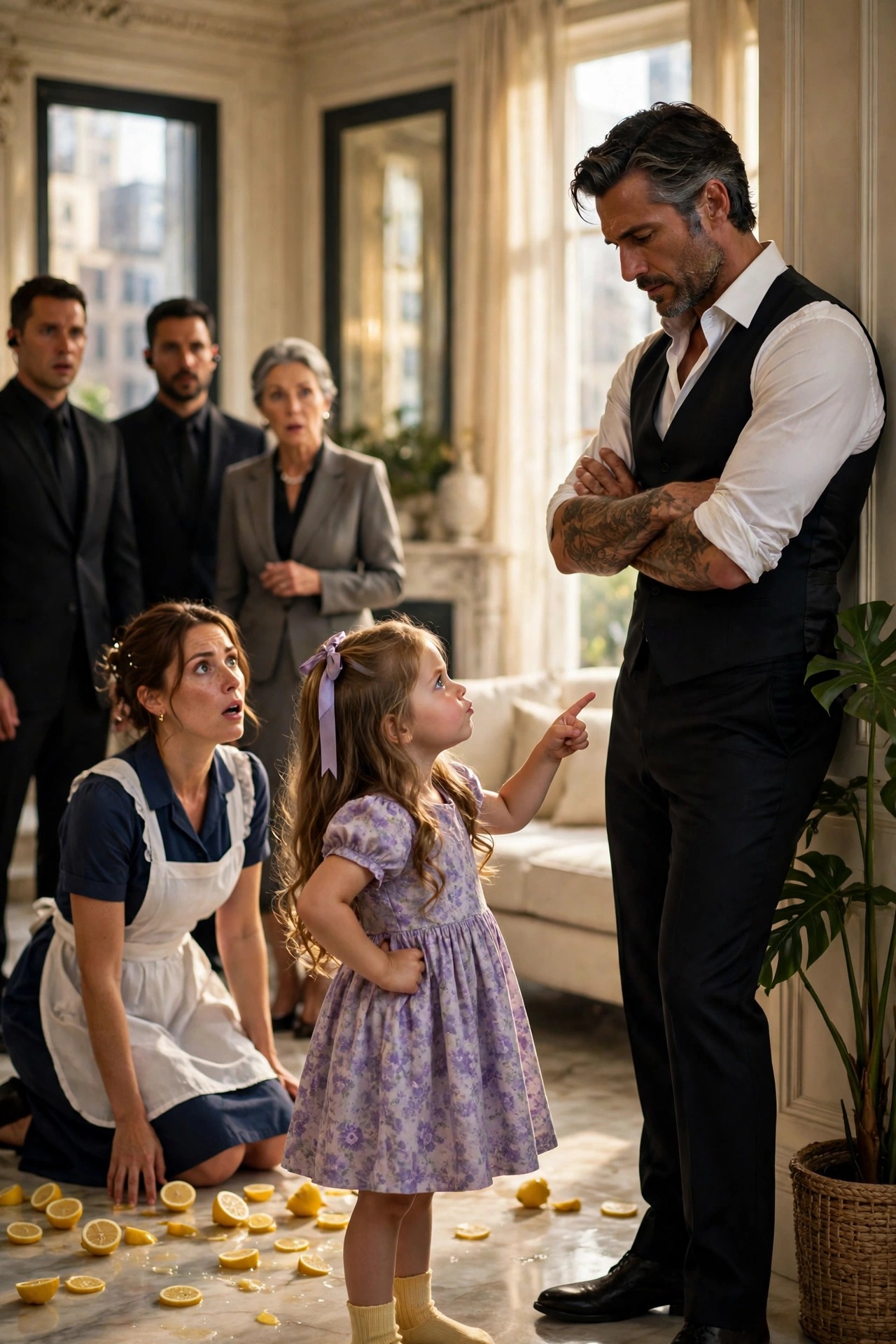
I did not believe he would come back the next morning.
Men like Vincent Marquetti did not keep promises made to four-year-old girls over toast. I told myself that while I laid out the breakfast things at half past five, while Lily hummed beside me and set her purple crayons in a neat row, point up, like soldiers. He would forget. Or he would remember and be angry that he had agreed to any of it. Either way, the spell would break, and our lives would go back to the careful, quiet shape they had been before she put him in a corner.
At six-fifteen exactly, I heard footsteps in the hall.
Not the angry ones from the day before. Slower. Almost — and I know how ridiculous this sounds — almost hesitant.
Vincent appeared in the kitchen doorway in his white shirt and black vest, sleeves rolled, silver showing in his dark hair where the morning light caught it. He stopped when he saw Lily, as if he had walked a long way to a door he was not sure he was allowed through.
"You came," Lily said, in the tone of a teacher pleasantly surprised by a difficult pupil.
"I said I would." He looked at the table. "Am I late?"
"Almost," she said. "Sit. Mommy made eggs."
He sat. In the same chair. And then, without being told, he reached for the napkin, put it across his knee, and looked at me.
"Good morning, Mrs. Reyes."
"Good morning, sir."
"Lily," he said gravely, "did I use my angry voice?"
"No," she said. "That was your good morning voice. Well done."
Nico, who had followed him in with a cup of coffee, turned so quickly toward the window that his shoulders shook. Tomas stared at the ceiling with the expression of a man who had decided, professionally, to see nothing for the rest of his life.
That was the first morning. By the third, there was a routine. By the end of the first week, Mrs. Bell was calling it, in a voice she used only when the pantry door was shut, "the Marquetti table," as if breakfast had become a place rather than a meal.
And God help us, Lily ran it like one.
"Wash your hands," she told Nico on the fourth morning, pointing at the sink with a crayon. "That is rule number one. It is on the refrigerator."
Nico looked at his hands. They were enormous, clean, and attached to a man who had probably never been ordered to do anything by a person under three feet tall. "I washed them upstairs, Miss Lily."
"Then wash them again downstairs. Germs can walk."
He washed them again downstairs. Tomas, without a word, washed his after him, presumably so as not to be next. Vincent, watching this, lifted his own hands in surrender and went to the sink himself, rolled his sleeves a little higher — I saw the tattoos run all the way up his forearms, dark and intricate — and washed his hands like a schoolboy, while my daughter inspected his work and nodded.
"Good," she said. "Now everybody can be safe."
Daniel used to say that. Rules keep people safe. Hearing it in her mouth, in that kitchen, aimed at those men, nearly undid me every single morning.
Phones were the second battle. On the fifth morning Vincent's phone buzzed against the table and Lily gasped as if he had produced a snake.
"No phones," she said. "Phones are for after breakfast. After is allowed."
"That could be important," he said.
"Breakfast is important," she replied. "You can be important after eggs."
There was a silence in which I watched a man who made politicians answer his calls at midnight consider this proposition. Then he picked up the phone, switched it off — off, not silent — and set it face down on the far counter.
"After eggs," he agreed.
Nico's phone buzzed that same morning. He looked at Lily. She looked at the phone. He switched it off without a word, and Tomas, smiling for the first time since I had known him, said, "She is more effective than the training program, boss."
"Don't encourage her," Vincent said, but there was no heat in it.
The happy face was the longest campaign of all.
"You are doing your mean face," Lily informed him on the second week, over oatmeal.
"I am eating," he said.
"Your eyebrows are doing it."
He attempted something. I will be honest: it was terrible. It looked like a man being shown a photograph of a smile and trying to reconstruct it from memory.
"Better," Lily lied kindly. "Practise helps. Daddy said practise helps everything, even being brave."
Vincent went very still at that, the way he always did when Daniel entered the room without being invited. He did not ask questions. He never did at the table. He just looked at Lily and said, quietly, "Then I will practise," and tried again, and this time something real crossed his face, brief and startled, like light under a door.
Lily beamed. "See? There it is."
Staff began finding excuses to pass the kitchen at six-fifteen. The cook, who had served that house for nine years and spoken, as far as I could tell, in ingredients, started leaving the pantry door open so she could listen. I heard laughter in the corridor one morning — actual laughter, from one of the younger security men — and he caught my eye and did not even look ashamed. The house was changing its sound. Rooms I had tiptoed through for six weeks had begun, very cautiously, to breathe.
I was grateful. I want that understood. I was grateful every morning my daughter ate breakfast unafraid, in a warm kitchen, with her rules on the refrigerator treated as law by men who could have frightened anyone on earth. I was grateful for the salary that meant the letters from the landlord had stopped. I was grateful, in a way I could barely admit, for the sight of Vincent Marquetti cutting Lily's toast into triangles because she had explained, patiently, that triangles tasted braver.
But gratitude and fear can live in the same chest. Mine did.
Because Lily was attaching to him the way children attach — wholly, without a single reservation, as if he had always been there. She saved him the chair with the best light. She drew him a second picture, a house with a purple door, and wrote underneath, in letters Mrs. Bell helped her sound out, MR VINCENT'S HAPPY FACE, and he took it upstairs himself. She began asking at bedtime whether Mr. Vincent had had a good day, whether anyone had used an angry voice at him, whether he had remembered to eat lunch, because lunch, she explained to her pillow, was also important, even if it was not on the refrigerator.
And one night she said, "When Daddy visits in my dreams, I tell him Mr. Vincent is practising."
I sat on the edge of her bed in the little room off the kitchen that was ours, and my throat closed, and I kissed her hair and said, "That's nice, sweetheart," and then I went into our small bathroom and cried as quietly as I knew how, which by then was very quietly indeed.
Mrs. Bell found me the next afternoon folding laundry in the service room, and she did not waste words. She never did.
"You are worried," she said. It was not a question.
"I'm always worried, ma'am. It came with the baby."
"Elena." She used my Christian name so rarely that I stopped folding. "I have worked in this house for twenty-two years. I have seen Mr. Marquetti be generous, and I have seen him be — " She chose her next word the way you choose a step on ice. "— final. He has never, in twenty-two years, sat at a kitchen table and let a child correct his manners. Do you understand what I am telling you? This is not a small thing that is happening. For any of you."
"I know Lily's getting attached," I said. "I watch it happen every morning. I don't know how to stop it without breaking something in her."
"It is not only Lily." She folded her hands, those elegant, capable hands. "Attachment to Vincent Marquetti is dangerous, Elena. For the child, because the world will eventually remind her who he is, and children do not survive such reminders gently. And for him." Her voice dropped. "A man like that survives by having nothing that can be taken from him. The morning that changes — the morning other people understand that it has changed — he becomes vulnerable, and so does everything he cares about. And a vulnerable man in his position does not become safer. He becomes more dangerous, or the people around him do. I am not warning you against him. I am warning you about the shape of his life."
I thought of black vehicles I had been told never to ask about. Of upstairs rooms I had never entered. Of the way the guards' eyes moved, always, to the windows first.
"What would you do?" I asked. "If she were yours?"
Mrs. Bell was quiet for a long time. Then she said, very gently, "I would stay, because you have nowhere better to go, and I would keep my eyes open, because love is not the same thing as safety. And I would teach my daughter that a person can be kind at breakfast and still live in a dangerous house."
She left me with the laundry and that sentence, and I carried both of them for days.
Vincent, meanwhile, was learning things I had not told him.
He asked Tomas for nothing, as far as I know. He asked me at the table, in the gaps of Lily's conversation, the way a man lays down cards one at a time. How long had we been in Chicago? Had Lily always liked purple? Small things. But one morning, when Lily had run to fetch her crayons, he said, without preamble, "Your husband was a paramedic."
"An EMT," I said, startled. "Yes."
"He died on duty."
"In a warehouse fire. Two years ago." I kept my voice level, the way you do when the words have worn a groove. "He went back in for a man who couldn't walk. Neither of them came out."
Vincent was quiet. "The man he went back for," he said. "Did anyone ever tell you his name?"
"No," I said. "I never asked. It wouldn't have changed anything."
"No," he agreed slowly. "It wouldn't." And there was something in his face then — a shadow, fast and gone, the same one I had seen when Lily pushed her rules across the table that first morning. I told myself I was imagining it. I had become very good at telling myself that.
The debts he learned about differently, and I never did find out how. Perhaps a salary application can tell a story if you know how to read it. Perhaps Mrs. Bell, meaning kindness, said a word. All I know is that on the Friday of the second week, I came back to our room after Lily's bath and found an envelope on my pillow.
No name. No note. Thick, plain, heavy in the way only money is heavy.
I counted it standing up with the door locked, my hands not quite steady, and then I counted it again, because I did not believe the first number. It was more than the landlord, more than the credit card Daniel's insurance hadn't covered, more than every red-printed letter I had ever hidden in a drawer from my own daughter's eyes. It was, to the dollar, everything.
I did not sleep deciding what to do. Lily did, deeply, with her ribbon clutched in one fist, and at five the next morning I was waiting in the kitchen when Vincent came down — early, before the guards, because somehow I had known he would be early, and somehow he had known I would be waiting.
"You left something in my room," I said.
He did not pretend. I will give him that; he never pretended with me. "Yes."
"Take it back."
"Elena — "
"Mrs. Reyes," I said, and my voice shook, and I hated that it shook. "I scrub floors, Mr. Marquetti. I polish silver I will never own and I cook breakfasts and I do it well, and that is the arrangement. I earn my keep. I am not — " I had to stop. "I am not a charity case you found in your kitchen. And my daughter is not going to grow up in a house where her mother was paid for in envelopes left on pillows in the night. Whatever you think that was, it felt like being bought. Take it back."
The silence lengthened. He looked at me for a long time, and I braced for anger, for coldness, for the man the city feared to walk into the room and end whatever had been growing at that table.
Instead he nodded, once, slowly, as if I had corrected his manners and he was filing the correction away with the others.
"You are right," he said. "It was badly done. Not the intention — the way of it. Forgive me."
I had not prepared for an apology. Lily had trained him too well and not at all: he said it plainly, and meant it, and waited.
"What is the money, then?" I asked at last. "Because it was exact. It was everything I owe, to the dollar, and that frightens me more than if it had been a fortune."
"It was meant to remove a weight," he said. "So that you would stay because you chose to, not because you were cornered." He paused. "I see now that an envelope does not remove a corner. It builds one."
"Then what do we do?"
He was quiet a moment. Then: "Mrs. Bell keeps the staff accounts. This morning I will instruct her to review yours. Whatever back pay and overtime you are owed — and over six weeks of five-o'clock mornings, I suspect it is considerable — will be calculated, documented, and paid through your wages, in writing, where you can check every figure. If the review shows your salary is below what the position should carry, it will be raised, also in writing, and you may accept or argue with Mrs. Bell, who argues better than I do." He almost smiled. "Will that insult you?"
It would not insult me. It nearly made me cry in his kitchen, which would have insulted me considerably, so I swallowed twice and said, "No, sir. That would be fair."
"Then it is done." He took the envelope from where I had set it on the counter, between us, and put it in his inside pocket without a flicker. "And Elena — Mrs. Reyes," he corrected himself, carefully, "for what it is worth: charity is for strangers. Nobody in this house thinks you are that."
Two days later Mrs. Bell presented me with a typed statement on estate letterhead, and a raise I had to sit down to read, and back pay calculated to the hour — less than the envelope, honest and checkable, and somehow worth ten times more to me because I could hold it up to the light. I signed it with Lily's purple crayon, because it was the pen nearest to hand, and Mrs. Bell pretended not to notice, and pressed her lips together in a way that, in her, was a declaration of emotion.
I might have begun to feel safe, that week. That is the part I am most ashamed of. I might have begun to believe the house would keep us.
The errand was an ordinary one. Mrs. Bell needed a particular ribbon for the dining-room flowers and a list of things from the pharmacy in town, and Tomas drove me, because Tomas drove everyone, and Lily stayed home with Mrs. Bell and a bowl of strawberries she was strictly rationing until dinner. I saw the car the first time outside the pharmacy — black, clean, unremarkable except that its windows were dark and it stayed a beat too long after the light changed. I saw it the second time, or its twin, two streets later, turning when we turned, unhurried.
I told myself town was full of black cars. I told myself grief makes watchers of us all.
Then I caught Tomas's eye in the mirror, and Tomas was not telling himself anything. He was counting.
"Take the long way home, Mrs. Reyes," he said pleasantly, in the tone he used for weather. "It is a nice afternoon for it." And he lifted his phone and said a few quiet words that were not about the weather at all, and drove us home by streets I had never seen, and all the way I sat with Mrs. Bell's shopping on my knees and my heart going like a fist on a door.
At the gate, nothing happened. In the kitchen, Lily flung herself at my legs and told me about the strawberries as if reporting a small war — two eaten, honour intact. I laughed, and held her, and over her head I met Tomas's gaze, and he gave me the smallest shake of his head that has ever meant: not now, not in front of her.
That evening, Ray came to the kitchen door.
Ray was the security man who ran the monitoring room — a quiet, narrow fellow, hired, Mrs. Bell mentioned once, about three months before I arrived, which in that house counted as new blood. He did not come into the kitchen. Men like Ray never quite crossed thresholds; they reported from them.
"Tell Mr. Marquetti," he said to Tomas, not to me, though I was standing at the counter with a dish towel in my hands, "the cameras on the east side glitched this afternoon. Twelve minutes, give or take. It's fixed now. Probably the heat."
"Twelve minutes," Tomas repeated.
"Give or take," Ray said, and left, and the door swung shut behind him on its soft hinge, and neither of the men in that kitchen had believed a single word about the heat. I could feel it, the way you feel weather change in a scar. Twelve minutes. About the length, I thought suddenly, of a drive through town, if you knew which streets a car would take.
I did not sleep well. And in the morning, I woke before Lily for once, and went down in the dark to make coffee, thinking about nothing more dangerous than the day's list.
The kitchen was as I had left it. The rules were on the refrigerator where they belonged, held by a magnet shaped like a lemon. The table was set for no one yet. And on the counter beside the sink, laid neatly, ribbon uppermost, ironed flat by somebody's careful hand, was Lily's spare lavender ribbon.
The spare. The one she had worn to town on my errand — no. Worn last week, to the market street with Mrs. Bell, and come home without, crying a little, while I promised we would find it and privately accepted it as lost to a pavement somewhere, gone.
I had not brought it back. Nobody in this house had brought it back. I had told no one but Mrs. Bell that it was lost at all.
But someone had found it, in a town full of streets, and carried it into Vincent Marquetti's kitchen in the night, and laid it out neatly for me to find at dawn — the way you leave a message you want read carefully, by the first person who comes down alone.
I stood in the dark kitchen and did not touch it, and for the first time since Lily had said "time-out" to the most dangerous man in Chicago, I understood, all the way down to my bones, that somebody outside those gates had stopped watching Vincent Marquetti.
They had started watching us.