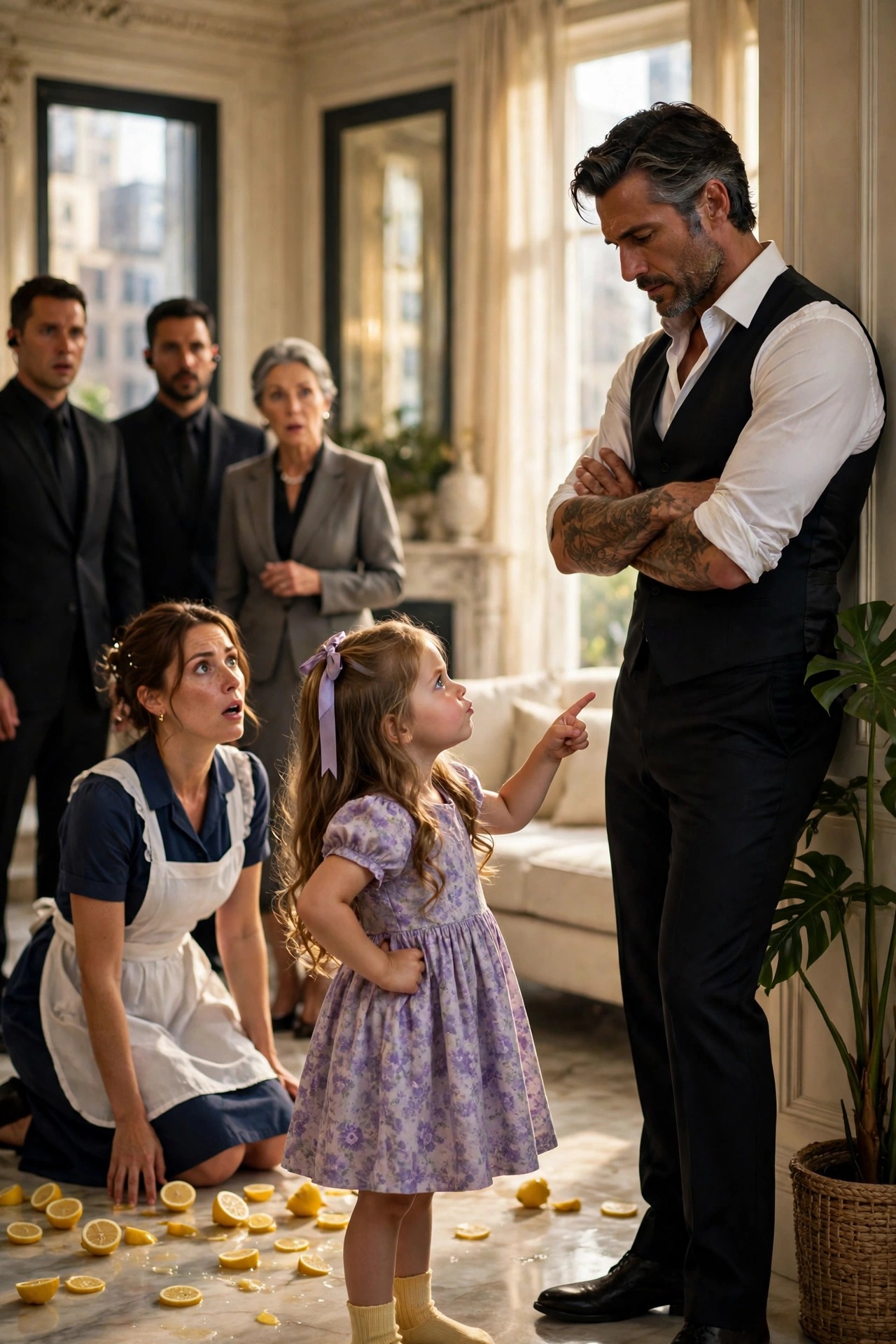
I did not tell Vincent about the ribbon that morning.
That is the sentence I have turned over more than any other since. I told Tomas, because Tomas was already in the kitchen doorway when I finally picked the thing up between two fingers, like evidence, like something that might bite. He looked at it for a long moment and said, "Mrs. Bell is checking who was on the east corridor last night, Mrs. Reyes. Don't mention it to Miss Lily." It was handled, in the way things in that house were handled — quickly, quietly, above my head. And I let it be handled, because Lily was calling for me from upstairs in the bright, bossy voice of a girl who wanted her toast cut bravely, into triangles.
Three days passed. Nothing happened, which in retrospect was the most frightening part. No black car. No ribbon where a ribbon should not be. Breakfast at six-fifteen, hands washed, phones off, Vincent's happy face improving by degrees that Lily charted on the back of her rules page like a doctor recording a recovery.
On the fourth day, a Saturday, Lily announced that the breakfast table needed flowers.
"Real ones," she said. "Not the dining ones. The dining ones are for being fancy. Breakfast flowers are for being happy."
"The farmers' market has flowers," Mrs. Bell said, from the doorway, and then, to Vincent, in a different tone altogether, "It might be managed, sir. With preparation."
I looked up, surprised. Vincent looked at Lily, who was already wearing her hat in anticipation, which is to say she had put it on backwards at the table.
"Guards," he said. It was not a question; it was a condition, delivered to the room. "Tomas plans it. Nico stays with them. I will be nearby, and nobody — " his eyes came to me, and gentled, in the way they had learned to do, " — nobody treats it as anything but a little girl buying flowers. That is what it is. Isn't it, Elena?"
He had never called me Elena at the table before. Lily, delighted by an outing and by being right about flowers, did not notice my pause.
"Yes," I said. "That's what it is."
The market was two towns over, bright with canvas awnings and the smell of peaches and cut grass, and for the first hour I almost believed us. Lily rode most of the way on the strength of three separate discussions about what colour happy was — yellow, we decided; yellow was happy's favourite — and when we arrived she marched between Nico and me with her small purse clutched in both hands, containing, Mrs. Bell had certified, exactly enough money for one bunch of flowers and one thing that was not flowers but was necessary, to be identified on sight.
Nico stayed half a step behind her shoulder. Tomas walked the far side of the stalls, unhurried, appearing and disappearing the way weather does. I saw Vincent only once, at a distance, in a plain dark jacket at the coffee stand, reading a newspaper he did not turn a page of, and I understood that this was what "nearby" meant in his world, and that he had dressed down and stood apart so that a four-year-old could have a morning that belonged to her.
"Those," Lily said, stopping so suddenly that Nico nearly walked into us both. "Those are the happiest."
Dahlias. Enormous, improbable dahlias, yellow and coral, in a bucket at the corner of a flower stall where the path narrowed between a honey stand and a row of parked carts. The flower woman was helping another customer. Lily let go of my hand to reach the bucket with both of hers, the way she did everything that mattered, entirely and at once.
I have tried, since, to put the next seconds in order. They will not go in order. They go the way they went: all at once, and too fast, and with the particular silence first — because there was a silence, a half-breath where the market noise seemed to draw back, and I knew as a mother knows, in my spine before my eyes, that something was wrong.
A man had stepped out from behind the honey stand. Smiling. Kneeling a little, the way people do with children, holding out a small paper bag.
"You dropped your ribbon, sweetheart," he said to Lily. "Want to come and get it? It's just here."
He was holding a lavender ribbon.
Not hers. A ribbon. The colour of hers. Somebody had done their shopping, too.
Lily, who had been taught by a father she barely remembered and a mother who had tried very hard, stepped back against my legs and said, clearly, "I don't know you."
"Smart girl," I said, and got my hands on her.
The second man came from the other side of the flower stall. I did not see him step in; I felt the path close. He took hold of the strap of Lily's little purse — not Lily, at first, the purse, as if this were a snatching, as if they wanted it to look like one — and pulled, and Lily cried out, and I did the only thing I have ever done quickly in my life without thinking. I went down on my knees in the dirt of that market path and wrapped both arms around my daughter and held on and screamed.
I screamed Nico's name. I screamed for help. I screamed the way I had not screamed when the fire officers came to my door, because at my door there had been nothing left to hold. Here there was everything to hold, and I held it, with the dahlias crushed against my shoulder and Lily's hat in my face and a stranger's hand trying, with horrible, businesslike patience, to work my arms loose.
"Mommy — " Lily said, into my neck, very small.
"I have you," I said. "I have you, I have you."
Nico arrived the way a door arrives when it is kicked. I will not describe it in detail, because I did not see most of it; I saw his shoulder come across my vision and the second man was simply not there any more, was on the ground among the cart wheels with Nico's hand flat on the back of his neck and Nico saying, in a voice I had never heard him use, quiet and almost friendly, "Stay. Stay exactly there." Somewhere behind me a stall went over. Somebody shouted. A third man — I learned later there had been a third, who had spent the whole morning inventing an argument with Tomas at the honey stand about change, about nothing, about a jar that didn't exist — that man was already running, and Tomas was already after him, and not running, somehow, in a way that was worse than running.
The first man was still in front of me. He had stopped smiling. He had one hand up, placating, backing away through the dahlias, and he was saying, "Easy, lady, easy, it was a joke, it was a — "
Then Vincent arrived.
I have thought about how to say this honestly. He did not run in shouting. He did not arrive like a hero in a film. He came around the end of the flower stall at a walk, in his plain jacket, with his newspaper gone, and the market — I swear this, and I was on my knees in the dirt — the market went quiet around him the way a room does, in rings.
The man saw him and understood something in one second that it had taken me six weeks to understand in pieces. His hands came up higher. He started talking very fast, to Vincent, not to me — names, apologies, a word that sounded like a place — and Vincent listened the way a cliff listens to weather.
"Elena," Vincent said, without looking at me. "Is she hurt?"
"No — " My voice cracked. "No, she's not hurt, I have her, she's not — "
"Lily," he said. "Sweetheart. Are you hurt?"
A small, furious, tear-soaked face lifted out of my neck. "He pulled my purse," Lily said. "And he lied about my ribbon. Lying is not on the rules but it should be."
"Noted," Vincent said gravely, and something in his terrible, controlled face eased by a fraction — and then hardened again as he turned back to the man, and I saw it, close up, at last and completely: who Vincent Marquetti was when he was not at my breakfast table.
There was nothing wild in it. That was what frightened me. No raised voice, no wasted movement. He stepped forward and took the man by the front of his jacket with one hand — one hand, with the tattoos running up his forearm — and brought him close, and spoke too quietly for me to hear, at length, without once looking away. The colour went out of the man's face in stages, the way light goes out of a house room by room. Twice the man nodded. Once he tried to speak and Vincent, barely shaking his head, stopped him with nothing but patience. It was the patience that terrified me. Anyone can be frightening in a temper. He was frightened of nothing, in no hurry at all, and utterly final, and I held my daughter in the dirt and understood that the man who practised his happy face over oatmeal had been, the entire time, this man too — that they were not two people. They were one person, and the breakfast table was the only place on earth where he set this down.
The man was saying something about a photograph when Lily cried out — not in fear; in outrage, because Nico, restraining the second man, had knocked the bucket, and the dahlias were in the dirt. "The flowers!" she wailed. "Mr. Vincent, the flowers are falling!"
Vincent stopped.
Mid-sentence. Mid-whatever-that-quiet-sentence-was. His head turned. He looked at Lily, and at me looking at him, and something crossed behind his eyes that I will remember when I am ninety — a man hearing a voice from a shore he had almost swum too far from.
He let go of the man's jacket. Gently. Almost absently, the way you set down a tool you have finished with. "Nico," he said. "Take both of them to Tomas. Nobody is to be damaged. Is that clear? Nobody. Whatever they came for, they leave here walking, and they leave here remembering that I chose that."
"Yes, boss," Nico said, after a pause I felt in my teeth.
Vincent came down on one knee in the dirt beside us, in his good trousers, in front of the whole watching market, and held out his arms, and Lily launched herself out of mine into his with the complete trust of a child who had once put him in a corner and been obeyed.
"You were good," he told her, over the top of her head, looking at me. His eyes were not gentle then. They were blazing, and controlled, and meant entirely for me. "You shouted. You held on. You were so good, Lily."
"I screamed," she reported, into his vest. "Really loud. Louder than breakfast."
"Louder than breakfast," he agreed, and stood up with her in his arms as if she weighed nothing at all. "Elena. Can you stand?"
I could. My knees were filthy and my hands were shaking so hard I hid them in my skirt, and I stood, and we walked out of that market between Nico and Tomas — who had returned, breathing slightly fast, with nothing to report that he chose to report — and no one took a photograph that I saw, and the flower woman ran after us, ran, with an armful of rescued dahlias wrapped in paper, and pressed them on Vincent and would not take money.
"For the little girl," she said fiercely. "For the table."
In the car, Lily fell asleep in six minutes flat, with her head on my arm and the dahlias across her knees like a small, defeated army, in the boneless way of children who have spent all their terror. I sat in the silence and listened to my own heart slow down, and watched Vincent in the front seat say nothing to anyone, and I made a decision the way you make decisions after a fire: completely, and without consulting the part of yourself that wants to stay comfortable.
I was going to pack our things that night and leave the Marquetti estate, and I was not going to be argued out of it.
He found me — no. I found him. Let the record be straight, because everything that came after depended on it: I waited until Lily was asleep in our room with the dahlias in a jam jar on the windowsill, and I put the half-filled suitcase on our bed where it could not be mistaken for anything else, and I went down to the kitchen, where I knew he would be. He was. Standing at the counter in the dark, in his shirtsleeves, with a glass of water he had not drunk, looking at a refrigerator covered in rules written in purple crayon.
"You knew," I said.
He did not turn around. "Say it all, Elena. You have earned saying it all."
"You knew it wasn't only a lost ribbon. You knew someone had been in this house, or near us, or — " My breath gave out and I started again, lower. "At the market, that man said something about a photograph. Before Lily shouted. I heard him. There is a photograph, isn't there? Of us. Of her."
"Yes," Vincent said.
The kitchen went very quiet. He turned around then, and his face in the low light over the stove was the face from the market, with the control still on it like a hand on a door.
"The first morning," he said. "At breakfast. Someone in the security monitoring room took a still from the cameras — Vincent Marquetti, sitting at his kitchen table, being corrected by a four-year-old girl. Within the hour it was sent out of this house with a message. I learned of it two days later, from a man who owed me a debt and chose to pay it in information. The message said: 'He has a weakness now. Find out everything about the mother.'"
"You have known for two weeks," I said. "While I made eggs. While she taught you your happy face. Two weeks, and you sat at my table and said nothing."
"I have had every man on the security rotation watched," he said. "I have had Tomas turn this house inside out in ways I will not describe at midnight in a kitchen. I have narrowed it to a handful of people, Elena — a handful — and I cannot yet prove which of them it is, and in my world, accusing the wrong man is not a mistake you can take back." His voice, for the first time since I had known him, lost its steadiness by a fraction. "I told myself I was protecting the two of you by keeping you in the dark. I have had two weeks to learn what I think of that sentence now. Say it."
"You lied to me," I said. "Every morning. By saying nothing. You let my daughter climb into your lap in a house with a traitor in it and you called it protection."
"Yes," he said. He did not flinch, and he did not defend himself, and somehow that was worse than any defence. "Yes. That is exactly what I did."
I had my resignation composed. I had practised it on the stairs. It was short and dignified and final, and it died, every word of it, on the sight of that man standing in his own dark kitchen taking an accusation from his housekeeper without reaching for a single one of the thousand powers he had. But I had a daughter asleep upstairs with dahlias in a jam jar, so I did the harder thing instead of the cleaner one.
"Here are my terms," I said. My voice shook. I let it. "Write them on the refrigerator if you can't remember them. One: no more lies. Not to protect me, not to spare me, not because the truth is in your world and I'm only in the kitchen. If it concerns Lily, I hear it the day you hear it. All of it. Forever, or I go. Two: her safety — whatever you plan, whatever Tomas plans, I see it and I approve it before it happens. Not the details of your business. I don't want them. But anything that touches my daughter passes across this table first, and if I say no, it is no, and you will have to find another way, and you will." I drew a breath that hurt. "Those are not requests, Vincent."
Something happened to his face at the sound of his name in that sentence. He looked, abruptly, less like the man in the market than like a man in a corner beside a houseplant, being told the conditions of his release.
"Accepted," he said. "Both. Without amendment." He paused. "Mrs. Bell will tell you I have never said that sentence before, either."
"Then we understand each other."
"We do."
We might have ended there — an agreement, a truce, a house rearranged — if a small voice had not come from the kitchen doorway, in bare feet and yellow lucky socks, trailing a blanket.
"Is the bad man mad because I gave a time-out?"
Lily stood in the doorway with her hair everywhere, holding the blanket and looking, for the first time in her life that I can remember, unsure of the rules. "I heard shouting voices," she said. "Not angry voices. Nearly." Her lip trembled with enormous dignity. "If I did a bad time-out, I can say sorry. That's rule four. That's for everybody. Even me."
Vincent Marquetti went down on one knee on his kitchen floor, in front of the refrigerator, so that his eyes were level with hers, six foot three of him folded down small, and he took her blanket-trailing hand in both of his with a care so deliberate it made my eyes sting.
"Listen to me, Lily Reyes," he said. "Nobody is mad because you gave a time-out. Nobody in this world is ever going to punish you for being good. You followed the rules. You were kind, and you were brave, and you were right." He swallowed. I watched the most feared man in Chicago swallow, hard, at one in the morning, in his socks. "If anyone ever tries — anyone — they will have to come through me, and then through your mother, and between the two of us, sweetheart, I do not like their chances."
"And you?" she said, small-voiced. "Are you in trouble for the time-out?"
"I am in trouble," he said honestly, because of course she got the truth too, now, in the size she could carry, "for not telling your mother something important. And I have said sorry, and I am going to do better. That is rule four as well, isn't it?"
She considered him with the full judicial seriousness of the bench. Then she nodded, and patted his cheek twice, the way she patted a page flat, and said, "Trying is okay," and went back to bed holding her blanket, calling over her shoulder that he still had to come to breakfast, because breakfast was not cancelled by trouble.
The kitchen was very quiet after she had gone. Vincent stayed on one knee a moment longer, looking at the doorway, and then stood, slowly, like a much older man.
"Breakfast is not cancelled by trouble," he repeated, half to himself. "Write that on the refrigerator, Elena."
"It isn't one of the rules," I said, and my voice was not steady either.
"It is now," he said.
I went upstairs and unpacked the suitcase. All of it. I put Lily's dresses back in the drawer and Daniel's photograph back on the nightstand, facing the bed, and I did it knowing exactly what I was doing and what house I was doing it in. I stayed — on my terms, in a house with a traitor in it, under conditions I had dictated to Vincent Marquetti at his own kitchen counter — because leaving would have meant running alone into a world where men carried lavender ribbons into farmers' markets, and staying meant my daughter slept behind walls that a dangerous man had sworn, on one knee, to stand in front of.
That is what I told myself, packing the dresses away.
At two in the morning, Tomas knocked on the estate's kitchen door — the outside door — twice, and came in with his coat wet from a rain I had not heard start, and put an envelope on the table between Vincent and me, where we still sat with our cold tea, too wired and too wrung out for sleep.
It had been left at the gate. No one had been seen leaving it. On the gate camera, Tomas said, there was — he used the word carefully, looking at me, keeping the new law of the house in front of witnesses — there was a glitch, of twelve minutes.
Inside the envelope was a photograph. Printed, on ordinary paper, a little grainy: our kitchen, in warm morning light. A laughing little girl with a lavender ribbon, mid-sentence, all authority. A huge man in a white shirt and black vest sitting very straight at a breakfast table with his napkin on his knee, looking up at her with an expression I had never seen on his face in the flesh, because in the flesh I had always been in the room.
The first breakfast. The first morning. Stolen out of this house's own cameras before Lily had even finished her toast.
Underneath it, on the same sheet, in plain printed letters, was one sentence.
"Four minutes is all we need."
Vincent looked at the photograph for a long time. Then he looked at me — not past me, not over me, at me, as an equal across a table where I now, by his own agreement, had to be told everything — and for the first time since I had entered his estate, I saw fear in Vincent Marquetti's face, and understood that it was not for himself.
"Now you see it all," he said quietly. "As agreed."
"I see it," I said, and reached across the table, over the rules and the photograph and twelve missing minutes, and put my hand flat and steady down beside his. "Now tell me the plan, Vincent. All of it. And then I'll tell you if I approve it."
Outside, beyond the iron gates, the rain went on falling on Chicago, and somewhere in the dark a clock I could not see had started, I was quite sure, to count down from four minutes.