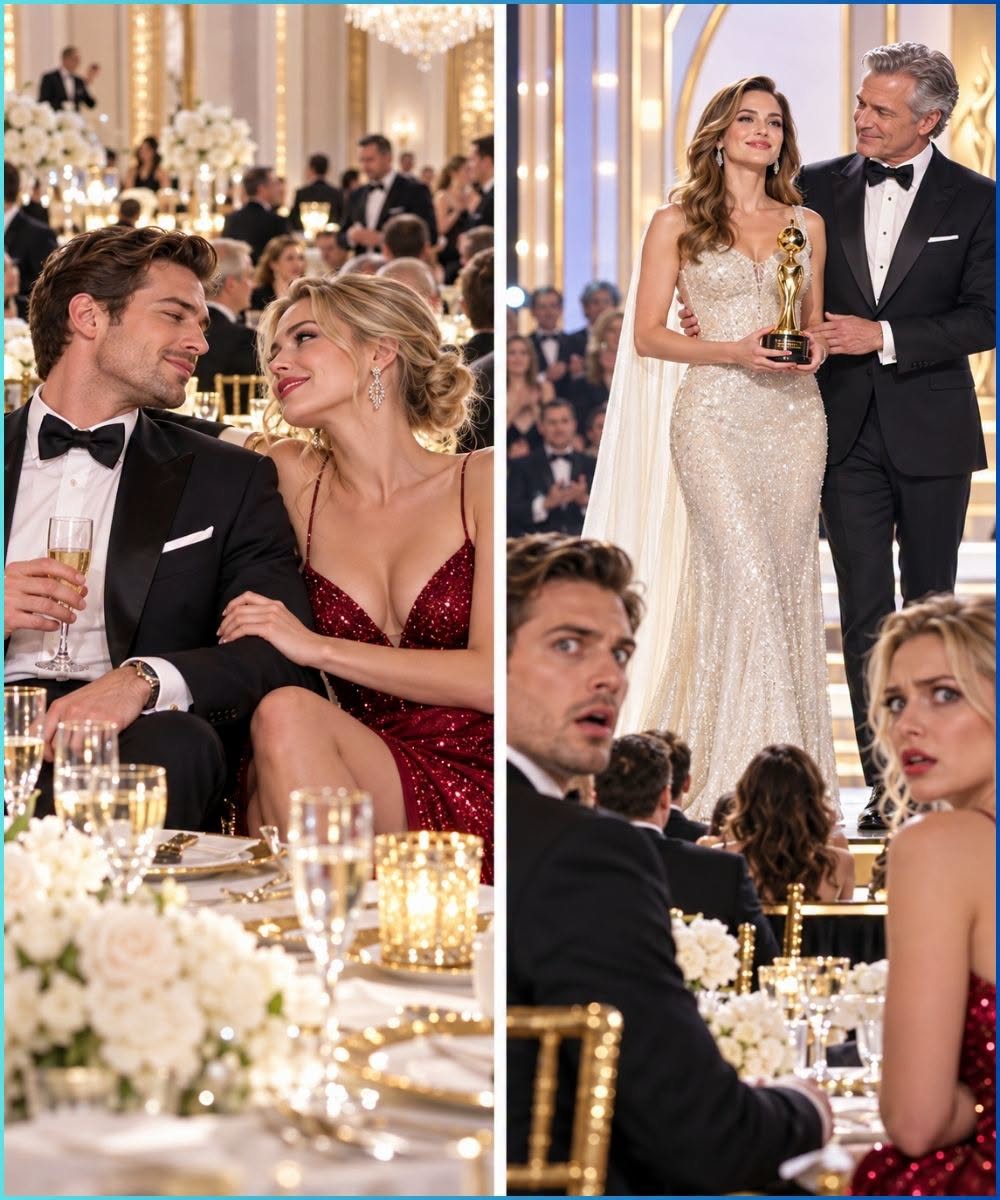
The National Civic Design Awards gala was held in a ballroom Claire had only ever seen in photographs, and the first thing she noticed was how loud it was. Not loud with music, although there was music, but loud with the particular sound of people who have dressed carefully and are determined to be seen talking to the right people. Chandeliers threw light across white tablecloths. Waiters moved with the practiced invisibility of people who have learned not to interrupt important conversations. Somewhere near the entrance, a photographer was arranging guests into groups that would look, in tomorrow's photographs, like natural gatherings of friends.
Claire arrived with Tessa and Eleanor, wearing a dark blue dress she had bought for herself, not for Evan, not for a photograph, but because it made her feel like herself when she looked in the mirror. She had not told Evan she was a finalist. She had not told him she would be there. She had not, in fact, spoken to him since the conversation in the kitchen, except through Priya about practical matters. She did not know if he would come. She knew, from the invitation list Tessa had seen, that Mercer Development Group had tickets, and that Vanessa would be handling introductions.
She did not spend long wondering about it. She spent the first hour doing what she had always done at professional events: talking to people about buildings, about neighborhoods, about the unglamorous details that made a project work. She talked to an architect from Detroit about land trusts, to a city planner about stormwater, to a young designer who told her, shyly, that Harborlight was the reason she had stayed in civic architecture instead of leaving for luxury condominiums. Claire thanked her, and meant it, and tried not to think about how many times Evan had told her that no one would care about public housing.
Then she saw them.
Evan was near the bar, in a suit that fit him perfectly, talking to a man Claire did not recognize, with Vanessa beside him in a dress that caught the light every time she moved. Vanessa was doing what she did best: smiling, touching Evan's sleeve lightly, making introductions sound like favors. For a moment Claire felt the old, familiar pull to make herself smaller, to move to another part of the room, to avoid a scene. Then she remembered that she was not a guest at Evan's event. She was a finalist at an awards gala for work she had done. She stayed where she was, finishing her conversation, and let Evan find her, or not find her, on his own terms.
He found her during the reception, and his face, when he saw her, went through several expressions so quickly that Claire could not have named them all if she had tried: surprise, confusion, calculation, and then a bright, public smile that did not reach his eyes.
"Claire," he said. "I didn't know you were coming."
"I am a finalist," she said simply.
Vanessa's smile froze for half a second. Evan laughed, a short, disbelieving laugh, as if Claire had told him a joke he did not quite understand.
"A finalist? For Harborlight?"
"Yes."
"But —" Evan began, and then he seemed to remember where he was, and who might be listening, and he lowered his voice. "You should have told me. We could have coordinated. Vanessa has been trying to get us an introduction to Whitmore all evening."
Claire looked at Vanessa, who was watching her with the careful attention of a woman reassessing a situation she had thought she understood. Claire did not feel triumphant. She felt tired, and also, strangely, free, because she no longer needed Evan to understand the size of what she had done in order for it to be true.
"I didn't tell you," she said, "because Harborlight is not a Mercer project, and this is not a Mercer evening. It is an awards gala. My firm submitted the work. I am here with my firm."
Before Evan could answer, Adrian Cole approached, with Graham Whitmore a step behind him. Claire had not expected Graham to seek her out in a ballroom, and she braced herself for an awkward moment. Instead, Adrian spoke with the same professional clarity he had shown in the conference room.
"Mr. Mercer," Adrian said, after greeting Claire and her colleagues, "I understand you were hoping to speak with Mr. Whitmore about Mercer Development Group. I wanted to save you a misunderstanding. The foundation's civic investment review is focused on projects submitted through their design teams, with independent evaluation. Harborlight Commons is under review as a Bennett & Rowe project, led by Ms. Mercer. It is not a Mercer Development Group project, and it would not be appropriate to discuss it as one."
It was not a loud statement. Adrian did not raise his voice. He did not look at Vanessa. He simply stated facts, in a room full of people who understood facts, and the effect was immediate. Evan's public smile wavered. Vanessa stepped back, just slightly, as if she were distancing herself from a conversation that had stopped being advantageous. A nearby investor, who had been listening with the polite attention of a man deciding where to put his money, turned to Claire with new interest.
"Ms. Mercer," he said, "is that your courtyard project? The one with the land trust?"
"Yes," Claire said. "Harborlight Commons."
Graham Whitmore did not make a speech. He did not praise Claire in front of the room, which Claire was grateful for, because praise from him in that moment would have looked like favoritism and would have undermined everything she had said about wanting an evaluation on the merits. He simply shook her hand, wished her well for the evening, and moved on to speak with the awards committee. His restraint, Claire realized, was a kind of respect. He was refusing to turn her work into a story about him.
The awards ceremony began an hour later. Claire sat between Tessa and Eleanor, her hands folded in her lap to keep them still. The presenter spoke about civic design, about buildings that served people who would never attend a gala, about the difference between a landmark and a place that remained useful long after the photographs were taken. Claire thought about Elena Alvarez, about Marcus and Rosa, about six months of meetings in which she had said nothing and learned everything. She thought about the townhouse, the ring in its dish, the spare room at Tessa's, and the document she had started the night she decided to stop pretending.
When the presenter announced the award for civic impact, she read the citation slowly.
"For a project that began by listening, that protects affordability by design rather than by promise, that brings healthcare and childcare to the ground floor of a neighborhood that asked for them, and that treats flood protection as a responsibility to surrounding streets, not only to itself — Harborlight Commons, by Claire Mercer of Bennett & Rowe Architects."
The room applauded. Tessa grabbed Claire's hand. Eleanor, who rarely showed emotion in public, put a hand on Claire's shoulder and said, "Go on, then."
Claire walked to the stage. The lights were bright. The chandelier above her threw small, shifting patterns across the floor. She looked out at the room, and for a moment she could not see individual faces, only a sea of people in evening clothes, waiting to hear what a woman who had designed affordable housing would say at a glamorous event.
She did not talk about Evan. She did not talk about betrayal, or about the hotel, or about the deck that had borrowed her courtyard. She talked about the neighborhood. She thanked the residents who had taught her what Harborlight needed, naming Elena Alvarez, and the parents, and the disability advocates, and the small business owners who had trusted her enough to tell her the truth about their lives. She thanked Tessa and Eleanor, and the team at Bennett & Rowe. She said that architecture, at its best, was not about changing the world with pretty buildings, but about solving problems people had been forced to live with, and then getting out of the way so those people could live their lives in the buildings.
She did not look at Evan while she spoke. She did not need to. She could feel, in the silence of the room, that the story had changed. Not because she had humiliated her husband, but because she had finally, in public, in plain language, been seen for what she had actually done.
When she walked off the stage, holding the award, Tessa hugged her so hard that Claire laughed. Eleanor said, "Well done," in a voice that sounded suspiciously unsteady. And across the room, near the bar where he had stood earlier, Evan was watching her, alone now — Vanessa had moved away to talk to another group — with an expression Claire had never seen on his face before.
It was not anger. It was not admiration, exactly. It was recognition, late and incomplete, the look of a man who had just understood that the woman he had described as sweet, and talented enough, and someone who would adjust, had been, all along, the most serious person in the room.
After the ceremony, the ballroom loosened into the kind of milling, celebratory crowd that forms when formality ends and people finally allow themselves to be pleased. Rebecca Lawson found Claire near the stage, shook her hand, and said, with the careful precision of a woman who understood process, "The committee's decision was unanimous, and it was made on the submission, not on tonight's speeches. I wanted you to hear that from me." Claire thanked her, and felt a weight she had not named lift slightly: the award was not a favor, not a consolation, not a story about a powerful man. It was a decision, documented, made by people who had read the work.
A young designer from the reception approached her again, this time with two friends, and asked Claire how she had kept the land trust in the project when, as the young woman put it, "everyone must have told you to drop it to make the numbers work." Claire answered honestly: people had told her that, more than once, and she had kept it because dropping it would have changed what Harborlight was, not just how it was financed. "A building can be beautiful and still displace the people it was supposed to serve," she said. "If you lose the affordability lock, you have not simplified the project. You have built a different project, with the same name."
Evan tried to speak to her backstage, in the corridor where the lights were less flattering and the noise of the ballroom faded to a hum. He began with congratulations, and Claire accepted them, briefly, because they were, in that moment, appropriate. Then he began to move, as he always did, toward the practical question: what this meant for Mercer, whether she would introduce him to Adrian, whether they could present a united front to investors now that the award had changed the conversation. Claire stopped him, gently, before he could build a plan on top of her evening.
"Evan, tonight is not a negotiation," she said. "I am happy to talk about practical matters, through Priya, when we are both calm. I am not going to turn an award for Harborlight into a meeting about Mercer. Harborlight is separate, and it will stay separate."
He nodded, and for a moment his face showed something Claire had rarely seen: not calculation, but simple tiredness. Vanessa, who had been waiting near the corridor entrance, touched his arm and said something low about leaving, and they left together, not in triumph, not in scandal, but in the quiet way people leave a room where they have discovered they are not the main characters.
Tessa found Claire afterward, holding two glasses of water, because Tessa knew that after an evening like that, water mattered more than champagne. "You did not look at him during the speech," Tessa said.
"I know," Claire replied. "I was looking at the room. And at Mrs. Alvarez, in my mind, sitting in the front row of a church hall, asking for a clinic. That was who I was speaking to."
Claire did not go to him. She did not need his recognition to make the award real. But as she stood beneath the chandeliers, holding a piece of glass and metal that weighed less than the model of Harborlight she carried in her mind, she understood what the night had actually given her. Not revenge. Not a reversal. A record, made in public, that could not be cropped, or re-captioned, or presented as someone else's design leadership.
The wife he had forgotten to see had been seen, finally, by a room full of strangers. More importantly, she had seen herself, and she was not going back to being unseen.
TITLE: The Wife He Forgot to See