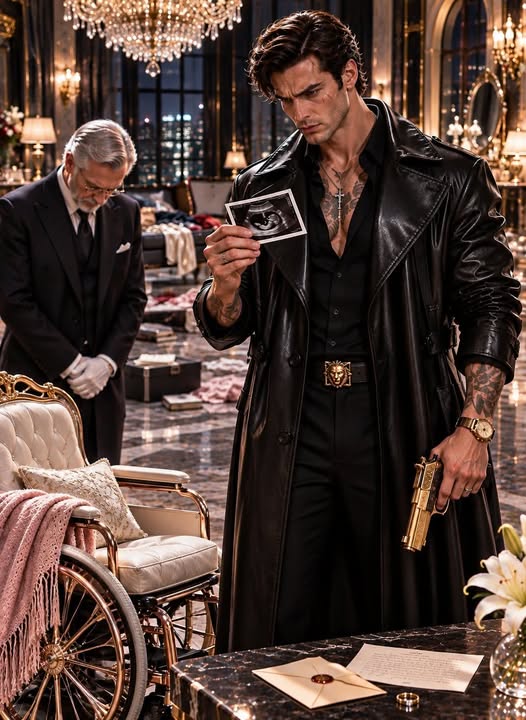
The cruelest words a wife can hear did not come from an enemy. They came from my husband's mouth, in his own house, on the happiest day of my life — and he said them to another woman while I sat outside his office door with our baby's first picture resting in my lap.
That morning, Dr. Patel had turned her monitor toward me and smiled. "Five weeks and four days, Mrs. Vale. Small, but strong. See that flicker? That's the heartbeat."
I stared at the tiny pulsing grain of light until my eyes blurred. Six years of marriage. Six years of Adrian and me telling each other that children simply weren't part of the plan we'd been given, that we were enough. And all that time, some quiet part of me had been grieving a door I believed was locked — locked by the same accident that had taken my legs and rearranged my entire life.
Now the door was open.
I asked the nurse to print three copies of the ultrasound. I held the warm envelope against my heart the whole drive home, planning. I would not text him. I would not call. Adrian Vale, thirty-nine years old, the most feared man in Chicago, a man who could walk through a room of armed rivals without changing expression — I wanted to see his face when I put that picture in his hands. I wanted to watch the ice crack.
On the way, I made the driver stop at a little engraving shop on Michigan Avenue, the kind with brass bells over the door. I bought a plain silver keychain, heavy in the palm, and had them stamp one word into the metal.
DADDY.
I laughed in the back seat like a teenager. I cried a little, too. The envelope and the keychain box rode side by side on my lap, and I rehearsed sentences all the way up the long private drive. *Adrian, we're having a baby. Adrian, in about seven months— Adrian, look. Just look.*
Our mansion sat behind gates and old trees, more fortress than home, and I had spent six years softening it — music in the mornings, flowers Rosa the housekeeper pretended not to buy with her own money, a garden I'd redesigned so every path fit my wheelchair. It was mine as much as his. I believed that. I believed it right up until the last ninety seconds of my marriage.
"Mr. Vale is in his office, ma'am," Rosa said, meeting me in the hall. Her eyes dropped to the envelope. Rosa missed nothing. Her whole face changed. "Oh, Mrs. Vale. Oh, my dear."
"Don't you dare cry before he does," I whispered, and she pressed both hands over her heart and nodded like a co-conspirator.
The west wing of the house was the old part, all dark wood and tall windows, and my wheels knew every board of it. I had designed my routes through that house the way generals design campaigns — the kitchen at seven, the library after his meetings, the garden doors thrown open whenever the weather allowed — and Adrian, who had built his fortune reading terrain, had learned them all in the first month of our marriage and arranged his life around them without ever being asked. His office door was the one threshold in the house I never crossed uninvited. That was his rule, made after a rival once tried to reach him through a secretary: *business stays behind that door, so that everything outside it stays clean.* In six years I had honored it so completely that stopping outside it that afternoon felt, even to me, like a small ceremony.
I had the whole announcement rehearsed. Not in the office — I wasn't a fool, and I knew Celeste or someone was always drifting through his workdays — but at lunch, in the garden, at the little iron table where he'd once taught me to play chess and lost with extremely poor grace. I would put the envelope in his hands. He would open it. And then I would watch the most guarded face in Illinois learn that it was allowed to be happy in public. I had even chosen my sentence. *Adrian, the doctor says five weeks and four days. Look — that's the heartbeat. That's ours.*
Outside the office, the corridor was quiet in the particular way of rooms where sound is being kept in. I could hear the low murmur of a meeting winding down — papers, the click of a pen, Celeste's laugh doing its bright, social work. I raised my hand to knock with the envelope balanced on my knees and a smile already forming, the way you smile a half-second before a door opens on people you love.
It is astonishing, the rest of my life will always insist, how much can be on one side of a door.
"He has Miss Rowan with him," she added. "Foundation business."
Celeste Rowan. Thirty-six, polished as glass, daughter of the man whose family had kept the Vale books for forty years. Celeste ran our charitable foundation, which gave her a key to the house's calendar, a seat at our table, and — I understood much later — a map of every door in my life. That afternoon she was just an inconvenience. I decided not to wait. I would knock, she would leave, and Adrian would learn he was a father before lunch.
The office door was half closed. I stopped my chair outside it, one hand raised to knock, the ultrasound envelope balanced on my knees.
Celeste's voice reached me first, low and sweet as syrup. "If you don't love your wife, Adrian, why are you still married to her?"
My hand froze in the air.
"Because she saved you?" Celeste went on, gentle as a knife sliding between ribs. "Is that it? You stay because she saved your life?"
Then my husband answered. Calmly. Clearly. The way he answered everything.
"I owe her my life, not my love."
The hallway tilted. Not metaphorically — my body actually swayed, and my fingers clamped so hard around the envelope that it bent. Through the narrow gap of the door I could see a slice of the room: the edge of his desk, his hand flat on the wood, and Celeste rising from her chair and coming around it. She moved into the slice of my vision and did the thing I had never once, in six years, seen another woman do.
She put her arms around my husband.
And Adrian — who had broken a man's wrist for touching his sleeve without permission — did not push her away.
Every insecurity I had buried under six years of being loved, I had thought, rose up in one suffocating wave. Because wasn't it possible? Wasn't it the story everyone in his world already whispered? The boss married the cripple who'd jumped in front of a car for him. A debt with a wedding ring. He'd stayed because honor demanded it, paid the bill every day with patience and ramps and a ground-floor bedroom, and counted the cost in silence. Six years of wishing he were free.
I thought of the night it happened. A restaurant valet stand, rain on the pavement, headlights swinging wrong. I was a trauma nurse coming off a double shift, nobody to him, and I saw the car before he did and I moved — I remember deciding, clearly, in one bright second, that the stranger in the black coat was not going to die in front of me. I woke in a hospital three days later with a spine that had finished its work. Two surgeries. Fourteen months of rehabilitation. Learning to dress, to transfer, to live at a different height from the world.
Adrian had visited every day. Adrian had filled my room with ridiculous flowers and sat through my rages and my grief without flinching, and eight months later, in the hospital garden, with my chair decorated in white roses, Adrian Vale had asked me to marry him. I had believed the garden. I had believed all of it.
Maybe the garden had been a receipt.
I did not knock. I did not confront him. I had survived an operating table twice and rebuilt my body from nothing, but I was not strong enough to sit in that doorway and watch my husband explain to me, kindly, that I had misunderstood the arrangement. I turned my chair around. The wheels made no sound on the runner. The envelope stayed in my lap, and the silver keychain in its little box felt like it weighed twenty pounds.
In our bedroom I packed one suitcase. Clothes for a week. My medication. My wheelchair charger. Nothing else — not the jewelry he'd given me, not the cards with his name embossed under mine, not the dresses bought for a life of galas. A woman leaving a marriage built on pity does not take the pity with her.
On his desk I placed three things in a row, neat as an accounting.
My wedding ring.
A cream envelope containing the ultrasound photograph and the printed report: *pregnancy, five weeks and four days.*
And a folded note with four words inside.
Your debt is paid.
Forty-seven minutes later, an accessible transport van pulled quietly to the mansion's side entrance — the entrance with my ramp, the one his men never watched because nothing dangerous was ever expected to come or go through it. The driver, a kind-eyed man named Walter, helped secure my chair and glanced at the single suitcase.
"Are you sure you've got everything, miss?"
I looked back at the house — the windows lit gold, the garden I'd planted at knee height so I could reach the soil, the whole beautiful fortress of my supposed life. Then I rested my palm flat against my stomach, where a heartbeat the size of a grain of rice was flickering away, strong and entirely unaware.
"No," I whispered. "But I have what matters."
At 10:18 that night, Adrian Vale came home and knew within four steps that his house was wrong.
No music. Gia always played music in the evenings — old soul records, low — and the silence had a texture he felt in his teeth. Her blanket was gone from the reading chair. Her charger was gone from the wall. The bedroom door stood open on a room that looked, somehow, already like a photograph of somewhere he used to live.
Then he saw the desk.
He picked up the ring first, because it made the least sense. Then the note. Four words, in her handwriting, the handwriting that labeled his tea tins and left notes on his pillow when she fell asleep before he came home.
*Your debt is paid.*
The envelope was last. He opened it standing up, and the ultrasound photograph slipped out of the report and into his hand, and the most feared man in Chicago sat down very suddenly in his desk chair because his legs had simply stopped consulting him.
Five weeks and four days. A heartbeat. A date circled in the nurse's handwriting. And at the bottom of the report, in the space for the patient's name: *Gianna Vale.*
He called her phone eleven times in nine minutes. Every call went to voicemail. Her voice, bright and recorded, said *Hi, you've reached Gia — you know what to do,* and he stood in the middle of the silent room saying her name to a machine.
Within minutes he was downstairs with his jaw set like a man going to war, demanding that security explain how his wife had walked out of a guarded house. Marcus, his head of security, pulled the footage with white knuckles: the side entrance, the van, his wife alone, lifting her chin at the gate camera in a way that made Adrian's chest seize — she'd *known* it was there. She'd wanted him to see that she left on her own power, under her own flag.
His financial manager, woken and terrified, confirmed the rest like a man reading a eulogy. She had touched nothing. Not the joint accounts. Not the medical fund. Not the emergency cash in the bedroom safe, the money he'd put there years ago *in case she ever needed to run from his world.*
She'd run from *him* instead, and she hadn't taken a single dollar of his with her.
Adrian stood in the doorway of the empty bedroom, the ultrasound photograph crushing slowly in his fist, when a soft voice spoke behind him.
"Maybe you should let her go."
Celeste Rowan stood in the doorway of his bedroom — his *bedroom* — in the middle of the night, composed as a portrait, and something in Adrian finally looked at her properly, the way he looked at things he was about to take apart.
"Did you know she was pregnant?" he asked.
Celeste went the color of paper. "No."
"Did you know she was leaving?"
"No."
His voice dropped to the register that had emptied rooms across three states.
"Then why the hell are you here?"