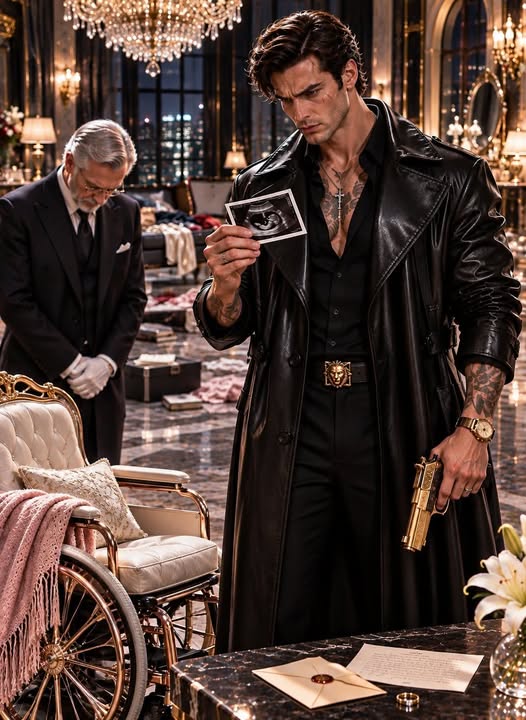
Adrian did not sleep. Men like him were trained out of panic the way soldiers are trained out of flinching, but there is a specific and ancient terror reserved for the moment a man discovers that the person who anchors his entire life has removed herself from it surgically, silently, and with better planning than any of his enemies had ever managed.
He began with Celeste, because she was there, and because a woman does not appear in a man's bedroom doorway at midnight with a eulogy prepared unless some part of her has rehearsed the evening.
"Talk," he said.
Celeste composed herself the way she did everything — beautifully, and a half-second too late to be believed. The foundation's quarterly review had run long. She'd been working in the library. She'd only come upstairs because she'd heard shouting and been concerned.
"You heard a silent house," Adrian said, "and came to my bedroom to be concerned."
"Adrian, you're distraught. You're not thinking—"
"I am thinking with perfect clarity for the first time in months." He set the ultrasound photograph on the desk between them like a drawn weapon. "My wife heard something in my office today. Something that ended my marriage in ninety seconds. You were the only other person in that room. Begin again."
Her eyes flicked to the photograph. Whatever she saw in his face then ended her performance; her shoulders came down a fraction. "I asked questions any friend would ask. *You* answered them, Adrian. If your words drove her away, perhaps you should examine your words."
It was, Marcus would tell him later, the moment Celeste Rowan made her fatal error — not lying, but telling a sliver of truth and trusting it to hold. Adrian went very still. She saw it. She gathered her bag and left with her head high, and the door had barely closed behind her before Adrian turned to Marcus and said, "Everything. Her calls, her calendar access, her movements for a month. Quietly."
Then he did something Chicago's underworld would not have believed: he walked into his office, closed the door, and sat in the dark in the chair where his wife had nearly knocked, and he replayed it. Celeste's syrup questions. His own voice. *I owe her my life, not my love.* Standing alone in the room, he could hear what Gia had heard — the flat finality of it, amputated from everything that came after. His stomach turned over. He had spoken the first half of a sentence like a man reading from a script someone else had written for him, and the other half — the half that mattered, the half that had been aimed like a blade at Celeste and everything she'd been implying for months — had still been in his mouth when Gia's world ended on the other side of the door.
He found the exact place on the hallway runner where her chair had stopped. He stood there a long time.
By dawn the machinery of the Vale organization was turned, all of it, to a single purpose. Not retaliation. Not a rival. A five-foot-four trauma nurse in a wheelchair with one suitcase and a four-word grievance, who had committed the most successful extraction from Adrian Vale's territory that anyone had ever performed.
The rideshare company surrendered its records to a phone call. Walter, the driver, was located by nine. He described the passenger who had paid in cash and cried without making a sound, and the drop-off: a brick building in Pilsen, a wellness clinic with a blue awning, an address he remembered because she'd asked him twice to confirm it had a ramp.
"She kept saying the number," Walter told Marcus, in a coffee shop, with his cap in his hands. "Like she was memorizing being somewhere else."
Adrian was already in the car.
But Pilsen was only the first thread, and Gia — who had planned her exit with a nurse's precision — had not stopped moving. The clinic belonged to Dr. Lena Ortiz, her physical therapist from the rehabilitation years, the woman who had taught her to transfer from chair to bed and bed to chair and who had once, famously, thrown a sponge at Adrian for hovering. Lena's staff were loyal and unimpressed by money. The clinic's manager informed Marcus, with enormous pleasure, that patient information was confidential, that Mrs. Vale was not a patient, and that if Mr. Vale wished to leave a message he could write it on the card provided.
Adrian wrote on the card. His hand — the hand that had signed a thousand ruinous documents — was not entirely steady.
*I didn't finish the sentence. Please let me finish the sentence. — A.*
It was, in its way, the most honest document Adrian Vale had ever produced, because the whole six years sat inside it. He had met his wife as a stranger's hands shoving him out of a car's path and a woman's body going under the lights in the rain. He had sat beside her hospital bed through the first surgery, and the second, and had read the surgeons' faces when they came out the second time and understood, before anyone said a word, the size of the bill the universe had handed her for his life. He had done the arithmetic a thousand times, in the small hours: her legs, her career, her whole first life, for his. And he had done the other arithmetic too, the one nobody believed: he'd have married her if she'd saved a kitten. He'd have married her if she'd never saved anything at all, if she had simply been the furious, funny trauma nurse who'd spent her unconscious weeks being described to him by her colleagues — *Gia would hate this music, Gia would have opinions about that surgeon* — until he was half in love with a woman he had never had a conversation with, and entirely unable to leave the building.
The proposal in the hospital garden had not been guilt. He had rehearsed it for a month. He had terrified a jeweler. He had stood in that garden with his heart slamming like a boy's and asked, and she had cried and said yes, and then immediately made him promise never to bring her white roses again because they reminded her of the hospital gift shop, and he had laughed with his face wet and thought: *there it is. That's the whole rest of my life, and it just laughed at me.*
He thought of that afternoon, standing in Pilsen with the card in his hand. He thought: *if she never reads another word from me, let it be the true ones.*
He left instructions that the building was to be watched from a distance great enough to honor the word *space* and close enough that nothing on earth would reach her. "Nothing touches her," he told the two men he trusted most. "Nothing frightens her. If she so much as looks cold, I want to know before she does."
Before the card, before the search widened, he had done the first and worst of the work himself: the footage, frame by frame, in the security office at 4 a.m., with the night operator dismissed and the monitors washing him blue. He watched his wife cross the hall he'd walked a thousand times. He watched her stop at a door he had forbidden her — his own rule, his own architecture of secrecy, indicted in silence. He watched her face at the moment of the sound he could not hear on the recording, watched her hand come up off the wheel rim, watched the exact frame where six years ended. He watched her turn the chair with a precision that broke him more than any tears could have: no fumbling, no collapse. A woman withdrawing from a position she had concluded was untenable. *Military,* some trained part of him noted. *She did it like a retreat under fire.* He made the operator — recalled, trembling — burn him a copy, and then he asked the question that started the second investigation, the one that would eventually unmake Celeste Rowan: "Her appointment that morning. The prenatal clinic. Who in this house, besides me, could see her calendar?" The answer was a list of four names. One of them was the foundation's.
Then he went home and did the rounds of a man auditing the wreckage of his own house. The financial manager's report lay on his desk, and he read it three times: *no transactions.* She had left tens of millions unguarded within arm's reach and taken a suitcase of clothes. Rosa, dry-eyed with fury, served him coffee he didn't drink and said the thing nobody else in his employ would have dared.
"You kept that Rowan woman in this house like a snake in the linen closet, Mr. Vale, begging your pardon. Mrs. Vale fed this family with her own hands and I've watched that woman watch her. Cats look at birds, sir, with more charity."
"Noted, Rosa."
"And you let her *hug* you." Rosa set the pot down with a crack. "In fourteen years of service I have never once seen you let anyone but that girl within arm's reach. If I'd been in that hallway—" She stopped. "Well. I wasn't. More's the pity for all of us."
The search, meanwhile, had the flavor of a siege conducted against a ghost. Her phone stayed dark. Her old colleagues at the hospital, canvassed with exquisite discretion, reported a beloved former nurse who had sent Christmas cards and attended no reunions. A college roommate in Milwaukee took Marcus's call, listened to the carefully edited version of events, and said, "If Gia left, she had a reason, and if you find her before she's ready, I will personally drive down there and sit on you," and hung up. Adrian, informed of this, had remarked that his wife had always collected formidable women the way other people collected stamps, and to leave the roommate alone and send her flowers.
Hospitals were checked, quietly, in widening rings — because the other fear, the one beneath the search, was of a call that would begin with *we regret.* Twice that first night Adrian had his coat on for unconfirmed reports; twice he came back up the stairs alone and stood in the bedroom doorway looking at the desk he could not stop looking at. He had the note framed. Not displayed — framed, in a plain black sleeve, and put in his desk drawer on top of the ultrasound report, because he said the two documents belonged together and because, as he told Marcus in the only explanation he ever offered, "A man should keep the worst thing he's ever read where he keeps his orders. So he reads it before he gives any."
That night, at 10:18 precisely, Adrian did something he would do every night for as long as she was gone, though no one told her for a long time. He went to the bedroom where her records were still stacked by the turntable, and he put on the soul album she'd been playing the evening before she left, and he sat in her reading chair, which was built for a woman a foot shorter than him, with his knees up like a boy, and he listened to the whole thing in the dark.
He read the note again by the turntable's amber light. *Your debt is paid.* He turned the ring over and over in his fingers, and he made a decision that would have terrified the men who feared him, had any of them understood it.
"Whatever it takes," he told the empty room. "Whatever she asks. Whatever I have to burn."
He did not yet know that across the city, in a small accessible apartment above a blue-awninged clinic, Gia was lying awake with one hand on her stomach and her phone face-down in a drawer — and that she had already heard, on the clinic's old television, a local news alert about a black-market ultrasound clinic raid that had nothing to do with her at all, and had still begun, immediately, to be afraid of what her husband's world might do now that she was outside its walls.
Fear, as it turned out, was justified. But not in the way she expected — because Adrian's men weren't the only ones who had noticed that the Vale boss's wife had vanished.
Someone else had been counting the cars at the gate.
And that someone had already sold what they knew.