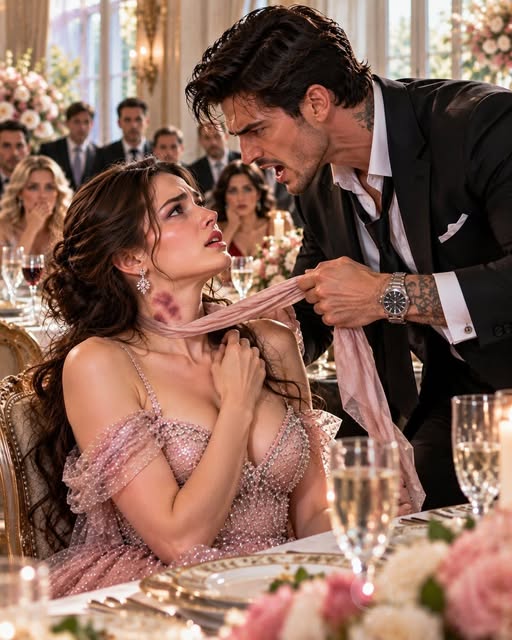
People who have never planned a wedding believe the stressful part is the flowers.
For three weeks, this family let Vivienne Castellano plan a murder at mine.
That was the cold heart of Luca's strategy, and there were nights I lay awake wondering if he had inherited more of this family's ice than I'd understood. Every detail proceeded exactly as scheduled. The dress fittings. The tastings. The rehearsal at St. Patrick's, where Vivienne glided through the candlelit nave with a clipboard and fussed over the placement of the quartet — the quartet, as it happened; Luca had decided it himself and had not consulted me again, and when I understood he had chosen his mother's music over his father's, I had to go and stand in the garden for a while. Aunt Vivienne pinned a sprig of orange blossom in my hair at the rehearsal with hands as steady as a surgeon's, and kissed my cheek, and told me I would be the most beautiful bride the family had ever seen, and I smiled into her powder-soft face and said I hoped the day would be everything she had planned.
She agreed that it would be.
What she did not know — what only five living people knew — was that her own planning had been quietly unwound and rebuilt beneath her hands like a stage set with the nails pulled out. The routes in red pen now belonged to us. The limousine company she had chosen so carefully had been bought, outright, by a DeSantis holding firm eleven days before the wedding, drivers and all. The "cousin" flying in from Chicago to read a blessing was a federal marshal's former partner whom Russo had known in another life, and the service weapon under his morning coat was licensed in three states. The priest — dear old Father Alban, who had baptized Vivienne herself — had been told, in confession-sealed confidence, exactly one thing: if there is a disturbance, Father, keep reading the service. Whatever happens, do not stop the Mass.
"You understand what you're asking me to consent to," I said to Luca, the night before the wedding, standing in my dress bag's shadow in the bridal suite while the house settled around us. "Tomorrow I walk down that aisle as bait wearing eight yards of silk."
"Yes," he said.
"And if your five people are wrong — if she's faster, or smarter, or there's a sixth person nobody counted—"
"Then I will have spent the rest of my life wishing I'd locked you in a room in the Hamptons with Russo and a month's books, which is plan B, and which you vetoed." He crossed the room and took my hands, and his were not steady, and I loved him so fiercely in that moment for not hiding it. "Elena. Tell me now and we vanish. Tonight. A car, a plane, a priest in Nevada with no questions. The family can keep its war. I keep you."
It was the only time he ever offered me the door. I want that remembered, about him. Whatever else the world says of Luca DeSantis — and the world says plenty — the night before our wedding he offered to burn his whole inheritance to the waterline rather than walk me down that aisle into a trap, even a trap of our own building.
I said, "She taught you to tie a tie. She held your mother when you were born. She sat at our table and called me daughter, and the whole time she was selling your funeral to the Rinaldis by the pound. If we run, she wins the family by default and buries it inside a generation. I am not a door, Luca." I lifted my chin. "Tomorrow I am a wall. Walk me down the aisle."
There is a coda to that night that belongs in this chapter, because the plan very nearly didn't survive it.
At two in the morning — seven hours before I was due to walk down the aisle — I woke in the bridal suite to find the lights on in the sitting room and Russo standing in the doorway with the expression of a man about to do something he has already decided to apologize for. Behind him, white-faced, was the wedding's own florist, a gentle Milanese named Ottavio who had arranged flowers for two popes, and who was now explaining at high speed, in three languages, that the last delivery of altar flowers — the white roses and the orange blossom, arriving that morning by the service door — had come from a wholesaler his firm did not use.
The cases had been opened in the kitchens under Russo's eye. The flowers were real. So were the two flat, waxed-paper packets sewn into the lining of the third case, each containing a disassembled pistol in oiled parts, and the extra usher's jacket, and a printed plan of the organ loft with the sightlines marked in that same elegant handwriting.
"She expected the loft to be turned away at the rehearsal," Russo said. "So she sent the weapon in with the flowers, to be assembled in the loft in the morning. A second man. Insurance." He looked at me standing in the doorway in my robe, with my wedding dress hanging shrouded on the wardrobe door like a ghost waiting its turn, and his voice gentled by exactly one degree. "The question, ma'am, is whether we call it now and burn the whole plan tonight, or whether we let the man come for his weapon in the morning and take him with the parts in his hands."
Luca was awake by then and standing beside me, reading the organ loft plan over Russo's shoulder, and the two of them looked at me — me, the bride, the bait, the person the gun in the flowers had been sent for — and waited, with the entire weight of the family's machinery held politely in check, for the injured party to do her arithmetic.
"Let him come," I said. "If we burn it tonight, she knows she's blown, and a woman like Vivienne doesn't surrender — she improvises, and she'd improvise at my wedding with something we haven't thought of. But a man walking to a flower case he's been promised is there—" I nodded at the diagram in Luca's hand, at the clean, elegant, doomed geometry of it. "He's already inside the story she wrote. Let him finish walking into it. Then Russo owns him before the first guest sits down, and her insurance policy becomes our evidence."
Russo looked at Luca. Luca looked at me for a long moment, and something passed across his face that I have since learned to identify as the specific expression of a DeSantis discovering, again, that he has married correctly in advance.
"You heard the lady," he said. "Set the case back exactly as it was. Every petal. And Russo — the man is to be taken breathing, and gently, and before the organist arrives. I want him having coffee with the police by the time my wife's car leaves this house."
That is how the wedding morning began: with a trap inside a trap, and the bride directing traffic.
The wedding day dawned the color of champagne.
I will not pretend I wasn't frightened. But fear, I had learned in that house, is just information, and my information was good: five people, three weeks, one trap. I walked down the aisle of St. Patrick's on Marco Bellini's arm — Vivienne's suggestion, originally, the right hand giving away the bride, a pretty piece of symbolism she had designed when she still thought Marco would be disgraced by now — and two hundred guests rose, and Luca turned at the altar, and whatever else happened that day I had that: his face, unguarded, in the candlelight, in front of everyone he had ever feared or ruled, looking at me like a man seeing shore.
We got as far as the vows.
I said my part first, because tradition in that church puts the bride first, and my voice carried to the back pews without a tremor. Then Father Alban turned to Luca, and Luca took both my hands, and the whole church heard him begin: "I, Luca, take you, Elena—"
The shot, when it came, was not loud. That is the thing civilians get wrong. In a stone church full of people it sounded like a book dropped on marble.
It did not come from the congregation. It came from the organ loft, where no one should have been but the organist, and its target was never Luca — that was Vivienne's final refinement, the one her red pen had been saving: not the groom, standing ready, guarded by his own instincts. The bride. The outsider. The unprotected girl whose death on the altar steps would break Luca DeSantis in front of two hundred witnesses and leave the family headless with grief exactly when the Rinaldis moved.
The bullet took the sprig of orange blossom out of my hair and a lock of hair with it, and buried itself in the altar flowers, because in the half-second before it, a man in a morning coat in the third pew — the "cousin from Chicago," may God bless his other life's training — had stood up into the aisle with his own weapon raised and fired at the loft, not to hit but to spoil, and spoiling was enough. The organ loft erupted. Ushers who were not ushers moved like water. Russo's people came out of the sacristy and the side chapels with the terrible calm of men who have been waiting three weeks to be allowed to do exactly this.
And in the front pew, Vivienne Castellano rose to her feet with her hand at her throat and her face the color of candle wax, and looked — not at the loft, not at the gunmen being walked down the aisle with their hands laced on their heads — but at me. At the bride standing whole and unbloodied at the altar, with a torn veil and a fistful of orange blossom on the marble at her feet.
I looked back at her. I raised my chin so the whole church could see the last fading shadow of the bruises on my throat — I had refused concealer that morning, and every woman in that congregation understood why.
The man they brought down from the organ loft was young — that was the worst of it, younger than Adrian, with a split lip from the stairs and a face already rehearsing whatever story he had been paid to believe. He did not get to rehearse it long. In the side aisle, surrounded by men in morning dress who had produced credentials of several different and mutually surprising kinds, the young man understood in stages where he was and what the morning had actually been, and I watched the understanding arrive: at the florist, already in a police car with his delivery manifest; at the second pistol, still sewn in waxed paper in a flower case in the cathedral kitchen, where Russo had taken the morning's earlier visitor with the parts of it literally in his hands; at the whole bright machinery of the day, which had never once, from the moment I said let him come, been pointed anywhere but at him.
"She said the family would thank us," he said, to no one in particular, in the tone of a man reading a sign in a language he has just realized he cannot speak. "She said we were saving the DeSantis name."
"She says a great many things beautifully," said the cousin from Chicago, not unkindly, and walked him out through the sacristy door into the custody of the waiting detectives, past the wedding guests who would dine out on the morning for the rest of their lives and never once tell it the same way twice.
I remember the silence after. Stone churches hold silence the way they hold cold, in the bones. Two hundred people sat in their silk and their shock, and Father Alban stood at the altar with his hands still folded, exactly where he had promised to stand, and every face in the building turned — past the fallen flowers, past the torn veil, past the groom with his jaw set like a man holding a door against a flood — to the front pew.
"Hello, Aunt Vivienne," I said, in the ringing silence. "We need to talk about the seating arrangements."