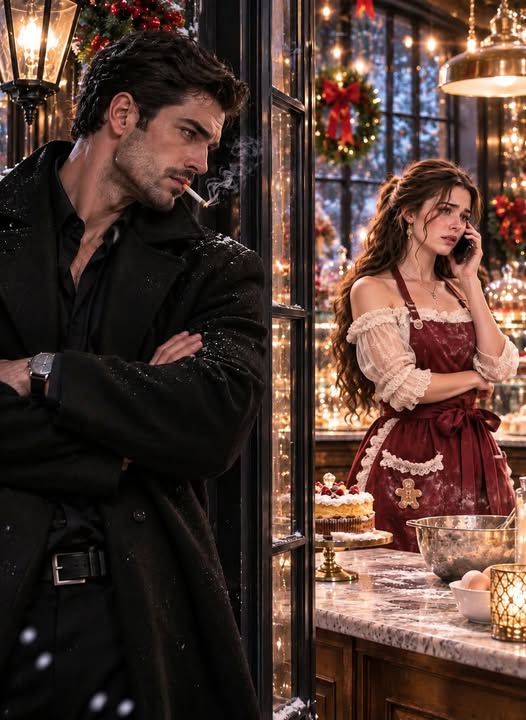
At 9:17 p.m., two days before Christmas, my mother called to tell me I wasn't welcome at our family celebration because I didn't look good enough for the photographs.
Twenty minutes later, my manager accused me of stealing six thousand dollars, my ex-boyfriend tore the evidence out of my hands, and both of them threw me out into a Boston blizzard.
What none of us knew — what I wouldn't understand until the velvet curtain moved — was that the most feared man in the city had been sitting six feet away the entire time, listening to every single word.
My name is Clara Bennett. I'm twenty-eight years old, and I have spent most of my life apologizing for existing. Apologizing for my size. Apologizing for my laugh being too loud, my appetite too honest, my body too much for the narrow, elegant world my mother wanted to live in. If there was a family photograph, I was the one asked to take it. If there was a chair that didn't match the set, it was mine that got moved out of frame.
I worked at Winter & Rye, a bakery on a cobblestone side street in Beacon Hill, the kind of place with fogged windows, brass fixtures, and a bell over the door that sounded like a small silver laugh. I had worked thirteen days straight — thirteen — because Brenda, our manager, kept promising that if I covered the holiday rush, I could have Christmas Eve and Christmas Day with my family.
I wanted that Christmas more than I had ever wanted anything. I had baked my mother's favorite almond tart from scratch, three layers, the way my grandmother taught me before she died. I had bought matching flannel pajamas for all of us — my mother, my sister Paige, and me — the silly kind with reindeer on them, because when we were little, before everything became about appearances, we used to wear them and drink cocoa and watch the snow come down over the Charles River.
I had decorated a Christmas cake that afternoon, too. White icing. Sugared cranberries. A tiny winter village piped along the base. My coworker Maya stood beside me while I worked and said it was the prettiest thing the bakery had ever put in the window.
And then, at 9:17, my phone lit up on the counter.
"Mom?" I said, wiping my hands on my apron, smiling before I even knew why. "Hi. I'm just finishing—"
"Clara, sweetheart, I need to tell you something, and I need you not to make it a scene." Her voice had that bright, careful tone she used at charity luncheons. "There's been a change of plans. Grant's family has invited us to Aspen."
Grant Holloway was my sister Paige's fiancé — old money, ski chalets, a mother who collected Christmas like it was a competitive sport.
"That's wonderful," I said slowly. "So when do we leave? Do I need to pack tonight? I can be ready—"
The silence on the line stretched one second too long.
"Clara." She sighed. "It's a small private plane. And Vivian — Grant's mother — she has this lovely idea of elegant family photographs at the lodge. For the engagement announcement. You understand."
"I don't think I do."
"I think you'd be more comfortable staying home this year. That's all. It's just one Christmas."
I looked at the cake in the window. My own reflection floated in the glass in front of it, flour on my cheek, hair escaping its knot.
"It's because of how I look," I said.
"Don't be dramatic."
"Mom. Say it plainly. You're ashamed of me."
"Those airplane seats are narrow, Clara. And the photographs— Vivian is very particular. I am trying to spare your feelings."
I closed my eyes. Behind me, the ovens ticked as they cooled. Somewhere out front, Maya was humming along to the radio, something old and warm about silver bells.
"It's not one Christmas," I said quietly. "It's every Christmas. Every photograph since I was fourteen. This is just the first time you've stopped pretending."
"Clara—"
"I baked your tart," I said. "Three layers. Grandmother's recipe. And I bought pajamas. Matching ones. Like when we were kids." My voice cracked, and I hated that it cracked. "Forget it. Have a beautiful Aspen Christmas, Mom."
I hung up before she could answer.
I stood behind the counter with the phone in my hand and fought the tears with everything I had, because crying at work felt like one more thing to apologize for. Maya came around the counter without a word and hugged me — flour, vanilla, and kindness, that's what Maya smelled like — and I let myself lean on her for exactly ten seconds.
"Are you okay?" she whispered.
I shook my head. Then I looked out the window at the snow coming down over the gas lamps, at couples walking arm in arm with their collars up and their heads together, at the whole soft, lit-up world that seemed to belong to other people.
"I wish I had someone for Christmas," I whispered. "Not a prince. Not a millionaire. Just one person. One person who would notice if my chair was empty."
I didn't know anyone had heard me.
I should explain about the tasting room. Winter & Rye had a small private room at the back, separated from the main floor by a heavy burgundy velvet curtain, where wealthy clients held quiet meetings over coffee. For sixteen Fridays, the same man had reserved it. He arrived at four, alone, in a black coat. He ordered an espresso and a plum pastry. He never brought a laptop, never raised his voice, never stayed past seven. His name, according to the reservation book, was Mr. Vale, and I had decided he was some kind of banker — rich, private, and allergic to small talk.
I didn't know his first name was Nico. I didn't know that men who controlled entire ports went quiet when he entered a room. I didn't know that politicians returned his calls before their own wives'. And I certainly didn't know that for sixteen Fridays, he had been sitting behind that curtain, close enough to hear me sing along to the radio, close enough to hear me tell Maya about the tart, the pajamas, and the chair.
The bell over the door rang hard — too hard.
Brenda Mercer came in out of the snow wearing her white designer coat, shaking flakes from her shoulders like the weather had personally offended her. And right behind her, brushing snow from his sleeves with a familiar, lazy grin, was Julian Cross.
Julian. My ex-boyfriend. The man who had ended things eight months earlier with the words, "You don't really fit my lifestyle anymore, Clara," as if I were a jacket he'd outgrown.
"Brenda?" Maya said. "We were just closing—"
"We're missing almost six thousand dollars in inventory," Brenda announced, and slammed a thick envelope down on my clean counter. "Imported chocolate. Vanilla. Saffron. Specialty flour. Gone. And you—" her eyes landed on me like a verdict "—are responsible."
The room tilted. "What?"
"You're the one who signs for deliveries," Julian said, smooth as oil. "You're the one with the keys to the stockroom. It isn't complicated, Clara."
"That's ridiculous. I record every delivery. Every single one, by hand, the day it comes in." I was already moving, pulling my worn black notebook out from under the counter, the one with the cracked spine and three years of my handwriting in it. "Look. Look right here. December twelfth — thirty kilograms of specialty flour on the purchase order. The truck never brought it. I noted it. I noted it twice. Someone changed that purchase order after I flagged it, using an administrator account. Your account, Julian. It has your login on the change log."
Something moved across Julian's face — quick, ugly, gone.
Then he snatched the notebook out of my hands.
"Stop making accusations," he snapped, and before I could grab it back, he tore out three pages — tore them clean out, the sound like a small scream — and crushed them in his fist.
"Those are my records!" I cried. "Julian, give them back—"
"Clara Bennett," Brenda said, folding her arms, her voice going flat and official, "you are fired. Effective immediately. Clear out your locker and go."
"You can't— I haven't done anything— you still owe me thirty-one hours of overtime! Thirteen days straight, Brenda. You promised me that time was approved."
"You'll receive whatever payroll decides after our investigation." She pointed at the door. "Get your things and leave."
"Outside?" I looked past her at the window, where the snow was no longer falling so much as attacking. "In this? It's a blizzard. The trains will stop. I live forty minutes away."
Julian laughed. It was a soft, pleased sound, and it hurt worse than the rest of it combined. "What's wrong, Clara? Nobody wants you at Christmas, and now nobody wants you here either?" He leaned closer, and his voice dropped into the register he used to use for secrets. "Maybe you should've thought about that before you started stealing."
Something in me — some small, tired, buried thing that had been apologizing for twenty-eight years — stood up.
"You borrowed four thousand eight hundred dollars from me when we were together," I said, and my voice shook but it held. "For your car. For your 'business opportunity.' You never paid back one cent. Don't you dare stand there and call me a thief."
His smile vanished.
Brenda pointed at the door again. "Out. Now. Or I call the police and you can explain the missing six thousand to them."
I reached for my coat with hands that wouldn't stay steady. Maya was crying silently behind the pastry case. The cake sat in the window with its little sugared village, and the snow hammered the glass, and I thought: this is it. This is the whole of my life. Empty chair. Empty bakery. Empty—
"That's enough."
The voice came from behind the velvet curtain. It was low, and quiet, and it stopped the room the way a hand stops a bell.
The curtain moved.
Nico Vale stepped out into the light in an immaculate black suit, tall, broad-shouldered, with cold gray eyes that went to Julian and stayed there. He didn't look angry. That was the frightening part. He looked the way a glacier looks — ancient, patient, and absolutely immovable.
Brenda's face drained of color. "M-Mr. Vale? I didn't realize anyone was still in the— this is a private employment matter, sir, if you'll just give us a moment—"
He ignored her completely. He walked past her and past Julian as if they were furniture, and he stopped in front of me, and his voice — that terrifying voice — gentled by some fraction I would think about for days.
"Clara." My name in his mouth sounded like something valuable. "Did you really work thirteen days without a day off?"
I blinked up at him. "Y-yes, sir."
"And they haven't paid your overtime."
"No, sir."
A muscle moved in his jaw. He turned then, slowly, toward Brenda and Julian, and the temperature of the room seemed to drop ten degrees.
"You have sixty seconds," Nico Vale said, "to explain why you accused an innocent woman of theft."
Julian swallowed so hard I heard it. "Sir. With respect. This is an internal matter. You don't know the full—"
Nico took his phone from his pocket with unhurried fingers. "Not anymore."
Then he looked at me — only at me, as if the other two had ceased to exist — and said the words that split my life into a before and an after.
"Clara, there's something you should know about this bakery." His gray eyes held mine. "I purchased it three weeks ago. And I have been investigating the missing money ever since."
My breath stopped.
"And the security recordings from December twelfth," he said, turning his head just enough to watch the color leave Julian's face, "show exactly who took it."