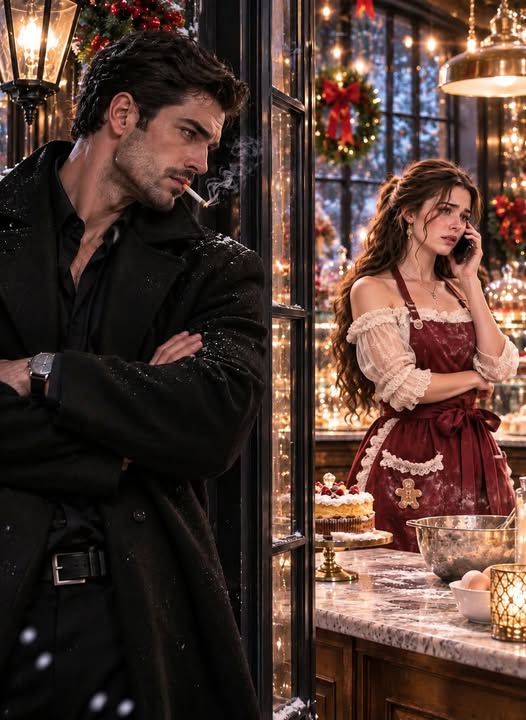
I went to the bakery at four in the morning on the day after Christmas because I couldn't sleep, and because a bakery at four a.m. is the most honest place on earth.
That was my reasoning. It was not Nico's reasoning, and when he found out — later, in the hospital, in a voice so quiet the nurse pretended not to hear — he informed me that my reasoning was a crime against his protocols, his blood pressure, and several laws he had personally decided to enforce.
But at four a.m., none of that had happened yet. There was just the dark street, the sleeping city, and Marco's man Karl asleep in a car across the road — a detail I learned afterward, and one Karl paid for, though not as much as Julian did.
I let myself in the back, the way I had a thousand times. I hung my coat on the hook. I tied my apron. I put the first trays in to proof and started the coffee the way we always did, and I stood in the warm, yeasty dark of the kitchen I had nearly lost, and I let myself be happy for one whole minute about the shape my life was taking.
Then, from the office doorway, Julian said, "You kept a copy, didn't you?"
He was standing in the dark with his coat still on and snow melting off him, and he looked like a man who had been awake for all of it — every hour since the cuffs came off me and went onto him the second time. His eyes were red-rimmed and bright. In one hand he held my office keys. In the other, a red plastic fuel can, the kind you fill at a gas station, and the smell of it rolled across the kitchen like a weather front.
"Julian." I put the counter between us. It was instinct, not strategy. "The police are looking for you. Karl is right outside. Put that down and walk out and this is still just a bad night."
"Karl is asleep." He smiled, and it was the worst thing I'd ever seen on a face I once kissed. "I watched him. An hour. Vale's great security, sleeping in a car like a mall cop. That's what your life is worth to the great Nico Vale, Clara. A sleeping mall cop."
"The notebook," I said, because understanding is a kind of armor. "You think there's a copy of my records in the office."
"Three years I ran money through this place," he said. "Three years, and it was clean, it was invisible, and then he buys the building and his auditors start reading your little logs. Your handwriting, Clara. Your little 'staff meal' lies. The detective told my lawyer the December footage isn't the worst of it — the worst of it is your records. The dates. The changed orders. Everything traces through everything, and it all starts in that office." He lifted the fuel can slightly. "So. The office burns. The server's in there, the paper's in there. And you—" his voice cracked, hideously, into something almost like grief "—you could have just signed what I told you to sign. You could have been nobody. Nobody was safe. Nobody had Fridays with the devil behind a curtain."
"He was investigating theft, Julian. You were the theft."
"I was surviving!" The shout knocked a pan off a hook somewhere and we both flinched. "You think Brenda found me? I found her. Six years skimming cream of her own, that woman, and I gave her a system. And you— flour on your face, crying over Christmas— you were the lock on the door, Clara. The patsy. Every bad bakery has one. The one nobody believes." He stepped forward. "But Vale believes you. Vale does paperwork for you. So the paperwork burns."
He threw the fuel can.
He didn't throw it at me — I need to be clear about that, because later it mattered to the lawyers and it mattered to Nico. He threw it at the office door, over my head, and it hit the doorframe and split and sprayed, and some of it hit the range where the pilot lights burned blue and patient.
Fire does not start the way it does in films. There is no dramatic bloom. There is a soft, almost disappointed whoomph, and then the world is orange and wrong.
The towels went first. Then the wooden shelves. Then the office door itself, a sheet of flame, and the smoke came down off the ceiling in a rolling black ceiling of its own, and Julian — Julian stood in the middle of it with his hands up in front of his face, screaming my name, because whatever he had planned in the cold, he had not planned on being inside it.
"Down!" I shouted. "Get down, get DOWN, Julian—" Smoke kills at standing height; thirty years of fire-drill posters live in a baker's bones. I dropped and crawled, and I could have gone for the back door — it was twelve feet, it was right there, Karl outside, air outside — but Julian was coughing in the middle of the floor, frozen, a man in a coat full of gasoline fumes, and I did the stupidest, most Clara Bennett thing in the world.
I crawled back and got hold of his sleeve and pulled.
He came — terror makes people light. We got as far as the ovens when the shelf above the office door gave way in a roar of sparks, and the way to the back door became a curtain I could not pass twice. The heat was a hand on my face. Julian was on the floor making a sound like tearing paper. My apron had caught at the hem; I beat it out against the tiles with my bare hand and felt the burn bloom across my palm like a brand.
Front, I thought. The shop. The windows.
We crawled through the swinging door into the shop on our hands and knees, under the smoke, past the cake case, past the tree, and I got my good hand under the front door handle and pulled, and the door — the beautiful old door with the silver bell — was locked, because I had locked it behind me at four in the morning like a careful manager, and the key was in my coat, and my coat was in the back, in the fire.
I beat on the glass with my burned hand and screamed for Karl.
What I saw through that glass is the thing I will keep when everything else about that night eventually fades: headlights, swinging wild across the snow as a car mounted the curb — and Nico Vale coming out of it before it had fully stopped, in a coat thrown over what he'd slept in, bareheaded in the storm, looking up at his burning bakery and my face in the window.
He didn't hesitate. That's the part the firefighters commented on later, at the hospital, with professional admiration. He took the cast-iron sandwich board from the sidewalk — forty pounds of advertising for soup — and he put it through the window in one swing, and the glass came down like a frozen waterfall, and the smoke rolled out over his head as he stepped through the wreckage calling my name.
"Here!" I screamed. "Here — Nico, Julian's down, I can't—"
He found us by sound. He got Julian first — dragged him by the coat to the broken window and handed him out to Karl like cargo, because Nico Vale, even burning, does triage — and then he came back through the smoke for me, and I remember his hand closing around my arm, and his voice, raw and stripped of every glacier I'd ever heard in it:
"I have you. I have you. Clara — I have you, hold on to me."
The cold outside was the sweetest thing I have ever breathed. I sat on the curb in the snow in my apron, coughing until my ribs ached, watching my bakery burn orange against the white street while Nico knelt in the slush in front of me holding my burned hand very carefully in both of his, not letting the snow touch it, saying my name like a man checking, over and over, that a thing is still true.
Julian, handcuffed to a paramedic's gurney with an oxygen mask on his face, was shouting something hoarse through the mask as they loaded him in — about Brenda, about lawyers, about how it wasn't supposed to— and Nico didn't even turn his head.
Maya arrived at the hospital an hour after I did, in her coat over her pajamas, carrying my phone and my purse and the expression of a woman who had driven through a blizzard on pure spite. She took one look at my bandaged hand and burst into tears, and then — because she is Maya, and grief and competence run in her in equal measure — she dried her face on her sleeve and started reporting.
"The firefighters said the kitchen's bad but the ovens might make it. The shop floor's mostly smoke. Your cake—" she stopped. "Your cake was in the case, Clara. The case held. It's smoked, it's— the village is gray. I told them not to throw it out until you say. And your coat—" She was fumbling in my purse. "Your coat's gone, but your phone was in it, and Karl got it out of the locker room before— anyway. It works. And Clara." She held the phone out like an offering. "Your notebook app. The photos. Tell him about the photos, because the detective's downstairs saying the office server is charcoal and I watched you go white."
It took me a moment, through the smoke still in my head, to understand what she meant — and then I did, and a laugh came up out of me that startled the nurse.
"Two years ago," I said to Nico, "Brenda lost a page of the delivery log. Not stole — lost, in those days I still thought losing was the worst of it. After that I started photographing every page of my notebook, every Sunday, on my phone. It backs up to the cloud. Three years of pages, Nico. Every delivery, every change, every initial. Julian burned an office." I lifted my good hand, phone and all, and let it fall back to the blanket. "He never touched the records. The records were never in the building. They were in my apron pocket the whole time he was tearing pages out of my hands."
Nico stared at me. And then — there in the hospital, in front of Maya and the nurse and a paramedic pretending to check a monitor — the most feared man in Boston put his face in his hands and laughed, once, like a man who has been handed back something he thought was ash.
"Of course they were," he said. "Of course. Sixteen Fridays and I still underestimated you. Marco will want a copy for the detective, and the detective will want to kiss you, and I will have to allow it because it will be professionally justified."
At the hospital, with my hand wrapped like a white parcel and the doctors using words like superficial and lucky, Nico sat in the plastic chair beside my bed in a coat that smelled of smoke, and he took my good hand, and he said:
"When Marco called, he said 'the bakery.' And I knew — before he finished the sentence, I knew where you would be. Four in the morning, Clara. Protocols." His voice broke — actually broke, the glacier calving at last. "You wished for one person who would notice if your chair was empty. Do you understand that I have noticed nothing else since? Your chair at that counter. Your absence from a room I pay men to watch. If I had been four minutes later—"
"You weren't," I whispered. "You weren't, Nico. You came through the window."
"Yes," he said, and pressed his forehead, very briefly, to my bandaged hand, like a man at an altar. "And I will keep coming through windows, and doors, and whatever else this world puts between us. That is the other thing I should have said on one of those Fridays."
Outside my hospital window, Boston was white and gold and beginning again. Somewhere across the city, my bakery was a blackened shell cooling in the snow.
Nico looked at it — no. He looked at me, and corrected himself before he even spoke, as if he'd caught himself valuing the wrong thing.
"The bakery will reopen by New Year's Day," he said. "That's a Vale promise, and I keep those. But Clara—" his thumb moved once, gently, across my knuckles "—buildings are paperwork. You are not."