The clock on the dashboard said 2:47 a.m. when I turned into my own driveway, and I remember the number because it was the last ordinary moment of my life.
Madison's perfume was still on my shirt. It clung to the collar where she had rested her head an hour earlier, at the beach house, with the ocean doing its slow black work outside the windows and her legs folded under her on my couch like she owned the place, like she owned me. She had asked the question with a glass of my wine in her hand, tilting her head the way she did when she already knew the answer she wanted.
"Do you think she'll ever actually leave you, Ethan? Emily. Do you think she has it in her?"
And I had laughed. God forgive me, I had laughed, and I had said the words that would follow me into every room for the rest of my life.
"Emily knows her place. She'll never leave."
I want you to understand who I was when I said that. My name is Ethan Carter. I am forty-three years old, and at that hour of that night I controlled half the East Coast's underworld. Nineteen casinos answered to me. Seven shipping docks moved what I told them to move. Over a thousand men stood up straighter when I entered a room, and some of them had killed for the privilege. I had buried rivals. I had buried my own father. I believed — the way you believe in gravity — that the world arranged itself around my will, and that the people I loved most were simply the parts of the world that arranged themselves the most quietly.
Emily had loved me before any of it. Before the money, before the power, before my enemies knew my name well enough to fear it. We were kids from nothing when we met, and when my father was murdered — when I came home at nineteen with his blood dried under my fingernails and my hands shaking so badly I couldn't work the buttons of my own shirt — Emily washed my hands in her mother's kitchen sink, one finger at a time, and promised me she wasn't leaving. She kept that promise for thirteen years. Through shootings. Through betrayals. Through nights I didn't come home and nights I came home with other men's threats still ringing in my ears.
She asked for one thing in all those years. One. We were lying in the dark, some anniversary I had almost forgotten and she hadn't, and she said it into my chest so quietly I almost missed it: "If you ever stop loving me, Ethan, tell me. Tell me before you give your heart to someone else. That's all. Just don't make me the last one to know."
I promised her that too. I was very good at promising Emily things.
The drive home took forty minutes and I spent it rehearsing nothing, which tells you everything about the man I was. Men in my position do not drive themselves at 2 a.m. unless they have something to hide, and I had hidden so much for so long that the hiding had become the shape of my life: two phones, two calendars, two versions of every evening, and a wife who got the edited one. I remember the road was empty and the radio was off and I was, by every measure I had ever used on myself, content. I had a empire that feared me, a beautiful woman asleep in a beach house behind me, and a wife I believed was a fixture — a load-bearing wall of my house, too permanent to inspect. I did not think about Emily once on that drive. I have thought about her on every drive since, including drives I take inside my own house, from one room to another, but that night the road was empty and I was content and the dashboard clock clicked over to 2:47 like it was nothing.
The house was dark when I let myself in, which was wrong. Emily never slept in a fully dark house; she left the lamp on in the hall and the small light above the stove, a trail of small mercies for a husband who came home at criminal hours. That night there was nothing. I stood in my own foyer with my keys still in my hand and felt the silence come up around my ankles like cold water.
"Emily?" I called.
The quiet answered with more quiet.
I told myself she'd gone to her sister's — except her sister lived in Oregon and Emily never traveled without telling Marcus. I told myself she'd fallen asleep in the library. I walked through my own house like a burglar, room by room, and it was in the doorway of our bedroom that my body understood before my mind did.
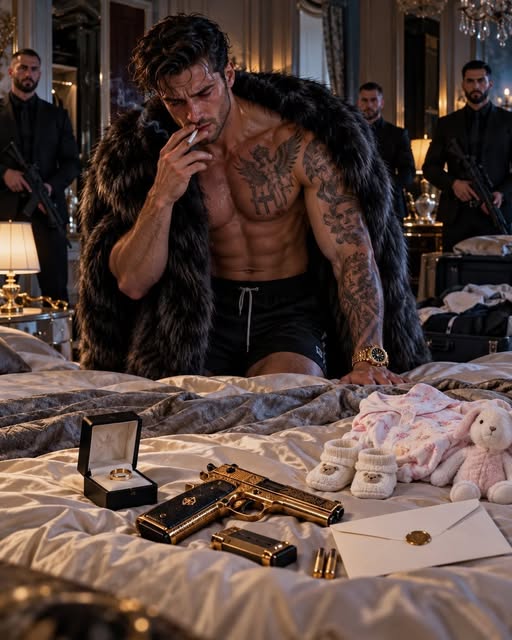
The bed was made. Made the way she made it, corners pulled tight, the throw folded at the foot — untouched. Nobody had slept in it. And on my pillow, arranged with a care that still makes my hands shake when I think of it, were three things.
Her wedding ring.
The gun I had given her thirteen years ago, the week after my father's funeral, when I taught her to shoot in a field behind her mother's house and told her, "If anyone ever comes for you and I'm not there, you don't wait for me. You understand?" She had kept it in her nightstand drawer every night since. She had never once left it anywhere.
And fourteen handwritten pages, laid in a neat stack beneath the ring, as if the ring were holding them down against a wind only she could feel.
I picked up the first page. Her handwriting. Steady. That was the worst part — how steady it was.
"Don't look for me, Ethan. The woman you're searching for died a long time ago. You just never noticed the body, because she kept cooking your dinners and warming your bed and answering to her name. I am not writing this to hurt you. I am writing it because you deserve, at last, to know the truth at the same speed I learned it. One day at a time."
The pages were a diary. Not of her life — of my betrayal. She had numbered the days.
Day 1 was the day she found the first receipt, in the pocket of a coat she was sending to be cleaned. A hotel I had told her was a business trip. She wrote: "I put it back in his pocket. I ironed the coat. I don't know why I ironed the coat."
I sat down on the edge of the bed — her side, I realized, I had sat on her side — and I read the education of my own cruelty.
Day 74: "He came home smelling of jasmine. I don't own anything with jasmine. I stood in the shower until the water went cold so he wouldn't hear me."
Day 156: "Our anniversary. He sent flowers to the house and a bracelet to a penthouse downtown. I know because the jeweler's assistant called here by mistake, so sweet, so sorry. I thanked her. I have become a woman who thanks people for telling her the truth by accident."
Day 219: "Today, I stopped crying."
I had to stop reading twice. I walked to the window and stood there with my forehead against the glass like a man in a cell. Below me the driveway was empty. Her car was gone — I hadn't even registered it coming in, that was how certain I was of her. Emily knows her place. She'll never leave.
Day 306: "I watched you sleeping and realized I still loved you. That hurt the most."
Then I turned the page, and the world ended.
Day 327: "Today, I lost our baby."
I read it four times. The words wouldn't assemble. Baby. Our baby. Emily had been eleven weeks pregnant — I would piece that together later from the pages around it, the doctor's appointments she had attended alone, the nursery catalog she had hidden under sweaters, the names she had already chosen and written in margins like prayers. Eleven weeks pregnant, and I had never known. I had been too busy lying beside Madison Blake to notice that my wife's body was changing, that she had started taking her tea in the mornings standing at the window with one hand held flat against her stomach, the way women do when they are keeping a secret that is also a joy.
Her next page was not numbered by day. It was numbered by the clock.
"At 10:19 p.m., I called you because something was wrong. You didn't answer. At 10:27, I called again, and you answered, and you told me not to bother you because you were 'in the middle of something.' At 11:03, I started bleeding. Marcus drove me. Marcus held the door. Marcus told the nurse my name because I couldn't stop shaking long enough to say it. You turned your phone off that night, Ethan. I checked. Six times I called from the hospital and the phone of the man I married was a dead black stone in another woman's bedroom."
I made a sound then — I don't remember it, but Marcus told me later he heard it from the driveway, through the walls of a house built to keep sounds in. My knees buckled. I went down beside the bed with the pages scattering, a grown man, a feared man, a man whose name emptied rooms, on his knees among his wife's handwriting like a penitent among relics.
Marcus found me there. Marcus Reed, my bodyguard of fifteen years, a man who had taken a bullet meant for me in a Philadelphia parking structure and never once mentioned it afterward. He stood in the doorway and he did not say "sir" and he did not say "Mr. Carter." He reached into his jacket pocket and he held out his hand, and in his palm was a hospital bracelet, the paper kind, worn soft at the edges, as if it had been carried in that pocket for weeks, taken out and looked at and carried again.
Emily Carter, it said. And a date I will carry to my grave.
"Sir," Marcus said, and his voice was not steady, and Marcus's voice was always steady. "I tried calling. Six times. You turned your phone off."
"Why didn't you come get me?" I said. "Why didn't you drive to the beach house and drag me out by my collar?"
"Because she made me swear I wouldn't." He closed my fingers around the bracelet because mine had forgotten how. "She said if I went to you, you'd come to the hospital out of guilt, and she'd have to watch you perform grief in front of the woman you'd chosen. She said she'd rather bleed alone than be pitied by you in public. Those were her words, sir. I've carried them around like a stone. I'm done carrying them."
I got up off the floor with the bracelet cutting into my fist and I gave the order that turned my empire upside down before dawn. Nobody sleeps. Every airport, every hotel, every safe house, every hospital, every dock. I want the manifest of every plane, every train, every car that left this state. I want her found.
But it was what arrived at dawn that undid me — three days later, after the airports and the hotels and the thousand men had found nothing, when I was sitting in the dark of my own kitchen with the fourteen pages weighted under the ring like a heart under a stone, my phone lit up with a file from a number I didn't know.
A voice recording. Hers.
I played it with hands that would not stop trembling, and Emily's voice filled my kitchen, soft and wrecked and calm, the way she sounded after crying for a very long time and finishing.
"Ethan. I didn't leave to punish you. I want you to know that, because I know you, and I know you'll make it a war because a war is a thing you understand. I left because when our baby died, the only person I wanted in that room was the man holding another woman. There is nothing after that, Ethan. There is no sentence I can say after that one, and there is no sentence you can say either."
A long pause. I could hear her breathing. I could hear, faintly, somewhere behind her voice, a sound I couldn't name — water, maybe. Wind.
"There's something else you never knew about our baby," she whispered. "And that's the real reason I had to disappear."
The recording ended.
Not faded. Not finished. Ended, the way a door ends a room — mid-breath, mid-truth, with the rest of my wife's sentence somewhere out in the dark where I couldn't follow it.
I played it eleven times before the sun came up.